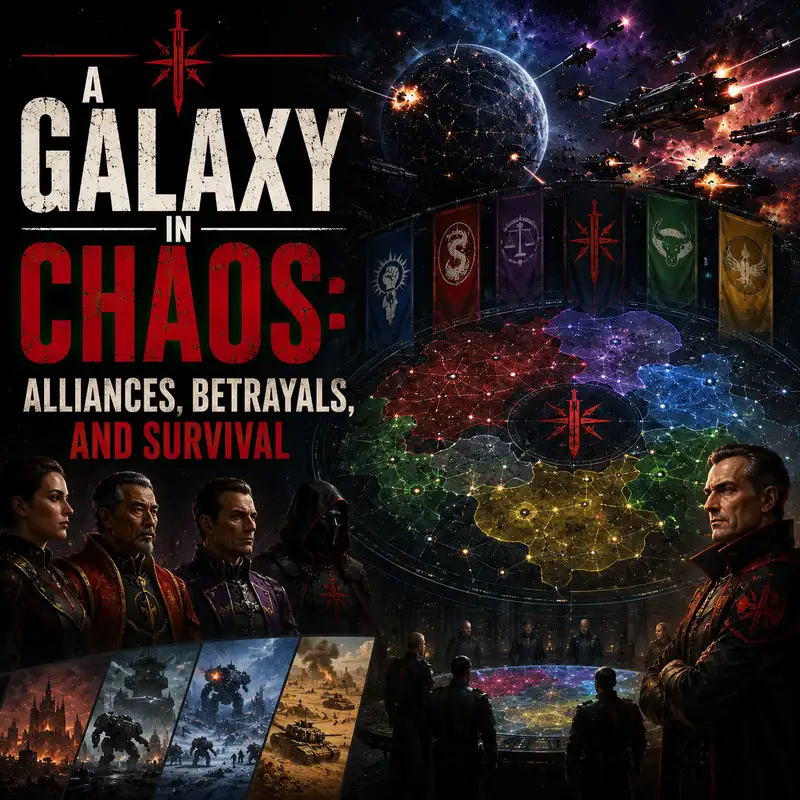
A Galaxy in Chaos: Alliances, Betrayals, and Survival
On October twenty-fifth, thirty sixty-eight, officers across the Free Worlds League received three pieces of news that made every existing order suspect. Parliament on Atreus had been struck with chemical weapons. Captain-General Thomas Marik had been exposed as a double installed decades earlier. The hyperpulse generator network was filling with interference and propaganda. A regiment on the Lyran border could no longer be certain who governed the League, whether its orders were authentic, or whether the enemy across the line was still the most important threat.
That was the Jihad at its most dangerous. It was not one clean war between the Word of Blake and a united Human Sphere. It was a collection of invasions, coups, border wars, private campaigns, civil conflicts, covert operations, and local struggles unfolding under a damaged communications system. The Word did not need to defeat every state at once. It needed those states to distrust one another, misread the situation, and spend their strength on enemies they already understood.
The resulting chaos changed the meaning of alliance and betrayal. Governments that had fought for generations cooperated for a single evacuation, then returned to guarding their borders. Military units obeyed provincial leaders when national headquarters fell silent. Mercenaries accepted contracts from employers whose governments might not survive the billing cycle. Clan and Inner Sphere forces sometimes attacked the same Blakist target without agreeing that they were allies. Survival produced cooperation, but rarely enough trust to make that cooperation permanent.
Interstellar states depended on the hyperpulse generator network for more than diplomatic messages. The network carried mobilization orders, intelligence reports, financial instructions, replacement requests, casualty lists, shipping schedules, and confirmation that distant commanders still possessed legal authority. JumpShips could carry physical messages, but only at the speed of normal interstellar travel. When the network failed, a governor might wait weeks to learn that the capital had been attacked and longer to discover whether the first report had been false.
The Blakist White-Out exploited that dependency through electronic interference, malicious software, propaganda, sabotage, and control of key stations. It did not silence every generator in the Human Sphere. A complete and uniform failure would have been easier to understand. Instead, some messages passed, some arrived late, some were altered, and some never existed outside the imagination of the person claiming to have received them. The network still worked just well enough to carry panic.
ComStar might have offered a common military and communications framework, but Case White removed that possibility early. In March of thirty sixty-eight, the Com Guards attempted to retake Terra and suffered catastrophic losses against defenses they had badly underestimated. The failure destroyed experienced formations and discredited another institution that might have coordinated resistance. Later Blakist broadcasts exposed ComStar secrets, including Anastasius Focht’s former identity as Frederick Steiner. Even accurate revelations served the White-Out. A fact released by the enemy at the right moment could damage trust as effectively as a fabricated order.
This favored regional commanders. A marshal responsible for several worlds could not postpone every decision until confirmation arrived from a capital under blockade. Local leaders began moving units, seizing supply depots, negotiating ceasefires, and launching offensives under emergency authority. Some acted responsibly. Others used the crisis to pursue ambitions that central government would once have restrained. The distinction between necessary initiative and insubordination often depended on who survived long enough to publish the official history.
The Word encouraged that fragmentation by attacking capitals and industrial centers while feeding old suspicions. New Avalon and Tharkad came under direct assault. Luthien descended into a struggle among Kurita loyalists, Black Dragon rebels, and Blakist forces claiming to restore order. Terra remained protected behind hidden divisions and naval defenses. Every state had to decide whether to defend its leadership, protect its factories, reinforce border worlds, or strike the Word before another crisis erupted somewhere else.
The Lyran Alliance and Free Worlds League showed how quickly an old border dispute could consume forces needed elsewhere. The conflict known as Operation BROKEN FIST began after Lyran provincial troops pushed across the border in thirty sixty-eight. Marshal Jeremy Brett organized a Free Worlds counteroffensive that recovered lost systems and then carried the fighting into Lyran territory. Both sides committed regiments, mercenaries, transport, and ammunition while Tharkad was occupied and the wider Jihad was spreading.
The campaign had its own logic. Border commanders could point to invaded worlds, threatened supply lines, and the political cost of appearing weak. Brett’s forces won important gains, while Lyran provincial commands fought to protect their regions without reliable direction from the Archon’s shattered capital. Neither side needed the Word of Blake to invent the grievance. The Blakists merely ensured that communications failed before anyone could decide whether the grievance still justified the campaign.
When Atreus was attacked, the League’s offensive began losing coherence. Units withdrew toward their home provinces. A naval battle group abandoned its assigned station and disappeared. Requests for guidance competed with rumors that the Captain-General was illegitimate and Parliament had ceased to function. Brett eventually ordered a return toward the prewar border and sought a ceasefire. Blakist interference delayed even that message. Peace required two governments to receive the same proposal, which had become a surprisingly ambitious technical requirement.
The revelation about Thomas Marik struck at the League’s political center. The double had governed effectively for decades and many officials continued supporting him because the alternative was immediate collapse. Others saw the deception as proof that the entire federal system had been compromised by ComStar and the Word of Blake. Paul Marik later overthrew the false Thomas and placed Corinne Marik in power with Blakist support. Provincial rulers, members of House Marik, and military commands then advanced competing claims to lawful authority.
This was betrayal at several levels. The public ruler was not the man he claimed to be. The real Thomas Marik had become the hidden Master behind the Word’s most secret programs. Officials who appeared loyal were serving Blakist interests. Yet many officers who abandoned Atreus did so because they believed they were preserving the League from a captured government. In a functioning state, desertion and loyalty are opposites. In the collapsing League, both could describe the same movement order.
The chemical attack on Atreus deepened the fracture by killing much of Parliament and crippling the Knights of the Inner Sphere. A small group of Knights survived and continued fighting as a resistance force. Alys Rousset-Marik built another opposition network, hiring mercenaries and drawing support from people who rejected both Blakist control and the competing provincial claimants. The League did not immediately disappear from every map. It disappeared as a single answer to the question of who could issue an order.
The Federated Suns faced the same pressure in a different form. New Avalon was blockaded and repeatedly attacked. National formations were tied to the capital, the Draconis March, and damaged regions still recovering from the Federated Commonwealth Civil War. Duke George Hasek of the Capellan March concluded that the crisis offered an opportunity to settle the old St. Ives question and reduce Capellan power before it could threaten his region again.
In June of thirty sixty-eight, Hasek launched Operation SOVEREIGN JUSTICE without making it the central war of the Federated Suns. His forces entered the Capellan Confederation along several axes, using House troops, regional commands, mercenaries, and dissidents who opposed Liao rule. The offensive achieved rapid gains. It also consumed transport and combat power while the national capital remained under Blakist pressure. A regional commander had converted strategic paralysis into a private war.
Hasek’s campaign was not irrational. The Capellan Confederation had recovered lost territory, absorbed St. Ives, and remained a historic threat to the March. The White-Out made future Capellan intentions difficult to judge. A successful offensive could create depth and destroy enemy forces before they mobilized. The plan failed at the political level because it assumed the people of St. Ives would treat invasion as liberation and that the wider crisis would prevent the Confederation from organizing a national response.
The orbital strike on Sian in October turned that response into vengeance. The Forbidden City was devastated, Candace Allard-Liao was killed, and Chancellor Sun-Tzu Liao was initially believed dead. Reports blamed a Federated Suns WarShip, but the surviving evidence left room for Blakist manipulation. Certainty was unnecessary. The attack gave Capellan commanders a clear story, a dead member of the ruling family, and an enemy already occupying Confederation worlds.
Operation THUNDERSTRIKE drove Hasek’s forces back and carried the war into the Capellan March. The Word inserted units that claimed to be assisting the Confederation, including forces that seized Kittery while presenting the attack as support for the Capellan counteroffensive. That temporary alignment served Blakist purposes without making the Word a dependable Capellan ally. The Word could help punish the Federated Suns, then attack Capellan interests once the local balance changed.
The Confederation survived because its institutions converted shock into mobilization. Warrior Houses, regular formations, intelligence services, local resistance, and allied Canopian forces supported the defense. Yet survival did not erase the cost. Worlds changed hands, civilians endured occupation and reprisals, and the March and Confederation spent years destroying resources that might otherwise have been used against the Word. Both sides could explain why the other had begun the war. Neither explanation repaired New Avalon or Sian.
Along the Federated Suns and Draconis Combine border, commanders also revived older hostilities. Draconis March forces raided Combine worlds in search of prisoners and later launched unsanctioned attacks on Galedon the Fifth and Matsuida. Combine troops responded while their own capital was divided by civil war. The operations drew in Blakist forces and Clan Snow Raven, turning a familiar border feud into a theater where nobody controlled all the participants.
Luthien had already shown the pattern. The Black Dragon Society used traitorous Combine formations to seize parts of the capital and challenge Theodore Kurita’s reforms. Loyal troops fought rebels wearing the same uniforms. The Word entered as a supposed stabilizing force and pursued its own occupation. Clan Nova Cat forces remained tied to the Combine but were themselves uncertain after the Second Star League’s collapse. Every participant claimed a different version of lawful order.
Clan Ghost Bear later struck Blakist forces across the former Free Rasalhague region and nearby Combine space. The Bears destroyed enemies that the Combine also wanted removed, but cooperation did not mean submission to Kurita command. Ghost Bear formations followed their own objectives, their own rules, and their own timetable. On Luthien, Bear forces could destroy Blakists while also attacking Combine units that interfered. The enemy of an enemy was useful. It was not automatically a subordinate.
Clan Snow Raven entered the regional war through grievance and misidentification. After the destruction of Raven naval assets and later attacks blamed on the Combine, Snow Raven forces retaliated against Kurita worlds and clashed with Federated Suns troops. Blakist manipulation, damaged intelligence, and existing hostility reinforced one another. The later plague disaster around Galedon showed the cost of this uncontrolled escalation, as war, orbital attack, refugees, and disease crossed political boundaries faster than any government could contain them.
The Clans were no more unified than the Great Houses. Ghost Bear fought the Word while continuing its own political integration with Rasalhague. Nova Cat searched for a role after the collapse of the Star League it had embraced. Snow Raven pursued security and revenge while deepening its relationship with the Outworlds Alliance. Jade Falcon faced the Ice Hellion invasion in Clan-held territory. The Jihad reached the Clans, but it did not give them one common interpretation of the war.
Mercenary commands experienced the chaos at the contractual level. An employer might lose its capital, expose its ruler as an impostor, or stop transmitting before a payment became due. Mercenary units had to decide whether to obey the last authenticated order, accept a regional contract, evacuate dependents, or sell their services to the authority most likely to provide transport. Salvage rights are useful only when someone controls the field and a DropShip remains available to move the salvage.
The destruction of Outreach shattered the largest mercenary information and support center in the Human Sphere. Wolf’s Dragoons survived through evacuation and help from Clan Wolf-in-Exile and the Kell Hounds, organizations connected by history as much as contract. Other commands gathered around regional employers, resistance movements, and planetary governments. Reputation still mattered, but survival increasingly depended on who had JumpShips, repair bays, and a destination not currently under blockade.
Solaris the Seventh offered a smaller model of improvised alliance. Blakist forces occupied the famous game world and attempted to use its arenas, industries, and communications value. Rival stables, local fighters, mercenaries, and resistance cells had spent years competing for money and status. Occupation gave them a shared enemy. Their cooperation remained untidy, but local knowledge and decentralized organization helped sustain resistance until the Blakists were driven out.
On Tharkad, surviving Lyran troops, civilians, intelligence personnel, and resistance groups continued fighting beneath occupation. On New Avalon, units that had served opposite sides during the recent civil war defended the same capital. At Hesperus the Second, factory workers and military formations understood that control of Defiance Industries affected every future campaign. These alliances were built less from reconciliation than from immediate arithmetic. There were more urgent enemies in the room.
The arithmetic extended to logistics. A planetary government might cooperate with a neighboring faction because only that faction possessed a functioning JumpShip route. A commander might release prisoners in exchange for medical supplies. A mercenary unit might remain loyal to an employer that could no longer pay because its dependents lived on the defended world. Another might leave because staying guaranteed destruction without changing the outcome. Grand political ideals remained important. So did coolant, antibiotics, reactor parts, and food.
Civilians faced choices with no clean labels. Cooperating with a Blakist governor might keep water flowing and prevent a punitive raid. Supporting resistance might help liberate the world while placing an entire district at risk. Local police could preserve order, enforce occupation decrees, or do both during the same week. Refugees carried intelligence and disease. Factory workers became military assets. A family’s survival could depend on recognizing which authority controlled the road today rather than which flag the world displayed on an old map.
The Word benefited from every divided response. While Lyran and League troops fought over border systems, Blakist divisions expanded the Protectorate. While Hasek and the Confederation fought over St. Ives, the Word tightened pressure on New Avalon and occupied worlds near Terra. While loyalists and Black Dragons contested Luthien, Blakist forces seized districts, stations, and industry. The Word converted other people’s wars into operational security.
The Word also suffered from the same disease it encouraged. Its regular militia, ROM, political factions, Shadow Divisions, and Manei Domini did not share one transparent command system. Some officers believed they were restoring the Star League. Others were defending the Protectorate, serving factional leaders, or carrying out the Master’s hidden design. Local commanders concealed information from supposed allies. Blakist units punished mercenaries and militia that refused extreme orders. A movement built through secrecy eventually discovered that secrecy made coordinated strategy difficult.
This is why the Jihad cannot be understood as a sequence of Blakist conquests followed by a united counterattack. For years, the Human Sphere lacked a shared strategic picture. Each region fought the crisis it could see. The Lyrans defended their capital and border. The Federated Suns fought at New Avalon, against the Confederation, and along the Combine frontier. The Combine fought rebels, Blakists, border raiders, and Clans. The League fought itself while several claimants insisted they were saving it.
Alliances formed when the immediate threat became larger than the inherited grievance. Clan Wolf-in-Exile helped rescue Dragoons. Canopian and Capellan troops defended Sian. Lyran border commanders and Free Worlds leaders negotiated ceasefires when Blakist danger became undeniable. Clan forces and House troops struck common targets without creating common governments. These arrangements worked because they were limited. Participants did not need to agree about history. They needed to agree about the next jump point.
Betrayal remained equally practical. The Word used false identities, infiltrated governments, manipulated reports, and abandoned partners once they had served their purpose. Provincial leaders rejected national rulers. Military units changed allegiance to protect local worlds. Some actions were treason in law and survival in practice. Others were simple ambition disguised by emergency. The communications collapse made motives difficult to verify and consequences impossible to contain.
The chaos began to recede only when separate survival efforts could exchange trustworthy intelligence, coordinate transport, and define the Word as a common strategic enemy. That process did not erase old wars. It suspended enough of them to make larger operations possible. The most important early victories were therefore not always captured planets. They were functioning message routes, shared target lists, repaired shipyards, and agreements that remained valid long enough for troops to arrive.
A galaxy in chaos was not a galaxy without order. It was a galaxy with too many competing orders, each backed by frightened governments, armed factions, inherited loyalties, and incomplete information. The Word of Blake created the conditions, but every state brought its own grievances into them. Alliances became tools of immediate survival. Betrayals became methods of political repositioning. Ordinary people learned that the identity of an ally could change between one HPG transmission and the next.
The Jihad spread because no single battlefield contained it. A capital could hold while a province launched its own war. A state could defeat an invasion while losing the trust that kept its military united. A commander could obey orders that were authentic, lawful, and strategically obsolete. The Human Sphere survived not because its powers suddenly trusted one another, but because enough soldiers, officials, technicians, and civilians learned to cooperate without waiting for trust to become complete.