A Normal Day in the 31st Century
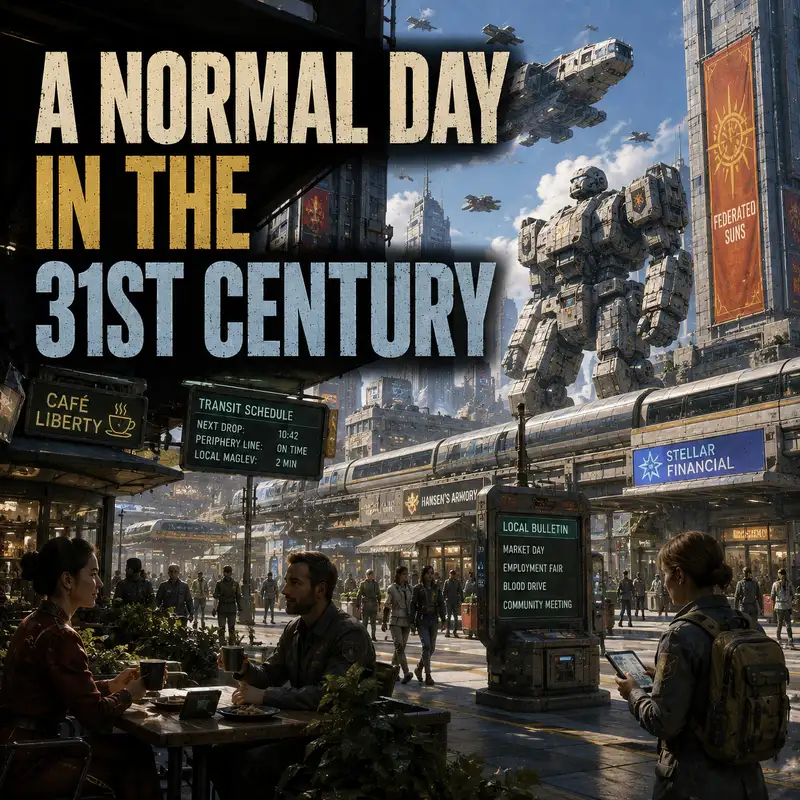
At six in the morning, the alarm sounds in an apartment above a machine shop on a prosperous Inner Sphere world. The lights come on without ceremony. Water runs, although the household has learned not to waste it. A local news program reports a trade dispute, a factory accident, and rumors of troop movements several systems away. Breakfast comes from local grain, preserved fruit, and coffee imported at a price that makes every cup a minor financial decision. Outside, buses carry workers toward an industrial district while a military transport rumbles toward the spaceport. No BattleMech steps over the skyline. No noble announces a war. Most days in the thirty-first century begin this way: with work to do, bills to pay, and distant events that may eventually become local problems.
To describe a normal day, however, we first have to admit that there is no single normal. The Human Sphere contains hundreds of inhabited worlds with different climates, histories, governments, industries, and levels of development. Life on New Avalon, Tharkad, Luthien, Sian, or Atreus can be urban, educated, connected, and technologically sophisticated. Life on a marginal agricultural colony may depend on weather satellites older than the local government. A mining settlement in the Periphery may possess a fusion-powered refinery but only one functioning medical scanner. The thirty-first century is a patchwork in which advanced machines, repaired antiques, local improvisation, and ordinary human habits exist side by side.
Around the year thirty twenty-five, the average civilian is more likely to encounter advanced technology as infrastructure than as personal luxury. Fusion power supports many developed cities, industries, transportation systems, and orbital facilities. Computers, communication networks, automated controls, and precision manufacturing are familiar. Yet access is uneven. A capital-world apartment may have reliable climate control and household electronics, while a frontier family uses rugged equipment designed for local repair. The future has not replaced every old tool simply because a newer one exists. Internal-combustion engines, wheeled trucks, hand tools, paper records, and human clerks remain useful. A device that can be maintained is often more valuable than one that is impressive.
The planet itself shapes the day before politics does. Some worlds are naturally comfortable. Others were terraformed during more prosperous centuries and still depend on environmental systems that may be difficult to replace. Air processors, water plants, irrigation networks, orbital mirrors, weather stations, and sealed habitats can be as important as any military fortress. On a harsh world, checking pressure seals or water allotments is housekeeping. On an agricultural world, the morning forecast matters more than news from a House capital. On a dense industrial world, pollution controls and power distribution determine whether neighborhoods remain healthy. The grand map of the Inner Sphere shows borders. The people inside those borders experience soil, gravity, weather, and the reliability of the machinery keeping them alive.
Food reveals both local abundance and interstellar distance. Most people eat what their world can produce, supplemented by preserved goods and regional trade. Grain, vegetables, livestock, cultured foods, and fish may be ordinary, although species and preparation vary widely. Wealthy consumers can buy imported delicacies. Poorer households notice every transportation delay in the market price. A failed harvest, damaged DropShip, pirate raid, or military requisition can turn a familiar product into a luxury. Worlds that cannot fully feed themselves are especially vulnerable. A JumpShip can cross interstellar distance, but it cannot make a harvest appear, and a government press release remains difficult to cook. For many civilians, logistics is not a staff-college concept. It is what is available for dinner.
Housing follows class, environment, and local history. A noble family may occupy an estate older than the current dynasty. Corporate executives may live in guarded towers near commercial districts. Skilled technicians and civil servants often form a broad middle class on developed worlds, with apartments, education, medical access, and some political influence. Factory laborers, tenant farmers, miners, and refugees may live closer to the margin. On poorer planets, several generations can share a dwelling because property and construction materials are scarce. On wealthy ones, even modest homes may include advanced appliances and local data access. The setting is feudal at the top, but daily life is not universally medieval. The person collecting rent may hold a hereditary title. The rent is still processed by a computer.
Work occupies most of the day, and most work has nothing to do with piloting a BattleMech. People farm, teach, manufacture, repair, mine, program, transport cargo, sell goods, treat patients, process records, operate power plants, and maintain the systems that make interstellar civilization possible. A single inhabited world needs millions of tasks completed before it can support one regiment. Industrial employment can involve automated production lines, heavy machinery, and computerized quality control. Agricultural work may combine old farming knowledge with satellite data and adapted crops. Government offices can be highly organized or magnificently inefficient, sometimes on the same floor. Famous warriors depend on all of these people, even when official histories remember only the warriors.
A factory worker in thirty twenty-five may spend the shift producing vehicle parts, pumps, electronics, building materials, or replacement components for machines designed centuries earlier. The factory may be locally owned, controlled by a noble house, or part of an interstellar corporation. Some equipment is modern by local standards. Other machinery survives because generations of technicians have refused to let it die. Maintenance manuals can become institutional treasures. A specialized bearing or sensor may require materials from another planet, so production schedules depend on ships no one in the factory controls. When a shipment is late, managers hold meetings, workers improvise, and the purchasing department discovers new definitions of urgency. The future remains familiar in that respect.
BattleMechs are visible symbols of the age, but they are rare compared with civilian vehicles, industrial machines, conventional armor, and the people who support them. Many civilians may see a BattleMech only during a parade, at a distant garrison, on a news recording, or when war arrives. On worlds with major factories or military academies, the sight may be common enough to lose some novelty. Even there, a BattleMech is not a personal automobile. It is an enormously expensive military asset surrounded by technicians, security, transport, and political authority. An ordinary person does not borrow one for the afternoon. The machine belongs to a state, military unit, corporation, noble family, or mercenary command, and every owner keeps records.
Local transportation is less dramatic. People commute by train, bus, wheeled vehicle, hovercraft, boat, or short-range aircraft depending on the world. Dense cities may have efficient mass transit. Rural communities may rely on trucks older than their drivers. Spaceports connect the surface to orbit through shuttles and DropShips, but most residents do not visit them regularly. A planet can be part of an interstellar state while most of its population remains within a few hundred kilometers of home. Distance has not disappeared. It has acquired more layers. A worker may cross a city in an hour, reach another continent in several hours, spend days traveling to a jump point, and then watch a JumpShip cross thirty light-years almost instantly.
Communication has the same uneven rhythm. Within a city or planetary network, calls, messages, broadcasts, and data transfers can be immediate. Between star systems, they depend on hyperpulse generators operated by ComStar. An HPG transmission can move information faster than a ship, but it is not the same as a casual conversation across the galaxy. Messages travel through a network of stations, priority costs money, and delays accumulate over distance. Governments, corporations, militaries, and wealthy individuals use the system routinely. Ordinary people may send interstellar messages less often or through services that bundle traffic. A family member living three systems away is reachable, but not necessarily available for a live chat after dinner.
This changes how people understand news. A battle may be over before civilians on another world hear that it began. Reports arrive through official channels, ComStar bulletins, merchants, military personnel, and travelers. Governments shape the story, and local broadcasters add their own assumptions. Rumors can move with a DropShip and remain persuasive for weeks because verification is slow. A citizen near a border learns to distinguish announced mobilization from actual danger. A factory manager watches for shipping disruptions. A farmer listens for tariff changes. The HPG network connects civilization, but it does not erase uncertainty. It merely allows uncertainty to arrive in a more organized format.
Money also works at several levels. The C-bill serves as a widely accepted interstellar standard, especially for governments, major trade, mercenary contracts, and transactions crossing borders. Local currencies remain common in everyday life. A shopkeeper may price food in planetary currency while an importer calculates costs in C-bills. ComStar's financial role gives it influence far beyond message traffic. For the average worker, however, money still means wages, rent, taxes, food, transportation, school expenses, and the possibility that inflation will arrive before a promised raise. Interstellar banking does not prevent a landlord from wanting payment on time. It only makes the paperwork capable of crossing space.
Government can feel both distant and immediate. The Great Houses rule enormous states through layers of regional authorities, planetary governments, nobles, ministries, corporations, and military commands. A citizen may never see the ruler whose portrait hangs in a public office. The local mayor, tax official, police chief, landowner, or company director matters more on an ordinary Tuesday. Some worlds have elected institutions and strong civic traditions. Others are tightly controlled, with limited political rights and active security services. Many combine representative bodies with hereditary power. Feudalism in BattleTech is less about every farmer serving a knight and more about authority delegated through personal loyalty, landholding, inherited office, and negotiated obligations.
The five great Successor States give that structure different meanings. In the Federated Suns, citizens may hear strong language about liberty while living under powerful nobles and uneven public services. In the Lyran Commonwealth, commercial opportunity and industrial wealth can be substantial, but prosperity is not distributed equally. The Draconis Combine emphasizes duty, hierarchy, and loyalty to the state. The Capellan Confederation links rights closely to citizenship and service. The Free Worlds League allows extensive regional autonomy, which can protect local identity or produce confusion. These descriptions are starting points, not daily scripts. A schoolteacher on one Davion world may have less freedom than a merchant on another Kuritan world, because planets preserve their own histories and institutions.
Law and public order depend heavily on location. A prosperous core world may have professional police, courts, legal representation, and reliable emergency services. A frontier community may rely on a sheriff, local militia, company security, or whichever authority can arrive before the dispute becomes permanent. Nobles and corporations can possess privileges unavailable to ordinary citizens. Political offenses may be treated differently from theft or violence, particularly in authoritarian states. Piracy, smuggling, organized crime, and corruption flourish where governments are weak or trade is valuable. Most people expect rules to exist. Their concern is whether those rules protect them, control them, or change when someone important enters the room.
Education ranges from excellent universities to classrooms with too few teachers and outdated equipment. Developed worlds train engineers, physicians, scientists, administrators, and military officers at levels needed to sustain advanced industry. Other communities focus on practical literacy, agricultural knowledge, technical apprenticeships, and local trades. Family status influences opportunity almost everywhere. A noble child may attend an academy leading toward government or command. A technician's child may gain a place through examinations, sponsorship, or military service. On poorer worlds, leaving school early can be an economic necessity. Knowledge survives through institutions, but also through families and workshops where experienced people teach the next generation to keep old systems functioning.
Medicine is similarly uneven. Major cities can support hospitals with advanced imaging, surgery, pharmaceuticals, prosthetics, and specialized care. Military medicine may be excellent where governments invest in preserving trained personnel. Rural clinics can be competent but short of equipment. Remote settlements may depend on one doctor, a few medics, and supplies arriving by irregular transport. A treatment available on a capital world may be unaffordable or unknown at the edge of the state. The Succession Wars damaged medical research and production along with military industry. People still benefit from centuries of knowledge, but that benefit follows wealth, supply chains, and political priority. The future has cures. It does not always deliver them.
Religion, language, and custom remain powerful parts of daily life. Humanity carried old faiths and cultural traditions to the stars, then created new local identities over centuries of settlement. A single world can contain many religions, languages, and ethnic communities. Festivals may commemorate Terran history, the founding of the colony, a local disaster, a military victory, or a saint known nowhere else. Governments encourage some traditions and suppress others. House propaganda tries to make loyalty feel personal, but local culture often proves more durable than official slogans. People marry, mourn, celebrate births, argue about music, cook family recipes, and complain that younger generations have forgotten how things should be done. Interstellar civilization has not improved that conversation.
Leisure survives because people require more from life than production quotas. Citizens watch sports, dramas, news programs, concerts, and recordings imported from other worlds. They gather in restaurants, bars, clubs, temples, parks, gaming halls, and neighborhood associations. Local teams can inspire more passion than distant rulers. Solaris Seven's BattleMech matches attract famous pilots and interstellar attention, but most entertainment is less destructive and more affordable. Popular culture moves through HPG reports, merchants, recordings, and travelers, so fashions spread slowly and arrive in altered form. A song may become famous in one state months before another hears it. By then, three local versions and one patriotic adaptation may already exist.
Military service remains close to civilian life even when combat is far away. Governments maintain standing forces, planetary militias, reserves, police units, and civil-defense organizations. Some states rely heavily on conscription or mandatory service. Others recruit through pay, status, education, family tradition, or the promise of citizenship. A military base can provide jobs and customers while bringing restrictions, noise, and the risk of becoming a target. Families follow postings, wait for messages, and learn that official casualty lists arrive with careful wording. A child may grow up admiring MechWarriors while a parent worries about fuel prices caused by the same regiment's deployment.
War usually enters the normal day indirectly before it arrives physically. Taxes increase. Military buyers receive priority. Skilled workers are reassigned. Shipping insurance rises. Refugees appear at stations and ports. News broadcasts become more certain while reliable information becomes less available. A border change on a strategic map can place the same town under a different flag without moving any buildings. Some occupations are orderly. Others bring reprisals, confiscation, resistance, and destruction. Most civilians do not choose the campaigns fought around them. They adapt, cooperate, flee, resist, or try to keep families alive. The famous battle may last one day. Its effect on schools, hospitals, housing, and trade can last a generation.
Interstellar travel is possible, but rarely casual. A passenger first reaches a spaceport, then travels aboard a DropShip from the planet toward a jump point. That leg can take days. The DropShip attaches to a JumpShip, which makes an almost instantaneous jump of up to about thirty light-years. The JumpShip then normally spends roughly a week recharging before another jump. A multi-system journey consumes time, money, and patience even when nothing goes wrong. Merchants, officials, soldiers, technicians, migrants, and wealthy travelers cross the stars. Many people never do. For them, another planet is real in the way a distant nation was once real on Terra: known through news, products, stories, relatives, and occasional visitors.
Planetary identity is often stronger than a map suggests. People may call themselves Davion, Steiner, Kuritan, Capellan, or Marik, but they also identify with a city, province, world, religion, company, family, or regiment. The capital of a Successor State can be weeks away in practical terms. A decree from the throne must pass through administrators who interpret it according to local conditions and interests. Border worlds may change allegiance several times while retaining the same accent, food, and grudges. This continuity helps explain why conquest is difficult. Capturing a planetary capital does not automatically persuade millions of residents that their history has changed. It merely gives them new forms to complete.
The technological character of the era is defined by contradiction. People can operate fusion plants and interstellar spacecraft while struggling to reproduce certain Star League systems. A household computer may be ordinary while a military sensor is treated as an irreplaceable artifact. A hospital may perform advanced surgery but wait months for a component. A factory may use automated machinery beside a production line rebuilt by hand. Lostech does not mean everyone lives among candles and broken radios. It means the highest achievements of the previous age survive unevenly, often without the industrial depth needed to replace them. The future works, but it works because technicians keep negotiating with the past.
By evening, the worker returns home. The news has changed slightly, although no one is sure whether the new report is more accurate. A child finishes schoolwork on a local terminal. A neighbor complains about transit delays. Someone checks the price of imported coffee and decides tomorrow's cup can be local. Above the city, a DropShip rises toward orbit, carrying cargo, passengers, and perhaps orders that will matter weeks from now. Most people will sleep without hearing a weapon fire. That is not a pause between the important parts of BattleTech. It is the civilization the wars are fought over, taxed to support, and too often damage.
A normal day in the thirty-first century is recognizable because the people remain recognizable. They work inside institutions older than their grandparents, use machines built from several technological ages, and live under governments that combine interstellar reach with intensely local power. They worry about employment, family, health, education, food, safety, and the decisions of distant leaders. BattleMechs may dominate the horizon when armies arrive, but they do not dominate every hour of life. The true scale of the Human Sphere is found in the millions of ordinary mornings that continue between campaigns. The future is not only the machine crossing the battlefield. It is everyone who must wake up the next day and keep the world running.