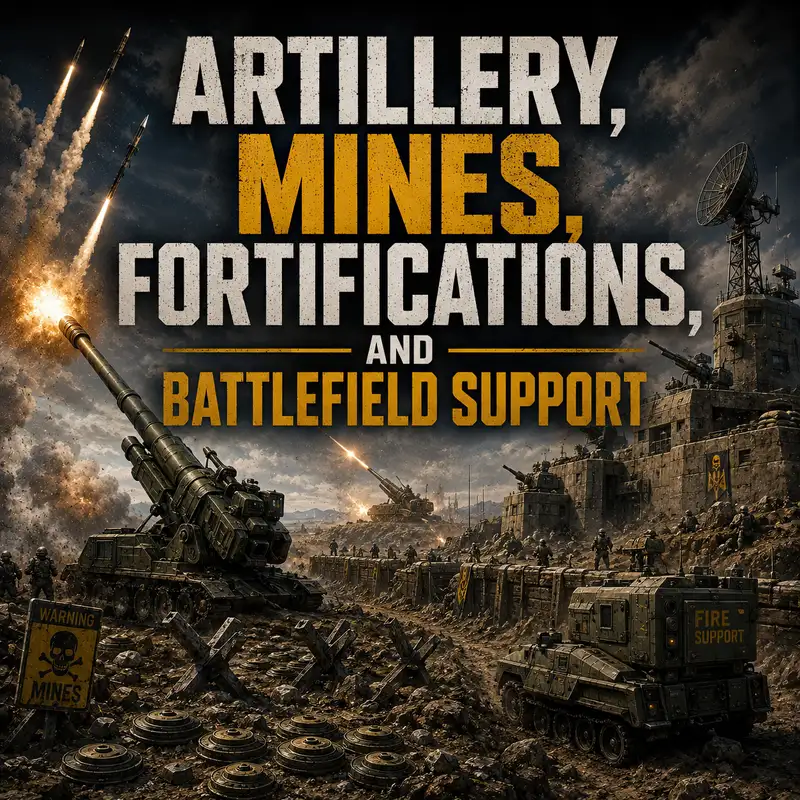
Artillery, Mines, Fortifications, and Battlefield Support
The lead BattleMech reached the pass and stopped. Nothing had hit it. The road ahead looked clear, the ridge line was quiet, and the enemy’s main force was still several kilometers away. Then an engineer found the first mine. Artillery landed behind the column moments later, cutting the road and damaging a recovery vehicle. The advance had not been defeated by a larger BattleMech. It had been defeated by prepared ground, indirect fire, and the loss of the people needed to move through both.
Artillery, mines, fortifications, and battlefield support rarely receive the attention given to famous machines and pilots. They are also the systems that decide where those machines can move, how long they can fight, and whether a damaged unit returns for another battle. A lance can win a firefight through superior gunnery. An army wins a campaign by combining that gunnery with engineers, observers, ammunition, protected positions, recovery equipment, and enough planning to make the enemy enter the wrong ground.
Artillery begins with a simple idea. A weapon does not need to see a target if someone else can see it, locate it accurately, and communicate the information. The gun may sit behind a ridge, inside a fortified base, or beyond the immediate battlefield. A forward observer identifies the target. Survey crews establish the firing position. Fire-control personnel calculate direction, distance, elevation, and timing. The crew loads and fires. The shell travels through the space between the plan and reality, where wind, weather, bad coordinates, enemy movement, and human error are waiting.
That delay separates artillery from most direct-fire weapons. A laser arrives almost as soon as the pilot fires it. An artillery shell may reach a target after the target has moved, the spotter has been forced into cover, or friendly units have entered the impact area. Good artillery units anticipate movement and correct rapidly. Poor ones strike the place the enemy occupied when the request began. Both produce large explosions. Only one is supporting the battle.
BattleTech forces use several broad artillery families. The Thumper is the lighter field piece, easier to move and supply but less destructive. The Sniper occupies the middle ground, balancing mobility, range, and effect. The Long Tom is the heavy weapon, capable of delivering powerful area fire while demanding a larger carriage, more ammunition handling, and greater logistical support. These names describe military roles as much as engineering. The heavier the weapon, the more of the unit exists to move, feed, protect, and repair it.
Arrow Four missiles provide another form of artillery. Instead of a conventional shell fired from a tube, the launcher sends a large guided missile toward the target area. Standard rounds can deliver area effects, while homing ammunition can use target-designation data to strike a specific unit with much greater precision. That precision depends on a working designation system, a clear target track, compatible ammunition, and someone close enough to illuminate the target without becoming the enemy’s next priority.
Artillery cannons shorten the concept for more direct battlefield use. They trade some of the range and high-arc employment of full artillery pieces for faster engagement and a weapon that can operate closer to the fighting. This can make them useful on mobile platforms that need area fire without waiting through a long fire mission. The compromise is familiar. A weapon designed to do artillery work near the front must carry the mass, recoil, ammunition, and attention that come with being near the front.
High-explosive ammunition is only the beginning. Artillery can deliver smoke to block observation, illumination rounds to expose movement at night, incendiary effects to deny terrain, and specialized ammunition against infantry or light vehicles. Some systems can scatter mines or fire guided projectiles. The most valuable round is not always the one producing the largest crater. A smoke mission that lets engineers cross an open road may matter more than a destructive strike against one armored target.
This variety turns an artillery battery into a tool for shaping decisions. Fire on a bridge may force an enemy onto a ford. Smoke can conceal a withdrawal or divide one formation from another. Illumination can destroy the protection offered by darkness. Incendiary fire can make woods, industrial sites, and urban terrain dangerous to occupy. Mine-delivery rounds can close a route after the enemy has already committed to using it. Artillery changes not only what survives, but what appears safe enough to attempt.
The spotter is therefore part of the weapon. Reconnaissance BattleMechs, infantry patrols, battle armor, aircraft, remote sensors, and electronic networks can all provide targeting information. The best observer understands the supported commander’s intent, not merely how to transmit coordinates. A battalion does not need fire on every visible enemy. It needs fire on the unit blocking the breach, the reserve approaching the flank, or the bridge that must remain closed for ten more minutes.
Spotters are vulnerable because the enemy understands the same relationship. A lightly armed scout near the front may be responsible for the fire of several distant batteries. Electronic countermeasures can break the link. Smoke and terrain can obscure the target. Counter-reconnaissance units hunt observation posts. A battery whose observers are destroyed still owns artillery. It has lost the ability to place that artillery where the battle requires it.
Communications discipline matters just as much. The observer must identify the correct target, use the correct reference system, and make clear where friendly troops are located. A confused grid coordinate can shift fire from an enemy position to a friendly route. Jamming, damaged relays, incompatible encryption, and hurried transmissions create opportunities for error. Artillery is often described as an impersonal weapon. The decision chain behind every fire mission is intensely human.
Counterbattery fire turns the artillery duel into a contest of detection and survival. Sensors, observers, sound ranging, radar, and the pattern of shell impacts can reveal where hostile guns are firing from. Once located, the battery may receive return fire from weapons it never saw. Experienced crews prepare alternate positions, fire limited missions, and move before the enemy completes the calculation. A heavy Long Tom system can be powerful and still become a fixed target if its support vehicles, route, and displacement plan are inadequate.
Ammunition is the battery’s daily limitation. Artillery shells and Arrow Four missiles are large, heavy, and consumed quickly. They must be transported between worlds, unloaded from DropShips, moved to protected depots, delivered to firing positions, and handled by trained crews. Different mission types require different rounds. A battery may possess plenty of ammunition and none of the smoke or guided munitions the commander suddenly considers essential. The offensive plan may remain elegant while the ammunition truck remains stuck behind a destroyed bridge.
Barrels, launch rails, recoil systems, loaders, and fire-control equipment also wear under sustained use. A gun firing repeated missions needs inspection and maintenance even if the enemy never reaches it. Heat, dust, weather, and propellant residue affect accuracy and reliability. Survey errors accumulate when the battery moves. Artillery is not a distant source of effortless explosions. It is a technical organization whose output depends on mechanics, calculations, and a supply system with very little sense of drama.
Mines shape the battlefield more quietly. Their primary purpose is not always to destroy. A minefield can slow an advance, channel movement, protect a flank, separate infantry from vehicles, and make an enemy deploy engineers under fire. The most important effect may be uncertainty. Once a force finds one mine, every patch of ground becomes a question. Speed falls, formations compress, and commanders begin measuring routes by risk rather than distance.
Conventional minefields can be laid by engineers, vehicles, artillery, missiles, or aircraft. Long-range missile launchers using Thunder ammunition can create minefields at distance, allowing a commander to close routes without physically reaching them. Air-delivered mines can cover larger areas quickly. Hand-emplaced mines can be concealed carefully and integrated with obstacles. Each method trades speed, density, precision, and logistical burden.
Anti-vehicle mines attack tracks, wheels, skirts, legs, and the lower structure of passing machines. Anti-personnel mines threaten dismounted troops and the engineers sent to clear a path. More advanced systems may use active sensors, command detonation, or target-sensitive triggers. None needs to destroy an assault BattleMech to succeed. Damaging a foot actuator, forcing a detour, or halting the column long enough for artillery to arrive can be operationally decisive.
A useful minefield is covered by observation and fire. Mines placed without surveillance can eventually be located, marked, bypassed, or cleared. Mines covered by infantry, direct-fire weapons, and artillery create a dilemma. The engineers must work slowly in the exact area the defender has already measured. The attacker can suppress the position, breach elsewhere, or accept losses. Every option consumes time and resources, which is the real currency of obstacle warfare.
Minefields also burden the side that lays them. Locations must be recorded accurately and distributed to friendly units. Routes through them must be marked without revealing those routes to the enemy. A changing front can leave friendly troops facing their own obstacles. Poor records become especially dangerous after headquarters moves, units rotate, or local militia replaces the formation that installed the mines. The mine does not care which uniform appears later.
Civilians pay the longest cost. Mines laid around towns, farms, roads, and industrial sites can remain lethal after the campaign has moved on. Floods, landslides, construction, and scavenging can shift or expose them. A government may claim the field was temporary while local families live with it for years. Clearing the battlefield is therefore part of war’s political aftermath, even when the maps have already changed color.
Engineers are the people expected to solve these problems while everyone else is shooting. They detect and clear mines, breach walls, fill ditches, repair roads, strengthen bridges, create firing positions, demolish obstacles, and prepare landing zones. They also build the obstacles the enemy must later defeat. A combat engineer carries weapons because the work happens near the front. The engineer’s defining equipment is still whatever changes the terrain.
Breaching is a combined-arms operation, not a technician walking forward with a detector. Reconnaissance identifies the obstacle and the forces covering it. Artillery and direct fire suppress the defenders. Smoke reduces observation. Engineers mark safe lanes, clear mines, demolish barriers, and improve the route. Assault forces pass through before the enemy can close the gap. If one part fails, the breach can become a traffic jam inside a surveyed killing zone.
BattleMechs can help. Their armor, lifting strength, and ability to cross rough ground make them useful for moving debris, carrying specialized equipment, or protecting engineer teams. IndustrialMechs adapted for military work can dig, lift, cut, and demolish. Dedicated engineering vehicles carry blades, cranes, rollers, bridges, and demolition gear. None is invulnerable. A machine focused on earthmoving generally has less space for the weapons and armor that attract procurement speeches.
Fortifications are the defensive side of the same engineering effort. A fortification can be a shallow fighting position completed in an hour, a reinforced bunker, a prepared BattleMech bay, a hardened command center, an underground ammunition store, or a network of walls, trenches, sensors, and covered routes. Concrete alone is not a defense. The system must help troops observe, move, communicate, survive, and apply fire while denying the enemy those same advantages.
Earthworks are often more useful than elaborate structures because dirt is available, difficult to jam, and surprisingly effective at absorbing violence. Berms let tanks fight hull-down. Revetments separate vehicles so one explosion does not destroy an entire position. Trenches protect infantry and connect strongpoints. Overhead cover reduces the effect of fragments and air attack. A BattleMech may tower over the work, but the maintenance vehicles and ammunition beside it benefit greatly from not being visible.
A strong defensive position uses depth. The first line observes and delays. The next line receives the attacker after artillery, mines, and obstacles have disrupted the formation. Reserves move through protected routes to threatened sectors. Command posts and supply sites sit far enough back to survive the opening fire. Decoys attract reconnaissance and bombardment. Alternate positions let defenders move before the attacker solves the original layout.
Fortifications trade flexibility for preparation. A bunker cannot pursue a retreating enemy. Fixed guns cannot easily respond to a threat outside their firing arcs. Once intelligence identifies the position, artillery, aerospace strikes, infiltration, and siege operations can attack it systematically. A defender who remains inside a strongpoint after its purpose has disappeared may discover that protection and entrapment can use the same walls.
The Battle of Tukayyid demonstrated how support systems could alter a contest against technically superior attackers. ComStar did not rely on one line of heroic BattleMechs. The Com Guards used prepared ground, artillery, minefields, hidden positions, reserves, and logistical planning across separate campaigns against the invading Clans. Clan forces possessed their own support capabilities, but many attacks were shaped by small bids, aggressive timetables, and a culture that often placed greater prestige on direct warrior combat. Some Clans adapted better than others. The defenses were designed to punish those that did not.
Tukayyid did not prove that fortifications automatically defeat superior technology. It proved that technology must still move through terrain, receive ammunition, maintain communications, and complete objectives on time. The Com Guards accepted losses, traded space, and forced attackers to spend strength on prepared problems. The battlefield support network made every Clan victory more expensive and every delay more useful.
Support continues after the firing. A damaged BattleMech may weigh dozens of tons and lie where no ordinary truck can move it. Recovery vehicles, cranes, winches, transporters, and engineering teams stabilize the machine, extract the pilot, remove ammunition hazards, and move the chassis to a repair site. Control of the ground determines whether the wreck becomes a repaired asset, spare parts, or enemy salvage.
Recovery planning begins before the battle. Routes must support the weight. Bridges must remain intact. Security forces must protect crews working around disabled machines. Medical teams need access to injured personnel. Technicians need replacement actuators, armor, coolant, tools, and lifting equipment. A commander who orders an advance across terrain the recovery section cannot enter is accepting that every mobility kill may become a permanent loss.
Medical support has the same relationship to endurance. Aid stations, evacuation vehicles, field hospitals, and mobile surgical facilities keep casualties from becoming deaths and return some personnel to duty. The effect is military and moral. Soldiers who trust the evacuation system fight with different expectations than those who believe a wound means abandonment. Medical units require power, water, transport, security, and time, all of which become scarce during a retreat.
Supply vehicles carry the less dramatic requirements that make advanced weapons possible. Missile reloads, autocannon ammunition, artillery shells, armor material, coolant, food, water, batteries, medical supplies, and replacement electronics must reach the correct unit. Fusion engines reduce fuel demand for many BattleMechs, but the army around them still uses conventional vehicles, generators, aircraft, and support equipment. A fusion-powered lance can be surrounded by a remarkably fuel-dependent organization.
Communications and command vehicles hold the system together. They relay orders, manage airspace, coordinate artillery, track friendly positions, and connect the front with higher headquarters. Electronic warfare can disrupt those links, while physical attack can destroy them. A headquarters may be far less armored than the BattleMechs it directs and far more important to the operation. This is why command posts move, transmit cautiously, use decoys, and still attract enemy attention with impressive consistency.
Support formations require protection because they are high-value targets. Raiders do not need to defeat the main battle line if they can destroy ammunition, bridges, repair facilities, or medical evacuation routes. A handful of fast BattleMechs or hovercraft in the rear can force an entire regiment to slow down. Infantry, vehicles, aircraft, and local security troops guard the support area so the frontline units can keep looking forward.
The balance differs among eras and factions, but the requirement does not. Succession War armies often improvised with aging artillery, civilian transport, local fortifications, and technicians keeping irreplaceable equipment alive. Wealthier states and restored Star League institutions could field more specialized support. Clan forces possessed advanced technology and capable lower castes, yet their social hierarchy often gave less honor to the technicians and laborers sustaining the warriors. The machine did not share the hierarchy’s opinion. It still required repair.
Battlefield support is easiest to ignore when it works. The road remains open. The minefield is marked. The artillery arrives on time. The damaged BattleMech returns to the bay. The wounded reach surgery. The ammunition appears before the bins are empty. None of those events looks like a duel, and all of them decide how many duels the force can survive.
The column at the pass eventually moved again, but only after engineers cleared a lane, artillery suppressed the ridge, recovery crews removed the damaged vehicle, and traffic controllers untangled the machines trapped behind it. The lead BattleMech crossed first and received the official credit for reopening the route. The people who made the route usable were already preparing to do the same work at the next obstacle.
Artillery, mines, fortifications, and battlefield support matter because they convert firepower into control. Artillery reaches beyond sight. Mines turn ground into delay. Fortifications turn preparation into endurance. Engineers, medics, technicians, and transport crews keep the force capable of acting after the first plan fails. BattleMechs may decide the most visible moments of a campaign. Support determines whether those moments occur on favorable ground and whether the army remains alive to exploit them.