BattleTech and MechWarrior: Same Universe, Different Doorways
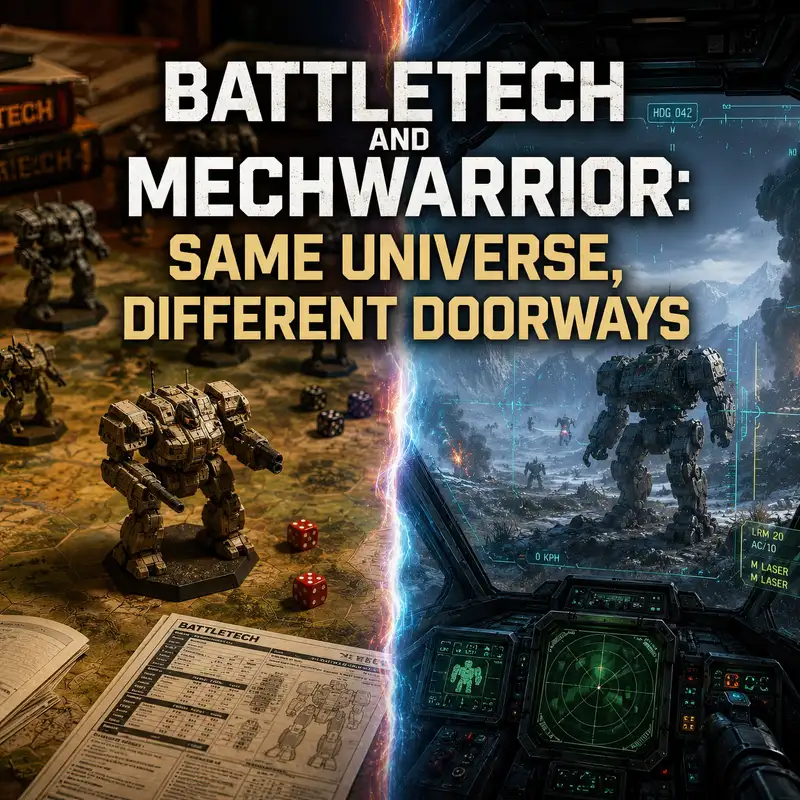
An Atlas steps into the open. On one side of the room, a player looks down at a hex map and asks whether the assault lance can cross the ridge before the enemy reaches the objective. On the other side, another player sees the same machine through a cockpit canopy, hears a missile warning, watches the heat display climb, and wonders why the left arm has stopped answering. Both are fighting in BattleTech. One of them may call the experience MechWarrior. The difference is not the universe. It is the seat, the scale, and the kind of decision the player has been asked to make.
The names create understandable confusion. A tabletop box says BattleTech. A computer game says MechWarrior. A novel may carry the BattleTech name while following a character called a MechWarrior. Another computer game simply carries the BattleTech title, yet it puts the player in command of a mercenary company rather than directly inside a cockpit. Store pages, old advertisements, game manuals, and fan conversations sometimes use BattleTech and MechWarrior almost interchangeably. They are closely connected, but they are not perfect synonyms. BattleTech is the larger setting and family of games. MechWarrior is an in-universe profession and a group of game experiences that usually bring the audience closer to the individual pilot.
Three definitions resolve most of the problem. A BattleMech is the machine. A MechWarrior is the person trained to pilot that machine. BattleTech is the fictional universe, the original tabletop war game, and the broad name under which its history, factions, technology, fiction, and many game systems are organized. A MechWarrior may serve a Great House, a Clan, a mercenary command, a Periphery state, a planetary militia, or some institution that has not yet decided which of those descriptions is least politically inconvenient. The title says what the person does. It does not tell us who owns the machine, who pays the pilot, or whether either will still exist when the contract ends.
BattleTech first appeared as a tabletop game in nineteen eighty-four. Its central experience was armored combat conducted with maps, counters or miniatures, record sheets, dice, and rules that translated movement, weapons, armor, internal damage, heat, and pilot skill into decisions at the table. The setting grew around that foundation. Technical descriptions explained the machines. Sourcebooks described governments, military units, worlds, and campaigns. Fiction gave names and motives to people who might otherwise have remained symbols on a map. The result became much larger than the original battle game, but the command perspective remained one of BattleTech’s defining doorways. The player could see the battlefield in a way no individual pilot ever could.
That elevated perspective matters. In classic tabletop BattleTech, a player may control one BattleMech, a lance of four, a larger formation, or a combined-arms force depending on the scenario. The player weighs terrain, firing arcs, movement, range, heat, ammunition, initiative, and the condition of several machines at once. A damaged BattleMech is not merely a shaking cockpit and a warning light. It is a unit whose reduced mobility may expose the entire formation. A fast scout is not simply exciting to drive. It is a reconnaissance asset, a flanker, an objective runner, or a very expensive way to learn that the enemy brought long-range fire support.
The tabletop view encourages a particular kind of understanding. It teaches that a battlefield is a system. One BattleMech creates opportunities for another. A unit holding a ridge can shape the route available to the enemy. A machine with short-range weapons needs someone else to help it survive the approach. A damaged heavy BattleMech may remain useful as an anchor even when it can no longer keep pace. Heat becomes a command problem as well as a pilot problem, because a formation that fires too aggressively may surrender its next turn’s mobility. The player is not only asking whether a weapon can hit. The player is asking what position will still be useful after the weapon fires.
BattleTech also extends beyond BattleMech duels. The full setting includes tanks, infantry, battle armor, aerospace fighters, artillery, engineers, reconnaissance, electronic warfare, transport, and the less glamorous machinery required to keep everyone supplied. Tabletop systems can bring those elements onto the map. Campaign rules can make repair, salvage, ammunition, replacement personnel, and transport matter between battles. That broader view exposes an uncomfortable military truth. Destroying the enemy’s most impressive machine does not automatically secure the road, the city, the spaceport, or the population. A commander who wins every duel and loses the supply column will eventually receive an excellent opportunity to reconsider priorities.
MechWarrior narrows the field of view and makes the experience more immediate. Inside the setting, a MechWarrior is a highly trained combatant linked to a BattleMech through controls, displays, a neurohelmet, and years of practice. In many MechWarrior video games, the player occupies that role directly. The horizon is no longer a map edge. It is what can be seen through the cockpit. Enemy units are not counters with known armor values. They are contacts identified through sensors, line of sight, targeting data, and sometimes the alarming discovery that the object behind the hill has friends. The player feels the machine as a place, not merely as a collection of statistics.
That cockpit perspective changes the decisions. A MechWarrior game may ask the player to manage throttle, facing, torso rotation, weapon groups, targeting, heat, ammunition, armor damage, and lancemate orders in real time. The BattleMech’s design becomes physical. A weapon mounted in an arm may track differently from one fixed in the torso. A machine with strong long-range firepower may feel vulnerable when an enemy closes. An ammunition-dependent design can become less useful during a prolonged operation even if its armor remains intact. Damage that appears on a tabletop record sheet as a marked location becomes smoke, sparks, a missing weapon, a degraded sensor picture, or a sudden reduction in speed at the worst available moment.
MechWarrior games therefore communicate aspects of BattleTech that a map cannot reproduce in the same way. Scale becomes emotional. A light BattleMech racing between buildings feels different from an assault machine turning slowly to bring its weapons to bear. Heat is not an accounting line. It is a rising warning that forces the pilot to choose between firing now and remaining functional a few seconds later. Friendly support becomes personal when a lancemate draws fire away from a damaged side. Withdrawal stops being a neat movement toward the map edge and becomes the long process of exposing your back armor while hoping the enemy has developed an unexpected respect for professional courtesy.
The cockpit view also hides things. A pilot sees the fight immediately around the machine, not the entire campaign. The player may receive objectives and radio reports without seeing the political negotiations that created them. A mission may present a target as a military necessity while leaving the employer’s motives uncertain. Logistics may be compressed into repair screens, market menus, or a payment summary. Travel may pass in seconds even though interstellar movement shapes strategy throughout the setting. This is not a failure. Every game chooses what to make detailed and what to abstract. The important mistake is assuming that whatever a game abstracts must not matter in the universe.
MechWarrior has also been the name of role-playing games, and that doorway changes the scale again. A role-playing campaign can follow pilots, technicians, intelligence officers, nobles, infantry soldiers, merchants, doctors, criminals, diplomats, or ordinary people pushed into military events. A Time of War provides a detailed BattleTech role-playing system, while MechWarrior: Destiny offers a more narrative-focused approach. Both can move beyond the cockpit. A character may negotiate a contract, investigate sabotage, treat wounded civilians, argue with a superior, secure spare parts, or discover that the enemy officer across the table has a more accurate understanding of the situation than the character’s own government.
This is an important correction to the title MechWarrior. The word can suggest that every meaningful story must center on an elite pilot. The setting does not work that way. A MechWarrior may be the person who pulls the trigger, but technicians determine whether the machine starts. DropShip crews determine whether it reaches the planet. JumpShip crews determine whether the unit reaches the star system. Intelligence personnel influence what the pilot expects to find. Infantry hold ground the BattleMech has passed through. Civilians live with the consequences after the formation leaves. Role-playing games make it easier to explore those relationships because the mission does not have to end when the reactor shuts down.
Consider the same mercenary raid through several doorways. In a tabletop battle, the central question may be whether a lance can seize a communications station before enemy reinforcements arrive. In a MechWarrior cockpit game, the player experiences the approach, identifies targets, protects lancemates, manages damage, and decides when to withdraw. In a role-playing session, the most difficult moment may occur before deployment, when the commander discovers that the employer’s intelligence is incomplete and the station serves nearby civilian settlements. In a campaign management game, success may be measured against repair costs, pilot injuries, salvage, reputation, and the availability of transport. The raid is the same operation. Each form reveals a different part of its truth.
The turn-based computer game titled BattleTech demonstrates why the names cannot be sorted into a simple tabletop-versus-video-game rule. That game places the player in command of a mercenary company in the year thirty twenty-five. Combat is tactical and turn based, while the campaign includes pilots, repairs, contracts, finances, salvage, reputation, and a mobile base of operations. The player does not personally aim each weapon from the cockpit. The player issues orders, builds a lance, manages risk, and attempts to remain solvent. It is a digital experience, but its perspective is closer to the map table and command office than to a first-person simulator. The name fits the viewpoint.
Mercenaries approaches the same general mercenary tradition from inside the machines. The player pilots a BattleMech, directs lancemates, takes contracts, acquires equipment, and moves through an Inner Sphere shaped by the Succession Wars and later conflicts. Company management remains present, but battlefield action is experienced directly. MechWarrior Five: Clans changes the institution and the historical moment. It places the player with Clan Smoke Jaguar during the Clan Invasion, leading a five-machine Star rather than a four-machine Inner Sphere lance. The controls still say MechWarrior. The social system, force organization, doctrine, and meaning of service are very different.
MechWarrior Online uses the cockpit as a competitive combat space. The emphasis falls on piloting, weapons, team coordination, BattleMech configuration, and the immediate problem of defeating another team. That experience can teach weapon behavior, movement, range, heat, armor facing, and the personalities of different chassis. It does not attempt to simulate every political or logistical feature of the Human Sphere during each match. The absence of a budget committee from the battlefield should not be taken as evidence that procurement has finally been defeated. It means the game has chosen a specific scale and purpose.
Novels provide another doorway, and they often move between the map and the cockpit in ways games cannot. A novel can follow a ruler making a strategic decision, a staff officer converting it into an operational plan, a MechWarrior carrying it into battle, and a civilian discovering what the official language concealed. Sourcebooks can present military reports, historical summaries, intelligence assessments, technical descriptions, and faction viewpoints. Fiction can give emotional continuity to events spread across worlds. Neither form is automatically more complete. A sourcebook may explain the campaign while a novel explains why one participant could not accept the obvious solution.
Because these doorways share names, characters, machines, and events, newcomers sometimes assume every portrayal fits together without adjustment. That is not always true. Core tabletop continuity provides the principal historical framework, but games and adaptations may compress distances, alter unit availability, simplify organizations, create characters for a specific story, or change how equipment works for playability. A weapon’s effective range in a game is not necessarily a literal measurement of setting physics. A mission created for an adaptation is not automatically a documented event in core history. Shared universe does not mean every interface, scenario, and dramatic choice is an equally authoritative historical source.
The distinction becomes especially useful when two products appear to contradict one another. A tabletop rule may let a unit act according to a sequence designed for fair play. A cockpit game may portray movement and weapon handling in continuous time. A novel may describe the confusion, fatigue, and limited perception that both game systems simplify. These are different models of the same kind of event. The correct response is not to force every detail into one mechanical explanation. It is to ask what each form is designed to show. Rules create decisions. Fiction creates perspective. Sourcebooks create context. Adaptations create access, sometimes by bending the scale.
The Clan Invasion offers a good example. At the strategic level, it is a massive military and political crisis beginning in the year thirty fifty, driven by the returning descendants of the Star League Defense Force. A campaign sourcebook can show invasion corridors, major units, objectives, and turning points. A tabletop scenario can isolate one engagement and ask whether a force can hold a position. A MechWarrior game can put the player in a single cockpit facing unfamiliar technology or, from the Clan side, inside a Star shaped by bidding, hierarchy, and expectations of honor. A novel can follow commanders, warriors, politicians, and civilians. None alone contains the entire invasion.
Era also matters. BattleTech products do not all begin in the same year. Some focus on the late Succession Wars. Others center on the Clan Invasion, the Civil War era, the Jihad, the Republic of the Sphere, the Dark Age, or the ilClan era. A player entering through one MechWarrior title may assume its political map represents the permanent state of the universe. It does not. Borders change. States merge, fracture, disappear, and return. Technologies move from rare to common or from experimental to obsolete. A familiar mercenary command may be young, powerful, ruined, divided, or long gone depending on the date. The doorway usually tells you where and when you entered, not the shape of all history.
This explains why two fans can both know BattleTech well and initially seem to be discussing different settings. One may know the year thirty twenty-five through a mercenary campaign. Another may know the Clan Invasion from a cockpit simulator. A third may follow the ilClan era through current sourcebooks and fiction. They share the same historical continuum but occupy different points along it. The confusion resembles two veterans comparing the same army after serving in different theaters and decades. The insignia may be familiar. The equipment, doctrine, enemies, and official explanation for everything may have changed several times.
Each doorway also creates predictable blind spots. A tabletop player may understand formation tactics yet underestimate how disorienting battle feels from one cockpit. A simulator player may become highly skilled at individual gunnery while overlooking why a regiment cannot sustain repeated operations without transport and maintenance. A novel reader may know political motives but have little sense of how terrain and heat constrain a BattleMech. A role-player may care deeply about individual characters while treating large campaigns as distant weather. These are not defects in the audience. They are consequences of perspective. The solution is not to defend one doorway. It is to look through another.
No single form has exclusive claim to authenticity. Classic BattleTech can reveal the engineering compromises and tactical relationships among machines. Alpha Strike can show larger formations and faster operational movement on the table. MechWarrior games can make the BattleMech feel heavy, dangerous, and physically demanding. Role-playing systems can show careers, institutions, and lives outside combat. Novels can examine motives and consequences. Sourcebooks can organize centuries of history. A newcomer does not need to pass through every entrance before being considered a legitimate fan. The Human Sphere has enough border controls without adding one at the hobby table.
It is still useful to know which question each name usually promises. BattleTech often asks where forces should go, how they interact, what the campaign means, and what political history produced the battle. MechWarrior often asks what it feels like to be one of the people sent there, what the machine demands from its pilot, and whether that person can survive the orders created at a higher level. There is considerable overlap. A MechWarrior game may include strategy and finance. A BattleTech game may create intense attachment to one pilot. The distinction is a guide, not a fortified border.
The two perspectives become strongest when they correct one another. From the map table, an assault may look efficient because the objective was taken and enemy losses were heavy. From the cockpit, the same assault may be remembered as a sequence of broken communications, overheated weapons, wounded lancemates, and a retreat route that nearly closed. From the command office, the repair bill may show that the victory cannot be repeated. From the political capital, the operation may be announced as proof that the war is proceeding exactly as planned. BattleTech gives us room to compare all four accounts. MechWarrior ensures we do not forget that someone had to live through one of them.
BattleTech and MechWarrior are therefore not rival universes and not separate halves that must be chosen between. BattleTech is the larger history, setting, and game tradition. MechWarrior is both a person inside that history and a close, often cockpit-centered way of entering it. One doorway may begin with a hex map. Another may begin with a targeting reticle. A third may begin with a character sheet or the first page of a novel. They lead to the same Human Sphere, where commanders move symbols, pilots carry out the movement, technicians repair what returns, and civilians inherit whatever the official report calls success.