Building a Mercenary Command: Recruitment, Transport, and Bankruptcy
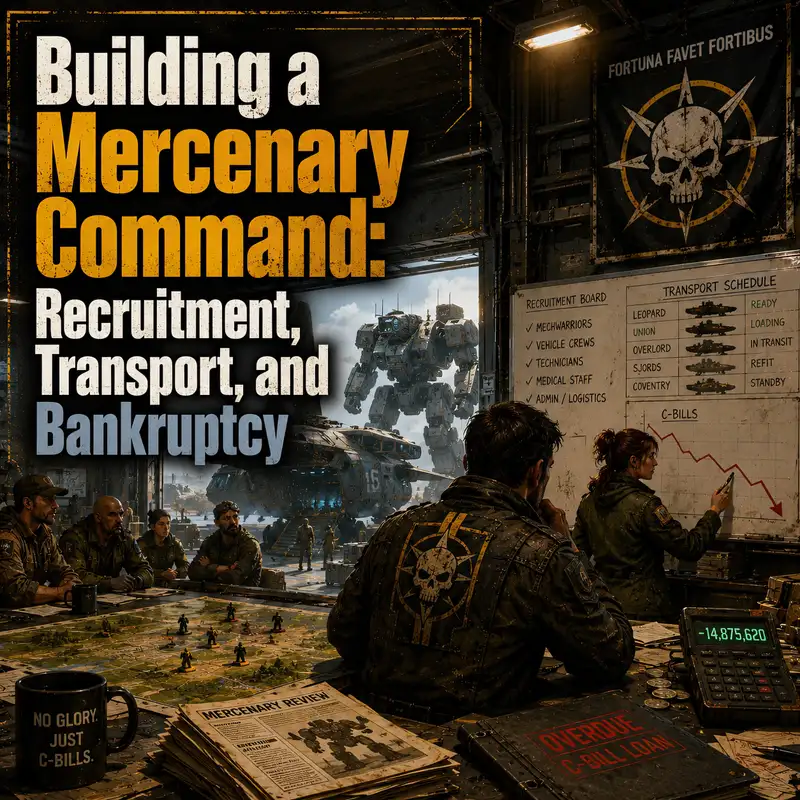
A newly formed mercenary company can look impressive from the far side of a landing field. Twelve BattleMechs stand in fresh paint. Pilots pose beside unit colors. Recruiters have already told the local news service that the command is ready for immediate employment. Then the commander checks the actual books. Two machines need parts. The senior technician has accepted another offer. The chartered DropShip leaves in nine days. Payroll is due in seven. The unit exists, but whether it will still exist next month is a separate question.
Building a mercenary command is not primarily an exercise in collecting BattleMechs. It is the creation of a military organization, a transport enterprise, a maintenance system, and a small business whose principal source of revenue involves being shot at. The visible combat force may be a lance, a company, or a battalion. Behind it must stand enough people, money, equipment, and mobility to reach a contract, perform it, survive it, and move on before the next set of bills arrives.
Mercenary commands begin in several ways. Some are remnants of defeated House units whose soldiers prefer employment to disarmament. Some are formed by veterans who leave regular service over politics, promotion, or simple exhaustion. Others grow around a noble family, a charismatic officer, a few inherited BattleMechs, or a corporation seeking a deniable security force. Governments have even created supposedly independent commands for missions they do not wish to own publicly. The origin matters because it determines who brings the money, who owns the machines, and who believes they should be in charge.
Every new command requires three kinds of capital. The first is human capital: people who can fight, repair, plan, negotiate, and administer. The second is material capital: BattleMechs, vehicles, weapons, spare parts, medical supplies, and communications equipment. The third is mobility: the ability to put all of that on another world. A commander who possesses only two of the three has not solved the problem. Soldiers and machines without transport are a planetary militia. Machines and transport without technicians are cargo. People and transport without weapons are passengers.
Recruitment usually begins with a trusted core. Friends from an academy, former members of the same regiment, relatives, or veterans of a shared campaign provide the first layer of cohesion. That trust is valuable because a new command has no record, limited cash, and few institutions strong enough to survive a serious internal dispute. It is also dangerous. Friendship does not automatically produce a competent operations officer, a reliable quartermaster, or an executive officer willing to tell the commander that the plan is unaffordable. A staff selected entirely for loyalty may remain loyal all the way into insolvency.
The first combat recruits are often the easiest people to imagine and the hardest to evaluate. A veteran MechWarrior may possess excellent battlefield instincts and a disciplinary record long enough to require its own filing cabinet. A young academy graduate may be technically skilled but untested under fire. A dispossessed MechWarrior brings experience without a BattleMech. An owner-pilot may arrive with a family machine worth more than the unit’s entire cash reserve, but also with firm opinions about who controls it, who repairs it, and whether it can be risked on someone else’s objective.
That ownership question must be settled before combat. Is the BattleMech the property of the command, the pilot, a lender, or a silent patron? Does an owner-pilot receive a salary, a larger share of profits, or voting rights? Who pays for repairs? If the machine is destroyed while following orders, does the command owe a replacement it cannot possibly buy? These questions can seem impolite during recruitment. They become much less polite when a family heirloom is lying in three pieces under enemy artillery fire.
Skill also has to be verified. Hiring halls on worlds such as Galatea and Outreach attract experienced professionals, desperate applicants, confidence artists, and people who are all three by lunchtime. Records can be examined through mercenary review organizations, former employers, and training evaluations, but paperwork cannot fully test judgment. A pilot who scores well on a range may still break formation in combat. A technician with modest credentials may be exceptional at keeping obsolete machinery alive. The commander is not merely filling positions. The commander is deciding which weaknesses the unit can afford.
Technical personnel deserve the same recruiting effort as MechWarriors, usually more. A BattleMech can demand dozens of labor hours during a quiet week before battle damage is considered. Ideally, each machine has a qualified technician, supported by assistants who inspect armor, myomer, electronics, actuators, weapons, and the fusion engine’s associated systems. A command that understaffs maintenance can conceal the problem for a while. Readiness reports remain optimistic, minor faults are deferred, and machines continue walking. Then several failures arrive together, which is machinery’s traditional way of participating in budget discussions.
Support staff expand rapidly once the commander counts honestly. Medics and surgeons keep wounded personnel alive. Intelligence specialists examine terrain, enemy strength, and local politics. Communications personnel maintain secure links. Armorers, vehicle crews, recovery teams, and warehouse staff handle the equipment that keeps BattleMechs in action. Administrators manage pay, legal records, insurance, dependents, and casualty notifications. A negotiator may earn no medals, but a single well-written transport or salvage clause can preserve more combat power than an additional medium laser.
Small commands solve this problem by making everyone perform several jobs. The executive officer may handle contracts. A lance commander may oversee training. The senior technician may also manage supply. This is efficient until combat, illness, or resignation removes one person and three functions disappear. Larger commands can afford specialists, but specialists create payroll and require their own supervision. Growth therefore creates a familiar military paradox. The organization needs staff to become larger, and it needs to become larger to afford the staff.
Pay structure shapes the command’s culture. A conventional salary gives personnel predictable income but forces the unit to meet payroll during travel, repair periods, and months without employment. Profit sharing reduces fixed expenses and gives members a direct interest in success, but it also turns soldiers into investors who may expect a voice in risk, salvage, and leadership. Bonuses can reward performance while encouraging reckless behavior if written badly. Whatever system is chosen, repeated failure to pay is not an accounting inconvenience. It is a recruiting campaign for the unit’s competitors.
Discipline must be established before the first contract. Mercenaries are not freed from military law merely because they sign private agreements. The command needs rules for treatment of civilians, prisoners, salvage, alcohol, personal weapons, and relations with local authorities. It also needs a process for removing a dangerous pilot without triggering a private ownership dispute over the pilot’s BattleMech. A commander who postpones these decisions in the name of comradeship is not avoiding conflict. The commander is allowing the first serious incident to write unit policy.
Force structure should follow the missions the command can realistically support. A standard Inner Sphere BattleMech lance contains four machines. Three lances commonly form a company of twelve, and three companies can form a battalion. Those numbers are easy to remember and expensive to sustain. Each added BattleMech requires a pilot, maintenance support, transport space, replacement parts, and a place in the tactical organization. A paper battalion with half its machines inactive is less useful than a company that can deploy together, communicate, and remain in the field.
Combined arms often provide better value than simply buying another BattleMech. Scout vehicles and infantry can screen landing zones, protect repair sites, gather intelligence, and secure prisoners. Tanks can deliver heavy fire without requiring rare MechWarriors. VTOLs can perform reconnaissance and medical evacuation. Artillery can shape a battlefield before the BattleMechs enter direct-fire range. These assets still require crews and transport, but they allow expensive machines to concentrate on missions that justify their use. A commander who uses BattleMechs for every task is paying premium rates for guard duty.
Equipment compatibility matters nearly as much as raw firepower. Mercenary units often assemble their rosters through inheritance, purchase, and salvage, producing a collection of machines from several states and several centuries. That variety can make the force adaptable. It can also force the supply officer to locate different ammunition, actuators, electronics, and armor fittings for every lance. A rare advanced weapon is not an advantage when the unit has no replacement parts and the nearest qualified technician is six jumps away. Standardization is desirable. Availability usually has the final vote.
The commander must also decide what remains in reserve. Every machine assigned to the line generates potential revenue, but a force with no replacement capacity becomes fragile. One serious engagement can reduce a company to two incomplete lances. Spare pilots without machines are an expense until they become essential. Spare machines without pilots are capital sitting idle until a casualty occurs. Good commanders accept some apparent inefficiency because war produces vacancies faster than hiring halls can fill them.
Transport determines whether the force is truly mercenary. A Leopard-class DropShip can carry a standard lance of four BattleMechs and two aerospace fighters. A Union can carry a company of twelve BattleMechs and two fighters. An Overlord can carry a battalion of thirty-six BattleMechs and six fighters. Those capacities encourage tidy organizations, but the ships also need crews, supplies, maintenance, and cargo space for parts. Filling every BattleMech bay while neglecting ammunition and support equipment is an efficient way to arrive with a force that can fight one impressive battle.
Owning a DropShip gives a command operational freedom. It can choose landing sites, control its deployment schedule, reposition during a campaign, and evacuate without waiting for an employer’s transport officer to discover urgency. The ship can serve as headquarters, workshop, hospital, warehouse, and home. It also becomes a single point of failure. A damaged drive, an unavailable part, or an aerospace attack during descent can immobilize the entire command. If the DropShip is destroyed with the BattleMechs aboard, the unit’s balance sheet and order of battle may become the same document.
A DropShip does not solve interstellar movement by itself. It travels between a planet and space, but it normally requires a JumpShip to cross from one star system to another. The mercenary command must own, share, or charter access to a JumpShip with enough docking collars for its vessels. JumpShips are far rarer and more expensive than DropShips, so even prosperous commands often depend on commercial schedules. A unit may control its descent to the battlefield and still spend weeks waiting at a jump point for the next available passage.
Chartered transport creates costs before the contract begins. The command pays to move toward the employer, may pay again to reach the target, and must preserve enough money to leave afterward. Multiple DropShips may not fit on the same JumpShip, forcing a unit to divide its movement or hire additional capacity. Delays consume food, salaries, and maintenance resources while generating no combat income. The employer sees a battalion arriving on schedule. The commander sees several months of expenses crossing the landing field.
Owning transport is not automatically cheaper. A captured Union or Overlord may appear to be the greatest salvage prize imaginable. It also arrives with crew requirements, inspections, fuel needs, docking charges, maintenance cycles, and systems that cannot be repaired by a BattleMech technician with a larger wrench. A command that cannot keep a vessel employed may discover that the ship consumes money faster than it saves charter fees. Independence is valuable, but ownership converts someone else’s invoice into the commander’s permanent responsibility.
The safest expansion therefore begins with transport planning rather than ambition. A lance that owns or reliably charters a Leopard can accept raids, escorts, reconnaissance, and limited security work. A company with a Union can pursue larger contracts and deploy as a coherent force. A battalion without assured lift may exist only on the parade ground. Size should be measured by what can be moved and supported, not by how many machines appear on the roster when every hangar door is open.
Start-up funding separates famous beginnings from common ones. Morgan and Patrick Kell used an inheritance to form the Kell Hounds and hired high-quality technical support early. Grayson Carlyle built the Gray Death Legion from survivors, local recruits, captured equipment, and battlefield necessity. Both became celebrated commands, but they began from opposite financial positions. One could purchase competence before earning a reputation. The other had to convert immediate survival into an organization. Most new commands fall somewhere between those examples and possess less money than either story sounds like in retrospect.
Asset value can conceal cash poverty. A company may own twelve BattleMechs worth millions of C-bills and still be unable to meet payroll. Selling one machine can fund operations, but it also reduces the force available for contracts and may damage the unit’s rating. Borrowing against equipment preserves the roster while placing the command at risk of repossession. A lender knows that BattleMechs are valuable. The lender also knows that mercenaries take valuable machines into places where artillery is common, so the terms are rarely charitable.
Working capital keeps the unit alive between contracts. Travel takes time. Negotiations take time. Repairs take time. Employers may delay payment while reviewing performance or disputing salvage. The command must maintain a reserve for salaries, food, medical care, docking fees, spare parts, and emergency transport. Money committed to a new BattleMech cannot also pay for six months of operations. Commanders who spend every C-bill expanding may discover that they have built a stronger force and shortened its life expectancy.
Contracts should therefore be judged by cash flow rather than headline payment. An advance can finance travel and preparation. Transport reimbursement can prevent the trip from consuming the profit. Support payments can cover technicians and parts. Battle-loss compensation can soften the destruction of equipment, though money does not guarantee a replacement machine exists. Salvage rights may offer the greatest reward, but only if the unit holds the field, recovers the wrecks, possesses the legal claim, and can transport what it takes. Potential wealth is not the same as available cash.
The Glory Warriors showed how narrow that difference could be. Formed from survivors of several shattered commands, they spent years on low-paying work and approached bankruptcy. A favorable salvage clause on a corporate security contract allowed them to claim valuable wreckage after defeating raiders. The proceeds cleared their debts and helped them expand to a third BattleMech company. Their recovery was real, but it depended on a battlefield opportunity that could not have appeared in any responsible budget forecast. Luck is a useful revenue stream only after it arrives.
Debt changes the choices available to a commander. Banks and private lenders charge mercenaries heavily because the risks are obvious. Employers may offer supplies on credit through arrangements that resemble a company store. The command receives armor, ammunition, food, and repairs, then discovers that the employer controls both the prices and the accounting. Debt grows until the unit must accept another contract, surrender equipment, or enter permanent service. The employer has acquired a military formation without paying the purchase price. The mercenaries remain independent in much the same sense that a DropShip in a tractor beam remains maneuverable.
Bankruptcy rarely begins with a formal declaration. It begins when the commander delays a repair to make payroll. The damaged machine misses training, so a less experienced pilot receives fewer hours. A contract is accepted at a poor rate because cash is needed immediately. The force deploys understrength, suffers avoidable damage, and cannibalizes another BattleMech for parts. Readiness falls, the unit’s reputation weakens, and future employers offer worse terms. Each decision is understandable. Together they form a campaign plan for defeat.
Combat success can accelerate the process. Aggressive operations may earn bonuses and salvage while consuming armor, ammunition, and engines faster than support payments replace them. A commander may complete every assigned objective and lose enough equipment to make the contract unprofitable. Casualties create death benefits, medical costs, and recruiting needs. Captured machines require recovery and repair. A victory that leaves the command stranded, indebted, and unable to field a complete lance is a tactical success followed by an organizational casualty report.
Replacement personnel create another danger. Rapid expansion or heavy losses force a command to recruit people who did not share its founding experiences. Veterans may resent inexperienced replacements. New officers may bring different doctrines. Owner-pilots may resist assignments from commanders they consider less qualified. Technical standards can decline as assistants are promoted too quickly. A unit can replace its head count without replacing its culture. The larger the loss, the more deliberate the rebuilding must be.
A durable command creates redundancy before it needs it. It cross-trains personnel, keeps accurate maintenance records, cultivates multiple suppliers, and avoids depending on one officer for every administrative function. It maintains relationships with transport captains and hiring halls. It sets aside money for withdrawal rather than assuming the employer will provide a ride. It knows which machines can be abandoned, which personnel must be evacuated first, and which records cannot be left behind. Survival planning is not pessimism. It is the logistical form of courage.
The best commanders also know when not to grow. A well-supported company with reliable transport can earn more consistently than a fragile battalion assembled through debt. A mixed force designed for security and reconnaissance may survive contracts that would destroy a prestigious assault unit with no affordable way to move. Reputation comes from completing missions and honoring agreements, not from owning the largest number of inactive BattleMechs on Galatea. Expansion should solve a demonstrated operational problem. Otherwise, it is an expensive method of creating more overhead.
A mercenary command is fully built only when it can survive the spaces between battles. Recruitment gives it skill and cohesion. Transport gives it strategic freedom. Financial discipline gives it time to repair, refuse bad work, and recover from losses. Bankruptcy removes those freedoms one by one until the commander is no longer choosing contracts, equipment, or even an employer. The final proof of a successful command is not the BattleMech standing on the field after victory. It is the technician who can repair it, the DropShip that can carry it, and the payroll that allows everyone to be there for the next fight.