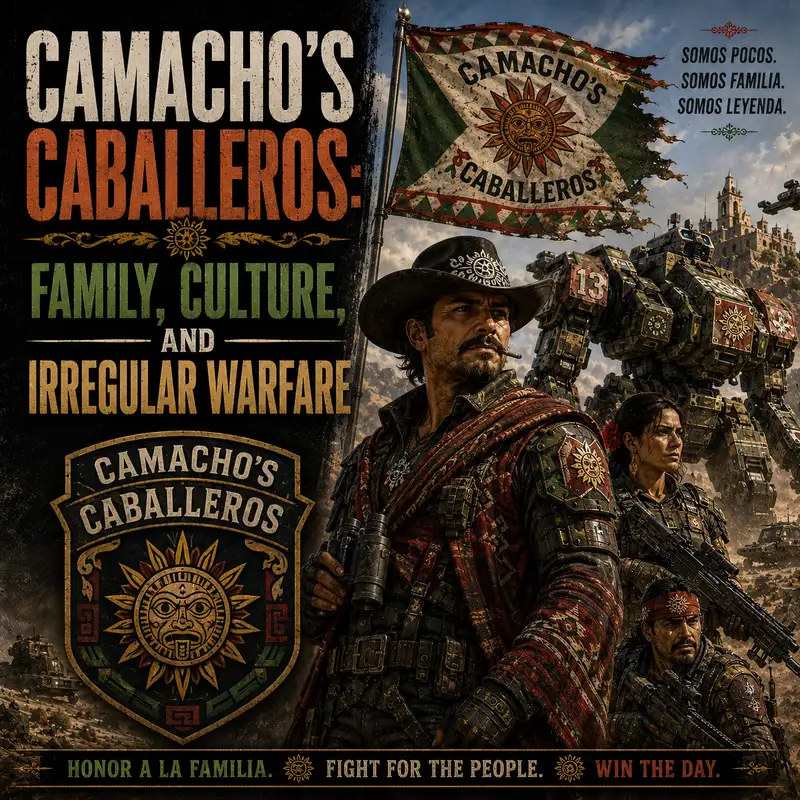
Camacho’s Caballeros: Family, Culture, and Irregular Warfare
By the time Camacho’s Caballeros reached the government complex in Port Howard, the problem was no longer how to defeat an enemy regiment. It was how to rescue their dependents before the people holding them decided the hostages had stopped being useful. BattleMechs could dominate the streets outside, but seventy-ton machines could not clear rooms, identify collaborators, or decide which frightened civilian was ready to help. That work fell to scouts, local fighters, and soldiers who understood that the Seventeenth Recon Regiment was not merely their employer. It was their family.
That is the best way to understand Camacho’s Caballeros. Their battlefield skill came from more than good MechWarriors or clever raiding plans. The command functioned as a mobile society held together by kinship, shared hardship, regional identity, and a willingness to adopt outsiders who proved themselves. Those same qualities created feuds, grief, and arguments that a conventional regiment might have hidden behind regulations. The Caballeros were difficult to standardize and sometimes difficult to command. They were also exceptionally difficult to surprise on ground where people trusted them.
The unit’s cultural roots lay in the Southwest Trinity Worlds of the Free Worlds League: Cerillos, Galisteo, and Sierra. These poor frontier planets had been settled by a mixture of Hispanic communities, Indigenous peoples from several traditions, migrants from the southwestern United States and northern Mexico, and people of Jewish descent. The result was not one uniform culture carried intact into space. It was a patchwork of ranching settlements, mountain communities, desert towns, family networks, and local identities accustomed to living far from the centers of League power.
That distance mattered. The Trinity Worlds had long histories of resisting outside control, and many of the people who formed the Caballeros preferred expatriate life to rule under Captain-General Thomas Marik. The command survived on corporate security contracts, planetary garrison work, and missions for the Federated Commonwealth. Outsiders sometimes saw the regiment as a traveling carnival with BattleMechs attached. What they were actually seeing was a military community moving with technicians, families, children, personal rivalries, local customs, and enough baggage to make a quartermaster consider a quiet career in piracy.
Carlos Camacho stood at the center of that community. Known as Tiburón, the Shark, he was both a mercenary colonel and a respected figure from Galisteo. His children served under him. Patricia Camacho, a skilled Phoenix Hawk pilot and graduate of the New Avalon Military Academy, was considered by Carlos the stronger successor. Her younger brother Gavilán had education and courage, but also a temper and much to prove. The command was therefore a family business in the most literal sense, with all the loyalty and awkward succession planning that description implies.
The larger regiment was far more diverse than House Camacho. Marisol Cabrera served as Carlos’s executive officer. Battalion commanders included Rabbi Bar-Kochba, Peter White Nose Pony, and officers drawn from the Trinity’s many communities. Kali MacDougall commanded heavy BattleMechs with a personality as forceful as her machines. Bobby Begay was a dangerous and controversial MechWarrior whose reputation made even some fellow Navajo soldiers uneasy. The Caballeros did not erase these identities. They placed them inside a command where personal standing had to be earned repeatedly.
Family in the Caballeros therefore meant more than blood. It included spouses, children, technicians, scouts, pilots, and people who had nowhere else to go. It could also include former enemies. The unit was willing to recruit talent from prisons, defeated formations, local resistance groups, and captured forces. Acceptance was not automatic, and old suspicions did not vanish because someone received a uniform. Yet the command’s ability to absorb outsiders gave it a replacement system that did not depend entirely on military academies or House recruiting offices.
Their preferred style of war reflected the worlds that produced them. Reconnaissance was not treated as a preliminary task performed before the real fighting began. It was the activity that made the rest of the battle possible. Scouts identified routes, watched supply lines, cultivated local sources, and learned how an opponent moved when officers believed no one was watching. Light and medium BattleMechs could probe, raid, and withdraw. Heavier machines provided the blow once the enemy had been drawn into the wrong place. Infantry, explosives, aerospace support, and artillery mattered because information without a way to exploit it is only an interesting report.
The Caballeros also fielded a mixed collection of machines rather than a perfectly standardized regiment. Old Phoenix Hawks, Shadow Hawks, Wolverines, and other familiar designs served beside heavier salvage and, later, captured Clan equipment. Individual pilots developed strong attachments to particular machines and modified them as resources allowed. This complicated maintenance, but it suited a command accustomed to improvisation. The regiment did not expect every company to solve problems in the same way. It expected officers to understand what their people and machines could actually do.
During the War of thirty thirty-nine, the Seventeenth Recon demonstrated that irregular skill could serve a conventional campaign. Assigned to Task Force Blizzard during the invasion of Vega, the Caballeros helped seize the Nasew spaceport and keep it open for Federated Commonwealth resupply. The mission was not glamorous. It was essential. A planetary offensive without a functioning port quickly becomes an expensive collection of stranded units. The Caballeros held the logistics node while other formations maneuvered, then helped drive away elements of the Fifth Amphigean Light Assault Group.
Their culture became even clearer in the year thirty forty-seven on Larsha. A teenage penal militia conscript named Cassiopeia Suthorn disabled Bobby Begay’s Wolverine using an overhead power cable and improvised tools. Patricia Camacho stopped Begay from killing her and recognized that anyone capable of bringing down a BattleMech under those conditions might be useful. Cassie entered the regiment, failed at several assignments, and eventually found her place among the scouts. The process was neither orderly nor sentimental. It was very Caballero.
Cassie became the clearest expression of the unit’s irregular warfare. She did not begin as a MechWarrior and built her reputation outside the cockpit. Her advantage came from studying BattleMechs as vulnerable machines rather than symbols of status. She learned access points, blind spots, emergency releases, maintenance habits, and the psychology of pilots who assumed infantry would flee. Her work depended on stealth, disguise, patience, and the ability to make fear useful. The Caballeros gave her room to operate because their command culture valued results even when the method looked deeply unreasonable.
On Borgan’s Rift in the year thirty forty-nine, the regiment was hired to eliminate pirates led by the Red Lion. Gavilán received the field command as a test. Cassie infiltrated the pirate-held ruins, identified their strength, and warned the Caballeros about the planned ambush. She then mounted a salvaged short-range missile launcher inside the remains of an ancient BattleMech displayed as a monument. When the Red Lion’s Rifleman entered the engagement, the dead machine fired. The ambush crippled the pirate leader and allowed Gavilán’s force to finish the battle.
Nothing about that victory depended on matching the pirates weapon for weapon in an open field. It depended on intelligence, deception, local materials, and a commander willing to trust a private operating alone. The Caballeros could fight conventional BattleMech engagements, but their most characteristic victories began before the enemy realized a battle had started. They treated ruins, power systems, civilian vehicles, industrial equipment, and local rumor as parts of the battlefield. The official order of battle was only the most visible portion of the force.
The Clan invasion exposed the limit of that approach. On Jeronimo in the year thirty fifty, the Caballeros fought beside Draconis Combine troops against Clan Smoke Jaguar. Superior Clan weapons and training forced the defenders into retreat through the Contra-Pelagian Mountains. The Caballeros used mineral-rich terrain to interfere with sensors and staged repeated ambushes while moving toward an evacuation site inside a dormant volcanic caldera. Their irregular methods delayed the Jaguars. They could not make the technological imbalance disappear.
Patricia Camacho made the final delay possible. Piloting her Phoenix Hawk, she attacked a pursuing Star of Smoke Jaguar OmniMechs alone. She killed the leading Puma, brought down a Vulture, and damaged the remaining machines badly enough to hold their attention while the regiment withdrew. One of the Jaguars eventually crushed her cockpit. Carlos arrived too late to save his daughter. The Caballeros escaped, but almost a third of the command was lost, and the officer many expected to inherit leadership was dead.
Because the Caballeros were a family, those casualties did not remain inside a personnel report. Patricia had been Carlos’s daughter, Gavilán’s sister, Cassie’s closest friend, and a future around which many officers had organized their expectations. Carlos carried the loss into later decisions. Gavilán’s confidence suffered under the comparison. Cassie turned grief into a personal hatred of the Clans. Family cohesion helped the unit survive, but it also ensured that every death traveled through several parts of the organization at once.
After Jeronimo, the regiment struggled through low-paying work until Chandrasekhar Kurita hired it to protect Hachiman Taro Electronics. Uncle Chandy, as the Caballeros called him, was a wealthy Combine industrialist, a cousin of the Coordinator, and a man whose business interests attracted political enemies. The contract placed the regiment inside a culture that often distrusted mercenaries and inside a corporate struggle involving the Internal Security Force, rival firms, Blakist operatives, and the Black Dragon Society. This was less a garrison assignment than a permanent intelligence emergency.
The Caballeros adapted because corporate security required the same skills as raiding, only with more paperwork and fewer obvious front lines. Scouts watched workers, visitors, roads, and service tunnels. MechWarriors had to fight in cities without destroying the facilities they were being paid to protect. Officers navigated false reports and political manipulation. Cassie operated as an investigator and infiltrator as often as a soldier. When disinformation sent the Ninth Ghost Regiment against the Hachiman compound, the Caballeros survived a battle neither side should have been fighting.
Internal tension accompanied the contract. Some officers questioned whether Carlos’s grief had weakened his judgment. Gavilán struggled to emerge from Patricia’s shadow. Strong personalities pursued private grudges and sometimes treated orders as opening positions in a negotiation. This was the cost of a command culture built on personal loyalty. A conventional regiment could appeal to the state, a promotion board, or military law. The Caballeros had Carlos, the family, and the shared belief that whatever arguments occurred inside the regiment, outsiders would not be permitted to destroy it.
Towne tested that belief more severely than Hachiman. Uncle Chandy sent the Caballeros to protect corporate interests and help prepare the Federated Commonwealth world against a possible Black Dragon attack. Towne was already divided by political factions and public distrust. Many residents saw the mercenaries as another outside force arriving with weapons and private motives. Before the Caballeros could organize a defense, they had to convince local people that cooperation would not simply replace one form of occupation with another.
The feared attack came in the year thirty fifty-eight. Black Dragon conspirators used the Fifteenth Dieron Regulars and several supporting formations to seize Port Howard and much of the planetary government. The Caballeros could not defeat the occupation through one formal engagement. They withdrew into the countryside, linked with surviving militia units, and helped build resistance cells. Miners supplied expertise with explosives. Local fighters provided routes and information. Scouts moved between groups that did not always trust one another. The campaign became a war of ambushes, sabotage, and political persuasion.
This kind of warfare demands restraint as well as aggression. Every artillery strike risked alienating the population whose support made the resistance possible. Every collaborator might also be a frightened official trying to keep a family alive. Every village could provide intelligence to either side. The Caballeros succeeded because they were accustomed to treating civilians as part of the operational environment rather than background scenery. They understood family pressure because their own dependents lived inside the campaign.
That vulnerability became immediate when occupation forces captured Caballero dependents and threatened their children. Scouts, militia members, and local allies attacked the government complex in Port Howard to free them. The assault required close-quarters fighting where BattleMech firepower offered little help. Captain James Powell, the Caballeros’ veteran scout commander, was killed during the rescue. The dependents were recovered, but the operation demonstrated the bargain at the heart of the regiment. Bringing families created loyalty and continuity. It also gave every enemy a target the Caballeros could never treat as expendable.
The final struggle for Port Howard combined the unit’s methods at every level. Local resistance groups disrupted the occupation. Scouts penetrated defended areas. Explosive specialists attacked infrastructure. BattleMechs struck isolated enemy formations and supported the advance once the Black Dragon network began to fracture. The Caballeros defeated the Fifteenth Dieron Regulars and its allies, a significant humiliation for a line Combine regiment that had expected corporate mercenaries and local irregulars to collapse under sustained pressure.
Victory expanded the family and endangered it. Salvaged BattleMechs, aerospace equipment, and personnel from the defeated forces helped create a fourth battalion. Towne fighters and new recruits from the Trinity Worlds entered the regiment. Bobby Begay received command of the formation. Many veterans distrusted the newcomers and the circumstances under which their equipment had been acquired. The Caballeros had always survived by adoption, but adoption did not erase memory. A family can welcome new members and still spend years arguing about where they sit.
Soon afterward, the regiment was invited to Luthien for Theodore Kurita’s birthday celebration. The invitation concealed another security mission. Black Dragon conspirators had penetrated the Coordinator’s own bodyguard and planned to kill him during the festivities. The Caballeros helped uncover and defeat the attempt alongside Combine forces and intelligence personnel. Once again, their usefulness came from operating across boundaries: mercenaries among regular troops, scouts among officials, outsiders able to notice behavior that insiders had learned to accept.
Their later fighting on Luzerne showed the same doctrine against a very different enemy. During conflict between the Draconis Combine and Clan Ghost Bear, Caballero scouts in fast BattleMechs located targets and called artillery onto Clan positions. The method traded individual glory for coordinated firepower, which was exactly the point. The regiment suffered heavily and lost longtime leaders, including Rabbi Bar-Kochba. Irregular warfare could improve the odds against the Clans. It could not make the Caballeros immune to losses from enemies with superior machines and disciplined formations.
The command’s deepest loyalty finally pulled it away from Uncle Chandy. Reports from Cerillos, Galisteo, and Sierra described new taxes, civil unrest, and the Bad Rock Massacre, in which federally employed forces fired on civilians. Carlos requested release from his contract and turned the regiment toward home. A Combine warlord branded the Caballeros rogue, but the accusation arrived after their DropShips had already departed. The contract mattered. The Trinity Worlds mattered more.
Swann’s Cavaliers and local provincial troops were already fighting ranchers and plains communities across all three worlds. The defending mercenaries had divided their strength to suppress a spreading guerrilla campaign. When Camacho’s Caballeros arrived on Galisteo, they possessed local support, detailed knowledge of the terrain, and a population willing to tell them where the enemy was vulnerable. They destroyed roughly half of the opposing aerospace force on the ground and overwhelmed an isolated battalion before Swann’s Cavaliers abandoned the region. The victory looked sudden because the local resistance had spent months preparing the battlefield.
Carlos became president of Galisteo’s provisional government, while Gavilán assumed greater responsibility for the regiment. The transition revealed how far the Caballeros had traveled. Expatriates who left the Free Worlds League rather than accept distant rule had returned as the principal defenders of an independent region. The mercenary command was now also a political institution. That gave the Trinity Worlds protection, but it placed military power, family authority, and civilian government dangerously close together.
Later generations tried to manage that contradiction rather than pretend it did not exist. Gavilán’s descendants continued to serve. Cassie’s daughter Anjelah married into House Camacho and eventually commanded the regiment after her husband’s death. Under her leadership, the Caballeros restricted outside employment to defensive work in the Bolan region that would not conflict with their obligation to the Trinity Worlds. The command still needed outside income, but it no longer treated employment as separate from homeland defense.
Camacho’s Caballeros were effective irregular warriors because their culture gave them access to resources conventional armies often overlook. Family networks produced recruits, intelligence, and reasons to endure. Regional diversity created specialists comfortable in deserts, mountains, cities, and frontier settlements. A willingness to adopt outsiders brought talent that formal institutions discarded. Decentralized leadership allowed scouts and junior officers to act before headquarters possessed a complete picture. None of those advantages appeared in the tonnage totals.
The same culture imposed costs. Personal arguments could become command crises. Blood succession complicated promotion. Dependents created vulnerabilities. Grief could distort decisions for years. Loyalty to the Trinity Worlds could override contracts and make the regiment politically suspect. The Caballeros were not an idealized family where everyone agreed. They were a real one, armed with BattleMechs, transport, artillery, and several generations of unresolved opinions.
Their irregular warfare was not romantic lawlessness. It was disciplined adaptation built on social knowledge. The Caballeros won when they understood the people, terrain, and hidden systems around the battlefield better than their opponents did. They suffered when superior force denied them time or when family losses narrowed their judgment. They survived because every scout, pilot, technician, spouse, and child understood that the regiment was not merely a place they served until the contract ended. It was the place they meant to return to when the fighting was done.