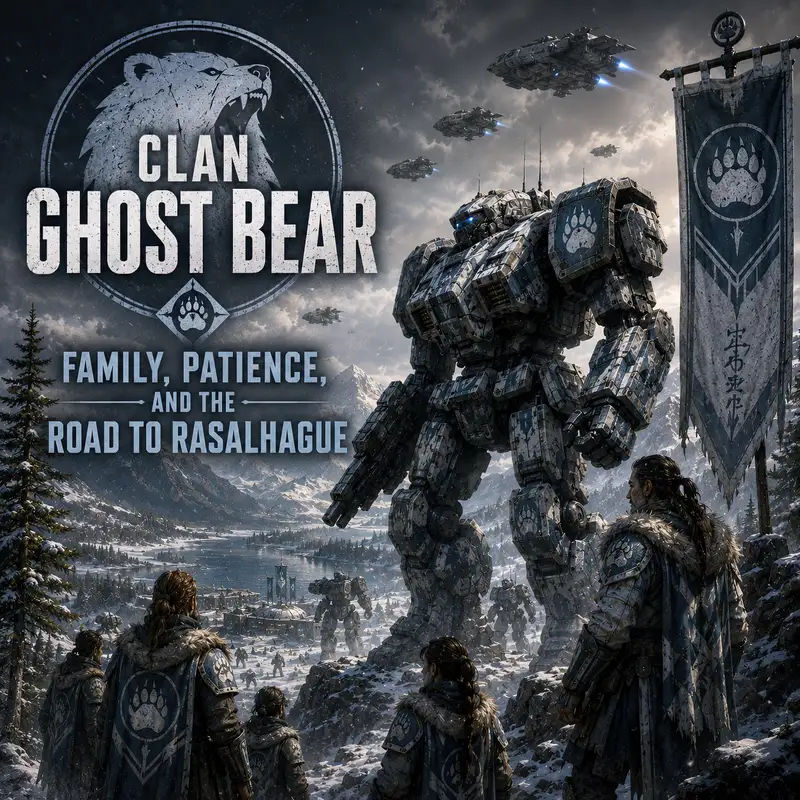
Clan Ghost Bear: Family, Patience, and the Road to Rasalhague
The last Ghost Bear ark ship left Clan space in early thirty sixty. It belonged to a migration carrying cargo no WarShip had been designed to protect. Families, scientists, technicians, merchants, genetic legacies, machine tools, prefabricated factories, and the records of an entire society were packed into vessels once built for battle. The Ghost Bears were not reinforcing an invasion corridor. They were abandoning the Homeworlds and moving their Clan into territory taken from the Free Rasalhague Republic and the Draconis Combine. A military conquest was becoming a permanent migration.
No other Clan made that choice on the same scale. The Wolves and Jade Falcons established occupation zones while preserving deep roots elsewhere. The Smoke Jaguars treated conquered worlds as possessions supporting a warrior elite. The Ghost Bears eventually moved almost everything that made them a functioning civilization. Their road to Rasalhague was therefore not simply an advance by BattleMechs. It was the result of a cultural idea planted at the Clan’s founding: strength came from keeping the group together, even when survival required changing where that group lived.
Clan tradition traces that idea to Hans Ole Jorgensson and Sandra Tseng. They were husband and wife, elite warriors who followed Nicholas Kerensky during the Second Exodus. When Nicholas divided his followers into separate Clans, he intended to separate them because both were considered too valuable to place in the same organization. Rather than obey or openly rebel, they walked into the Antarctic wilderness of Strana Mechty with the intention of dying together.
The founding story says a ghost bear found them in a cave after their supplies were exhausted. The animal did not kill them. It kept them warm and brought food until they recovered. When the couple emerged, they discovered that the creature was not solitary but part of a family group. They returned to Nicholas and argued that communal strength deserved a place beside individual achievement. Nicholas allowed them to remain together, and they defeated six opponents while fighting as a team to claim leadership of the new Clan.
Whether every detail occurred exactly as later tradition remembered is less important than what the Ghost Bears chose to remember. Other Clans treated conventional family bonds as suspicious competitors to loyalty. Ghost Bear culture made family part of loyalty. Warriors maintained close connections with trothkin, Starmates, and sometimes civilian blood relatives. Even political participation reflected the difference. A Bloodname was not required to vote in the Ghost Bear Clan Council. Every warrior possessed a voice, though the civilian castes remained outside the ruling military body.
This did not make the Ghost Bears democratic in the Inner Sphere sense, and it certainly did not make them gentle. They retained trueborn privilege, caste assignment, bondsmen, and government by warriors. Their version of family could be intensely inward-looking. Those accepted into the group received loyalty and protection. Outsiders could meet suspicion, coercion, or overwhelming force. Family expanded the circle of obligation, but the Clan still decided where the circle ended.
Operation Klondike exposed that boundary. Assigned to Arcadia beside Clans Star Adder, Steel Viper, and Blood Spirit, the Ghost Bears ignored the landing plan prepared by Star Adder Khan Absalom Truscott. Their decision left the Star Adders facing a regiment without expected support and contributed to severe losses, including Truscott’s death. The Bears then conducted their own campaign slowly and methodically, clearing cities, rotating damaged units, and integrating captured populations where possible.
Their occupation was not consistently restrained. When nomadic communities obeyed only while troops were present, the Bears shifted from administration to disarmament and eventually forced resettlement. The campaign established a pattern that would recur for centuries. Ghost Bear commanders preferred deliberate action and usually tried to understand the problem before committing. Once they committed, they could pursue the chosen solution with very little sympathy for those standing outside the Clan’s definition of order.
Patience became the second great Ghost Bear virtue. Their culture warned that careless movement invited disaster and that partial commitment was worse than none. New tactics and technology were often observed in another Clan’s service before the Bears adopted them. Once convinced, they embraced the change thoroughly. The Great Work expressed the same idea in civilian and personal life. A Ghost Bear might spend decades building a sculpture, composition, technical project, or other creation that would not be finished until the maker’s life was finished.
The military reflected this slow accumulation. Asteroid mining and resource development gave the Clan a strong economic base. Rather than chasing every political crisis, the Bears built one of the larger toumans through steady investment. They favored hard-hitting BattleMechs, large numbers of Elementals, and cohesive units whose members had trained together for years. Transfers often occurred by Star or Binary instead of moving individuals, because breaking an established team could damage the trust that made it effective.
That cohesion had costs. A warrior might take an unnecessary risk to rescue a trothkin or refuse to abandon a unit that had become tactically irrelevant. Replacements could struggle to enter close-knit formations. Conservative testing delayed useful innovation. Patience could become hesitation, and loyalty could become vengeance. The Ghost Bears were stable not because their virtues had no weaknesses, but because the Clan usually had enough institutional depth to survive those weaknesses.
By the Political Century, the Bears were firmly Crusader. Khan Nadia Winson called for an invasion vote in the year thirty hundred, only to see Clan Wolf delay the decision through the Dragoon Compromise. When the ComStar vessel Outbound Light reached Clan space in thirty forty-eight, the argument ended. The Ghost Bears fought beside the Smoke Jaguars in the Trial of Refusal against Clan Wolf, narrowly won, and lost both of their Khans during the fighting.
The replacement leadership entered Operation Revival with confidence and a serious logistical mistake. Khan Karl Bourjon expected limited resistance and did not want to burden the Homeworlds. The Ghost Bear invasion force carried fewer supplies than any of the other invading Clans. Early victories against weak Periphery defenders seemed to justify the choice. Once the Bears struck prepared Inner Sphere worlds, ammunition, parts, transport, and garrison requirements began overruling the original estimate with the usual lack of ceremony.
Their advance slowed. Local rebellions overran small garrisons, forcing frontline troops to return to worlds already counted as conquered. The Bears won battles but fell behind the other invasion corridors. This was not a failure of technology or personal courage. It was an operational failure created by underestimating the enemy and treating supply as something that would follow victory automatically. The plan assumed the Inner Sphere would collapse quickly. The Inner Sphere had several centuries of experience disappointing plans built on that assumption.
The crisis changed the Clan’s leadership. After saKhan Theresa DelVillar was mortally wounded on Last Frontier, Aletha Kabrinski won election as her replacement and openly condemned Bourjon’s handling of the invasion. Bjorn Jorgensson became Khan after a vote of no confidence and defeated Bourjon’s attempt to reverse the decision through a Trial of Refusal. The new Khans inherited a stalled offensive, inadequate supply, and warriors whose confidence had been damaged by problems they could not shoot.
Jorgensson and Kabrinski responded with reforms rather than a larger speech. Steel Viper forces were contracted to garrison several worlds. The merchant caste was ordered to create an unbroken supply chain from the Homeworlds to the front. Zellbrigen would not be offered automatically to Inner Sphere formations that had no intention of honoring it. Occupied populations received better treatment because every rebellion consumed troops and transport that should have been moving forward. Pragmatism began changing political belief.
The world of Rasalhague became an early symbol of both ambition and limitation. The Bears wanted the capital of the Free Rasalhague Republic, but Clan Wolf also claimed the right to attack it. Jorgensson recognized that he could not win the bidding once the cutdown fell below five Clusters. He kept bidding anyway, forcing the Wolves down to three in hopes that the reduced force would fail. Clan Wolf took Rasalhague in fifteen days. The Bears had used the bidding system intelligently and still watched a rival win the prize.
Their reorganized war effort performed far better afterward. The fifth invasion wave captured eighteen worlds, including Alshain, an important industrial and strategic center that became the Bear headquarters. The Clan was no longer advancing as a poorly supplied expedition. Its merchants, technicians, transport crews, garrisons, and warriors were being connected into a functioning occupation system. That achievement prepared the Bears for something more important than the next wave. It created the infrastructure needed to move the Clan itself.
Tukayyid revealed how far the Bears had come and how far they still had to go. They landed three frontline Galaxies and attacked the cities of Spanac and Luk. Alpha Galaxy took Spanac, while the forces moving on Luk met stronger resistance. When the Com Guards threatened the Bear supply depot, the Khans faced a choice between continuing the offensive or protecting the ammunition and matériel needed to hold what they had already taken.
They returned to Spanac. The Bears retained their primary objective but lacked the strength to capture Luk, producing a partial victory rather than the complete success required for the Clan invasion. They accepted the judgment and the fifteen-year truce. It was not glorious, but it was recognizably Ghost Bear. They had pursued the offensive directly, discovered the logistical limit, and chosen preservation over a final attack that might have destroyed the force without changing the result.
The truce redirected their attention from Terra to the worlds already under their control. Industrial expansion increased. Limited trade was permitted. Local governments were restored instead of requiring every city to function under direct military occupation. These changes were practical before they were ideological. The Bears needed productive worlds, cooperative administrators, and civilians who did not require a Cluster of OmniMechs to supervise every tax office.
Distance then became the decisive problem. Months of travel separated the occupation zone from the Homeworld population and industry. The people left in the Kerensky Cluster resented supporting relatives who now lived on richer Inner Sphere worlds. The occupation zone could not develop fully while its scientific, technical, commercial, and political institutions remained divided across an enormous supply line. In thirty fifty-four, growth had begun to stall.
Bjorn Jorgensson proposed the answer that a less patient Clan might never have considered and a less cohesive Clan could not have attempted. Move everyone. The whole warrior caste voted on the plan, and the relocation began in early thirty fifty-five. Secrecy was essential because rival Clans would have attacked lightly defended holdings, captured transport, or challenged for industrial assets as soon as they understood what was happening.
Clan Snow Raven quietly helped convert mothballed Leviathan-class dreadnoughts into ark ships. The vessels carried people, machinery, records, supplies, and the productive systems needed to recreate Clan society. Each convoy required JumpShips, escorts, recharge schedules, technicians, medical facilities, and secure destinations. Factories could not simply be folded into a cargo bay. They had to be dismantled, transported, rebuilt, tested, and connected to local power, labor, and raw materials.
The migration was a military operation whose decisive cargo was civilian. Scientists preserved genetic repositories and research programs. Merchants shifted contracts and distribution networks. Technicians kept both the fleet and the equipment inside it functioning. Laborers left settlements their families had built over generations. Warriors protected the movement but could not complete it alone. The Ghost Bears had always claimed the Clan was a family. The relocation forced them to behave as though every caste belonged to that family.
By the time the last ark ship left in early thirty sixty, the move was nearly irreversible. The Bears retained limited enclaves in Clan space, but their future was now in the Inner Sphere. They renamed their holdings the Ghost Bear Dominion. At the Great Refusal, Jorgensson renounced the Crusader cause, allowing the Warden Clans to stand apart from the defense of the invasion. The political declaration followed the logistical reality. A Clan that had moved its children, factories, and future into conquered territory was no longer an expedition waiting to go home.
The people already living there did not automatically become enthusiastic relatives. Most had been citizens of the Free Rasalhague Republic or the Draconis Combine before Clan occupation. Rasalhague culture had survived centuries of Kuritan rule and had fought hard for independence in the year thirty thirty-four. The Clan invasion destroyed most of that young republic less than two decades later. Ghost Bear promises of stability could not erase the fact that Bear BattleMechs had helped take the worlds in the first place.
The Dominion therefore developed through accommodation and coercion at the same time. Local governments received considerable freedom, trade expanded, and civilian life could continue without complete caste reorganization. The warrior caste still held final authority. Clan law, Trials, and military status remained privileged. The arrangement was more tolerant than Smoke Jaguar occupation, but the comparison set a very low administrative standard.
Ragnar Magnusson became the most useful bridge between the two societies. He was the son of the Free Republic’s first Elected Prince, a Rasalhague officer captured by Clan Wolf, a warrior of Clan Wolf-in-Exile, and then a Ghost Bear bondsman after a Trial in thirty sixty. By the following year he commanded the First Rasalhague Bears, a mixed Cluster that included former soldiers of the Royal Rasalhague Army throughout its Stars. His career made him living evidence that identity could cross the boundary between Clan and Sphere.
The bridge was not built without blood. In thirty sixty-two, rogue Alshain Avengers launched an unauthorized assault on the Dominion capital. Their intelligence was poor, their WarShip was outmatched, and the attacking regiments were destroyed. Ghost Bear retaliation began as a fury rather than a campaign plan. Clusters struck nearby Combine worlds while the Draconis Combine and Clan Nova Cat fought to contain them.
The conflict exposed the danger inside the Bear idea of family. An attack on Alshain was treated as an attack on the whole Clan, and loyalty accelerated retaliation before strategy caught up. The advance took worlds but lacked a coherent end state. Both sides eventually used a Trial on Courchevel to end the war, returning most conquests and giving the combatants an honorable exit. The Bears could be patient for years and still become dangerously impulsive when the family was struck.
In the aftermath, the Dominion consolidated further. The Bears drove Clan Hell’s Horses from its Inner Sphere holdings and eventually took Gunzburg and Rasalhague from Clan Wolf. Possession of the Rasalhague homeworld mattered beyond the map. The Clan now ruled the cultural center of a people whose surviving republic still existed on a handful of worlds. The political question was no longer whether the Bears could conquer Rasalhague. It was whether they could become part of it.
Ragnar again became central. In August of thirty seventy, he addressed the Free Rasalhague government on Orestes on behalf of the Dominion and opened negotiations for an accord covering all Rasalhagian peoples. The following year, the Riksdag elected to join the Dominion, and an advisory council brought together representatives of the old Republic, the Royal Rasalhague Army, and Ghost Bear castes. The new body remained heavily weighted toward the Clan, including a warrior veto. Integration had begun, but equality had not.
The Jihad accelerated cooperation because both societies faced enemies that cared little about their constitutional differences. Bear and Rasalhague formations fought the Word of Blake, protected shared worlds, and suffered together. Joint service built connections that policy alone could not manufacture. It also gave the former Republic’s soldiers greater leverage. A government may describe one population as subordinate until it needs that population’s regiments at the front.
Resistance remained real. In thirty seventy-six, Rasalhague formations rejected parts of the Clan Trial system and mutinied. The Dominion recalled ethnically Rasalhagian units from the anti-Blakist campaign to suppress the revolt. Two years later, a Motstånd bombing on Alshain killed hundreds of Clan and Rasalhague civilians, members of the Unity Council, and former First Prince Christian Månsdottir. The road to union included terrorism, military repression, and people who believed cooperation meant surrendering the independence their parents had fought to obtain.
The final institutional shift followed the Second Combine-Dominion War, fought from thirty ninety-eight to thirty-one oh-one. The Dominion won territory, but the more important result came inside its government. Civilian leaders could point to decades of administration, industrial production, and military sacrifice. Ragnar Magnusson supported reforms that reduced the warrior caste’s exclusive control. The new structure balanced a Prince responsible for civilian affairs, a Khan commanding the touman, and representative councils in which trueborns, freeborns, and civilians all possessed recognized standing.
In thirty-one oh-three, the state took the name Rasalhague Dominion. The change did not mean Clan Ghost Bear disappeared. Its warriors still commanded the military, its customs remained visible, and its political influence was immense. Nor did the old Free Rasalhague Republic simply return. The new state was a hybrid created by conquest, migration, resistance, negotiation, and shared war. Neither side obtained its original political ideal.
Family made that outcome possible because Ghost Bear identity could expand. The Clan had been founded by two people who refused to accept that duty required separation. Over time, the same cultural instinct allowed warriors to recognize ties to civilian kin, absorb former enemies, move every caste together, and eventually treat Rasalhagian institutions as part of the society rather than temporary tools beneath it. Family was not sentimental decoration. It was an organizational principle with political consequences.
Patience mattered because the Bears were willing to observe failure and change course. They learned from the supply collapse of Operation Revival, the partial victory at Tukayyid, the burden of direct occupation, and the impossibility of governing a permanent homeland as though it were a captured depot. Their patience could become stubbornness, and their loyalty could become vengeance. Yet it also gave them time to build supply networks, move a civilization, and negotiate a state that no original Clan blueprint had anticipated.
The road to Rasalhague was therefore not a straight march from Strana Mechty to Terra. It was a slow withdrawal from the belief that conquest alone created legitimacy. Clan Ghost Bear survived by carrying its family into the Inner Sphere and then discovering that the family had to grow larger than the Clan. The result was not pure, peaceful, or complete. It was durable, which in the Human Sphere is often the more difficult achievement.