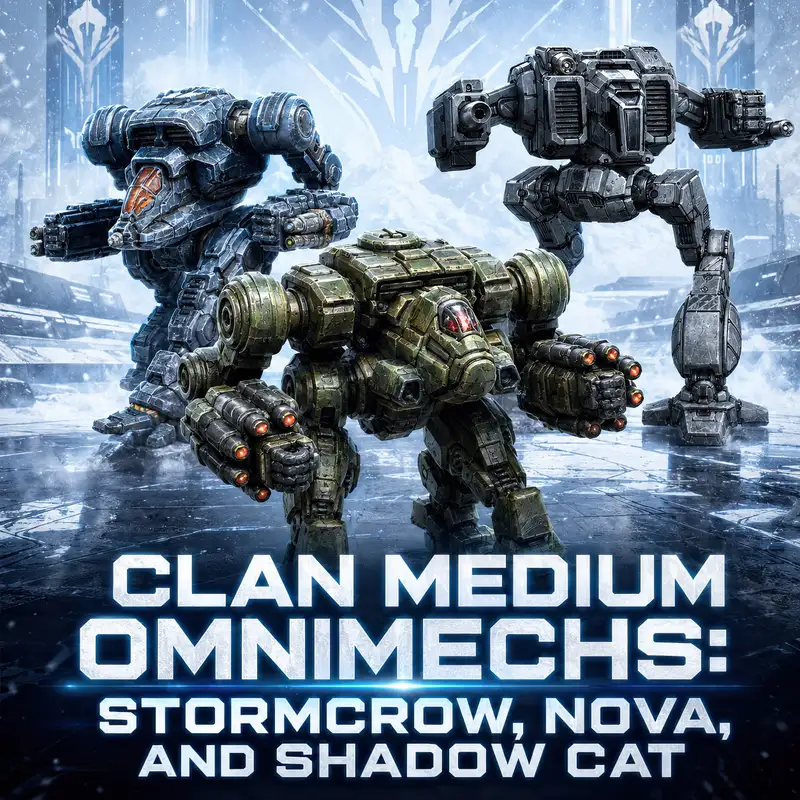
Clan Medium OmniMechs: Stormcrow, Nova, and Shadow Cat
An Inner Sphere commander watching a Clan Star advance in the early invasion could make three dangerous mistakes. The first was to assume a fifty-ton machine was merely a medium BattleMech. The second was to assume its visible weapons defined what it would carry tomorrow. The third was to assume every medium OmniMech solved the same problem. A Stormcrow could trade fire like a heavier machine while moving with the scouts. A Nova could jump into close range and release enough laser fire to overwhelm almost anything its size. A Shadow Cat could place a Gauss rifle round from a distant ridge, accelerate away, and appear somewhere the return fire was not.
These machines mattered because Clan medium OmniMechs were not compromises in the Inner Sphere sense. They were concentrated expressions of mature Clan technology. Endo steel frames, ferro-fibrous armor, extralight engines, double heat sinks, extended-range weapons, and modular OmniPods let a medium chassis carry capabilities that Succession War armies associated with much larger BattleMechs. The result was tactical choice, not invincibility. A Clan commander could select a configuration for the mission, transport Elementals on the chassis, and field a force whose speed, range, and firepower did not match the categories Inner Sphere officers had used for centuries.
Omni technology had begun with Clan Coyote’s Coyotl in the year twenty-eight fifty-four. The important innovation was not simply that weapons could be removed. Conventional BattleMechs could be refitted, given enough time, labor, and inventive language from the maintenance chief. An OmniMech used standardized interfaces, adaptable software, and modular pods that allowed major equipment changes far more quickly. That flexibility still depended on trained technicians, suitable facilities, spare pods, and a supply system able to deliver the desired equipment. An autocannon pod left on the DropShip was perfectly modular and completely unavailable.
The Nova was the oldest of the three and the machine most directly tied to a new form of combined arms. Clan Hell’s Horses introduced it in the year twenty-eight seventy, when Elemental battle armor was becoming a central part of Clan ground warfare. Elementals were heavily protected infantry with enough firepower to threaten vehicles and BattleMechs, but they still needed a practical way to cross the battlefield. The Nova was the first OmniMech designed from the beginning with handholds, communications connections, and power interfaces that allowed Elementals to ride securely into combat. That feature became standard on later OmniMechs.
At fifty tons, the Nova used an extralight engine to reach roughly eighty-six kilometers per hour. Five jump jets allowed it to cross about one hundred fifty meters in a bound. Ten tons of armor gave it nearly the maximum protection practical for the chassis, while sixteen tons of pod space remained available for mission equipment. The base machine carried fourteen double heat sinks before any configuration added more. It was not exceptionally fast for a Clan medium, but it could move with heavy formations, cross broken terrain, and survive long enough to deliver both its MechWarrior and attached Elementals to the decisive point.
The Prime configuration made the Nova famous and occasionally made its pilot wish the heat display were less honest. Twelve extended-range medium lasers were divided between the arms. Four additional double heat sinks raised the total to eighteen, yet a full volley still produced almost twice the heat the machine could remove at once. The Nova Prime could not fight by holding down every trigger until one side disappeared. A disciplined pilot used one arm, changed position, cooled, and then committed the full battery when a target was exposed or already damaged. The machine could deliver an astonishing close-range strike. It could not repeat that strike indefinitely without losing speed and control.
The arm arrangement gave the Nova another tactical advantage. Six lasers on one side could engage a target while the other arm remained available for a different angle, a second opponent, or a later volley. The machine retained hands for climbing, clearing obstacles, and the practical tasks that rarely appear in heroic battlefield paintings. When Elementals dismounted, the Nova could support them with precise energy fire rather than ammunition-dependent weapons. The combined formation known as a Nova joined one Star of OmniMechs with one Star of Elementals. The BattleMechs supplied mobility and heavy fire. The armored infantry attacked fortifications, vehicles, and vulnerable sections of enemy machines.
The Prime was only one possible answer. The Nova A replaced the close-range laser wall with two extended-range particle projection cannons and anti-missile systems, turning the chassis into a long-range sniper. The B used an ultra-class autocannon and a large pulse laser. The C carried a Gauss rifle. The D combined long-range missiles with an autocannon suited to vehicle hunting and air defense. Later configurations added advanced tactical missiles, heavy lasers, active probes, and specialized weapons. Omni technology allowed the same base machine to arrive as a brawler, sniper, fire-support platform, or urban fighter without rebuilding the chassis from the inside out.
That flexibility did not protect the Nova’s production line. Clan Hell’s Horses built it at Tokasha MechWorks until Clan Ghost Bear captured Tokasha in the year twenty-nine twenty-one. Production stopped, and the new owners concentrated on spare parts rather than complete machines. By then the Nova had spread through every Clan through trade, Trials, and capture as isorla, the Clan term for war prizes. Existing machines remained common enough to serve for centuries, but their numbers declined. Clan Jade Falcon restarted production on Sudeten in the year thirty seventy-three, more than two hundred years after the original line had closed.
Inner Sphere engineers understood the design’s value quickly. The Draconis Combine eventually produced the Black Hawk K U, named after the Inner Sphere reporting code for the Nova. Their version weighed sixty tons, ten tons more than the Clan machine, because Combine industry could not reproduce the same balance of structure, engine, armor, and pod space at the original weight. The copy remained useful, but its added mass measured the technological gap. Clan superiority was not one miraculous gun. It was the accumulated advantage of materials, cooling, miniaturization, and manufacturing standards working together.
The Stormcrow represented a later generation and a different ideal. Its ancestry ran through the Corvis and the experimental Omni-Corvis developed by Clan Hell’s Horses. The Omni-Corvis appeared during the Battle of Tokasha in the year twenty-nine twenty-one, just as Ghost Bear forces seized the industrial complex. Technical material and components then spread through Clan space. Clan Snow Raven scientists refined the concept, and the final Stormcrow entered production in the year twenty-nine thirty. Conquest had turned one Clan’s project into widely scattered knowledge.
At fifty-five tons, the Stormcrow sat at the upper limit of the medium class. A three hundred thirty-rated extralight engine drove it to roughly ninety-seven kilometers per hour. Nine and a half tons of ferro-fibrous armor gave it the protection to survive opponents it could not simply outrun. The base chassis offered twenty-three tons of pod space, an exceptional amount for a machine with that speed and armor. It lacked fixed jump jets, so cliffs, cities, and broken ground could restrict it more than the Nova or Shadow Cat. On open or rolling terrain, however, few medium BattleMechs combined so much mobility with so much usable payload.
The Stormcrow Prime showed why the chassis earned a reputation for balance. Two extended-range large lasers provided powerful long-range fire. Three extended-range medium lasers covered the closer engagement. Twelve additional double heat sinks joined the ten built into the base machine, giving the Prime enough cooling to use its energy battery with unusual freedom. It needed no ammunition and could remain in the field while armor, actuators, the engine, and the pilot held together. That made it ideal for reconnaissance in force, long patrols, mobile defense, and deep operations where a missile truck might become a decorative obstacle after the magazines emptied.
A Stormcrow could fight like the center of a fast Star. It had the speed to accompany lighter scouts, the armor to survive contact, and the weapons to defeat many Inner Sphere mediums before they reached favorable range. Against heavier opponents, it could stay mobile, concentrate fire with its starmates, and disengage before mass became decisive. The stable chassis and generous pod capacity also made it forgiving by Clan standards. That did not mean easy. A pilot still had to preserve side torsos protecting the extralight engine and avoid being fixed in terrain where faster movement no longer mattered.
Its alternate configurations demonstrated the full value of the chassis. The A combined a long-range missile launcher with pulse lasers and Streak short-range missiles, creating a vicious close fighter that could contribute during the approach. The B mounted an ultra-class twenty autocannon and six extended-range medium lasers, which was less a balanced weapons plan than a formal request for the enemy to leave. The C emphasized accurate autocannon and pulse-laser fire. The D became a missile-support machine with a Narc beacon. For Tukayyid, the temporary configuration replaced the heaviest close weapon with a Gauss rifle, four medium lasers, and a targeting computer for more reliable long-range dueling.
The Draconis Combine gave the machine the reporting name Ryoken, intended to mean hunting dog, after encountering it in Smoke Jaguar service. The name was appropriate. The Stormcrow was widespread among the Clans, but it was especially common in the Smoke Jaguar touman during the invasion. Its versatility suited a Clan that valued direct offensive action and often expected individual warriors to win through aggression. A Stormcrow could carry that aggression without accepting the fragility of some faster OmniMechs. It was not as visually dramatic as a Timber Wolf. It may have been the more efficient answer to many missions commanders actually needed completed.
Efficiency had limits. The Stormcrow was expensive, dependent on advanced engines and materials, and still required OmniPod stocks appropriate to the intended configuration. Its Prime configuration solved ammunition supply but not battle damage. A destroyed extended-range laser could not be replaced by philosophical commitment to modularity. The machine’s lack of fixed jump capability also mattered whenever roads, ridges, or urban obstacles controlled movement. Configurations could add jump jets, but every ton assigned to mobility was a ton unavailable for weapons, cooling, or electronics. OmniMechs changed the location of the compromise. They did not eliminate it.
The Stormcrow survived because it had become too useful to belong to one lineage. Production appeared at several sites, and later engineers used it as the foundation for heavier or more advanced descendants, including the Ryoken Two and the machine known as the Skinwalker or Ryoken Three. The original remained in service because twenty-three tons of interchangeable mission equipment on a fast, armored medium chassis never stopped being practical. A successor could be more powerful. It was difficult to become more broadly useful without also becoming heavier, more expensive, or both.
The Shadow Cat was the youngest and most specialized of the three. Clan Nova Cat developed it in the year thirty oh three to replace the Ice Ferret while preparing for Operation Revival. The designers accepted a reduction in raw speed compared with the older machine, then restored much of that advantage through myomer accelerator signal circuitry. They added extensive jump capability, useful pod space, and enough long-range firepower to make reconnaissance dangerous for whoever was being observed. The result was a scout that did not merely report contact. It could remove the enemy scout and continue the mission.
The forty-five-ton chassis used a two hundred seventy-rated extralight engine for a normal maximum speed of roughly ninety-seven kilometers per hour. Its acceleration system could push it close to one hundred thirty for short bursts. Six jump jets carried it about one hundred eighty meters. Seven tons of ferro-fibrous armor was light beside the Nova or Stormcrow, while seventeen tons of pod space remained. The Shadow Cat therefore survived through movement, terrain, and range. It had enough armor to endure scattered fire. It did not have enough to exchange repeated heavy hits while proving a point about warrior courage.
The Prime configuration carried a Gauss rifle, two extended-range medium lasers, and an active probe. The rifle gave a medium scout the ability to strike with assault-class force at long distance while generating little heat. The probe helped locate hidden units, infantry, and vehicles that ordinary sensors might miss. The lasers covered enemies that survived long enough to close. This was an unusually coherent reconnaissance package. The Shadow Cat could detect, identify, attack, and relocate without waiting for a heavier machine to arrive. Its limited Gauss ammunition still required discipline, but every round carried enough authority to make discipline worthwhile.
The same systems that made it dangerous created sharp failure points. Myomer acceleration placed additional stress on the machine and could damage movement systems if pushed at the wrong moment. Jumping revealed the machine’s position and added strain to a chassis already built for speed. Seven tons of armor left little room for a poor landing under enemy guns. The extralight engine made side-torso penetration especially dangerous, while a Gauss rifle hit could remove much of the machine’s combat value at once. The Shadow Cat was not fragile in the manner of a light scout. It was unforgiving in the manner of an expensive machine that expected its pilot to use every advantage correctly.
Alternate configurations shifted the reconnaissance mission without abandoning it. The A used two extended-range large lasers, a Streak missile launcher, extra cooling, and the active probe. The B carried paired long-range missile launchers, electronic countermeasures, and the probe, allowing it to find targets and support a larger missile plan. The M used pulse lasers for a fast close-range attack. A Tukayyid configuration combined an autocannon, short-range missiles, pulse lasers, and the probe. Later versions added advanced tactical missiles, targeting computers, heavy lasers, and newer Gauss systems. The chassis could become a sniper, missile spotter, striker, or electronic scout according to the pods available.
The Shadow Cat first fought Inner Sphere forces during the Battle of Luthien and then appeared against ComStar on Tukayyid. Its success encouraged other Clans to acquire it, including Smoke Jaguar, Cloud Cobra, Diamond Shark, Fire Mandrill, Steel Viper, and Wolf. Production in the Clan Homeworlds eventually faded and stopped around the Wars of Reaving, possibly influenced by the design’s association with the exiled Nova Cats. Inner Sphere production continued. After later political upheavals, Clan Sea Fox acquired rights to manufacture and sell the design, ensuring that a machine born from Nova Cat preparations for invasion remained available long after Clan Nova Cat itself had been destroyed.
Placed beside one another, the three OmniMechs reveal why the Clan medium class caused such alarm. The Stormcrow offered balance. It could fight across ranges, absorb damage, and change roles without sacrificing its basic efficiency. The Nova offered shock and infantry integration. It delivered Elementals, jumped through difficult terrain, and concentrated close-range energy fire at a level few opponents could survive. The Shadow Cat offered information and precision. It found targets, struck from distance, and used speed and jumping mobility to deny retaliation. They shared technology, but not purpose.
A well-organized Clan force could use all three as parts of one operational method. Shadow Cats ranged ahead, found concealed units, and reported routes. Stormcrows followed as the durable mobile center, ready to defeat enemy screens or hold contact. Novas carried Elementals toward fortifications, cities, and positions where armored infantry could attack from angles BattleMechs could not. Other configurations could reverse those roles, because the pod system allowed a Stormcrow to become missile support or a Nova to become a sniper. That flexibility complicated enemy intelligence. Identifying the chassis did not always identify the threat.
Tukayyid demonstrated the boundary between machine quality and campaign success. Clan forces brought OmniMechs with superior speed, range, and firepower, including configurations of the Stormcrow, Nova, and Shadow Cat. ComStar answered with prepared terrain, layered defenses, artillery, mines, disciplined reserves, and a willingness to make the Clans spend ammunition, time, and warriors for every objective. An OmniMech could change weapons between battles. It could not change a flooded valley, replace a destroyed supply convoy, or recover operational time lost to a bad plan. Technology multiplied good decisions. It also made poor decisions more expensive.
Inner Sphere forces learned to counter these machines by attacking the circumstances that made them superior. Long-range fire and mines restricted the Nova’s approach before its laser battery became decisive. Artillery and prepared obstacles denied the Stormcrow room to maneuver. Scouts, electronic warfare, and overlapping fields of fire reduced the Shadow Cat’s ability to strike unseen. Fast units threatened the flanks. Infantry attacked landing zones and concealment routes. Commanders targeted technicians, spare pods, ammunition stocks, and DropShips because destroying the support system could neutralize several OmniMechs without winning three separate duels.
The logistical burden remained substantial. Each machine occupied a full BattleMech bay aboard a DropShip. Each required advanced replacement parts, specialized diagnostic equipment, and technicians trained to configure pods without compromising balance or targeting software. The Nova also had to coordinate with the Elementals riding it, including communications, dismount points, and recovery. The Stormcrow’s all-energy Prime eased ammunition demand, while ballistic and missile configurations restored it immediately. The Shadow Cat’s Gauss rifle needed heavy ammunition and careful maintenance. Clan efficiency reduced some burdens. It never allowed a quartermaster to become theoretical.
Medium tonnage gave the Clans an important strategic balance. These machines were lighter to transport and recover than assault OmniMechs, numerous enough to form the backbone of front-line Stars, and fast enough to exploit the initiative Clan warriors expected to seize. They carried enough armor to survive against Inner Sphere defenders and enough pod space to tailor a force before the DropShips opened. The medium OmniMech was not merely halfway between light and heavy. It was where advanced technology produced the widest range of useful choices without allowing engine mass or armor demand to consume the entire design.
The Stormcrow, Nova, and Shadow Cat endured because each gave those choices a clear military purpose. The Stormcrow proved that a medium OmniMech could possess the endurance and firepower of a line heavy while retaining striker speed. The Nova turned the OmniMech into transport and partner for battle armor, then backed that doctrine with a laser battery that punished anyone who allowed it close. The Shadow Cat made reconnaissance an armed contest of sensors, range, and movement. Their danger did not come from being three versions of the same superior machine. It came from forcing an enemy to solve three different problems before the Clan commander changed the pods and asked the questions again.