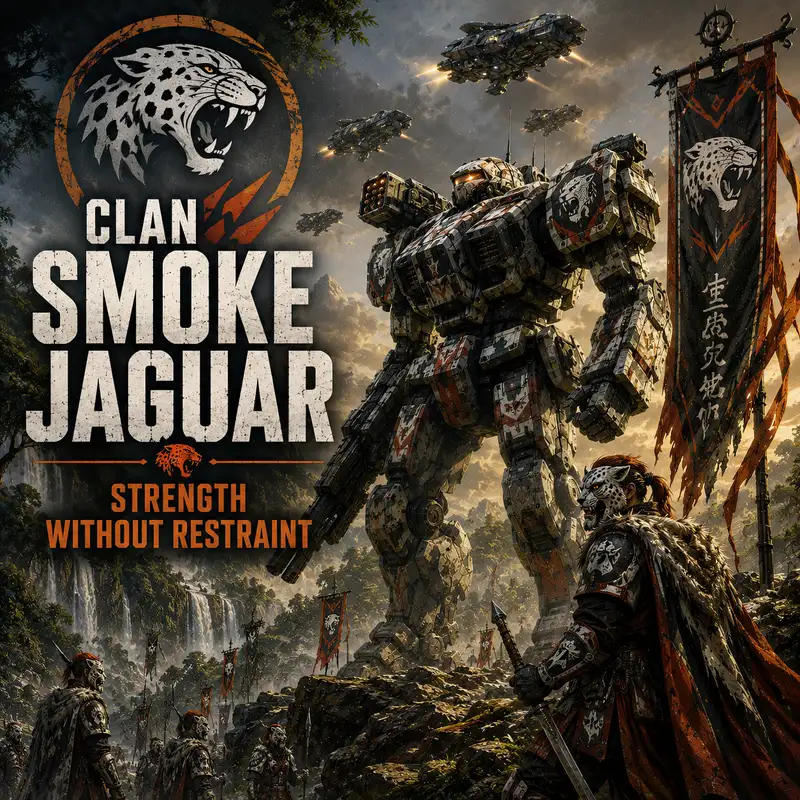
Clan Smoke Jaguar: Strength Without Restraint
The city of Edo was already under occupation when Clan Smoke Jaguar decided it had not surrendered enough. Hohiro Kurita had escaped Jaguar custody with help from local resistance networks, and the search for him had become a public humiliation. Galaxy Commander Cordera Perez answered by evacuating Clan troops and ordering WarShips to fire on the city from orbit. The weapons did not distinguish between a hidden prince, a resistance cell, and a family sheltering below. Edo burned because a commander believed terror could restore authority that battlefield victory had failed to secure.
The bombardment of Turtle Bay became the clearest symbol of Clan Smoke Jaguar, but it was not an isolated lapse in an otherwise restrained history. The Jaguars repeatedly treated force as proof of legitimacy and escalation as proof of resolve. That approach produced exceptional warriors, fearsome frontline formations, and some of the Clan Homeworlds’ most aggressive commanders. It also weakened their economy, alienated their civilians, discouraged honest reporting, punished survivors, and left them with almost no allies when the Inner Sphere finally struck back. Their problem was never a lack of strength. It was strength without restraint.
Clan tradition traced that character to Franklin Osis, the first Jaguar Khan. He had followed Nicholas Kerensky during the Second Exodus after surviving the collapse of the Pentagon Worlds. Later accounts describe his brother Simon being killed by a smoke jaguar on Strana Mechty. Franklin froze during the initial attack, then killed the animal with a hunting knife after his brother died. The episode became a founding myth about fear conquered through violence. Nicholas saw both the usefulness and the danger in Franklin’s rage, training him as a MechWarrior and officer rather than allowing fury alone to define him.
The distinction did not last. During Operation Klondike, Franklin led the Jaguars on Eden. At Kaliningrad, rumors of Jaguar brutality helped trigger an uprising in which several warriors were killed. The situation required intelligence, riot control, negotiation, and discrimination between armed rebels and civilians. The Jaguars had prepared for battlefield conquest, not political control. Franklin withdrew his forces and leveled the city with aerospace and artillery strikes. The rebellion ended because much of the place where it had occurred no longer existed. It was an effective method for clearing a map and a disastrous method for governing the people who remained on it.
That early campaign established the pattern. Jaguar doctrine favored direct attack, concentrated firepower, personal aggression, and rapid exploitation of weakness. Their warriors were expected to close with the enemy rather than depend on deception or prolonged maneuver. They became highly capable in short, violent Trials where the objective was clear and the opponent accepted the same rules. The Jaguar touman gained OmniMechs early, won battle armor through combat, and maintained powerful ground and naval formations. When the problem could be defeated in front of them, the Jaguars were among the most dangerous forces in Clan space.
Problems that could not be defeated in front of them received less attention. During the Golden Century, other Clans expanded colonies, trade, resource extraction, and civilian transport. Smoke Jaguar leaders concentrated on military holdings and treated peaceful development as secondary. Their merchants had little political influence. Their scientists and technicians were valued for what they produced for warriors, not for independent judgment. The Clan possessed advanced weapons while neglecting the economic depth needed to replace those weapons during a prolonged war. A strong touman sat on a narrower industrial foundation than its commanders preferred to admit.
The Londerholm Revolt in the year twenty-nine twelve showed the domestic cost. Famine and decades of oppressive rule drove laborers and merchants into rebellion across several Jaguar holdings. The warrior caste answered with massacres, destruction of settlements, and executions that extended beyond those who had taken up arms. Afterward, Khan Ian Moon removed what remained of civilian self-government and placed even greater authority in warrior hands. The immediate threat disappeared. So did another channel through which shortages, corruption, and local anger might have reached the leadership before becoming armed revolt.
The Jaguars could still expand through conquest. In the year twenty-eight sixty-eight, under Khan Theodore Osis, they won the right to Absorb Clan Mongoose. The campaign included one of the largest naval battles the Clans had yet fought and ended with Mongoose territory, equipment, and populations passing into Jaguar control. The victory enlarged the Clan, but its leaders refused to preserve many captured genetic legacies because they considered them tainted by political scheming. Even in success, the Jaguars preferred purity and punishment to exploiting every useful asset. Their enemies learned that defeat could mean more than loss. It could mean deliberate erasure.
By the late thirtieth century, the Jaguars had become committed Crusaders. They believed the Inner Sphere had wasted the Star League legacy and could be restored only through conquest. Khan Leo Showers gave that belief its opportunity when the ComStar exploration ship Outbound Light reached Huntress in the year thirty forty-eight. Showers controlled the prisoners and their records, presented the discovery as evidence that the Homeworlds faced exposure, and helped force approval of Operation Revival. The Smoke Jaguars had spent generations treating decisive action as moral clarity. Now one of their Khans placed the entire Clan invasion on that foundation.
The Jaguars received an invasion corridor through the Draconis Combine. Their early campaigns appeared to justify every assumption. Frontline Clusters equipped with OmniMechs, Elementals, advanced aerospace fighters, and superior weapons shattered many defending units. Inner Sphere commanders struggled to identify the invaders, understand their organization, or respond to engagement ranges their own machines could not match. Worlds fell after short battles. Jaguar officers saw confirmation that strength and discipline had overcome a decadent civilization. The opening victories were genuine. The conclusions drawn from them were not.
Conquest produced duties that Trials had never taught them to value. Occupied cities needed police, administrators, food distribution, transport security, and intelligence networks. Local officials understood languages, customs, criminal organizations, and political loyalties that Clan warriors dismissed as signs of disorder. Jaguar commanders often refused that help and treated noncompliance as insolence. Small garrisons responded to sabotage with collective punishment, creating more resistance and requiring more garrisons. The Clan was winning planets faster than it was learning how to hold them.
Turtle Bay brought those failures together. Jaguar forces captured Hohiro Kurita without initially recognizing the value of their prisoner. Local resistance, including criminal networks willing to oppose the occupation, helped him escape. The Jaguars reacted with searches and repression that widened civilian support for the fugitives. Perez then ordered the orbital attack on Edo. Militarily, the city’s destruction did not recover Hohiro, improve intelligence, or secure the wider occupation zone. Politically, it gave the Draconis Combine a grievance that could unite factions more effectively than any speech from the Coordinator.
The atrocity also damaged the wider Clan campaign. Even hardline Crusaders condemned the use of orbital fire against a civilian city. Clan Wolf used the outrage to pressure the invaders into removing WarShips from later planetary bids, reducing a major Clan advantage. Inner Sphere leaders now understood that defeat might bring more than occupation, while Clan rivals understood that Jaguar behavior threatened the legitimacy of the entire invasion. Perez intended to frighten one world into submission. He helped teach two civilizations to treat the Smoke Jaguars as a problem requiring destruction.
The Battle of Wolcott later in the year thirty fifty showed the opposite failure. Theodore Kurita selected difficult terrain, concealed the quality of his defenders, and accepted a formal contest whose terms would bind the Jaguars if they lost. The Smoke Jaguar force entered a prepared battlefield expecting inexperienced opposition. Swamps, deception, hidden supply points, and disciplined attacks reduced the advantages of Clan range and mobility. The Jaguars were defeated and surrendered four OmniMechs and twenty-four Elemental suits under the agreed terms. Their honor kept the promise. Their pride resisted the operational lesson.
Wolcott should have encouraged better intelligence and greater respect for local conditions. Instead, humiliation strengthened the desire for a larger victory. The Jaguars pressed for an attack on Luthien, the capital of the Draconis Combine. Vengeance against Kurita and jealousy of Clan Wolf’s rapid advance both shaped the decision. Clan Nova Cat joined the operation, and five Clan Galaxies faced a defense built around twelve Inner Sphere regiments, Wolf’s Dragoons, the Kell Hounds, fortifications, aerospace support, and the political determination to prevent the Combine from losing its center.
The fighting in January of the year thirty fifty-two was enormous by the standards of the invasion. Jaguar units achieved local breakthroughs and inflicted severe losses, but the defenders used depth, reserves, terrain, and cooperation among forces that had once regarded each other as enemies. The Clan attack could not convert tactical penetration into strategic collapse. By the end, less than half of the Smoke Jaguar force returned to its DropShips. Luthien survived, House Kurita gained prestige, and Davion assistance demonstrated that fear of the Clans could overcome rivalries the invaders had expected to exploit.
Jaguar leadership responded to Luthien by blaming many of the people who had survived it. Warriors associated with defeat found careers blocked, reputations damaged, and assignments shifted toward marginal service. Senior leaders and politically protected officers escaped much of the same judgment. The policy created the appearance of uncompromising standards while discouraging experienced veterans from explaining what had gone wrong. A force learns through honest reports, protected disagreement, and commanders willing to separate bad luck from bad planning. The Jaguars preferred a cleaner procedure. They punished the witnesses.
Tukayyid made that habit catastrophic. In the bidding for the great Trial against ComStar, the Smoke Jaguars won the honor of landing first and taking prestigious objectives. They also bid away an entire Galaxy, leaving themselves with less combat power and little margin for error. Their planning gave insufficient attention to supply, terrain, and the possibility that the Com Guards were neither weak nor inexperienced. Prestige determined the opening position. Logistics was expected to support whatever prestige had selected.
Alpha Galaxy drove toward Dinju Heights while Beta Galaxy advanced through the Racice River delta toward Port Racice. The Com Guards used marshes, artillery, mines, prepared defenses, ambushes, and repeated withdrawals to draw the Jaguars deeper into ground that reduced their range and mobility. Beta Galaxy became trapped in the wetlands. Alpha suffered its own losses and command disruption. SaKhan Sarah Weaver was killed, Khan Lincoln Osis was believed lost for a time, and the surviving formations lost cohesion. When ilKhan Ulric Kerensky ordered withdrawal, some Jaguar warriors preferred death to what they considered dishonor.
The defeat was severe enough that Clan Smoke Jaguar never restored its former strength. Its response made recovery harder. Survivors of Tukayyid were stigmatized much as Luthien veterans had been. Their experience with Inner Sphere tactics became a mark of failure rather than a resource. The Clan replaced losses with younger warriors, reorganized formations, and maintained an aggressive posture, but the institution had removed many people best qualified to explain the enemy. Strength without restraint had now turned inward, treating institutional memory as contamination.
The occupation zone continued consuming troops and resources after the truce. Raids, uprisings, garrison requirements, and long supply lines stretched the Clan’s industrial base. Jaguar scientists responded with one of the Clan’s most innovative projects, the ProtoMech. These smaller machines were intended to provide useful combat power while consuming far fewer materials than a BattleMech. The program was developed in secrecy because the scientists expected warrior leaders to reject it before combat proved its value. Even the Clan’s solution to resource scarcity had to be hidden from the caste that controlled the resources.
The most dangerous Jaguar enemy emerged from within the warrior caste. Trent had survived Tukayyid and experienced the contempt directed at those who returned from defeat. His growing opposition to Jaguar leadership eventually led him to provide the route to the Clan Homeworlds and the location of Huntress to Inner Sphere authorities. Personal grievance mattered, but his defection also reflected a deeper institutional failure. The Jaguars had created a culture in which criticism had no safe path upward. Information therefore traveled sideways to the enemy.
By the year thirty fifty-eight, leaders of the reborn Second Star League wanted a campaign that could prove the Inner Sphere was capable of collective action and end the Clan invasion at its source. Clan Smoke Jaguar offered the clearest target. It had committed the most infamous atrocity, occupied Draconis Combine worlds whose liberation would unite the coalition, and possessed few allies willing to risk themselves on its behalf. The Star League planned two linked operations. Operation Bulldog would destroy the Jaguar occupation zone. Task Force Serpent would travel the Exodus Road and strike Huntress.
Operation Bulldog began in May of the year thirty fifty-nine after reconnaissance raids had softened garrisons and tested defenses. Forces from the Great Houses, ComStar, mercenary commands, and defecting Clan Nova Cat units attacked in coordinated waves. The coalition brought numbers, WarShips, upgraded equipment, intelligence, reserves, and a supply system designed for a campaign rather than a ceremonial Trial. Integration was imperfect, especially among states with centuries of mutual suspicion, but the operation could absorb friction. The Jaguars could not.
The first worlds fell quickly. Jaguar commanders attempted local counterattacks and a broader strike against the coalition’s support structure, but the targeted worlds were prepared and the attacks consumed forces needed elsewhere. Clan Ghost Bear remained neutral. Clan Nova Cat had changed sides. Other Clans watched rather than intervene. By the end of August, the Smoke Jaguars had been driven from the Inner Sphere. A Clan that had terrorized occupied civilians and antagonized its peers discovered that strategic isolation becomes very literal when JumpShips begin leaving without reinforcements.
Task Force Serpent faced the harder journey. Ten elite regiments and supporting forces traveled through the Deep Periphery toward Huntress, carrying enough matériel to destroy the Jaguar military base but not enough to replace every loss. Marshal Morgan Hasek-Davion died before the assault, leaving command to General Ariana Winston. When the force landed in March of the year thirty sixty, it attacked barracks, factories, repair sites, communications centers, and supply depots. The objective was not simply to win a battle. It was to remove the Clan’s ability to rebuild after one.
The Huntress garrison fought with the determination expected of Smoke Jaguars. ProtoMechs entered combat and inflicted serious losses, proving the scientists’ secret project had military value. Task Force Serpent captured major objectives, but its units were exhausted and badly reduced. Then Jaguar formations retreating from the Inner Sphere returned and found their homeworld occupied. Galaxy Commander Hang Mehta organized a counterattack, and Lincoln Osis arrived to direct the defense. The battle became an attritional struggle neither side could sustain comfortably.
The timing that had failed the Jaguars throughout Operation Bulldog failed them again. Victor Steiner-Davion’s forces completed the Inner Sphere campaign ahead of schedule and reached Huntress while Task Force Serpent was close to collapse. The reinforcements broke the Jaguar counterattack. By the end of the campaign, the Star League task force had been reduced from the equivalent of ten regiments to fewer than two, and General Winston was dead. The Jaguars had imposed a brutal cost. They had not preserved the Clan.
Lincoln Osis escaped to Strana Mechty with a small remnant and represented the Smoke Jaguars during the Great Refusal. His remaining force faced the Tenth Lyran Guards as part of the Trial that would decide whether the Crusader invasion could continue. The Jaguars fought hard and lost. Osis then attempted a final personal challenge against Victor Steiner-Davion and died. With Huntress occupied, the touman shattered, its holdings seized, and its last Khan dead, Clan Smoke Jaguar ceased to exist as a recognized Clan.
Its destruction was not the result of one atrocity or one battlefield defeat. Turtle Bay made the Jaguars hated, but hatred alone does not plan an interstellar offensive. Luthien and Tukayyid weakened them, but other Clans survived comparable disasters. Operation Bulldog succeeded because decades of Jaguar choices had produced a brittle state. Civilian repression weakened economic initiative and trust. Punishment of survivors obstructed learning. Aggressive politics created enemies. Disdain for allies ensured few would intervene. A culture built to prove strength had removed many of the institutions that make strength recoverable.
The warrior caste was destroyed more completely than the wider Jaguar population. Survivors from every caste remained on scattered worlds, in captured facilities, and among prisoners or bondsmen. Trent and the Elemental officer Paul Moon helped gather thousands of them, along with ships and equipment, at Wayside Five. There they formed the community later known as the Fidelis. Survival required a lesson the old Clan had resisted. Warriors, scientists, merchants, technicians, and laborers had to cooperate because no caste possessed enough people or resources to rebuild alone.
The Fidelis later served Devlin Stone and the Republic of the Sphere through the Jihad and Dark Age, preserving their origin as a guarded secret. In the year thirty-one fifty-one, after fighting alongside Clan Wolf on Terra, they were permitted to reconstitute Clan Smoke Jaguar. Prohaska Moon became Khan, and the reborn Clan entered Alaric Ward’s new Star League as a nonvoting force bound closely to the ilKhan. The name returned, but not the old independence. History had granted the Jaguars another existence under conditions designed to restrain them.
That rebirth does not erase Edo, Londerholm, or Huntress. It makes the central question more important. Clan Smoke Jaguar possessed courage, discipline, advanced technology, and warriors capable of imposing terrible losses even while their society collapsed. What it lacked was the restraint to preserve civilians, accept criticism, cultivate allies, and recognize that fear is not the same as loyalty. The old Jaguars proved they could destroy almost anything placed before them. Their enemies proved that included Clan Smoke Jaguar itself.