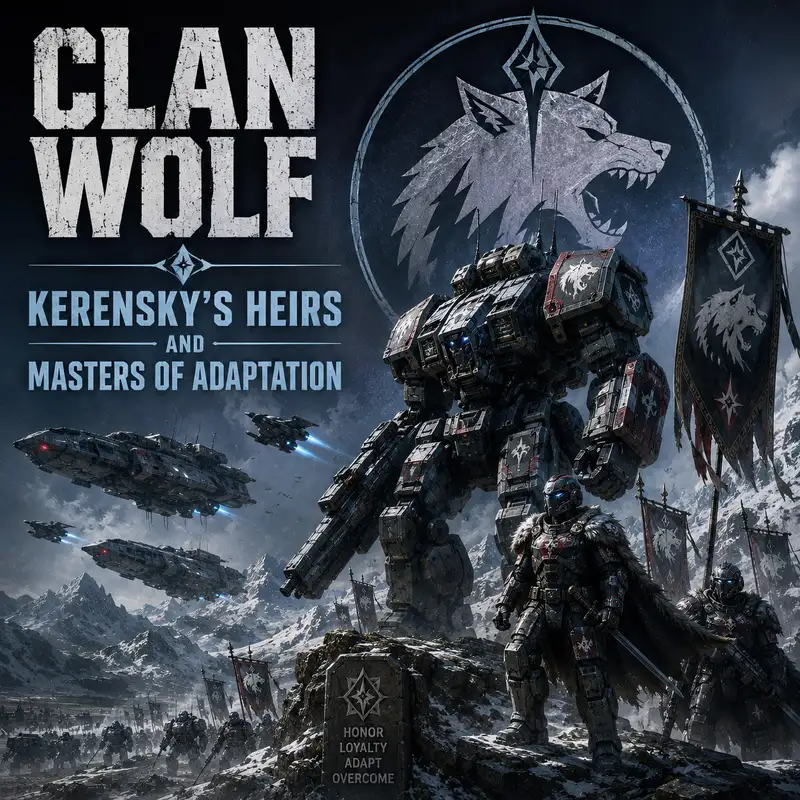
Clan Wolf: Kerensky’s Heirs and Masters of Adaptation
On New Year’s Day in the year thirty-one fifty-one, Alaric Ward committed nearly the entire Clan Wolf touman to a single objective. Fourteen Galaxies assembled for the drive on Terra, leaving the Wolf Empire with little more than garrison troops, local security forces, and a reputation that would now have to perform the work of several thousand absent warriors. The gamble was extreme. It was also characteristically Wolf. When the old plan no longer fit the situation, Clan Wolf changed the plan, accepted the risk, and moved before its rivals could adjust.
That habit explains why Clan Wolf became one of the most successful and persistent powers in Clan history. The Wolves were not always the strongest Clan, the most technologically advanced, or the most ideologically consistent. They were often divided, politically isolated, and one defeat away from extinction. Their advantage was a culture that treated intelligence, logistics, improvisation, and selective disregard for tradition as legitimate tools of war. Clan Wolf survived by changing faster than the institutions trying to destroy it.
The Clan’s privileged position began with Jerome Winson. He had served the Star League Defense Force, followed Aleksandr Kerensky into exile, and remained close to the Kerensky family through the Pentagon years. When Nicholas Kerensky led the Second Exodus, Winson followed him as well. Nicholas later selected him as the first Khan of Clan Wolf, and the Wolves became the first Clan certified for combat. The relationship was personal before it became political. That mattered in a society where personal loyalty was being rebuilt into hereditary prestige.
Nicholas named the Clan for the great wolves of Strana Mechty. The animal represented more than aggression. It hunted through patience, cooperation, speed, and a sudden concentration of violence. Nicholas and Andery Kerensky also placed their Bloodnames and genetic legacies within Clan Wolf, giving it a status no other Clan could match. The Wolves became guardians of Kerensky’s line, a distinction that inspired loyalty among allies and resentment among rivals, particularly Clan Jade Falcon.
Their conduct during Operation Klondike offered an early example of the approach that would define them. On Eden, the Wolves were assigned the Abaddon Heights, a region suffering from the disease known as the Curse of Eden. Rather than begin with bombardment, they offered an antigen. Smaller settlements surrendered because Clan Wolf could solve a problem their existing rulers could not. Where resistance continued, the Wolves advanced slowly, isolated armed groups, and attempted to limit civilian losses. They used medical science and political leverage before relying on firepower.
That restraint had limits. When the Grand Council ordered the Annihilation of Clan Wolverine, Clan Wolf won the right to carry it out. The Wolves drove the Wolverines from Circe, pursued the survivors, dismantled their institutions, and helped enforce punishments against civilians and children. Their service to Nicholas was not a humane inheritance. Clan Wolf’s adaptability could reduce destruction when moderation served the mission, and it could support extreme violence when loyalty and political legitimacy demanded it.
The year twenty-eight thirty-four transformed the Clan again. A feud with Clan Widowmaker led to a Trial of Refusal on Ironhold. During the fighting, Widowmaker Khan Cal Jorgensson killed Nicholas Kerensky. The Wolves responded with an enraged campaign of Absorption that destroyed Clan Widowmaker as an independent power. Clan Wolf received its territory, equipment, civilian population, and genetic legacies, despite Jade Falcon attempts to divide the spoils. Jerome Winson became ilKhan, and the Wolves emerged larger, richer, and more politically dominant.
The Golden Century showed that Wolf strength did not come only from conquest. Compared with many other Clans, Wolf leaders allowed their civilian castes greater room to experiment, colonize, trade, and develop industry. That freedom remained limited by warrior rule, but it gave scientists, merchants, and technicians space to solve problems without waiting for a MechWarrior to discover an interest in agricultural planning. Wolf settlements expanded, and major industrial centers developed on worlds such as Paxon and Tiber.
Their acquisition of OmniMech technology demonstrated political flexibility. Clan Coyote introduced the first OmniMech in the year twenty-eight fifty-four. The Wolves wanted the design but avoided challenging an important ally. When Clan Jade Falcon won the technology from the Coyotes, Wolf forces intercepted the Falcons and took the plans from them instead. The result preserved the Coyote relationship, weakened a rival, and closed the technological gap. It was not an elegant solution, but military procurement rarely asks whether elegance survived the budget meeting.
Battle armor followed an even more complicated path. Clan Wolf acquired powered underwater work suits from Clan Goliath Scorpion and spent decades converting the concept into armor capable of operating across several environments. Wolf scientists produced the first successful Elemental battle armor, then exchanged the technology through Trials with Clan Hell’s Horses, whose breeding program had produced the large infantry phenotype suited to the suits. The final system came from trade, research, captured opportunity, and inter-Clan competition rather than one isolated breakthrough.
This pattern became Wolf doctrine. First, learn the enemy accurately. Second, prepare the force and supply system for the actual campaign rather than the campaign tradition says should occur. Third, accept calculated risk once battle begins. Other Clans often emphasized the final stage because risk produced visible glory. The Wolves placed equal value on the work before contact, when intelligence officers, merchants, technicians, and transport planners made victory possible without receiving a Bloodname for it.
The same method shaped Wolf politics. When Crusader support for an invasion of the Inner Sphere grew, Khan Kerlin Ward offered the Dragoon Compromise in the year thirty hundred. Instead of voting immediately for conquest, the Clans would send an intelligence force to study the Successor States from inside their own military system. Wolf’s Dragoons were formed largely from freeborn warriors, trained for the mission, and disguised as mercenaries. Their assignment delayed invasion while gathering information no Grand Council speech could provide.
The Dragoons eventually stopped reporting, but the compromise had already demonstrated how Wolf leaders fought political battles. They rarely rejected the Clan system outright. They used its rules, rituals, and rivalries to create room for another option. Ulric Kerensky continued that tradition, delaying invasion votes as news of the Fourth Succession War and the War of Thirty Thirty-nine reached the Homeworlds. When the ComStar vessel Outbound Light was captured in the year thirty forty-eight, delay finally became impossible.
Clan Wolf stood alone against Operation Revival and demanded a Trial of Refusal. Bidding reduced the opposition, but the Wolves still faced roughly four times their strength and lost. They were then compelled to join the invasion they had opposed. Leo Showers assigned them a less prestigious corridor through the Free Rasalhague Republic and placed his headquarters aboard the Wolf flagship, implying that the Clan required supervision. Wolf society was also divided between Ulric’s Wardens and Crusaders led by Garth Radick.
Ulric answered the political humiliation with operational success. The Wolves would obey the decision and outperform the Clans that had forced it upon them. They studied every opponent, even forces other Clans dismissed as barbarians. The capture of Phelan Kell was especially important. He became a bondsman, then a warrior, and eventually a senior Wolf leader. Clan Wolf did not merely interrogate him for information. It allowed knowledge from an enemy to reshape planning, tactics, and the Clan’s understanding of the Inner Sphere.
Logistics created the difference between Wolf success and the more uneven advances of its rivals. Ulric increased supply flow, placed caches forward in enemy territory, and reduced the time required to repair and rearm his Clusters. Wolf commanders acquired local resources with enough restraint to avoid creating unnecessary resistance. Other Clans sometimes landed with only a small ammunition reserve and expected the merchant caste to repair the schedule later. Clan Wolf treated the schedule as part of the weapon.
The conquest of Rasalhague showed how the Wolves combined preparation with risk. A bidding contest with Clan Ghost Bear forced them below a comfortable commitment, leaving only three Clusters for the operation. The Wolves still succeeded, aided by Phelan’s knowledge and their ability to concentrate force where it mattered. They had not avoided the dangerous bid. They had built enough understanding of the target to make the risk survivable.
By the end of the fourth invasion wave, Clan Wolf had taken roughly twice as many worlds as any rival. Their success embarrassed Crusader leaders who had expected the Wardens to fail. After Tyra Miraborg’s attack killed Leo Showers, the other Khans elected Ulric as ilKhan partly to trap him into commanding the invasion. Ulric accepted, placed Natasha Kerensky in Wolf leadership, and used his new authority to complicate the plans of rival Clans. Political punishment became another position from which to maneuver.
Tukayyid was the clearest demonstration of Wolf adaptation in battle. The Wolves did not bid recklessly for an early landing. They prepared for a long campaign, protected their supply chain, and configured many OmniMechs around energy weapons that would not depend on constant ammunition deliveries. They suspended zellbrigen against an opponent expected to exploit it. Natasha Kerensky and Phelan Ward contributed direct knowledge of Inner Sphere methods. Clan Wolf then achieved the only complete Clan victory on Tukayyid.
That success did not save the original Clan. It deepened the division between Wardens and Crusaders, while Ulric’s acceptance of the fifteen-year truce made him a target. His enemies accused him of betraying the Clan mission and denying generations of warriors their chance for glory. In the year thirty fifty-seven, the political challenge became the Refusal War against Clan Jade Falcon. Ulric committed almost the entire Wolf touman to a conflict that neither side could win without crippling itself.
The campaign was not simply an attempt to defeat the Falcons. Ulric designed a survival plan. Phelan Ward took selected warriors, civilian specialists, families, equipment, and genetic legacies into the Inner Sphere. That group became Clan Wolf-in-Exile and settled near Arc-Royal. Ulric and Natasha remained with the main force and inflicted losses severe enough to delay any renewed invasion. Both died, and the old Clan Wolf was effectively destroyed, but one Wolf society had escaped intact.
A second survived through Vlad Ward. He had witnessed the treachery surrounding Ulric’s death and refused to accept the claim that the remaining Wolves had been legally absorbed by Jade Falcon. Vlad challenged the Falcon leadership, killed Vandervahn Chistu, gained the Ward Bloodname, and became Khan of the temporary Clan Jade Wolf. He then killed Elias Crichell in a Trial and declared Clan Wolf reborn. Where Phelan preserved people and culture through withdrawal, Vlad preserved the name through Clan law and personal combat.
The two successor Clans chose different identities. Wolf-in-Exile remained Warden and cooperated with Inner Sphere powers, defending the Arc-Royal region against further Clan aggression. Vlad’s Clan Wolf adopted a more openly Crusader position and imposed tighter control over civilian life. It rebuilt by taking warriors and genetic material through the Harvest Trials and by incorporating personnel from rival Clans. Adaptation did not always make the Wolves more tolerant. Sometimes it meant changing the ideology while preserving the institution.
The split exposed the weakness in the claim that Clan Wolf was Kerensky’s single, uncontested heir. Both groups carried Wolf traditions. Both held Bloodnames and remembered the same founders. Both could point to sacrifice as evidence of legitimacy. One guarded the Inner Sphere from the Clans. The other still intended to claim it. The heritage survived because it had divided, and each half defined survival differently.
The Word of Blake Jihad forced further change. Nuclear attacks struck Tamar, the capital of the Wolf Occupation Zone, while Arc-Royal was attacked as well. Vlad eventually launched Operation Damocles Two, abandoning the Clan Homeworlds and relocating Wolf assets into the Inner Sphere. During the Wars of Reaving, the Home Clans Abjured the Wolves. Clan Wolf then raided the Kerensky Blood Chapel, removed copies of the Kerensky genetic legacy, and destroyed the site rather than allow rivals to claim it.
That act captured the Wolf relationship with tradition. The blood legacy was sacred, but the chapel holding it was expendable. Geography mattered until it endangered survival. Political recognition mattered until the recognizing council became hostile. The Wolves preserved what they considered essential and discarded the rest. Their enemies saw opportunism and sacrilege. The Wolves saw a distinction between honoring Kerensky and obeying every institution that spoke in his name.
The post-Jihad years left Clan Wolf badly weakened. Its touman had lost warriors, its sibko program had been damaged, and hostile powers surrounded the Occupation Zone. Wolf leaders accepted more freeborn warriors and transferred advanced machines from second-line units to keep frontline Galaxies effective. These were practical measures that challenged traditional prestige. A Clan that insisted only ideal personnel and ideal equipment were acceptable would have possessed a beautifully pure order of battle and not enough units to defend it.
The collapse of the hyperpulse generator network created another opening. Clan Wolf entered a secret arrangement with the Lyran Commonwealth and used Operation Hammerfall to move against fractured Free Worlds League territories. The migration was not merely a military raid. Warriors, civilian castes, factories, transport, and families shifted into a new region. Clan Wolf was relocating a state while conducting offensive operations, a task far more complicated than winning the planets listed in the campaign order.
When the Lyran partnership failed, the Wolves changed direction and attacked former allies. On the first day of the year thirty-one forty-two, their holdings became the Wolf Empire, with Gienah as its capital. The new realm stretched across more than sixty conquered worlds taken from Lyran and Free Worlds League space. Wolf administrators recruited from local populations and allowed enough continuity to reduce resistance. The empire remained coercive, but it was more than a temporary occupation zone maintained by visiting warriors.
Alaric Ward embodied the fusion the Wolf Empire had created. His genetic heritage connected Vlad Ward with Katherine Steiner-Davion and Victor Steiner-Davion, combining Clan and Inner Sphere dynastic lines inside a trueborn warrior. He was ambitious, ruthless, and often arrogant, but he also learned from defeat and used local recruitment, political claims, deception, and negotiation as readily as formal Trials. He did not represent a return to an untouched Clan past. He represented what centuries of contact had made possible.
The final drive on Terra brought every Wolf habit together. Scientists found a way through the Fortress Republic’s Wall and tested the route with unmanned JumpShips. Alaric concentrated nearly all available Galaxies at New Earth, accepted help from Wolf’s Dragoons, and drew warriors from the exiled branch. The plan abandoned strategic depth in the Wolf Empire to create overwhelming force at the decisive point. It was brilliant concentration and a logistical hazard large enough to require its own map.
Clan Wolf fought the Republic of the Sphere, then faced Clan Jade Falcon for the right to become ilClan. The campaign ended in April of the year thirty-one fifty-one with a Wolf victory and Malvina Hazen’s defeat. Devlin Stone dissolved the Republic, Alaric became ilKhan and First Lord, and the surviving Wolves-in-Exile were brought back into the larger Clan. After centuries of argument, division, and exile, Clan Wolf held Terra and claimed to have fulfilled Kerensky’s promise.
The price revealed the limit of the achievement. Only a fraction of the Wolf force that entered the Terra campaign remained effective afterward. The Wolf Empire had been stripped of most of its defenders. Star Colonel Othar, left on Gienah, had to create new Galaxies from available personnel while local enemies, mercenaries, and Wolf’s Dragoons tested the borders. By the middle of the year thirty-one fifty-two, the Free Worlds League had begun a larger offensive into the underdefended realm.
Clan Wolf had reached the objective that justified centuries of Clan history and immediately inherited a problem no Trial could settle. Holding Terra did not automatically secure the empire behind it. Declaring a Star League did not make every state accept its authority. The same concentration that won the ilClan Trial weakened the political and economic base required to sustain the victory. Operational success had once again produced a strategic bill for someone outside the victory ceremony to pay.
The Wolves deserve their reputation as masters of adaptation because they repeatedly learned what other Clans dismissed. They used medicine during conquest, civilian initiative during colonization, captured technology during expansion, freeborns for intelligence, bondsmen for planning, logistics for speed, and foreign populations for reconstruction. They changed doctrine at Tukayyid, divided to survive the Refusal War, abandoned the Homeworlds during the Jihad, migrated an entire society during the Dark Age, and risked an empire to take Terra.
None of this makes Clan Wolf naturally wiser or morally superior. The same flexibility supported Annihilation, Absorption, occupation, political murder, and imperial conquest. Wolf leaders could respect civilians when cooperation served the mission and punish them when resistance challenged authority. Adaptation made the Clan effective. It did not make every objective legitimate or every victory just.
Clan Wolf became Kerensky’s heir not by preserving one unchanged doctrine, but by repeatedly deciding which parts of the inheritance could be altered and which parts had to survive. The name endured through absorption, exile, abjuration, migration, and civil war because the Wolves treated identity much as they treated an OmniMech configuration. The chassis remained recognizable. The weapons changed for the mission. By the time Clan Wolf stood on Terra, it had fulfilled Kerensky’s promise by becoming something neither Aleksandr nor Nicholas could have fully recognized.