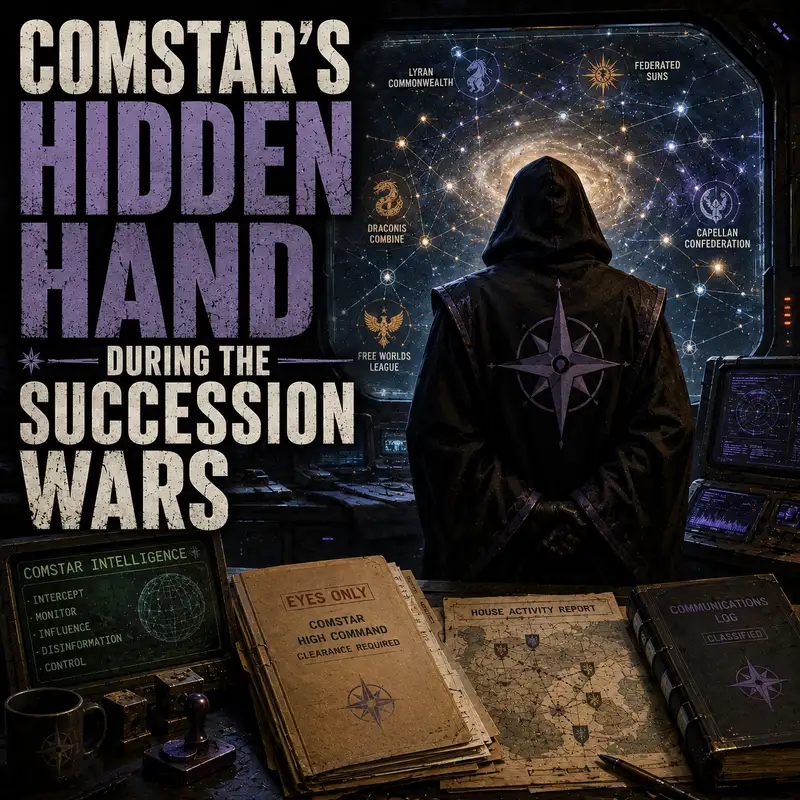
ComStar’s Hidden Hand During the Succession Wars
On the nineteenth of March, twenty-eight thirty-seven, Captain-General Charles Marik ordered the hyperpulse generator station above Oriente destroyed. The target belonged to ComStar, the organization that carried interstellar messages for every Great House. The station also contained Charles’s sister, Jeanette, a ComStar adept who had been supplying him with military intelligence. Charles had concluded that the same network helping him win battles was also feeding his enemies. He chose to silence one station with WarShip fire. ComStar answered by silencing an entire interstellar state.
The exchange revealed the central contradiction of ComStar during the Succession Wars. Publicly, the Order was neutral. It maintained communications, protected Terra, settled mercenary disputes, and provided a currency accepted across hostile borders. Secretly, its leaders filtered intelligence, manipulated news, punished governments through communications interdiction, assassinated scientists, destroyed recovered technology, funded raiders, and concealed military forces equipped from Star League stockpiles. ComStar did not create the ambitions of the Great Houses. It learned how to steer those ambitions while appearing to stand outside them.
That power began with infrastructure. After the Amaris Civil War, the hyperpulse generator network was badly damaged. Without it, a message could travel no faster than the JumpShip carrying it. Orders, market information, diplomatic instructions, and warnings of invasion might take weeks or months to cross a realm. Jerome Blake was appointed Minister of Communications in the year twenty-seven eighty and charged with rebuilding the network. The assignment appeared technical. In a collapsing political system, control of communications quickly became a form of government.
Blake understood that the coming war threatened Terra, the surviving Hegemony infrastructure, and the network he had restored. He negotiated the Communications Protocol of twenty-seven eighty-seven, securing recognition of ComStar’s neutrality and access to its services for all five Great Houses. Then, in June of twenty-seven eighty-eight, he shut down the hyperpulse generators and launched Operation Silver Shield. Troops loyal to ComStar seized Terra. When transmissions resumed, Blake announced that the Sol system was neutral and under ComStar’s protection.
Operation Silver Shield was a seizure of power, but Blake’s original purpose should not be confused completely with the policies of his successors. He had watched the High Council fail, Kerensky depart, and the House Lords prepare to destroy the institutions he was trying to preserve. Terra without an independent defender would have become the richest objective in the First Succession War. The communications network without neutrality would have been divided, occupied, or destroyed. Blake’s solution was audacious because he treated technical administration as sovereignty. It also worked.
ComStar’s Letter of Credit strengthened that sovereignty. The instrument evolved into the C-bill, a currency tied to the cost of transmitting information through the network. Because every Great House needed ComStar and distrusted its rivals, the C-bill became useful for interstellar trade. ComStar also founded the Mercenary Review Board and expanded its archives. These services reduced some of the friction produced by political collapse. A merchant, mercenary commander, or planetary government could deal across borders using institutions that did not formally belong to any House.
Neutrality provided access. Access produced information. Every HPG station handled military orders, diplomatic reports, commercial messages, and personal traffic. ComStar promised confidentiality, but the organization possessed opportunities no ordinary intelligence service could match. ROM, formed during Blake’s rule as an internal security and intelligence organization, could study patterns even when it did not read every message. Increased traffic toward a border suggested mobilization. Urgent transmissions from a factory world suggested trouble. A communications provider did not need to know every secret to recognize where the secrets were moving.
After Blake’s death in the year twenty-eight nineteen, Conrad Toyama transformed ComStar. He replaced much of its corporate appearance with a religious hierarchy and presented Blake’s writings as sacred guidance. Ritual protected technical knowledge by making the operation of advanced systems appear inseparable from the Order. Over time, the performance became belief. More importantly, Toyama embraced the idea that the Great Houses would destroy themselves and that ComStar would eventually emerge to restore civilization. Peace was no longer simply welcome evidence that the network had survived. It was a threat to prophecy.
The First Succession War ended through exhaustion in the year twenty-eight twenty-one. The Houses had devastated fleets, industries, and populations, but all five states remained intact. A sustained peace might have allowed them to rebuild their laboratories, recover Star League technology, and reduce their dependence on ComStar. Toyama therefore moved beyond observation. The ComStar News Bureau exaggerated the significance of border incidents and presented minor clashes as evidence of wider danger. The method was efficient. A nervous ruler rarely needs fabricated enemies when selective reporting can make the real ones appear closer.
In early twenty-eight twenty-seven, Toyama proposed Operation Divine Intervention. ROM began passing information about the Draconis Combine Mustered Soldiery and the Internal Security Force to Lyran intelligence. Lyran commanders used the material to anticipate Combine movements and frustrate its forces. At the same time, ComStar’s news apparatus emphasized tension between the Lyran Commonwealth and the Free Worlds League. The operation did not order any House army to attack. It arranged the information environment so that pride, suspicion, and existing war plans would do the rest.
Coordinator Jinjiro Kurita reacted to repeated embarrassment by launching major attacks against the Lyran Commonwealth and Federated Suns in the year twenty-eight thirty. That offensive marked the opening of the Second Succession War. Jinjiro made the decision, and House Kurita supplied the troops. ComStar had supplied the humiliation and helped conceal the hand behind it. This distinction matters. The Order was not controlling rulers like machines. It was studying their institutions, prejudices, and personal weaknesses, then applying pressure where a predictable response was most likely.
The Free Worlds League became the most revealing target. Jeanette Marik passed intelligence to her brother Charles, allowing League forces to achieve significant victories against Lyran and Capellan opponents. The information was accurate enough to build trust and useful enough to influence operations. Charles eventually noticed that some of his own plans failed as though the enemy had received similar assistance. ComStar’s advantage depended on every customer believing that the service was neutral or, at the very least, secretly favorable to them alone. Charles decided to test that assumption.
Operation Cookie Jar created a false report that the League had discovered a major Star League cache on Cursa. The message moved through channels ComStar could monitor. A Capellan force soon attacked the supposedly valuable site and headed directly toward the bait. The cache did not exist. Charles now had persuasive evidence that information transmitted through ComStar had reached an enemy. His response was strategically understandable and politically disastrous. He attacked the Oriente station rather than finding a way to expose the network without surrendering access to it.
ComStar declared the Free Worlds League excluded from the hyperpulse generator network. Stations shut down, personnel disappeared into prepared hiding places, and the League’s interstellar command system collapsed into courier traffic. A general could still send an order aboard a JumpShip, but the order might arrive after the target world had fallen. Intelligence became stale in transit. Provincial leaders acted independently. The other four Successor States exploited the paralysis, taking worlds while the League struggled to coordinate defense.
The interdiction demonstrated that ComStar possessed a strategic weapon more powerful than many fleets. It could not destroy a BattleMech regiment directly, but it could prevent headquarters from knowing where that regiment was needed. It could isolate a ruler from Parliament, governors, merchants, and commanders. Charles resisted for almost two years while SAFE and ROM fought a shadow war. In late twenty-eight thirty-eight, with League territory lost and political support collapsing, he sent his son to Terra under a flag of truce and accepted ComStar’s terms.
No Great House could ignore the precedent. ComStar had shown that neutrality was conditional and that the conditions would be interpreted by ComStar. An HPG station was officially protected from attack because everyone needed the network. That protection also gave the Order secure compounds on hundreds of worlds, diplomatic standing, and personnel who moved through every realm. A state confronting ComStar had to fight an organization embedded inside its own territory while risking the service that held the state together. It was an unusually favorable arrangement for the organization being confronted.
Raymond Karpov, who became Primus during the Second Succession War, expanded the hidden campaign from manipulation to systematic technological suppression. The war was already destroying factories, universities, shipyards, and technical communities. House governments were also trying to preserve what remained. Karpov believed even limited recovery threatened ComStar’s future position. In the year twenty-eight thirty-eight, he enlarged ROM’s mission and authorized what became Operation Holy Shroud.
ROM agents targeted scientists, engineers, laboratories, communications research, and expeditions seeking Star League caches. Some victims died in accidents. Others disappeared or were killed in operations designed to implicate rival intelligence services. ComStar sought caches before the Houses could find them and obstructed efforts to reproduce technologies outside its control. By the time the operation ended in the year twenty-eight forty-three, more than three hundred leading scientific minds had been eliminated.
The number describes only part of the damage. A senior researcher represented a laboratory, students, institutional memory, and years of accumulated work. Killing one person could delay an entire field when equipment and education were already collapsing. ROM also selected targets across political borders and concealed the common pattern. Each Great House saw its own experts dying and concluded that another House was responsible. The operation therefore damaged technology twice. It removed the people capable of recovery and gave governments another reason to distrust scientific cooperation.
ComStar did not cause every lost factory or every vanished technology. The Great Houses conducted the bombardments, raids, and scorched-earth campaigns that destroyed most of the Star League industrial base. Their rulers repeatedly chose military advantage over shared recovery. Holy Shroud made that collapse deeper and harder to reverse. ComStar’s responsibility lies not in replacing House guilt, but in deliberately ensuring that the survivors of House destruction could not rebuild too quickly. The Order preserved knowledge on Terra while preventing millions elsewhere from benefiting from it.
The Second Succession War ended through exhaustion in the year twenty-eight sixty-three. Again, peace threatened ComStar more than stalemate did. ROM estimated that the Successor States might recover much of the lost Star League technical base within several decades if reconstruction continued. Karpov responded in twenty-eight sixty-six by leaking information about the Shadow War inside the Draconis Combine. The revelation humiliated Coordinator Miyogi Kurita and exposed internal conflict between the military leadership and intelligence institutions. Fighting with the Lyran Commonwealth erupted again and helped ignite the Third Succession War.
The pattern was now institutional. ComStar did not need to invent a new doctrine for every crisis. It monitored internal disputes, identified information likely to provoke a ruler, and released it through channels that concealed the source. The Third Succession War then continued for more than a century and a half as a lower-intensity conflict of raids, border campaigns, and competition for shrinking resources. Most of those operations were planned by the Great Houses for their own reasons. ComStar’s hidden hand worked at the level of conditions, not daily battlefield control.
That distinction limited ComStar’s risk. The Order could encourage war without supplying the divisions that fought it. It could preserve its own equipment while House regiments wore out. It could charge for the messages carrying casualty reports and replacement requests. It could present itself as the custodian of civilization while ensuring that no rival recovered enough capacity to challenge its monopoly. The arrangement was strategically elegant. It was also morally dependent on millions of people continuing to live under the consequences of wars ComStar claimed merely to observe.
The Order gradually added direct military power. Blake’s troops had been demobilized or hidden after the seizure of Terra, and their Star League equipment was stored rather than discarded. In the year twenty-nine thirty-three, ComStar formally created the Guards and Militia that would later be known as the Com Guards. Their existence, size, and technology remained secret. HPG compounds still appeared to be defended mainly by local agreements and the threat of interdiction. Behind that public image, ComStar was building formations capable of enforcing policy when information alone was insufficient.
The Tripitz Affair in the year twenty-nine seventy-nine showed how the hidden military would be used. Taurian forces discovered an abandoned Black Lion class battlecruiser near New Vandenberg and believed the vessel might be restored. A functioning WarShip would have transformed the regional balance and demonstrated that advanced naval technology could return outside ComStar’s control. Primus Yin Takami ordered the First Division of the Guards and Militia to destroy it. The unit removed its identifying markings, painted its machines white, defeated the Taurian defenders, and reduced the Tripitz to a wreck.
ComStar described the preservation of balance as justification. The practical result was the destruction of a recoverable Star League asset so no outside power could possess it. The mission also exposed an important change from Blake’s original defensive logic. Operation Silver Shield had seized Terra to prevent the Houses from destroying a common center. The Tripitz operation destroyed technology because another society might successfully restore it. Preservation had shifted from protecting knowledge to controlling who was permitted to use it.
Takami also authorized Operation Holy Shroud Two in the same year. The second campaign again targeted scientific and engineering progress, but it achieved less than the first. The Great Houses had improved counterintelligence and were more cautious about protecting researchers and discoveries. ComStar remained largely undetected, yet its agents could no longer remove expertise with the earlier operation’s efficiency. The failure was relative. Even an unsuccessful campaign forced governments to spend scarce resources guarding laboratories against enemies they could not identify.
Other schemes were less disciplined. Beginning in the early thirtieth century, ComStar supplied Periphery bandit kings to encourage raids along the borders of the Draconis Combine and Lyran Commonwealth. The Jolly Roger plan initially appeared successful because pirate attacks increased tension without revealing the sponsor. Then several pirate leaders combined their forces and stopped following ComStar’s preferences. In the year thirty oh four, the affair escalated into attacks on HPG compounds. ComStar’s secret troops destroyed the renegades, but only after suffering heavily against the raiders it had helped strengthen.
The episode demonstrated the difference between manipulation and control. Providing weapons, intelligence, or opportunity creates an actor with its own interests. Pirates do not become obedient civil servants merely because the ammunition arrived with discreet paperwork. ComStar could eliminate the immediate problem and conceal much of the evidence, but the operation damaged internal careers and revealed that covert tools could turn against their owner. The hidden hand occasionally discovered that the object being moved had hands of its own.
Wolf’s Dragoons created a more serious mystery when they arrived in the Inner Sphere in the year thirty oh five with pristine BattleMechs, extensive transport, and unfamiliar designs. ROM could not determine their origin. Precentor ROM Vesar Kristofur later encouraged Anton Marik’s rebellion against his brother Janos, partly to weaken the Free Worlds League and partly to place the Dragoons under pressure severe enough to reveal how they replaced losses. Kristofur joined Anton’s circle and fed the duke’s suspicion that the mercenaries would betray him.
The scheme ended in civil war, hostage killings, and the destruction of Anton’s cause. Wolf’s Dragoons turned on him after dependents and members of the command were executed. Anton died, Kristofur escaped, and ComStar learned little about the Dragoons’ origins. Primus Julian Tiepolo removed Kristofur and sent him into exile. The punishment allowed ComStar to treat the disaster as the excess of one agent, but the agent had operated inside an institutional culture that rewarded weakening rivals and hoarding technological advantage. Rogue behavior and approved policy had become difficult to separate.
ComStar’s public services remained real throughout these operations. It kept the HPG network functioning when no Great House could replace it. It preserved archives, maintained Terra, supported interstellar finance, and provided channels through which enemies could negotiate. Without ComStar, the Succession Wars might have produced even greater fragmentation. A network can save lives even when its owners misuse it. That is what made ComStar more durable than a conventional conspiracy. Billions of people depended on the same institution whose secret policies helped prolong their insecurity.
Its influence also had limits. ComStar could provoke a war, but it could not determine every campaign. It could assassinate scientists, but not prevent all research. It could destroy the Tripitz, but not erase every cache. It could support pirates, but not guarantee obedience. It could monitor the Great Houses, yet Wolf’s Dragoons remained opaque. The Order was neither omniscient nor omnipotent. Its strength came from choosing moments when a small intervention could redirect forces already under tension.
The Great Houses therefore remain responsible for the Succession Wars. Minoru and Jinjiro Kurita, the Davions, Steiners, Liaos, and Mariks pursued dynastic claims, invaded neighbors, and accepted the human cost. Their generals selected targets and their governments raised armies. ComStar’s guilt is different. It presented itself as the fire brigade while occasionally pouring fuel into rooms where others had already struck matches. The flames belonged to the Houses. The institution controlling the alarm system decided more than once that the fire should continue.
By the year thirty twenty-five, the strategy appeared successful. The Inner Sphere remained divided. Advanced technology had declined outside protected enclaves. ComStar controlled the principal communications network, a widely accepted currency, deep archives, an intelligence service, and hidden military formations equipped beyond what most governments suspected. No Great House had restored the Star League or displaced the Order from Terra. From the First Circuit’s perspective, history was moving toward the future predicted by its own doctrine.
The cost was embedded in every delayed reconstruction, every scientist whose death was blamed on the wrong enemy, and every regiment sent forward because carefully released information made restraint appear dangerous. ComStar’s hidden hand did not write the entire history of the Succession Wars. It altered the margins at exactly the points where margins became campaigns. An organization founded to keep humanity connected discovered that division made it indispensable. The HPG stations continued transmitting across the darkness, while the people controlling the network quietly decided which truths arrived, which discoveries vanished, and how long the darkness should last.