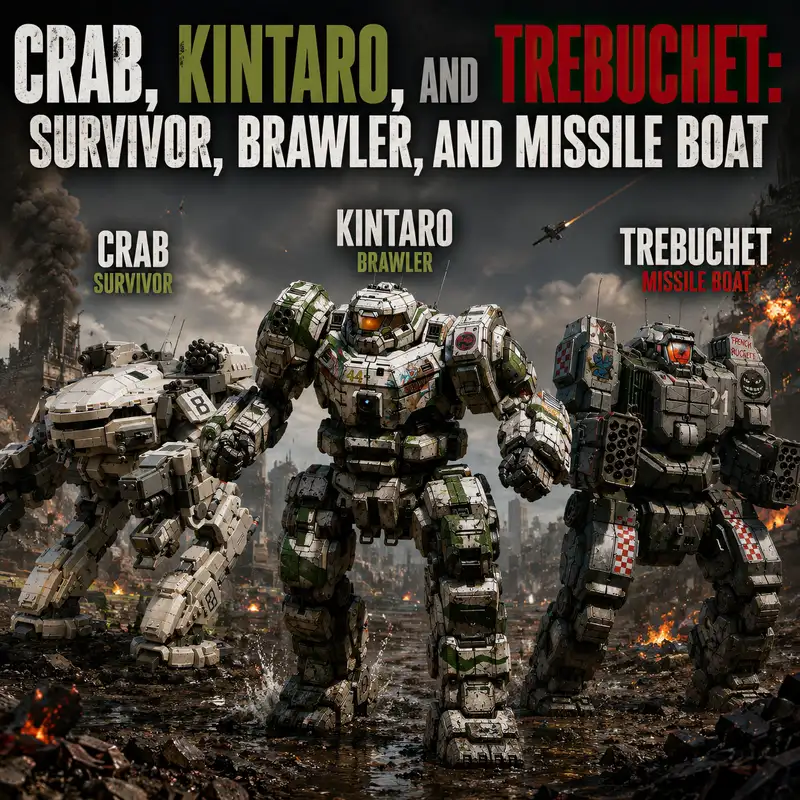
Crab, Kintaro, and Trebuchet: Survivor, Brawler, and Missile Boat
A commander reviewing three medium BattleMechs after a long pursuit might receive three very different reports. The Crab still has power and every weapon can fire, although its armor is scorched and its laser lenses need alignment. The Kintaro has battered the enemy at close range, but its missile bins are nearly empty and the cooling system has been worked hard enough to concern the technicians. The Trebuchet spent its last long-range missiles before the final objective and survived only because another unit kept enemy scouts away. All three machines have done useful work. None has solved the same problem. Their real identities are not defined by weight alone, but by what each design expects from ammunition, distance, supporting units, and time.
The Crab and Trebuchet each weigh fifty tons. The Kintaro weighs fifty-five. In their best-known Succession Wars configurations, all three can reach roughly eighty-six kilometers per hour, and none carries jump jets. On a movement chart, that makes them look like close relatives. On a battlefield, they represent three sharply different theories. The Crab is an endurance-minded raider whose energy weapons and straightforward components favor long operations. The Kintaro is a heavily armed close-range striker that turns speed and armor into a violent missile attack. The Trebuchet is a mobile fire-support platform intended to fight as part of a lance. The question is not which one is the best medium BattleMech. The useful question is what kind of war each machine is prepared to survive.
The Crab was created in the year twenty-seven nineteen, during the late Star League, by Cosara Weaponries on Northwind. The Star League Defense Force wanted a medium raider and guerrilla fighter able to operate away from dependable supply. That requirement shaped nearly every sensible feature of the design. A two hundred fifty-rated fusion engine gave the fifty-ton machine good road speed. Its weapons drew power from the reactor rather than ammunition bins. Its major components were proven and comparatively easy to service. It lacked jump jets, so it was not ideal in mountains, dense cities, or terrain broken by deep ravines. Across ordinary ground, however, it could cover distance, choose routes, and remain useful after a missile or autocannon-equipped companion had begun counting its remaining volleys.
The original C R B twenty-seven carried two large lasers, one medium laser, and one small laser. Sixteen single heat sinks gave the pilot options, not immunity from heat. Firing both large lasers together consumed most of the machine’s cooling capacity before movement or the smaller weapons were considered. A disciplined pilot alternated weapons, slowed the rate of fire, or accepted a temporary rise in temperature to deliver a decisive pair of shots. The result was steady rather than spectacular firepower. A Crab could engage at useful range, keep shooting without resupply, and retain weapons after a long march. It was less suited to smashing through a prepared line in one exchange. Its arm-mounted laser assemblies were also delicate enough that careless hand-to-hand fighting could create hours of alignment work for the maintenance crew.
That balance captures the Crab’s character. It was built to keep functioning, but not to absorb punishment without consequence. Its armor was respectable, its speed suited reconnaissance in force, and its all-energy armament removed the danger of ammunition explosions. It worked best screening a column, raiding communications sites, or forcing an enemy to chase it farther than planned. It could remain armed when ammunition trucks were delayed, which happened often enough during the Succession Wars to count as a design advantage.
The Crab’s survival was not guaranteed. Fewer than one thousand had been built when the Star League collapsed. In twenty-seven eighty-six, the Cosara factory on Northwind was nearly destroyed during the opening violence of the First Succession War. Technicians kept portions of the production line alive and manufactured whatever parts they could, but advanced armor and sophisticated electronic systems became increasingly difficult to replace. The downgraded C R B twenty appeared by twenty-eight ten, using standard armor and more ordinary communications and targeting equipment. This was not an improvement in performance. It was an improvement in survivability at the industrial level. A machine that can be built and repaired with available technology is more valuable than a superior design that exists only in a technical manual.
By the end of the Fourth Succession War, only about one hundred Crabs were believed to remain in regular Inner Sphere service, and those survivors were the downgraded model. That number sounds like evidence of failure. It is better understood as evidence of persistence. The factory had been devastated, the technological base had collapsed, and the original production run had been small. Even so, crews kept the surviving machines active for centuries. ComStar had preserved original examples in hidden Star League stockpiles and later used them with the Com Guards. During the War of thirty thirty-nine, ComStar also transferred downgraded Crabs to the Draconis Combine through Operation Rosebud. After the Helm Memory Core helped restore lost knowledge, Northwind could again upgrade and eventually produce more capable machines.
Calling the Crab a survivor means more than saying it has no ammunition bins. Its basic concept remained useful after the political and industrial world that created it disappeared. Later variants added extended-range weapons, double heat sinks, jump capability, and command networks, but preserved the original logic. A Crab rewards commanders who value endurance, manageable maintenance, and repeated engagements over one overwhelming attack. It may not impress an officer who judges BattleMechs by the largest weapon mounted. It often impresses the technician who must send the same machine back out tomorrow.
The Kintaro began with a more specialized idea. Introduced in twenty-five eighty-seven for the Star League Defense Force, the original K T O nineteen was designed to carry a Narc missile beacon. The beacon was fired at relatively short range and attached itself to an enemy target. Properly equipped friendly missiles could then home more effectively on the signal. In theory, the Kintaro would approach, mark a valuable target, and withdraw while missile-heavy units exploited the beacon. It was a team weapon disguised as a medium BattleMech. The concept promised to make an entire lance more accurate, but it placed the most dangerous portion of the mission on the pilot who had to get close enough to attach the beacon.
The original Kintaro carried two six-tube short-range missile launchers, two medium lasers, a small five-tube long-range missile launcher, and the Narc system. Its two hundred seventy-five-rated engine gave it the same approximate top speed as the Crab, despite five additional tons of mass. Its armor provided good protection, but there were no jump jets to help it cross obstacles or break contact. The small long-range launcher could harass an enemy during the approach. The short-range missiles and lasers were there because a machine close enough to tag a hostile BattleMech was also close enough to be fired upon. The Kintaro could fight its way out, but its mission assumed that timing, terrain, and supporting fire would cooperate.
That assumption was fragile. Eighty-six kilometers per hour did not guarantee a clean withdrawal from fast enemies or an alert formation. The Kintaro had to enter the range of autocannons, short-range missiles, and physical attacks. Its left-arm weapon feed was complicated, and sudden movement during reloading could jam the short-range launcher. The beacon could improve allied missile fire, but the platform carrying it might be trapped before that benefit mattered. The Kintaro was a capable machine assigned a difficult job that depended on the rest of the lance following doctrine precisely.
The Succession Wars then removed the mission itself. The last known factory producing Narc systems was destroyed in twenty-seven ninety-two, and the technology became unavailable to most Inner Sphere forces. General Dynamics eventually rebuilt Kintaro production on Ozawa, but only with Succession Wars technology. The resulting K T O eighteen replaced the missing beacon with a third six-tube short-range missile launcher. That substitution transformed the machine. A specialized target-marker became a close-range missile brawler. The Kintaro no longer had to approach an enemy so that someone else could deliver the main attack. It approached because the Kintaro itself now carried the attack.
Three six-tube short-range launchers could tear into armor already weakened by long-range fire, scatter hits across vulnerable sections, and turn exposed internal systems into a repair crew’s next crisis. Two medium lasers added dependable energy fire, while the small long-range launcher gave the pilot something to do before reaching the preferred distance. The machine retained good armor and medium-class speed. Against a damaged opponent, it was an excellent finisher. Against a lighter BattleMech, it could be brutally persuasive. Against a heavy machine that had already committed its weapons elsewhere, a Kintaro arriving on the flank could change the local fight very quickly.
The Kintaro paid for that striking power in heat, ammunition, and tactical risk. Its standard cooling system could not support repeated full salvos while the machine was running hard. A pilot who fired every launcher and both lasers at once gained a dangerous burst of firepower, but also created a temperature problem that could slow the next maneuver and reduce accuracy. The sensible pattern was to close under cover, fire a concentrated attack, then reduce weapons use or disengage while the heat sinks recovered. Ammunition added another limit. The Kintaro carried enough missiles for a fight, not for an indefinite campaign without reloads. Those bins also placed explosive material inside a machine designed to receive close-range fire.
The lack of jump jets made route selection especially important. In open country the Kintaro could approach along a flank. In forests, cities, and broken hills, a blocked street or steep ridge could expose it while a jump-capable opponent escaped. Reconnaissance, smoke, electronic warfare, and friendly fire support improved its chances of arriving with enough armor left to matter. It was a strike asset, best committed after another unit had fixed the enemy’s attention and opened a route into the flank.
Later Kintaros repeatedly tried to reconcile the original target-marking mission with the popularity of the brawler. ComStar preserved older models and developed variants with better cooling, command-network equipment, improved beacons, and energy weapons. The K T O twenty replaced the beacon with a large laser and used double heat sinks, giving the Draconis Combine a powerful machine during the War of thirty thirty-nine. Later designs restored advanced beacon systems and networked targeting. Yet the Succession Wars K T O eighteen had already established the reputation that many pilots remembered. The Kintaro was the medium BattleMech that could arrive at close range and unload enough missiles to make a heavier opponent reconsider its schedule.
The Trebuchet was designed around the formation from the beginning. The original T B T three C entered Star League service in twenty-seven eighty, after Terra had been liberated from Stefan Amaris and shortly before Aleksandr Kerensky led most of the Star League Defense Force into exile. It combined advanced guided missiles, improved ammunition protection, double heat sinks, a lighter structure, and a lightweight engine. More important was the doctrine. The Trebuchet was expected to move with a lance and add concentrated missile fire wherever the commander needed it, not scout alone or win close-range duels.
The First Succession War made the advanced original difficult to build and repair. Corean Enterprises responded in twenty-seven ninety-nine with the T B T five N, a simpler fifty-ton model that could remain in production. It carried two fifteen-tube long-range missile launchers and three medium lasers. A two hundred fifty-rated engine preserved the useful top speed of roughly eighty-six kilometers per hour. Ten single heat sinks handled the missile launchers well enough when the pilot was not also demanding maximum movement and close-range laser fire. Seven and a half tons of armor protected the machine, which was adequate for a support platform but thin compared with the Kintaro. There were no jump jets and very little spare capacity.
The two long-range launchers gave the Trebuchet firepower out of proportion to its mass. From behind a ridge, a tree line, or a friendly screen, it could send repeated missile salvos toward targets identified by scouts and forward observers. The missiles could damage exposed armor, force an enemy to keep moving, discourage light units from lingering in open terrain, and contribute to a larger concentration of fire. A Trebuchet did not need to destroy a BattleMech by itself to be useful. It needed to make every hostile movement more expensive while preserving the stronger direct-fire units for the moment they were required.
That mission depended on organization. The Trebuchet needed accurate target information, protected firing positions, and a supply system able to move bulky missile reloads forward. The Free Worlds League Military often paired Trebuchets with Archers. The Regulan Hussars used siege lances built around an Archer, two Trebuchets, and a Centurion. The heavier Archer added sustained missile fire. The Trebuchets provided mobile volume. The Centurion offered direct-fire protection against units that tried to close. This was not an invincible formation, but it expressed the design correctly. Each machine covered a weakness that another could not solve alone.
The Trebuchet’s greatest weakness was endurance. Each launcher carried enough ammunition for eight full salvos. A brisk engagement could empty the bins before the final objective. Three medium lasers remained, but they did not make the Trebuchet a well-armored close-combat machine. Its protection was too limited for prolonged brawling, and loaded ammunition bins created their own danger. The design could hit hard from range, but it could not absorb its own style of attack for long.
Heat management also revealed the intended role. Both missile launchers could fire steadily while the Trebuchet remained relatively stationary. Running, firing lasers, or combining every weapon forced a choice. The pilot could sustain missile fire from cover, move rapidly and reduce the rate of fire, or use the lasers against an approaching threat while support paused. The Trebuchet worked when its commander allowed those choices before an enemy imposed them.
The design spread beyond the Free Worlds League, and new manufacturers kept it from becoming a regional curiosity. Variants exchanged one launcher for jump jets, replaced long-range weapons with short-range systems, or used recovered technology to improve mobility, protection, and cooling. Those changes confirmed the central tension. Every ton spent making the Trebuchet more independent reduced the concentrated missile fire that justified it. The missile boat was powerful because it specialized, and vulnerable for the same reason.
Placed in one lance, the three machines could complement one another. The Crab could move ahead or along a flank, using its endurance and communications equipment to locate threats without worrying about ammunition expenditure. The Trebuchet could remain behind cover and fire on targets revealed by the Crab or other reconnaissance assets. The Kintaro could wait until the enemy had turned toward the missile threat, then close against a damaged or isolated target. The Crab would screen and sustain. The Trebuchet would shape the battlefield with long-range fire. The Kintaro would exploit the opening. A sensible commander would still add infantry, vehicles, aerospace support, and recovery assets, because three BattleMechs are not a complete campaign plan.
Terrain could reverse their relative value. On a long raid across open country, the Crab’s all-energy armament and easy maintenance were difficult to match. In an urban ambush or a battle around industrial structures, the Kintaro’s armor and short-range missile attack could be decisive if it reached the right street intact. Across rolling ground with observers on the high points, the Trebuchet could punish movement from beyond the effective reach of many opponents. Dense mountains were unkind to all three classic configurations because none could jump. A commander who ignored that limitation might discover that the enemy had chosen the battlefield with more care than the procurement office.
Logistics made the distinction even sharper. The Crab needed replacement armor, laser components, coolant service, and careful work on its optical systems, but it did not require ammunition convoys to remain armed. The Kintaro needed large quantities of short-range missiles close to the front, where supply vehicles were vulnerable and where ammunition handling was least forgiving. The Trebuchet needed long-range missile reloads in a steady flow, along with spotters and communications links that turned those missiles into useful fire rather than expensive weather reports. All three required DropShip space, technicians, recovery equipment, and spare actuators. Their equal speed did not make their support burdens equal.
Their reputations can mislead. The Crab can look underarmed, yet it remains dangerous after heavier salvos exhaust their ammunition. The Kintaro can look overwhelming, yet it must survive the approach and manage heat afterward. The Trebuchet can look fragile, yet a protected missile boat need not stand where the enemy can easily answer. Each becomes disappointing when ordered to fight like one of the others. A Crab is not a Kintaro with lasers, and a Trebuchet is not a Crab awaiting ammunition.
The labels survivor, brawler, and missile boat therefore describe more than weapon layouts. They describe three relationships with time. The Crab expects the operation to continue after the first engagement and preserves combat power through energy weapons and maintainability. The Kintaro compresses combat power into a short, violent window when range, heat, and ammunition all favor immediate action. The Trebuchet spends limited ammunition to influence the battle before the enemy can close, trusting the formation to protect it afterward. One design survives by staying useful. One wins by arriving at the right moment. One succeeds by making the rest of the lance more dangerous.
That is why these three medium BattleMechs endured despite their compromises. The Crab survived the collapse of its factory because technicians could keep its essential idea alive. The Kintaro survived the loss of the technology that justified its creation by becoming a more direct and aggressive machine. The Trebuchet survived because armies continued to need mobile missile support and accepted the supply burden that came with it. None was perfect. Each asked commanders to understand what it could not do. On the battlefield, that understanding mattered more than a technical readout, because the machine that survives is usually the one given a mission its designers actually prepared it to perform.