Dragon, Quickdraw, and Crusader: Flawed, Common, and Dangerous
A maintenance chief inspecting a battered heavy lance could identify the problems before opening a single access panel. The Dragon’s hip actuator was overdue for another overhaul. The Quickdraw’s exposed ankle housing had taken a glancing hit, and its pilot had spent the last engagement one laser volley away from overheating. The Crusader still carried enough missiles to fight, but every ammunition bin represented another way for enemy fire to turn the machine inside out. The battalion commander listened, checked the approaching enemy, and ordered all three back into the line. None was perfect. All were common. By dawn, each would be dangerous for exactly the reason it had survived so long.
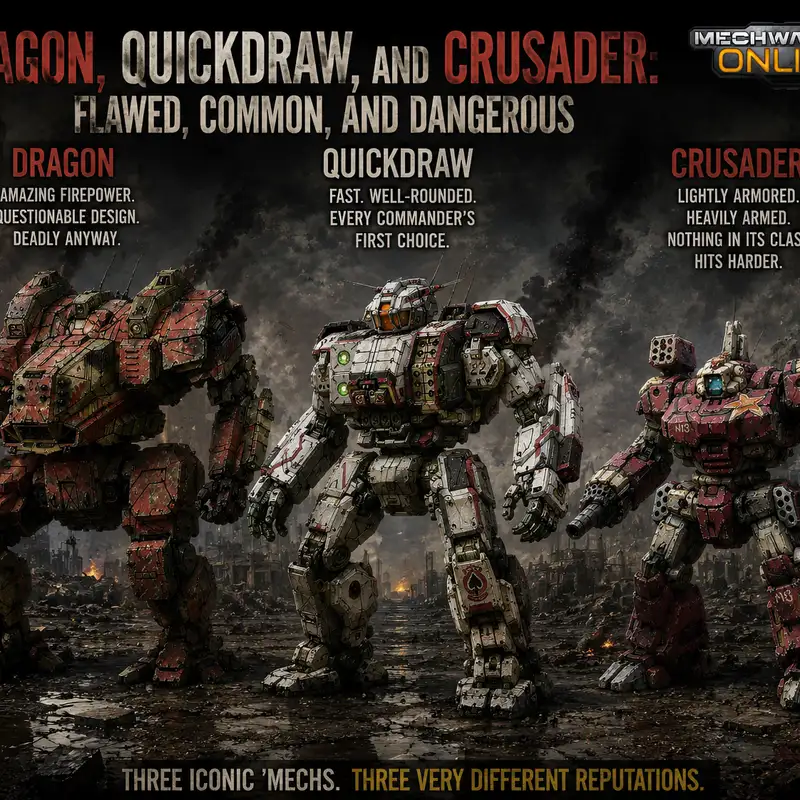
The Dragon, Quickdraw, and Crusader occupy an awkward part of BattleMech history. They are heavy machines without the overwhelming protection or firepower usually associated with the class. Their original configurations contain compromises obvious enough to attract criticism from pilots, technicians, and anyone with a clean sheet of paper. Yet armies did not fight wars on clean paper. They fought with factories already built, spare parts already stocked, and crews already trained. These three designs endured because they could perform useful work across many campaigns, and because a flawed machine available by the company was often more valuable than an excellent machine available by reputation.
Luthien Armor Works introduced the Dragon one N in the year twenty-seven fifty-four as a candidate to replace the Shadow Hawk. The Star League Defense Force rejected it in favor of improving the older machine. The Draconis Combine quietly adopted the design instead, and that rejection became one of House Kurita’s most productive procurement opportunities. When the Star League dissolved and the Successor States began consuming inherited arsenals, the Combine possessed a modern heavy BattleMech built on defended industrial worlds. The Dragon did not need to win an international competition. It needed to keep leaving Luthien Armor Works in numbers the Draconis Combine Mustered Soldiery could absorb.
At sixty tons, the Dragon used a powerful three hundred-rated fusion engine to reach roughly eighty-six kilometers per hour. That speed placed it closer to many medium BattleMechs than to the slower heavies it often fought beside. Ten tons of armor protected the chassis, with particularly useful coverage around the torso and rear. Its low, squat profile made it stable and harder to knock down than its mass suggested. The Dragon could advance through fire, change sectors faster than many enemy heavies, and remain difficult to finish once the fight became confused. What it could not do was jump. Broken terrain, walls, and ravines could still dictate its route.
The standard weapons fit was efficient rather than imposing. A class five autocannon in the right arm and a ten-tube long-range missile launcher in the torso gave the Dragon respectable fire while it closed. One medium laser fired forward from the left arm, and another protected the rear. The ammunition supply was unusually generous. The autocannon carried forty rounds, while the missile launcher had enough reloads for twenty-four volleys. The machine could remain active through extended operations without demanding immediate resupply. It also carried no weapon that frightened another heavy BattleMech by itself. The Dragon created danger through movement, endurance, and repeated hits rather than one decisive opening salvo.
That modest firepower was the design’s most obvious flaw. A Warhammer, Marauder, or Thunderbolt could bring more destructive force to the same exchange. Even some medium BattleMechs could challenge the Dragon’s forward battery. The rear laser consumed mass that many pilots would rather have aimed toward the enemy, while the long-range weapons produced steady damage without quickly breaking heavy armor. A Dragon fighting alone could appear underarmed for its weight. A company of Dragons was a different problem. Their speed allowed several machines to concentrate, maintain pressure, and exploit a flank before slower defenders could reorganize.
Combine doctrine turned that concentration into the Dragon’s real weapon. The machine could screen heavier units, lead mobile assaults, pursue damaged enemies, or operate as the durable center of a fast formation. Once close, sixty tons of armor and structure gave the pilot powerful physical options. The autocannon’s protective sleeve allowed the right arm to survive rough treatment better than many gun mounts, and Dragon pilots often finished an engagement with kicks or body blows. The machine was not a classic close-range brawler in its weapons fit. It became one because its speed delivered mass to the point where mass itself could be used as a weapon.
The Dragon’s recurring mechanical weakness was its hip actuator, which required frequent maintenance and periodic overhaul. That problem mattered because the entire design depended on mobility. A degraded hip did not merely reduce convenience. It threatened the ability to concentrate, pursue, and withdraw. Combine technicians learned the machine intimately because they had little choice. A battalion containing many Dragons also contained a maintenance organization stocked for their joints, armor, autocannon feeds, and engines. Repetition created efficiency. The defect never disappeared, but the institution became better at preventing it from deciding a battle.
Scale made the Dragon common. During the Succession Wars, nearly every Draconis Combine battalion and almost every company fielded at least one, while some formations were built around the design in much larger numbers. Captured machines entered Federated Suns and Lyran service, mercenaries acquired them, and the Free Rasalhague Republic inherited examples after independence. The Dragon’s silhouette became inseparable from House Kurita not because no one else could pilot it, but because the Combine could replace, repair, and organize it at a scale rivals rarely matched. Familiarity also made enemies underestimate it. They saw a predictable machine and sometimes forgot that predictable doctrine can still be executed well.
The Grand Dragon eventually demonstrated how much potential remained in the chassis. Replacing the standard autocannon with a particle projection cannon gave the machine a stronger energy weapon and reduced some dependence on ballistic ammunition. Prototypes appeared around the late Succession Wars, and production expanded from the year thirty forty onward as factories converted to the improved design. By the middle of the thirty-first century, original Dragon production was being phased out. The replacement did not prove the Dragon had been useless. It proved that the original engine, armor, and mobility had always deserved a better main gun.
The Quickdraw shared the Dragon’s sixty-ton mass and three hundred-rated engine, but pursued mobility much more aggressively. Technicron Manufacturing introduced the four G in the year twenty-seven seventy-nine as a proposed replacement for the Rifleman. Very few reached regiments before the First Succession War began seven years later, and the machine never displaced its intended predecessor. The comparison had been poorly chosen. The Rifleman was a specialized anti-aircraft and fire-support platform. The Quickdraw was a mobile skirmisher whose best work occurred while crossing difficult ground, threatening a flank, and making itself irritatingly hard to surround.
Its ground speed matched the Dragon at about eighty-six kilometers per hour. Five jump jets added the ability to cross roughly one hundred fifty meters in a bound. The Quickdraw could clear a stream, jump from one urban block to another, or rise onto a ridge without following a road under enemy observation. Highly articulated ankles helped it maintain footing on gravel, mud, ice, and steep slopes. The machine could operate where many heavies became cautious. Its mobility was not a minor enhancement. It was the design’s central defense, tactical advantage, and maintenance concern.
Those same ankle assemblies were notoriously exposed. The circular rotor housing could be damaged by weapons fire or a well-placed kick, crippling the machine’s movement. A Quickdraw that lost mobility also lost the quality that justified its light protection. Eight tons of armor was limited for a heavy BattleMech, leaving little margin once concentrated fire began landing. The design therefore created a harsh relationship between pilot skill and survivability. A careful pilot used terrain and jump routes to avoid clean shots. An aggressive pilot who confused mobility with invulnerability often delivered a damaged Quickdraw directly to the recovery crews.
The weapons fit looked broad on paper. A ten-tube long-range missile launcher provided reach, a four-tube short-range launcher exploited damaged armor, and four medium lasers covered close combat. Two of those lasers faced rearward from the right torso. The arm actuators could bend backward, allowing the arm-mounted lasers to join them and place all four beams into an enemy behind the machine. That feature made pursuit dangerous and supported the Quickdraw’s role as a skirmisher. It also meant that half the standard laser battery was not normally pointed toward the target during a forward attack.
Heat forced the pilot to decide how much of that firepower was truly available. Thirteen single heat sinks could not comfortably dissipate the full weapons load, especially after a jump. A Quickdraw firing its missiles and forward lasers while moving hard accumulated heat quickly. Turning the arms backward to punish a pursuer produced an impressive defensive volley, but it did not make the cooling system more charitable. The machine fought best in pulses. It jumped, fired a selected group of weapons, broke contact, and cooled before returning. Remaining in one position for a prolonged exchange converted tactical flexibility into a steadily rising cockpit temperature.
Used correctly, the Quickdraw was dangerous because it could alter the geometry of a fight. It could reinforce a threatened flank faster than a slower heavy, follow medium BattleMechs through broken ground, or jump behind an enemy that believed its rear was protected by terrain. It could raid, pursue, screen a withdrawal, and punish anyone who followed too closely. It was less successful when assigned to stand beside an Archer or Warhammer and trade fire. The Quickdraw was a heavy machine for commanders who needed movement more than dominance. That distinction was sometimes lost during the Succession Wars, usually at the pilot’s expense.
Despite failing to replace the Rifleman, the Quickdraw spread through every Successor State. Conventional technology made it understandable to factories and field workshops. Its speed allowed it to fill gaps in mixed formations, while its weapons covered enough ranges to remain useful after casualties disrupted the original plan. No state needed to redesign its entire doctrine around the machine. It could be assigned where a fast heavy, durable medium, or mobile reserve was missing. Procurement officers appreciate equipment that solves several shortages at once, even when it solves none of them perfectly.
Variants reveal repeated attempts to correct the Quickdraw’s strange weapon arrangement and heat burden. The four H moved more firepower into the forward arc. The five A removed the long-range missile launcher for additional forward lasers and heat sinks, but the greater energy battery still demanded restraint. The five K and five M used recovered Star League technology, including double heat sinks and improved armor protection, to make the machine more sustainable. Newer models gradually replaced the oldest four Gs in major armies, while original machines remained common in Periphery forces and less affluent mercenary commands. The Quickdraw survived because every improvement could begin with a chassis already worth moving.
The Crusader was older than both. Its lineage began in the year twenty-five ninety-six, and early models saw combat during the Reunification War. The familiar three R entered production in the year twenty-seven fifty-two, near the height of Star League military power. TharHes Industries and other manufacturers turned the design into a widespread Star League Defense Force workhorse. It had originally been conceived for close combat, but its weapon mix allowed it to perform fire support, anti-aircraft defense, counterinsurgency, and general line duties. The Crusader became common because it was difficult to find a mission for which it was completely unsuitable.
At sixty-five tons, the three R moved at a maximum speed of roughly sixty-five kilometers per hour. It carried no jump jets, but twelve tons of armor gave it strong protection, especially around the legs. The machine could remain near the main line, absorb punishment, and continue fighting after lighter missile carriers would have withdrawn. Its hands and reinforced lower body also made it effective in physical combat. The Crusader was not fast enough to dictate every engagement. It was durable enough to remain relevant as the engagement moved from long range to a very personal distance.
Its weapons appeared to cover almost every battlefield requirement. Two fifteen-tube long-range missile launchers provided a thirty-missile barrage. Two six-tube short-range launchers, mounted in the legs at hip height, added a heavy close-range volley. Each arm carried a medium laser and a machine gun along with the long-range launcher. The machine could support an advance, defend itself against infantry, and continue attacking once the enemy moved inside the preferred missile distance. Few standard heavy BattleMechs offered that much range flexibility. Few asked the pilot to manage so many ammunition feeds at once.
The Crusader’s flaw was not a shortage of weapons. It was the inability to use all of them freely. Ten single heat sinks were inadequate for continuous firing across the full battery. Both long-range launchers could already strain the cooling system during movement. Closing and adding the short-range missiles and lasers created a larger heat burden precisely when the pilot needed full mobility and accurate control. The correct firing pattern changed with distance. Long-range salvos shaped the approach. Close-range weapons replaced them rather than simply joining them. A pilot who treated every launcher as permanently available could become a stationary target surrounded by several tons of increasingly nervous ammunition.
That ammunition was distributed through the side and center torso. The long-range reloads occupied the side sections, while short-range missiles and machine-gun ammunition sat near the center of the machine. Before cellular protection became common, a penetrating hit could produce catastrophic consequences. The Crusader carried the tools for several missions and the explosive risk of carrying all their supplies at once. Early models also suffered heat-related stress around the arm-mounted launchers and lasers. Engineers corrected that problem with distinctive collars that diverted hot gases away from vulnerable actuators and internal structure. The solution was practical, visible, and less expensive than admitting the arms had been designed too enthusiastically.
The Crusader remained dangerous because its transitions were difficult for an enemy to exploit. A missile boat often became less useful once attackers closed. A brawler often suffered while crossing long-range fire. The Crusader could begin as fire support and finish as a close-combat machine. Its leg-mounted short-range launchers remained stable while the arms tracked other targets, and the heavy armor allowed it to survive the change in range. The machine did not excel as much as an Archer at bombardment or a dedicated assault design at close combat. It made the enemy face a credible threat throughout the movement between those conditions.
Production made the Crusader nearly impossible to erase. Factories on Tharkad, Oliver, Asuncion, and Bernardo kept the design available after the Star League fell. Every Successor State fielded examples, and House Steiner became especially associated with the machine. Lyran technicians were known for returning damaged Crusaders to service quickly, an advantage made possible by experience, parts, and a design considered rugged and straightforward to maintain. A machine repaired in one day contributes more to a campaign than a superior machine awaiting a component from another world. The Crusader turned that unromantic truth into centuries of service.
Its early variants addressed the heat problem with the directness expected of field armies. The Federated Suns’ three D reduced the short-range missile launchers and removed the machine guns to add cooling. The Draconis Combine’s three K reduced the long-range launchers and also removed the machine guns for even more heat sinks. The Capellan three L used smaller missile racks to add both cooling and jump jets. Each state gave up part of the original all-range battery to make the remaining weapons easier to use. The existence of several successful answers showed that the standard three R’s problem was real. Their continued resemblance to the original showed that the chassis was not.
Placed together, the Dragon, Quickdraw, and Crusader reveal three different ways a heavy BattleMech could be dangerous without being ideal. The Dragon used speed, armor, endurance, and massed employment to compensate for modest firepower. The Quickdraw used jumping mobility and unusual firing arcs to compensate for thin armor and limited cooling. The Crusader used a broad weapons suite and rugged protection to compensate for heat and ammunition risk. None could ignore its weakness. Each could force the enemy to deal with a strength that remained useful across many ordinary battles.
Their logistics shaped those strengths. The Dragon carried deep ammunition reserves but demanded attention to its hip actuators. The Quickdraw needed two missile types, jump-jet maintenance, and careful inspection of exposed ankle assemblies. The Crusader consumed large quantities of missiles and placed several magazines inside a machine expected to remain close to the fighting. All three occupied full BattleMech bays aboard DropShips and required heavy recovery equipment after serious damage. Common did not mean cheap. It meant the industrial and military system had already decided the expense was familiar enough to manage.
Enemies learned specific counters. Against Dragons, they tried to exploit the limited forward firepower, deny room for coordinated movement, and damage the hips before the machines reached physical range. Against Quickdraws, they targeted the ankles, forced continuous firing, and waited for heat or thin armor to reduce mobility. Against Crusaders, they disrupted spotters, attacked ammunition support, and concentrated fire on the torso magazines. These methods worked against isolated machines. The problem was that common BattleMechs rarely appeared as isolated curiosities. They arrived inside formations whose commanders had spent generations learning the same weaknesses.
That institutional memory explains why reputation and battlefield utility often diverged. A technical comparison can make the Dragon look undergunned, the Quickdraw look fragile, and the Crusader look overarmed for its cooling system. A campaign map asks different questions. Which machine can march with the available regiment? Which factory can replace the actuator? Which ammunition is already in the depot? Which technicians have repaired this chassis for twenty years? Which pilot knows exactly how far to push the heat before breaking contact? The answers repeatedly favored machines that critics considered compromises.
The Dragon, Quickdraw, and Crusader became dangerous because their flaws were known, not because their flaws were imaginary. Armies wrote tactics around them. Technicians stocked the right parts. Pilots learned which exchanges to avoid and which moments justified the risk. Manufacturers produced improved variants without discarding the basic investment. An enemy facing one of these heavies was not facing a design specification. The enemy was facing a mature military habit backed by factories, training, salvage, and experience. Perfection may win a procurement argument. Common machinery, used with discipline, is what keeps returning to the battlefield.