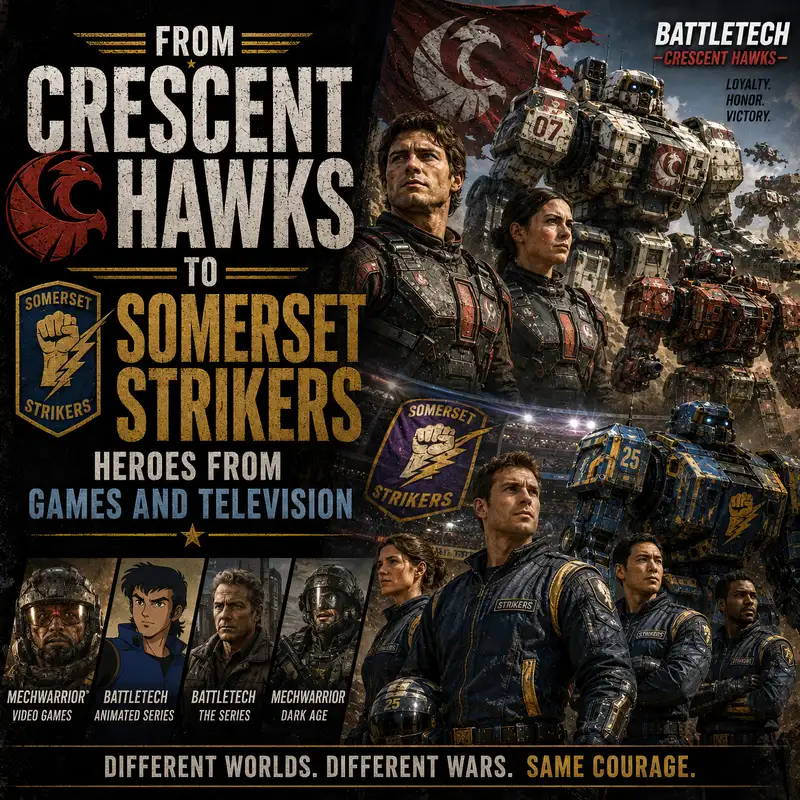
From Crescent Hawks to Somerset Strikers: Heroes From Games and Television
Jason Youngblood was supposed to be fighting a training exercise. The weapons around him were supposed to be simulated, the instructors were supposed to be watching, and the BattleMechs approaching the Pacifica Training School were supposed to behave like targets in a lesson. Then four Jenners opened fire with live weapons. The Citadel began coming apart, the chain of command disappeared, and an eighteen-year-old cadet discovered that the difference between practice and war could be measured in the time it took a laser to burn through armor.
For many BattleTech fans, that moment was not read in a novel or described across a tabletop map. It happened on a computer screen, with the player making Jason’s decisions. A few years later, another generation met Major Adam Steiner on television as Clan Jade Falcon overran Somerset. Between the Crescent Hawks games and the animated adventures of the First Somerset Strikers, BattleTech created heroes who did more than inhabit the setting. They taught audiences how to enter it.
These stories also require careful handling because they do not all occupy the same place in BattleTech continuity. The Crescent Hawks computer games were official licensed products, but the games themselves are treated as apocryphal rather than direct canon. Their major characters, units, and broad events were later incorporated into canonical publications. The animated series received an even more unusual solution. The First Somerset Strikers and many of their exploits are real within core continuity, while the television program is treated as a dramatized in-universe holovid whose producers improved the facts whenever accuracy interfered with morale.
The Crescent Hawk’s Inception appeared in the year nineteen eighty-eight, developed by Westwood Associates and published by Infocom. It was part role-playing game, part tactical combat game, and part introduction to the economics of being a MechWarrior. Jason could train in piloting and personal combat, purchase equipment, learn technical skills, earn or lose C-bills, and practice in a Locust, Wasp, or Chameleon. The path to military greatness began with coursework, repair shops, and personal finances, which is considerably closer to real organizational life than most heroic legends admit.
Jason’s famous father, Jeremiah Youngblood, commanded the original Crescent Hawks, a small special-operations force connected to House Steiner and the Kell Hounds. Jason therefore entered training with a family name already attached to expectations. He was not a seasoned regimental commander or a dynastic ruler. He was a cadet trying to become worthy of someone else’s reputation. The game used that inheritance to make the setting personal before it made the stakes interstellar.
The Draconis Combine attack on Pacifica, also known as Chara Three, transformed the training environment into an occupied world. Jason escaped the destruction of the Citadel and had to move through towns controlled by enemy troops, replace his uniform with civilian clothing, avoid patrols, and determine who could be trusted. The struggle was not a clean BattleMech duel. It was a resistance campaign in which information, disguise, local movement, and access to repair facilities mattered as much as gunnery.
Rex Pearce, an old comrade of Jeremiah’s, gave Jason a link to the original Crescent Hawks. Together they searched for other agents, recruited pilots and specialists, followed clues, and tried to recover the contents of a damaged holodisc left by Jeremiah. Some potential recruits were reliable. One might be an enemy agent. The player could assemble different versions of the unit, which meant the Crescent Hawks were not simply handed to Jason by the plot. They had to be rebuilt person by person while the occupation continued around them.
The objective was a hidden Star League depot that both Jeremiah and the Combine had been seeking. Inside were valuable spare parts and Jeremiah’s Phoenix Hawk Land-Air BattleMech. The cache was important, but it did not turn Jason into an invincible warrior. Its communications equipment allowed him to call for help, and its stored material gave House Steiner something worth recovering. Katrina Steiner’s arrival with a heavily armed DropShip helped break the invasion. The decisive lost technology was not a mystical superweapon. It was a functioning supply and communications system.
That distinction shaped Jason’s heroism. The player could improve skills, choose recruits, salvage or acquire machines, and decide how much risk to accept. Jason became a commander because the person at the keyboard learned how to preserve a fragile force. A damaged light BattleMech could be more valuable than a dramatic victory if it was the only machine available for the next patrol. The game made heroism procedural. It emerged from preparation, repeated judgment, and the occasional realization that stealing an UrbanMech from an arena would create several additional administrative complications.
The Crescent Hawks’ Revenge followed in the year nineteen ninety and changed the scale. Much of the open role-playing structure gave way to a sequence of tactical missions in which the player commanded multiple BattleMechs and supporting elements. Outcomes could alter later engagements. Enemies allowed to escape might return, and losses could narrow the options available in the next operation. Jason was no longer merely surviving an occupied planet. He was learning that command meant living with consequences created several missions earlier.
The sequel opened with the Crescent Hawks traveling toward a Kell Hounds base on Lyons. Their DropShip arrived during an attack and crash-landed, killing its pilot and placing the survivors directly inside the defense. They helped protect the base, recover equipment, and disrupt the attackers. Morgan Kell then supported Operation Liberty, a raid on Dieron intended to free Jeremiah Youngblood from imprisonment. Federated Suns armored forces helped create the opening, while Jason’s small unit penetrated the prison complex.
The rescue was a heroic objective with a grim result. Jeremiah was recovered, but later canonical accounts made clear that captivity and torture had left him physically and psychologically broken. He did not emerge as the restored patriarch ready to resume command. Jason had accomplished the mission and still could not recover the father he remembered. That consequence separated the Crescent Hawks from simpler adventure stories. BattleTech often allows people to be rescued without pretending they can be returned unchanged.
The game then carried the unit through the War of thirty thirty-nine and into larger operations. The player had to choose assignments, coordinate lances, protect convoys, manage withdrawals, and fight through battles that did not revolve entirely around Jason’s personal machine. This reflected an important change in perspective. A MechWarrior sees the enemy in front of the cockpit. A commander must also see the unit that is low on ammunition, the road that must remain open, and the force that will be needed after the apparent objective has been secured.
Its final campaigns brought the Crescent Hawks into the Clan invasion. By then, the unit had grown into a company and received training on recovered technology before joining the Kell Hounds in the defense of Luthien. Jason, whose life had been shaped by hatred of the Draconis Combine, now fought to defend the Kurita capital against Clan Smoke Jaguar and Clan Nova Cat. The alliance was not sentimental reconciliation. If Luthien fell, the entire Inner Sphere would face a more dangerous strategic situation. Jason’s mature test was whether he could place that reality above his personal history.
The broad outline of that story later entered core continuity, though individual missions and details were revised. Jason fought at Luthien, lost his Phoenix Hawk Land-Air BattleMech, and eventually returned to Pacifica as an instructor in anti-Clan warfare. The cadet whose education had been interrupted by an invasion became the veteran responsible for preparing others. Later generations of the Youngblood family carried the Crescent Hawk name, allowing a player-created legend to become an inherited institution inside the setting.
The importance of the Crescent Hawks was therefore larger than their unit strength. The games gave the player an accessible identity inside a complicated universe. Jason was close enough to famous figures such as Katrina Steiner and Morgan Kell to connect with the wider history, but small enough that one recruit, one repair, or one salvaged machine could matter. The Human Sphere was introduced from the ground level, where strategic events arrived as damaged DropShips, missing relatives, and bills that still had to be paid after the victory screen.
Television required a different kind of hero. BattleTech’s animated series appeared in the year nineteen ninety-four and had only a brief running time in which to explain the Clan invasion, the Federated Commonwealth, House Kurita, interstellar travel, BattleMechs, Elementals, and several rival systems of honor. The solution was not subtle. It was, however, memorable. Clan machines became visually distinct, enhanced imaging transformed cockpit combat, and every political problem was given a face who could argue about it before the next weapons exchange.
The opening disaster belonged to Somerset. Clan Jade Falcon struck the world during the first wave of the invasion, destroyed the local defenses, and captured the military academy commanded by Andrew Steiner. Andrew’s brother Adam was serving as an instructor at the Nagelring on Tharkad. Adam asked for permission to lead a reconnaissance mission behind the Clan advance. His official purpose was intelligence collection. His personal purpose was to retake his home and rescue his brother. Those objectives pointed in the same direction until they did not.
Adam could not simply request a regiment and several transports. The Federated Commonwealth was already reacting to a strategic emergency and lacked spare JumpShips. His opportunity arrived when authorities impounded the Draconis Combine merchant JumpShip Katana and its DropShip Kwaidan. Adam commandeered both vessels, along with their deeply unimpressed crews. The Combine later ordered those crews to cooperate against the common Clan threat. The First Somerset Strikers began not with a parade, but with a transportation dispute resolved by emergency authority.
The resulting team was deliberately mismatched. Rachel Specter served as Adam’s intelligence and tactical officer. Ciro Ramirez was a talented young Wolfhound pilot who resented being treated like a student. Zachary Miles Hawkins brought military experience and a strong distrust of the Combine. Valten Ryder was skilled, insubordinate, and accustomed to working outside respectable channels. Katiara Kylie was an aerospace cadet with more initiative than official permission. Franklin Sakamoto was a merchant and smuggler who knew the Katana, the Kwaidan, and several useful ways around regulations. Technicians and ship crews made the entire arrangement mobile.
Their mission produced the unit’s defining phrase: information is ammunition. The Strikers could not stop the invasion by defeating one Star Colonel. They could learn how Clan forces issued challenges, organized units, deployed Elementals, used OmniMechs, and interpreted surrender. In the canonical account, data and matériel taken during their raids contributed to Federated Commonwealth research on the Mad Dog OmniMech and Elemental battle armor. That knowledge helped solve problems affecting the Bushwacker BattleMech and the Infiltrator and Sloth battle armor programs.
The television series made Clan Jade Falcon understandable by concentrating its threat in Star Colonel Nicolai Malthus, usually seen in a Summoner, and in officers such as Kristen Redmond and the Elemental commander Pytor. They were antagonists, but their behavior was shaped by institutions rather than unexplained evil. They issued batchalls, bid away forces, took bondsmen, and treated ritualized combat as proof of political legitimacy. The Strikers often saw arrogance. The Falcons saw opponents who refused the rules that made warfare meaningful in Clan society.
That misunderstanding created both danger and opportunity. Adam learned that Clan honor could limit enemy behavior, but only if he understood the exact terms being offered. Malthus learned that Inner Sphere soldiers would use ambushes, mines, corrupted software, hidden weapons, and withdrawal without considering those actions shameful. Each side repeatedly mistook a different military culture for a lack of culture. The Strikers survived because they adapted faster than their opponents accepted that adaptation was necessary.
Ciro Ramirez made the conflict personal. Captured on Romulus, he became a Jade Falcon bondsman and eventually chose to join the Clan warrior system. The animated version presents the transformation quickly, but the core idea is important. Ciro was ambitious, proud, and frustrated by his position in the Federated Commonwealth. Clan society offered him recognition, a direct warrior identity, and an explanation for why his talents had been undervalued. His decision did not make Clan rule benevolent. It showed why conquest can attract some of the people it subordinates.
Adam’s growth came from learning that his private rescue mission could not consume every strategic opportunity. He had to protect intelligence, preserve the captured transport, cooperate with people he distrusted, and sometimes place the wider war ahead of Somerset. The Strikers remained a small irregular force, not an army capable of holding every world it touched. Their successes depended on mobility and surprise. Once the Clans concentrated against them, courage alone could not create reinforcements.
The holovid’s climax compressed those contradictions into a Trial of Possession. After the Strikers retook the Somerset Military Academy, Adam and Malthus fought for control of the planet. Their BattleMechs were disabled, and the duel continued on foot until Malthus conceded. Adam believed he had recovered Somerset. Malthus honored the agreement literally by withdrawing Clan troops while taking the planet’s population, including Andrew Steiner, with him. The hero won the contest and received an empty world. It was an unusually sharp ending for a program designed to sell heroic certainty.
Core continuity preserves the achievement while changing the details. The real First Somerset Strikers briefly recaptured Somerset from second-line Jade Falcon forces in November of the year thirty fifty. The Federated Commonwealth judged the position impossible to reinforce and ordered Adam to withdraw. The Falcons retook the undefended world during their next advance. The population was not carried away as depicted. Several exploits shown as part of the Somerset mission were drawn from a later and larger raid against Barcelona in the year thirty fifty-two.
The canonical sourcebook published in the year nineteen ninety-five explained the difference with an elegant piece of BattleTech bureaucracy. The animated series became a Tharkad Broadcast Company production released after Tukayyid. It was a morale program based loosely on the real Strikers, combining missions, simplifying technology, exaggerating personalities, and improving the ending until it fit the needs of wartime broadcasting. In-universe critics disliked it. Young viewers watched it, merchandise sold, and military recruiting improved. Accuracy lost the review board and won the budget meeting.
That framing allowed the setting to preserve both versions without pretending they were identical. The sourcebook treated the characters and broad operations as historical, while visual oddities and contradictions became artistic license or propaganda. The BattleMech identified as a Mauler, for example, fits the earlier Daboku more closely in the established timeline. Enhanced imaging, experimental equipment, and simplified unit strengths could be translated into game rules or corrected in later histories. The cartoon remained enjoyable precisely because it no longer had to function as an unedited combat report.
The characters also outgrew the program. Adam Steiner continued through core history, rose to senior command, and eventually became Archon during the Word of Blake Jihad. Rachel Specter remained an important officer in his career. Ciro’s allegiance to Clan Jade Falcon later raised legal questions about whether a captured bondsman who accepted Clan identity had committed treason or survived coercion. The Somerset story did not end when the broadcast did. It became the early chapter of lives that were allowed to become more complicated than their television roles.
Jason Youngblood and Adam Steiner represent two different ways of creating a BattleTech hero. Jason began as a player’s responsibility. His character emerged through training choices, recruitment, tactical decisions, and the preservation of a small unit. Adam arrived as a written protagonist with a defined voice, a visible family crisis, and a team built for conflict. Jason taught players to command. Adam taught viewers to interpret a new enemy. Both began by trying to save family members and matured when the larger war demanded more than personal revenge.
Their supporting casts were equally important. Rex Pearce connected Jason to his father’s generation, while technicians and recruits made the Crescent Hawks functional. Rachel, Franklin, Hawk, Val, Katiara, and Ciro forced Adam to lead people who did not share one culture or one reason for serving. Neither unit was a collection of solitary aces. Each story made teamwork visible, along with the transport crews, intelligence officers, and repair personnel that allow BattleMechs to matter beyond one engagement.
Games and television simplified BattleTech, but simplification was not automatically distortion. The computer games reduced centuries of politics to decisions a player could understand from one occupied planet. The animated series reduced the Clan invasion to a small team pursued by one memorable rival. Those choices created clear entry points. The deeper setting remained available behind them, ready to explain why House Kurita could be both Jason’s enemy and his ally, or why Malthus could keep his word while still producing a strategic tragedy.
The best measure of these heroes is not whether every mission happened exactly as shown. It is whether the stories captured the military and human logic of the setting. Small units survive through information, transport, maintenance, and trust. Personal motives can begin a campaign but cannot sustain one. Victory may recover a prison, a data core, or a planet without repairing the people damaged along the way. Propaganda can preserve a name while altering the event that created it.
The Crescent Hawks and the Somerset Strikers endured because they gave audiences someone to stand beside while the Human Sphere became understandable. One story began when live fire entered a training exercise. The other became, inside the setting itself, a televised version of history edited for morale. Between them lies a distinctly BattleTech idea of heroism: people make imperfect decisions with limited forces, later generations argue about what really happened, and the machines remain memorable because the human choices inside them still matter.