How Clan Society Actually Works
A Clan laborer can spend a lifetime mining the ore used in an OmniMech, yet never decide where that machine is sent. A technician may understand its reactor better than the warrior assigned to pilot it, but the warrior stands above both in law, status, and political power. Clan society calls this efficient. Its critics call it tyranny. Both are partly correct, because the Clans are not merely armies with civilian support. They are complete societies built to ensure warriors rule while everyone else keeps the ruling system alive.
Nicholas Kerensky designed that system after watching the Star League in Exile destroy itself. The Pentagon Civil War showed him soldiers dividing by nationality, ambition, and personal loyalty. His answer was not representative government. It was to replace inherited identities with assigned functions. Every person would belong first to a Clan and second to a caste. Competition would remain, but it would be regulated through ritual, testing, and controlled violence rather than allowed to expand into unrestricted civil war.
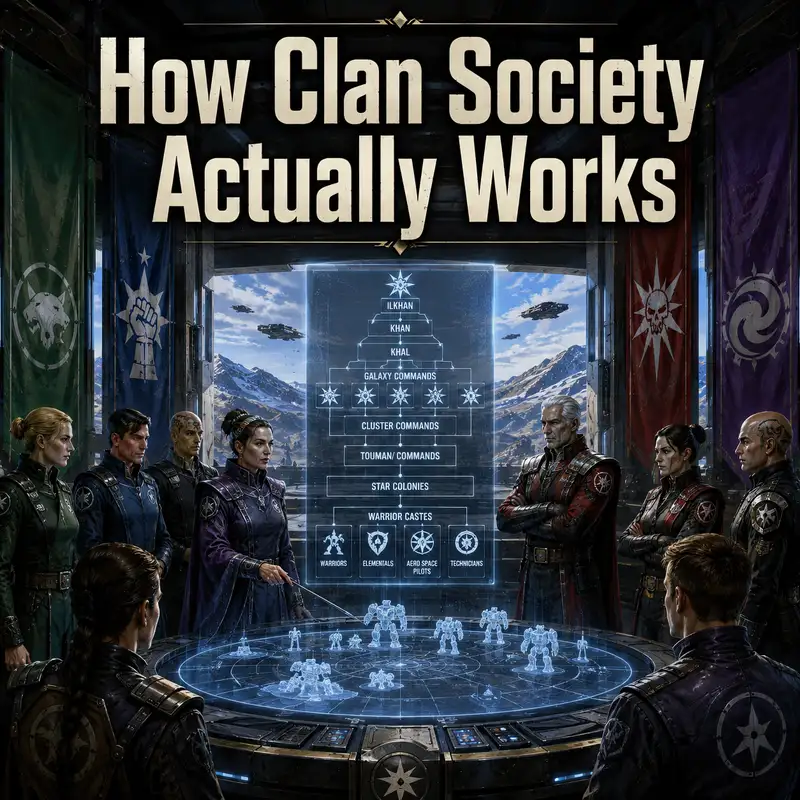
The five official castes are warriors, scientists, technicians, merchants, and laborers. A sixth group, the Dark Caste, exists outside the system for criminals, fugitives, rebels, and people who reject their assigned place. The structure resembles an organization chart, with warriors at the top and laborers at the bottom. Yet caste determines much more than employment. It shapes education, housing, social prestige, access to resources, reproductive expectations, legal standing, and political influence.
The warrior caste is the smallest and most prestigious. Its members command the military, provide much of the police power, sit in the governing councils, and define what the Clan considers honorable. Warriors are taught to view themselves as protectors. The official argument is that every caste supports them because only warriors can defend the Clan and preserve Kerensky's mission. The practical arrangement is less generous. The caste controlling the weapons also decides what protection is worth.
Within the warrior caste, the deepest division is between trueborns and freeborns. A trueborn is artificially conceived from selected genetic legacies and developed in an artificial womb. The donors are called the genefather and genemother, terms describing genetic contribution rather than parenthood. Trueborns are not simple clones. Scientists combine established lines and screen for harmful traits, seeking candidates suited for MechWarrior, aerospace, or Elemental service. Training and competition then determine who remains a warrior.
Trueborn children are raised communally in crèches before entering a sibko, a sibling company formed from related genetic combinations. A sibko may begin with dozens of cadets and sometimes as many as one hundred. They train together in academics, conditioning, Clan history, tactics, and their intended military specialty. Their strongest bonds are usually to sibkin rather than biological parents they may never meet. The Clan becomes family in theory. In practice, the sibko is the family sharing meals, injuries, punishment, and ruthless competition.
Attrition is deliberate. Cadets face examinations and combat exercises, and failure can remove them from the warrior path before the final test. Around age twenty, survivors fight a Trial of Position. Their performance determines whether they become warriors and what rank they receive. A cadet who defeats one opponent may enter the ranks. Greater success brings higher standing. Failure usually means transfer to a civilian caste. The system claims to select merit, but it asks children to prove their worth through violence.
Testing down is one of Clan society's defining procedures. A failed warrior candidate is not automatically killed. The Clan has invested too much food, education, and medical care to waste useful labor. Many test-downs become technicians, police, or laborers. They often carry better training than their new peers, but also the stigma of failure. Reassignment preserves a life while stripping away the identity that life was built around. Efficiency and cruelty are frequently the same procedure viewed from different sides.
Freeborns are conceived naturally, usually within the civilian castes, though some earn warrior training. Most trueborns regard them as inferior and use the insult freebirth openly. Freeborn warriors are commonly placed in second-line, garrison, or less prestigious formations regardless of ability. Exceptional individuals can rise to command, but the exceptions are memorable because the barrier is real. Clan rhetoric praises achievement, yet birth method influences training, expectations, and access to opportunity. It is meritocracy with starting positions assigned in advance.
Even a successful trueborn does not automatically possess political power. That requires a Bloodname, one of the surnames inherited from the original founders. Warriors normally use only a given name until they win the right to carry one. Eligibility follows a recognized genetic line, usually through the genemother's heritage. When a Bloodright becomes vacant, candidates compete in a Trial of Bloodright, a single-elimination series of duels. The winner gains both a name and entry into the ruling class.
A Bloodname is more than a decoration. Bloodnamed warriors may sit on a Clan Council, compete to become Khan, and have their genes selected for future trueborns. Each Bloodname traditionally contains up to twenty-five Bloodrights, though political reavings can reduce that number. Clan society abolished ordinary hereditary nobility, then rebuilt a form of nobility around ancestry and combat. The surname is not inherited automatically, but only those with the correct lineage may fight for it.
Each Clan is governed by a Clan Council composed of its Bloodnamed warriors. The council decides major policy and elects a Khan and saKhan. The Khan leads the Clan and commands its military power, while the saKhan serves as deputy and often directs major operations. A Loremaster preserves law, history, and precedent while managing formal proceedings. This is not simple dictatorship by one commander. A Khan can be challenged or replaced. The limitation is that almost everyone entitled to participate belongs to the same military elite.
Above the individual Clans sits the Grand Council. Each Clan is represented by its Khan and saKhan, and the body rules on matters affecting all Clans. It acts as the highest court for inter-Clan disputes, regulates major Trials, and can authorize measures such as Absorption, Abjuration, or Annihilation. During a common emergency, it may elect an ilKhan to coordinate all Clan forces. Clan government therefore contains voting, courts, legal challenges, and checks on leaders. It reserves those mechanisms primarily for warriors.
The paradox is that warriors do not handle most daily government. Civilian caste councils, guilds, conclaves, and local assemblies manage agriculture, factories, transport, housing, medicine, education, and infrastructure. They study problems, prepare recommendations, and carry out approved work. Clan Councils often endorse their proposals because a Bloodnamed MechWarrior may be excellent at destroying a power station and sensibly reluctant to explain how its coolant pumps should be replaced. Warriors set priorities and retain final authority. Civilians keep those priorities from becoming slogans on a failing wall.
The scientist caste controls research, medicine, genetics, education, and the breeding programs central to warrior identity. Scientists create trueborn generations, assess children for aptitude, preserve knowledge, and develop medical systems that keep injured warriors alive. This gives them enormous quiet power over which bloodlines continue and which traits are valued. Warriors rank them below the military caste, yet the warrior ideal depends on scientists to produce its next generation. That contradiction eventually encouraged political resistance within parts of the caste.
Technicians keep almost everything functioning. They repair BattleMechs, fighters, vehicles, computers, power systems, and industrial machinery. They serve aboard DropShips, JumpShips, and WarShips, often providing much of the crew. Nurses, electricians, armorers, programmers, and specialized trades belong to the same broad caste. A warrior may claim a damaged OmniMech through a Trial of Possession, but it becomes useful only after technicians rebuild it, locate compatible parts, and explain why courage does not repair a cracked heat exchanger.
The relationship between warrior and technician can be close without being equal. Units depend on experienced technical teams, and sensible commanders value them. Yet technicians have limited political rights and may be blamed for failures caused by impossible schedules or inadequate parts. Warriors receive the honor of victory. Technicians often receive another machine requiring immediate repair. Clan efficiency rests on technical professionalism and the expectation that support personnel accept responsibility without comparable authority.
The merchant caste acquires materials, organizes production, manages trade, and moves goods through Clan territory. It includes traders, manufacturers, artisans, ship operators, and planners. Warriors often distrust merchants because negotiation appears less honorable than combat, although strong militaries require strong economies. Clan Sea Fox, once called Clan Diamond Shark, became the great exception by granting merchants unusual prestige and influence. The hierarchy is universal in principle, but individual Clans interpret it differently when reality becomes too profitable to ignore.
Clan economics do not resemble a typical Inner Sphere market. Productive assets belong to the Clan, private property is limited, and individuals receive work credits and access to food, housing, clothing, and amenities according to caste, grade, and performance. Civilian castes contain many levels of responsibility, allowing members to improve their conditions through advancement. Competition therefore survives wherever formal combat is absent. Office politics outlived the abolition of private corporations, which may be the best evidence that the Clans remain entirely human.
The laborer caste is the largest by far. Farmers, miners, builders, dockworkers, sanitation crews, and industrial workers provide the physical foundation of Clan civilization. They are officially honored as essential and socially treated as the lowest caste. Their work is often dangerous on the harsh Clan worlds. Laborers are not simply unskilled. Many possess deep practical expertise, but receive less education, fewer comforts, and little political influence. The warrior elite is numerically sustained by people who will never enter a Circle of Equals.
Scarcity shaped nearly every Clan custom. The early colonies had limited resources and hostile environments, so recycling and careful allocation became moral duties. Wastefulness is an insult suggesting indiscipline. Buildings, uniforms, machines, and household goods tend toward utility, while salvaged material is reused whenever possible. Even medical practices and organ transplantation reflect the refusal to discard something functional. The Clan military grew from a culture where every kilogram mattered and ceremonial combat was partly intended to prevent factories, cities, and trained personnel from being destroyed.
Ordinary Clan life is not necessarily luxurious. Military research produced superior weapons, armor, OmniMechs, battle armor, and advanced medicine, while civilian technology received less attention. A settlement might maintain a cutting-edge genetic laboratory beside austere housing. The system can regrow damaged tissue while deciding that additional living space would be wasteful. Technology follows political priorities. It does not improve every life equally.
Family life differs sharply by caste. Trueborn warriors do not grow up in conventional households and normally have no parental relationship with their geneparents. Their strongest bonds develop within the sibko, unit, and Clan. Among civilians, family connections survive more clearly, although reproduction remains regulated through caste expectations and genetic matching. Children are commonly raised through communal systems, and aptitude testing may redirect them into different work. The official purpose is efficient service. The state also claims a large role in deciding what a child is for.
Because reproduction is managed, sexual relationships are often separated from marriage, inheritance, and parenthood. Warriors may treat coupling as friendship without expecting a permanent household. Civilian partners can maintain personal relationships while meeting reproductive obligations assigned by caste. Customs vary, and lower-caste families often preserve stronger emotional continuity than warrior doctrine prefers to admit. Clan society tried to weaken the family as a rival loyalty. It never removed affection, jealousy, grief, or the desire to know one's origins.
Honor supplies the system's moral language. A Clansman is expected to keep promises, avoid waste, fulfill assigned duties, and place the Clan above comfort. This can produce remarkable trust. Theft is comparatively uncommon, agreements carry weight, and a person who gives their word is expected to act. The same culture turns dissent into moral failure. Refusing an assigned role is not merely a career choice. It can be judged un-Clanlike, selfish, or treasonous. Cooperation is strengthened by shared values and by the knowledge those values are not optional.
The Trials convert that moral system into law and politics. Trials of Position determine advancement. Trials of Possession decide control of territory, equipment, or genetic legacies. Trials of Refusal challenge decisions. Trials of Grievance settle personal disputes, while Trials of Bloodright award honored names. More extreme rituals can destroy or absorb entire Clans. Nicholas intended controlled combat to channel conflict away from total war. It often works, but it assumes physical victory is a reliable measure of political correctness.
A batchall formalizes many military challenges. The attacker identifies the objective and forces, the defender responds, and commanders bid to win with the smallest commitment. Zellbrigen may divide battle into individual duels. These customs are often dismissed as foolish theater, especially after Inner Sphere forces exploited them. Their purpose was rational. They limited casualties, protected infrastructure, and made disputes predictable. Their weakness was equally rational. A system based on mutual restraint performs poorly against an opponent who rejects its assumptions or values survival more than ceremonial fairness.
Clan justice follows the same hierarchy. Warrior police maintain order, while legal specialists investigate and present cases. Juries or caste councils judge offenses, with Clan Councils handling the most serious. Punishments include humiliation, loss of grade, physical penalties, exile, or death. Long imprisonment is uncommon because prisoners consume resources without producing useful work. Warriors may challenge some judgments through a Trial of Refusal. Civilians generally cannot. The law possesses procedures, but equality before that law is not one of its claims.
Bondsmen reveal another contradiction. A prisoner captured in combat may be placed under a bondholder and required to serve the victorious Clan. The bond is marked symbolically and enforced through honor, pressure, and the captor's authority rather than ordinary chains. Some bondsmen are released. Others are adopted after proving useful and loyal. Some remain in servitude for life. Clan culture describes the process as honorable incorporation, and talented enemies have become respected members. The captive's consent remains limited, making the distinction between tradition and coercion important.
Age creates its own pressure within the warrior caste. A warrior who can no longer compete for frontline status may be transferred to second-line or solahma service. Solahma units perform garrison, security, and desperate assault missions, giving older warriors a chance to die usefully in battle rather than retire quietly. This preserves the ideal that a warrior's value rests on combat performance. It also discards experience that another society might use for teaching, administration, or strategic planning. The Clans conserve metal with great care and sometimes spend veteran lives with remarkable enthusiasm.
Clan culture is not joyless. Visual art, sculpture, architecture, crafts, competitive sports, oral performance, and ritual remembrance all exist. The Remembrance preserves each Clan's account of its history in epic form, binding identity to the Exodus, Nicholas Kerensky, and later achievements. Written material and older cultural works can be restricted or censored, while oral traditions remain strong. Religion varies widely. Clan Cloud Cobra organizes spiritual communities called Cloisters, while Nova Cat, Coyote, and Goliath Scorpion traditions include forms of mysticism. The warrior hierarchy limits alternative power structures, but it never achieved complete uniformity of belief.
Nor are the Clans culturally interchangeable. Ghost Bear society places unusual value on family and communal loyalty. Sea Fox elevates commerce and merchant influence. Hell's Horses gives greater respect to combined arms and the contributions of different military branches. Cloud Cobra integrates religion into Clan identity. Smoke Jaguar historically represented a far harsher relationship between warriors and civilians. Geography, founding personalities, military experience, and political adaptation changed each Clan over centuries. The caste framework remained recognizable, but the lived experience inside it could differ considerably.
Contact with the Inner Sphere forced further change. Conquered populations could not always be reorganized immediately into traditional castes, and the invading Clans lacked enough administrators to manage every world directly. Some occupation zones used local institutions under Clan supervision. Others imposed harsher restructuring, relocated populations, or treated resistance as proof of inferiority. Clans that settled permanently among Inner Sphere societies adapted more than those remaining in the Homeworlds. Clan culture presents itself as fixed law inherited from the Founder. Its history shows continuous negotiation with conditions the Founder never anticipated.
The system's strengths are real. Clan society preserved advanced knowledge, mobilized scarce resources, produced highly trained specialists, and created institutions capable of transferring factories or cities between Clans without total administrative collapse. It offered many members predictable work, education suited to that work, basic material support, and a powerful common identity. Ritualized conflict often prevented disputes from becoming wars of extermination. The Clans did not endure for centuries because every civilian was constantly forced at gunpoint. Many people believed in the structure, found meaning within it, or judged its stability preferable to the chaos their ancestors had escaped.
Its weaknesses are equally real. Political authority is concentrated in a hereditary-competitive warrior elite. Freeborn prejudice wastes talent. Caste assignments limit individual choice. Civilian expertise can be overruled by warriors who possess status rather than understanding. The breeding program turns ancestry into public property. Trials confuse combat skill with justice. The system protects society from uncontrolled competition by making controlled competition the basis of nearly every institution. When the rules fail, the Clans can move from ritual restraint to collective punishment with alarming speed.
Clan society actually works because the warriors do not run all of it. Scientists plan, technicians maintain, merchants acquire, administrators coordinate, and laborers produce. The warrior caste supplies legitimacy, coercion, and strategic direction while claiming the achievements of the entire structure as proof of warrior superiority. That arrangement can be efficient, disciplined, and stable. It can also be rigid, unequal, and brutally intolerant of people who refuse their assigned purpose.
The clearest image of the Clans is therefore not a lone OmniMech issuing a challenge. It is the entire chain behind that machine: the scientist who shaped the pilot's bloodline, the instructors who reduced a sibko to its survivors, the merchant who obtained the materials, the laborers who processed them, and the technicians who kept the reactor alive. The warrior steps into the cockpit and receives the honor. Clan society works because millions of other people make certain the cockpit is there, then live under a political system built on the claim that this proves the warrior deserved to rule.