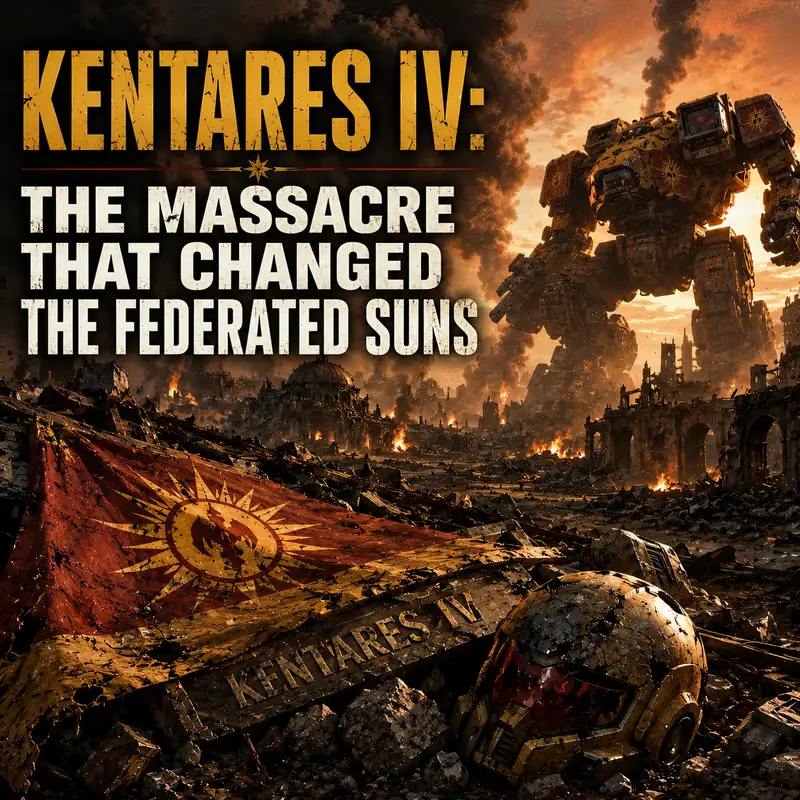
Kentares IV: The Massacre That Changed the Federated Suns
Sergeant Latha Pischel watched an elderly officer climb down from a BattleMaster near the town of New Snowfield. The man wore an ordinary Draconis Combine field uniform marked with a colonel’s insignia. He dismissed most of his escort and walked into a meadow with a Buddhist priest. Pischel was a sharpshooter of the Seventh Crucis Lancers, part of a battered resistance force being pushed through the Carmelite Mountains. He did what infantrymen are trained to do when a senior enemy officer presents an exposed target. He fired once, struck the man in the back, and withdrew. Only later did he learn that he had killed Coordinator Minoru Kurita, ruler of the Draconis Combine. The rifle shot was tactically routine. Its consequences were anything but routine.
By August of the year twenty-seven ninety-six, the Federated Suns was close to military disaster. The Draconis Combine had spent nearly a decade driving through Davion territory, first across the Draconis March and then into the Crucis March. Combine formations were only one jump from New Avalon, the Federated Suns capital. The Armed Forces of the Federated Suns still possessed strong units, but many had been defeated, scattered, or tied down on other fronts. Every retreat created another garrison requirement, another refugee movement, and another damaged supply line. House Davion had not ceased to function, but the strategic initiative belonged to House Kurita. Minoru was preparing the position from which he hoped to finish the campaign.
Kentares the Fourth mattered because offensives do not advance on courage alone. The Combine needed a forward logistics base able to receive DropShips, organize supplies, repair BattleMechs, and support the final approach to New Avalon. Its preferred depot on New Rhodes the Third had been compromised by resistance activity led by survivors of the Tenth Robinson Chevaliers. Kentares offered a replacement. It sat close enough to the front to shorten transport routes and possessed the infrastructure needed to support a large force. That made the planet more than another occupied world. It was intended to become the hinge of the Combine campaign, the place where an invasion that had outrun its supply system could pause, rebuild, and strike again.
The people defending Kentares understood that value. Surviving elements of the Seventh Crucis Lancers, local troops, and civilian resistance groups harassed occupation forces and interfered with preparations for the new base. They could not defeat the Draconis Combine Mustered Soldiery in open battle, but they could force it to escort convoys, search mountain routes, protect depots, and divert troops from the main advance. In June, Minoru accompanied the elite Sixth Sword of Light to the planet. Aerospace support and superior numbers broke the immediate resistance at the landing zone. Over the next month and a half, Combine forces compressed the defenders onto Bucholia and then into the Carmelite Mountain Chain. The resistance was losing ground, but it was still making Kentares expensive.
Near New Snowfield, Pischel’s platoon observed elements of the Sixth Sword of Light moving through the area. When the senior officer dismounted, Pischel recognized importance but not identity. Minoru was not dressed in ceremonial robes or surrounded by an unmistakable imperial procession. To a hidden Federated Suns infantryman, he looked like an elderly colonel who had made the questionable decision to stand in the open during a campaign. Pischel took the opportunity. The shot killed Minoru almost immediately, and the sniper slipped away in the confusion. There was no heroic duel, no speech, and no carefully designed assassination plan. One of the most consequential deaths in BattleTech history began with a soldier exploiting a moment of poor battlefield security.
The Federated Suns high command reacted with dread rather than celebration. First Prince John Davion knew Minoru’s son and successor by reputation. Jinjiro Kurita was intelligent and militarily capable, but he was also violent, unstable, and intensely attached to his father. John feared that the new Coordinator would answer the killing with an act of personal revenge. He ordered remaining Federated Suns troops evacuated from Kentares, reasoning that Jinjiro might have less reason to attack the planet if the responsible military forces were gone. JumpShips were diverted, and most of the surviving defenders escaped. The decision saved trained soldiers and denied the Combine prisoners. It also left millions of civilians without a field army between them and a ruler whom Davion leadership already considered dangerous.
Jinjiro arrived on Kentares and converted grief into state policy. He ordered his troops to kill the population. When an officer questioned the meaning of the order, Jinjiro had him killed. The Buddhist priest who had been with Minoru appealed for mercy and was murdered as well. These details matter because the massacre was not a confused episode at the end of a battle. The order was clarified, enforced, and sustained. From September eleventh of the year twenty-seven ninety-six until February fifteenth of the following year, Draconis Combine forces systematically hunted and executed the inhabitants of the planet. The operation lasted one hundred and fifty-seven days. More than fifty-two million people died, approximately ninety percent of the population.
The numbers can make the crime difficult to comprehend. Fifty-two million deaths did not result from one bomb, one artillery mission, or one panicked afternoon. They required checkpoints, searches, transportation, guard details, ammunition, reports, and a command system willing to keep the process moving for five months. Hospitals, residential districts, shelters, and isolated communities became targets. Even ComStar personnel on the world were not protected by their organization’s usual neutrality. At times, Jinjiro required executions to be conducted at close range rather than through modern weapons. The method forced soldiers to participate personally and made the act of obedience impossible to confuse with ordinary combat. Kentares was mass murder performed by a military bureaucracy.
That bureaucracy did not function without resistance from within. Some Combine troops began overlooking civilians during searches or concealing people who would otherwise have been killed. Others broke psychologically. Suicides increased among personnel who could not reconcile the order with their understanding of duty and honor. Units that had entered Kentares as disciplined combat formations emerged damaged in ways that replacement machines could not repair. Jinjiro believed revenge would demonstrate the power of House Kurita. Instead, he forced his own soldiers to choose between obedience to the Coordinator and the moral claims of the warrior code used to justify that obedience. Many obeyed. Some refused quietly. Almost none remained untouched.
Information escaped because people inside the occupation chose to preserve evidence. Members of Jinjiro’s command vehicle crew passed recordings to a local ComStar representative. Nolan Mordiki, responsible for the Kentares hyperpulse generator station, continued transmitting reports even as Combine troops threatened the facility. The communications network carried news beyond the planet. That did not save most of Kentares, but it prevented the government responsible from containing the story. In a war already filled with nuclear attacks and dead worlds, Kentares stood apart because the killings were deliberate, prolonged, and documented. The Federated Suns did not have to rely solely on rumors from retreating troops. It received evidence of an organized extermination carried out under the direct authority of the new Coordinator.
“Remember Kentares” became a rallying cry, but slogans do not move regiments by themselves. The massacre changed behavior because it gave scattered formations a common reason to accept risks they had previously avoided. By the autumn of the year twenty-seven ninety-seven, the Third Deneb Light Cavalry, the Seventh Crucis Lancers, and the Twentieth Syrtis Fusiliers were gathered around Goderich. All had recent ties to Kentares or the surrounding campaign. They broke discipline and launched attacks against nearby Combine positions without waiting for a carefully coordinated national offensive. By the middle of November, they had liberated Logandale and Marlette and ruptured defensive lines on both worlds. Other Federated Suns units began acting with the same aggression.
Those attacks succeeded partly because the Draconis Combine’s strategic position had deteriorated. Minoru’s advance had always depended on long and vulnerable supply routes. The destruction of the New Rhodes depot had already forced the Combine to improvise. Jinjiro then diverted combat formations, transportation, and command attention into the massacre rather than the drive on New Avalon. Occupied worlds demanded garrisons, while BattleMechs at the front needed parts, ammunition, technicians, and replacement pilots. Kentares did not create new Federated Suns regiments from anger. It changed the willingness of existing regiments to attack at the moment the enemy was overextended and morally disordered. Motivation met opportunity, which is usually more useful than motivation meeting a fortified line.
The initial counterattacks were also dangerous. Vengeance can produce momentum, but it can just as easily produce exhausted units, poor reconnaissance, and objectives selected for emotional rather than operational value. The three regiments around Goderich attacked before a unified plan existed. Their success made the indiscipline appear inspired. Failure would have made it look exactly like indiscipline. The Federated Suns needed political leadership able to turn anger into a sustainable campaign. John Davion began preparing a larger counterstroke, but he did not live to command it. In December of the year twenty-seven ninety-seven, an assassin killed John and his son Joshua at a field headquarters on Ipava. The identity and sponsorship of the killer remained uncertain.
The throne passed to Paul Davion, a nineteen-year-old with no opportunity for a quiet apprenticeship. He inherited a realm close to defeat, a traumatized population demanding action, and field commanders who had already demonstrated that they might attack without permission. One of Paul’s first important decisions was to approve the spontaneous assaults after the fact. He presented them not as failures of discipline but as victories belonging to the entire Federated Suns. This was shrewd politics, but it was more than propaganda. Punishing the commanders would have suppressed the very initiative the army needed. Allowing every unit to pursue private revenge would have destroyed operational control. Paul legitimized the energy, then began bringing it back under state authority.
The transformation was therefore both emotional and institutional. Kentares gave soldiers and civilians a shared grievance. Paul gave that grievance an organized military purpose. Intelligence networks improved, units were regrouped, transport was assigned, and counteroffensives were prepared against a Combine force that could no longer rely on effortless momentum. The official campaign began in the year twenty-eight oh one, with Paul personally directing operations to reclaim the Draconis March and relieve the pressure on the Crucis March. The Federated Suns army that returned to the offensive was not suddenly larger than the force that had retreated. It was better focused, more willing to accept losses, and supported by a population that now regarded the northern war as an existential struggle.
Kentares itself became an early objective. Liberating the planet carried political weight, but it also removed a potential Combine logistics base and secured a route needed for further operations. Federated Suns forces returned in the year twenty-eight oh one. Urban fighting around Amishton and Davisbury included Vulcan BattleMechs used to drive Combine infantry from built-up areas. The choice was practical. The Vulcan had been designed for anti-infantry and urban work. It was also a reminder that liberation could damage what the occupier had left standing. BattleMechs, artillery, and aerospace support do not become gentle because the flag on the command post has changed. The Federated Suns recovered Kentares, but recovery of sovereignty was not the same as recovery of the world.
The liberating troops discovered that the resistance had never entirely disappeared. A company-sized group from the Seventh Crucis Lancers, commanded by Captain Kieran McKinnon, had survived and continued harassing Combine forces after Jinjiro withdrew. Their attacks disrupted occupation troops, preserved local knowledge, and made the final liberation easier. The survivors became known as McKinnon’s Raiders. Paul later used their experience in long-range raiding during the broader counteroffensives. This was a concrete military legacy of Kentares. A nearly destroyed formation developed methods for surviving behind enemy lines, selecting vulnerable targets, and operating with limited support. The Federated Suns turned those methods against the extended logistics system that had once carried the Combine almost to New Avalon.
The war did not reverse in a single dramatic advance. The Federated Suns conducted several major counteroffensives over the next seventeen years. Worlds were liberated, lost routes reopened, and Combine garrisons forced to retreat or surrender. Progress depended on JumpShips, repair capacity, intelligence, and the ability to replace exhausted formations. It also depended on the Draconis Combine’s declining cohesion. By the year twenty-eight eighteen, Federated Suns forces had pushed the Combine back toward the prewar frontier, erasing most of Minoru’s gains. “Remember Kentares” accompanied the advance, but the slogan worked because Paul’s government connected memory to logistics and command. Anger supplied endurance. Organization turned endurance into territory.
Jinjiro never found a comparable answer. His order had damaged the moral authority of his command and the fighting quality of units expected to enforce it. Officers faced a Coordinator whose response to failure increasingly involved coercion, execution, and demands for attacks regardless of cost. The Draconis Combine Mustered Soldiery remained dangerous and professional in many formations, but professionalism cannot fully compensate for a command climate that punishes honest assessment. Soldiers who had watched Kentares unfold knew what obedience could require. Commanders who questioned policy knew what questioning might cost. The Combine did not collapse, but the force that had once advanced with confidence became more rigid, more defensive, and less able to adapt to a recovering opponent.
The massacre also changed the Federated Suns beyond the immediate campaign. The state had always contained regional loyalties and long-standing hostility along the Combine border. Kentares gave those feelings a national symbol. The Draconis March, in particular, carried the memory as evidence that House Kurita represented not merely a rival government but a threat to civilian survival. That interpretation endured for centuries. Military units, local nobles, and ordinary communities used Kentares to explain suspicion of the Combine even during periods of diplomacy. A border raid could be understood through the memory of the massacre. So could a peace proposal. Kentares unified the Suns in the First Succession War, but the unity came packaged with a durable political hatred.
The memory became formal. Kentares Day was observed on the first Friday of October as a national day of mourning. Memorial services were held across the Federated Suns. On Kentares itself, observance lasted longer, reflecting the difference between national commemoration and local grief. For citizens far from the Draconis March, the massacre became history, ceremony, and political identity. For survivors and their descendants, it was also an empty place at a family table and a community that no longer existed. Governments are very good at turning loss into symbols. Symbols can preserve truth and honor the dead. They can also simplify complex policy into a permanent instruction: never trust the other side.
The world never fully recovered. The Federated Suns restored control, built memorials, and later used Kentares as a military position, but investors and settlers remained cautious. The planet was close to the Combine frontier, associated with mass death, and vulnerable to renewed attack. Economic reconstruction cannot be ordered as easily as a regiment. Skilled workers must return. Families must believe their children have a future. Merchants must trust that routes will remain open. Fifty-two million murdered people cannot be replaced by an appropriation bill, no matter how generous the announcement. Kentares became strategically important, politically sacred, and economically wounded at the same time.
Pischel survived the evacuation and later learned whom he had killed and what Jinjiro had done. He blamed himself and took his own life. His fate reveals how perpetrators can shift moral weight onto those least responsible for the atrocity. Pischel fired at an exposed enemy commander during an active campaign. He did not order the population murdered, organize the executions, or compel the Draconis Combine military to obey. Jinjiro made those choices. His officers enforced them, and thousands participated. The shot created the occasion for revenge, but it did not make revenge inevitable. Treating Kentares as the accidental result of one sniper’s decision risks obscuring the deliberate decisions that followed.
The Draconis Combine lost more than the territory it had spent years conquering. It lost the chance to portray its campaign as the restoration of lawful authority. Minoru had claimed the title of First Lord and advanced toward New Avalon as a ruler seeking supremacy. Jinjiro answered his father’s death by exterminating the people he supposedly intended to govern. The contradiction was visible across the Inner Sphere. A state can compel obedience through fear, but fear is a poor substitute for legitimacy on occupied worlds and an expensive foundation for military morale. Kentares converted a nearly successful invasion into evidence that defeat of the invader was a matter of survival.
The massacre did not give the Federated Suns victory. It gave a beaten society a common reason to continue, and it gave a young ruler the political space to reorganize the fight. The actual recovery required years of transport schedules, repair work, intelligence gathering, casualties, and command decisions. That distinction matters because the dead of Kentares were not a strategic resource. They were civilians murdered by an occupying army. Their memory influenced the war because survivors, soldiers, and leaders decided that the crime would not be allowed to mark the end of the Federated Suns. The Combine came within one jump of New Avalon. It was stopped, in part, by the hatred its own Coordinator created behind the front.
Kentares remained on the map, but the world that existed before the massacre did not. Its memorials preserved the number of the dead, while its damaged communities carried consequences no campaign history can count precisely. Across the Federated Suns, the name became a warning, a prayer, and a command. It rallied regiments and helped restore a collapsing state. It also ensured that generations would look across the Kurita border through the memory of one hundred and fifty-seven days. Jinjiro intended to make Kentares an example of what happened when House Kurita was defied. He succeeded. The example simply taught the Federated Suns the opposite lesson: submission offered no safety, and survival required resistance.