Lasers, Autocannons, Missiles, and PPCs
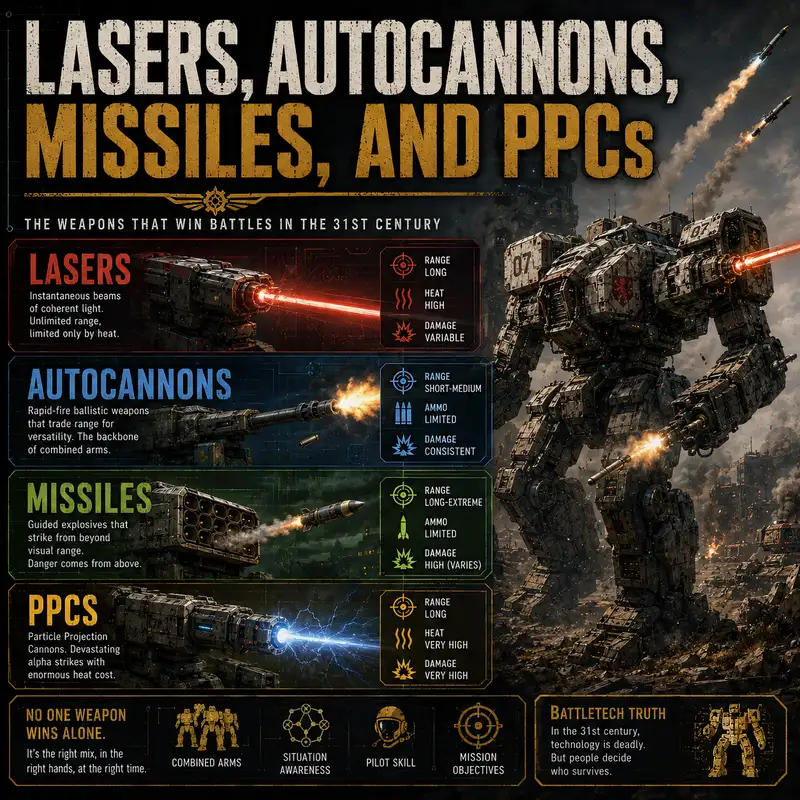
A lance commander does not hear four versions of the same weapon when the firing starts. A laser snaps across the valley and adds heat to the machine that fired it. An autocannon answers with recoil, smoke, and one fewer round in the magazine. Long-range missiles climb above a ridge toward a target the launcher may not see directly. Then a particle projection cannon releases a blue-white discharge that strikes with the force of a heavy gun and leaves its own BattleMech fighting a rising temperature gauge. All four attacks can damage armor. They do not impose the same problem on the pilot, technician, or supply officer. The real question is never simply which weapon hits hardest. It is which burden a commander is prepared to carry in order to deliver that damage.
BattleTech weapon design is built around tradeoffs. Every system consumes some combination of mass, internal space, electrical power, cooling capacity, ammunition, maintenance time, and money. A weapon with no ammunition requirement may generate more heat. A cool-running gun may need a large magazine and a steady supply of shells. A missile launcher may reach over terrain but scatter its damage across several locations. A particle projection cannon may strike hard at long range but become awkward when an enemy closes. These details determine where a BattleMech wants to fight, how long it remains effective, what support it needs, and what follows the first exchange. A useful weapons load is not a collection of impressive names. It is a plan for surviving the engagement.
Lasers are the cleanest place to begin because their basic advantage is easy to understand. They require no ammunition. A BattleMech with functioning power and a working laser can keep firing as long as the machine remains operational and its cooling system can manage the heat. That gives lasers tremendous logistical appeal. There are no shells or missile reloads to store, and no ammunition bins waiting for a penetrating hit. A distant unit can carry laser-armed machines without dedicating as much transport space to munitions. This does not make the weapon free. The laser assembly still requires maintenance, optics can be damaged, focusing systems must remain aligned, and the waste heat has to go somewhere. On a BattleMech, it usually becomes a problem the pilot must solve under fire.
Standard lasers are commonly grouped as small, medium, and large, though manufacturers produce many different models within those categories. The medium laser is widespread because it offers useful damage for modest mass. It appears on light machines and remains relevant on assault BattleMechs. Its weakness is range. A pilot must close enough to enter the reach of enemy weapons and physical attacks. Small lasers press that logic further. They are compact and dangerous at very close range, but the machine has to survive the approach. Large lasers extend the reach and increase the damage, though at the cost of greater mass and much more heat. Each size tells the pilot where the designer expected the fight to occur.
The absence of ammunition often tempts a pilot to fire every available laser whenever a target appears. Heat management provides the correction. A fusion-powered BattleMech produces heat through movement and weapons fire, then sheds it through heat sinks. When heat generation exceeds cooling, the machine may slow, targeting becomes harder, and severe overheating can cause shutdowns or ammunition explosions elsewhere in the chassis. A laser-heavy design gives its pilot endurance in ammunition but demands discipline in firing. The pilot may have to choose between running and shooting, between one large laser and several medium lasers, or between an immediate volley and preserving cooling capacity for the next exchange. A weapon that never runs out of shots can still run out of safe opportunities to fire.
Advanced laser technology changes the balance without removing it. Extended-range lasers reach farther but normally generate more heat. Pulse lasers deliver repeated bursts and improve the chance of placing energy on a moving target, though they are heavier and their useful range varies by model and technological base. The Clans developed lighter, more capable versions of many energy weapons. Inner Sphere engineers answered with recovered technology and specialized designs. Each advance moved the tradeoffs rather than abolishing them. Better range might cost heat. Better accuracy might cost mass. Greater damage might require a larger cooling system. Even the most advanced BattleMech carries a design philosophy rather than a perfect answer.
Autocannons approach the problem from the opposite direction. They are ballistic weapons that throw physical projectiles at the target. The name covers a broad family of mechanisms and calibers, from weapons that fire rapid streams of smaller rounds to guns that deliver fewer, much larger shells. The familiar classifications of autocannon two, five, ten, and twenty describe performance categories, not a fixed bore diameter. Weapons in the same class may operate differently while producing comparable battlefield results. Some autocannons reach across long distances with limited damage. Others strike with enough force to tear away major sections of armor at close range. All exchange energy-weapon heat for weight, ammunition, and recoil.
The great attraction of an autocannon is that it can deliver substantial damage without producing the extreme heat of an equivalent energy volley. That matters on machines with limited cooling, on hot worlds, and during sustained fighting. A pilot can fire a ballistic main gun while reserving heat for movement or other weapons. The drawback is mass. The weapon is heavy, its feed system occupies internal space, and its ammunition consumes additional tonnage. Every round fired reduces future endurance. A jam, damaged feed mechanism, or empty bin can turn a massive gun into expensive ballast. The autocannon does not ask the pilot to manage heat as aggressively as a laser or particle projection cannon. It asks the entire unit to manage supply.
Ammunition creates flexibility and danger. Different ballistic loads can support specialized missions, depending on the weapon and era. Precision ammunition may help against fast targets. Armor-piercing rounds may seek deeper damage. Flak ammunition can improve performance against airborne threats. This flexibility helps ballistic weapons remain useful even when a simple mass-and-damage comparison looks unfavorable. The same magazine is also a vulnerability. If enemy fire reaches stored ammunition, the result can destroy the BattleMech from within. Protective systems can reduce that danger in later designs, but they do not make ammunition weightless, harmless, or available without a supply chain.
The Hunchback built around an autocannon twenty shows what a weapon can do to an entire tactical identity. Its main gun is devastating at close range and commands attention before it fires. An enemy that ignores it risks losing armor, a limb, or an entire BattleMech to one well-placed shot. The Hunchback pilot uses terrain, formation support, and threat to reach the weapon’s preferred distance. The enemy tries to keep away, disable the gun, or force the Hunchback to waste limited ammunition on poor shots. The autocannon twenty is powerful for the damage it inflicts and the movement it compels. A gun that changes where the enemy will stand is already influencing the battle.
Missiles divide the burden differently. The launcher is often lighter than a ballistic gun delivering comparable potential damage, but it requires ammunition and depends on guidance and fire control. BattleTech missile launchers are commonly identified by the number of missiles they attempt to fire in a volley. A long-range missile fifteen sends a larger salvo than a long-range missile five. A short-range missile six offers more potential hits than a short-range missile two. Not every missile in a salvo necessarily strikes. The result is distributed damage rather than the concentrated blow of a large autocannon or particle projection cannon. That is a weakness against intact armor and a strength against a target already covered in gaps.
Long-range missiles are fire-support weapons. They allow a BattleMech, vehicle, or emplacement to threaten targets at distances where many direct-fire weapons cannot answer effectively. Under the right conditions, they can also be fired indirectly with help from a spotter, allowing the launcher to remain behind a ridge or other cover. Long-range missile units therefore shape movement, punish exposed routes, and support faster allies operating closer to the enemy. The price is dependence. The launcher needs ammunition, targeting information, and time. At very close range, standard long-range missiles become awkward. If scouts lose contact, communications fail, or the enemy closes rapidly, the missile boat may discover that excellent range is less comforting when the battle has moved inside it.
The Catapult is one of the clearest expressions of that doctrine. In its classic long-range missile configuration, it carries paired launchers supported by medium lasers. At distance, it can deliver repeated salvos while using terrain and friendly forces for protection. When the enemy closes, the lasers provide a defense, but they do not transform the machine into an ideal brawler. The pilot must preserve ammunition, hold useful firing positions, and avoid isolation. Supply crews must keep missiles moving from a DropShip or depot to the launcher. A Catapult with full bins is a mobile fire-support asset. A Catapult with empty bins is an armored machine carrying launch tubes and strong opinions about how the resupply plan should have worked.
Short-range missiles serve a different purpose. They are intended for close combat, where their warheads can hit several locations across a target. Against untouched armor, that spread may seem inefficient compared with one concentrated strike. Against a damaged BattleMech, it becomes dangerous. Multiple impacts can find exposed internal structure, strike actuators, damage weapons, or reach ammunition. Short-range missiles are excellent partners for weapons that first open armor. An autocannon or particle projection cannon creates the breach, then a missile salvo searches for the machinery behind it. Experienced pilots therefore think in combinations. One system removes protection. Another exploits the opening. The loadout becomes a sequence of effects rather than a list of guns.
Missile technology also offers unusual flexibility. Specialized ammunition can lay mines, create smoke, interfere with sensors, or support other battlefield tasks. Artemis fire control can improve the effectiveness of conventional salvos. Narc beacons can help compatible missiles home on a marked target. Streak systems conserve ammunition by refusing to launch without a satisfactory firing solution, then release a highly effective salvo when the system confirms the shot. These technologies vary by era and add cost and maintenance demands. A missile launcher can deliver more than explosive damage, provided the unit brings the correct ammunition and does not leave it on the wrong DropShip.
Particle projection cannons occupy a special place between the endurance of lasers and the impact of heavy guns. A standard particle projection cannon is an energy weapon that accelerates a stream of charged particles toward the target. It requires no ammunition, and its strike delivers heavy damage at substantial range. The effect is dramatic, but its battlefield value is practical. A BattleMech armed with one can threaten armored targets beyond medium-laser distance without depending on a magazine. The cost is heat. Firing places a major load on the cooling system. Standard models also perform poorly at very close range, where targeting and focusing limitations make a nearby enemy surprisingly difficult to engage effectively.
That minimum-range problem gives the particle projection cannon a clear tactical personality. The pilot wants open ground, long lines of sight, and enough mobility or friendly support to prevent an enemy from rushing inside the weapon’s best envelope. A fast opponent will attempt exactly that. Closing the distance may be dangerous, but remaining far away allows the cannon to work under favorable conditions. This creates a contest of position. The cannon pilot manages range and heat. The opponent uses terrain, speed, smoke, or numbers to compress the fight. The weapon establishes a zone in which the enemy must decide whether to endure accurate fire or risk a rapid approach.
The Awesome eight Q demonstrates the discipline required. Its three particle projection cannons provide formidable long-range firepower, backed by enough heat sinks to support a deliberate firing pattern. The pilot can unleash all three when the opportunity justifies the heat, then adjust the next volley to cool. That rhythm is central to the machine. The Awesome needs no ammunition trucks for its main weapons, giving it excellent campaign endurance, but it does need an intact cooling system. Damage to heat sinks can be as tactically important as damage to a gun. A machine that still possesses all three cannons may be unable to use them safely. Its ammunition count is effectively written on the heat scale rather than stored in a magazine.
Later particle projection cannon variants alter range, mass, heat, and damage. Extended-range models reach farther, usually at a substantial heat cost. Snub-nose versions trade long reach for improved close-range usefulness. Light and heavy models change the balance between mass and striking power. Clan versions provide their own advantages in range and efficiency. Every improvement exists within an industrial context. A weapon may excel on a test range and remain difficult to maintain in a frontier regiment. It may fit perfectly on one chassis and distort another. The question is not whether an advanced cannon is better in isolation. It is whether the complete BattleMech can carry, cool, repair, and employ it without sacrificing its mission.
The contrast between the Catapult C one and the Catapult K two makes this visible on the same chassis. The C one is built around paired long-range missile launchers and supporting medium lasers, making it a mobile fire-support machine that depends on ammunition. The K two replaces that missile-centered identity with paired particle projection cannons and additional close-defense weapons. It no longer needs long-range missile reloads, but it must manage heat and direct line of sight. The silhouette remains recognizable, but battlefield behavior changes. One version can arc salvos over terrain with a spotter. The other wants clear firing lanes and controlled range. A refit that changes weapons can change doctrine, logistics, and the pilot’s daily decisions without changing the name painted on the maintenance schedule.
Mixed armaments exist because battles rarely remain at one distance. A BattleMech may carry long-range missiles for the approach, a particle projection cannon or autocannon for the main exchange, and medium lasers or short-range missiles for close combat. This creates flexibility and complexity. The pilot must choose what to fire, which target deserves limited ammunition, and how much heat to accept. The technician supports several different systems. The supply section must stock every ammunition type. A machine with an answer for every range may carry less armor, move more slowly, or lack the cooling to use all those answers at once. Sometimes a specialized machine with a disciplined commander is more useful than a generalist carrying three solutions and enough heat sinks for one of them.
Weapon combinations also reveal how damage becomes a military problem. Concentrated weapons such as heavy autocannons and particle projection cannons are good at opening armor. Lasers provide dependable follow-up fire without spending ammunition. Missiles can spread impacts across the target and search for vulnerable internal components. A commander may pair machines so one strips armor and another exploits the damage. Fire support can force an enemy out of cover and into the firing lanes of direct-fire units. A close-range brawler can protect a missile carrier from fast attackers. The useful question is not whether missiles are better than lasers. It is whether the force can create a sequence in which each weapon reaches the part of the fight it was designed to solve.
Logistics decides how long that sequence can continue. Lasers and particle projection cannons do not require ammunition, but both depend on intact power, cooling, precision components, and trained technicians. Autocannons need shells that match the weapon, feed mechanisms that remain clean, and transport capable of moving heavy reloads. Missile units consume bulky ammunition quickly during sustained combat. Every ammunition bin represents cargo that crossed interstellar space, survived a DropShip landing, reached a depot, and moved forward. A commander who plans only the first volley has not planned a battle. A designer who ignores the supply system has built a demonstration model with armor.
Industry and doctrine shape which tradeoffs a military accepts. A state with strong energy-weapon production and limited transport may favor ammunition-independent designs. A force defending near established depots can support ballistic and missile-heavy machines more easily. Mercenaries may value common ammunition or energy systems that reduce dependence on an employer’s promises. Frontier units often prefer equipment they can maintain with the parts and expertise actually available. None of the Great Houses uses only one weapon family, and no faction can be reduced to a favorite gun. Procurement follows factories, alliances, captured equipment, inherited stockpiles, doctrine, and the uncomfortable fact that armies often fight with what they own rather than what the staff college would prefer.
Tabletop rules turn these engineering and tactical realities into clear categories, range bands, heat values, ammunition counts, and damage numbers. Those abstractions are essential to the game, but they should not be mistaken for a claim that every autocannon of one class has the same barrel or that a missile salvo behaves identically in every atmosphere. In the setting, manufacturers build different mechanisms that achieve similar battlefield performance. Pilots deal with recoil, visibility, sensor quality, terrain, weather, maintenance, and the reliability of specific models. The game compresses those details so decisions remain playable. The fiction expands them again. A weapon that looks inefficient on a construction sheet may still appeal to commanders who value cooling, ammunition options, familiar maintenance, or the industry behind it.
Lasers, autocannons, missiles, and particle projection cannons are not four steps on a ladder from worst to best. They are four answers to the same military question. Lasers trade ammunition for heat and range limitations. Autocannons trade heat efficiency and concentrated impact for mass, recoil, and magazines. Missiles trade concentrated damage for reach, flexibility, and distributed effects, while demanding ammunition and guidance. Particle projection cannons trade heavy long-range energy fire for heat and an awkward close fight. The most successful BattleMech is not the one carrying the most impressive weapon. It is the one whose weapons match its armor, mobility, cooling, supply system, pilot, and mission. Every trigger pull reveals the same truth. Firepower is never just what leaves the barrel, launcher, or emitter. It is everything the army had to carry, cool, maintain, and risk in order to make that shot possible.