Marauder: Elegance, Firepower, and Fear
During the Amaris Civil War, Star League commanders discovered that the Marauder’s greatest compliment had become a battlefield liability. Its advanced electronics made it a natural command post, and its unmistakable silhouette told enemy gunners where senior officers were likely to be. Troops loyal to Stefan Amaris began hunting Marauders deliberately, helping inspire development of the heavily protected Nightstar. A BattleMech designed to frighten the enemy had become so recognizable that simply piloting one could place a commander at the top of the firing list.
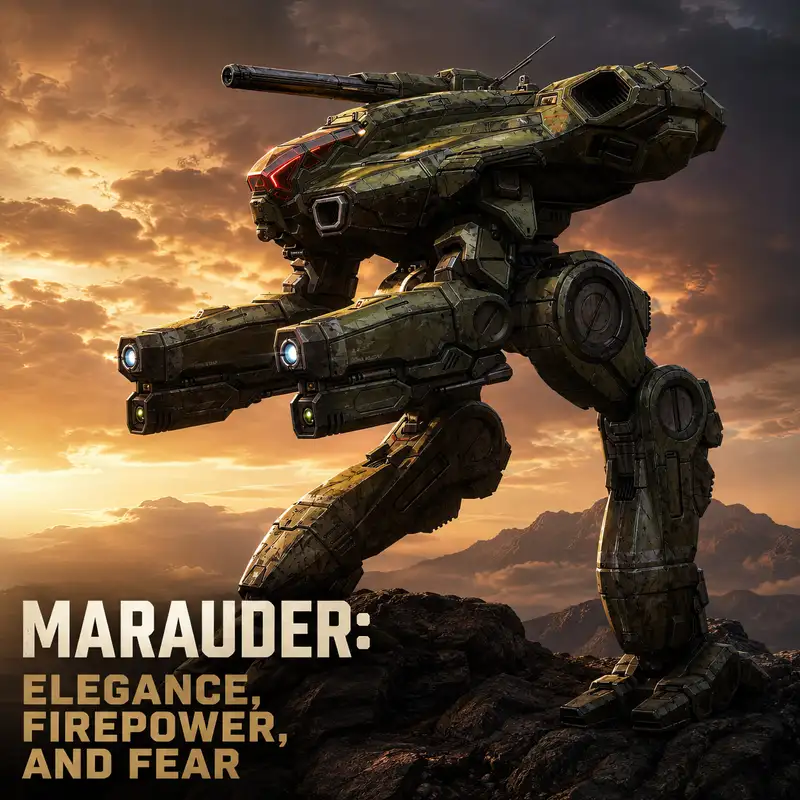
That contradiction explains much of the Marauder’s appeal. It is elegant without being delicate, powerful without being an assault machine, and frightening without theatrical decoration. Its low, forward-canted body, broad gun arms, narrow waist, and dorsal autocannon look unlike the upright human shape of many early BattleMechs. Every major feature appears directed toward one purpose: find the enemy at range, bring heavy weapons onto the target quickly, and maintain pressure until something important breaks. The Marauder looks dangerous because its shape honestly describes its work.
General Motors introduced the original Marauder in the year twenty-six twelve as a seventy-five-ton attack and direct-fire support BattleMech. The Star League wanted a machine able to accompany heavy formations, destroy lighter opposition, and serve as a stable weapons platform for experienced pilots and field commanders. Its three-hundred-rated fusion engine produced a top speed near sixty-five kilometers per hour. That was sufficient for a battle line, but there were no jump jets. A Marauder could maneuver with purpose across open ground. It could not ignore rivers, cliffs, collapsed streets, or a demolished bridge.
The original Star League models used advanced materials and protection that later generations struggled to reproduce. By the late Star League, Royal units operated improved Marauders with extended-range particle projection cannons, double-strength heat sinks, and ammunition protection. Those capabilities depended on specialized factories, trained engineers, and dependable interstellar supply. When the Star League collapsed, the design survived, but its technological advantages became difficult to preserve. The familiar Marauder three R, introduced during the early Succession Wars, was a simplified descendant built from equipment that surviving industries could manufacture and repair.
That Succession Wars model carried two particle projection cannons, one in each armored arm housing. A class-five autocannon sat above the right side of the torso, and two medium lasers provided protection at closer range. The weapon arrangement was unusually coherent. The particle cannons and autocannon could all engage across similar distances, allowing the pilot to concentrate fire without juggling several unrelated engagement envelopes. The medium lasers were not the main attack. They were an acknowledgment that enemies sometimes survived the approach, terrain sometimes shortened the fight, and even the finest long-range plan eventually encounters someone who has not read it.
The two particle projection cannons created the Marauder’s reputation. Each could tear a meaningful section of armor from a BattleMech without consuming ammunition. Mounted on flexible arm joints, they offered broad fields of fire and traversed more readily than many fixed torso weapons. A Marauder could shift aim between targets, fire while changing its facing, and use the arms to track opponents trying to move around the formation. The guns were also sufficiently rugged that the housings could be used in physical combat when necessary. That was not the preferred employment of precision energy weapons, but battlefield necessity is rarely concerned with preserving factory alignment specifications.
The torso-mounted autocannon supported the particle cannons in a different way. It produced less heat, carried enough ammunition for twenty firing cycles, and gave the pilot another long-range weapon while the cooling system recovered. Its shells were not as destructive as the energy bolts, but they could keep armor under pressure, exploit an opening, or force an enemy to remain behind cover. In a sustained engagement, the autocannon helped the Marauder maintain a firing rhythm instead of alternating between overwhelming heat and silence. The tactical concept was sound. The weapon’s connection to the chassis was less impressive.
That linkage became one of the design’s best-known weaknesses. The autocannon had been integrated awkwardly, and damage around its mount could disable the weapon even when the gun itself remained intact. The rotating connections between the torso and leg assemblies also required protection, leading many pilots and technicians to add improvised armor around vulnerable points. The powerful Dalban targeting system occupied space that restricted the pilot’s forward view. None of these flaws made the Marauder ineffective. They made it a military machine, which is another way of saying that the brochure and the maintenance report described different objects.
The classic Marauder carried sixteen single heat sinks. That was enough for disciplined long-range fire, but not enough for continuous use of every weapon. Firing both particle cannons while moving produced a gradual heat buildup. Adding the autocannon was manageable because the ballistic weapon generated relatively little waste heat. Adding both medium lasers at close range changed the calculation. A pilot had to decide whether the target justified a full volley, whether one particle cannon should pause, or whether movement mattered more than another shot. The Marauder rewarded crews who understood tempo. It punished those who mistook a large number of triggers for a fire-control doctrine.
Its armor also demanded judgment. Eleven and a half tons provided respectable protection, while the machine’s narrow, low profile made it a difficult target compared with many upright designs. Yet the armor was not heavy for a seventy-five-ton BattleMech. A Marauder could survive return fire, but it was not meant to stand motionless and exchange punishment with an assault machine. Its protection worked best when combined with range, cover, controlled movement, and the threat of its own weapons. The silhouette inspired fear partly because a commander wanted the Marauder damaged before it established that kind of engagement.
This made the Marauder a direct-fire support machine rather than a simple brawler. It belonged near the center of a formation, where scouts could identify targets, other units could protect its flanks, and its command systems could reach the force around it. From there, it could break armor, suppress an avenue of approach, or concentrate fire on a hostile heavy BattleMech. Massed Marauders were used as shock units during the Succession Wars, but their effect came from coordinated fire rather than blind charges. Concentrated particle cannon fire could create an opening that faster units then exploited.
The machine’s command reputation grew from more than appearance. Its communications and targeting electronics were advanced, and battalion or regimental commanders valued a platform that could observe, coordinate, and still influence the battle directly. The Marauder was also favored in the Star League’s Gunslinger Program, where elite pilots trained for BattleMech combat against skilled opponents. It suited commanders and duelists for the same reason. The weapons rewarded accurate fire, the heat curve rewarded discipline, and the armor punished mistakes without necessarily making the first mistake fatal.
Command use created a dangerous feedback loop. The more capable officers selected Marauders, the more enemy intelligence associated the silhouette with headquarters and elite pilots. The more often enemy gunners concentrated on Marauders, the more their crews learned to use distance, concealment, and supporting units. During the Amaris Civil War, this targeting became severe enough that the Star League sought a more heavily protected command machine. The Marauder’s fame had produced a tactical tax. It remained an excellent command platform, but everyone on the battlefield understood that destroying it might disrupt more than one firing line.
A Marauder lance therefore required ordinary military support despite its extraordinary reputation. Reconnaissance assets had to find targets before the enemy found the Marauder. Infantry and vehicles guarded terrain where a seventy-five-ton machine could be ambushed. Engineers opened routes because the chassis could not jump. Ammunition carriers supplied the autocannon, although the energy weapons remained dangerous after the bin was empty. Recovery crews needed equipment capable of moving the machine if a leg or rotation ring failed. Elegance did not reduce the weight on the recovery manifest.
Logistically, the Marauder was easier to sustain than many mixed-weapon heavies. It required only one ammunition type, and its principal firepower came from the reactor. A unit far from a depot could conserve shells and still retain both particle cannons. The tradeoff was technical. Energy weapons and targeting electronics demanded careful calibration, the arm joints had to preserve smooth tracking, and the dorsal gun’s vulnerable linkage needed inspection. A Marauder could fight after its ammunition supply weakened. It could not fight well after neglected maintenance turned precise weapon mounts into expensive guesswork.
The Succession Wars tested whether the design could survive without the society that created it. Factories were lost, technical knowledge declined, and surviving machines became inherited assets rather than replaceable equipment. General Motors and Independence Weaponry remained important to Marauder production, while additional manufacturers and repair networks eventually spread the chassis across the Human Sphere. Scarcity still shaped employment. Armies often paired the available Marauders with Warhammers, Thunderbolts, and other heavy machines rather than fielding complete formations of one type. A famous design can be common in military imagination while remaining inconveniently absent from the actual supply table.
Regional variants reveal how each state tried to preserve the Marauder’s central idea with the components it could obtain. The Federated Suns introduced the three D in the year twenty-eight thirty-four by replacing the autocannon with a large laser and adding more heat sinks. The change removed ammunition dependence and eliminated the troublesome gun linkage, creating a cleaner energy platform. It also increased the importance of heat management. The three D could remain armed through a long raid, but every major weapon now drew directly on the cooling system. Independence from ammunition is useful. Independence from thermodynamics remained outside the procurement budget.
The Free Worlds League developed the three M in the year twenty-eight seventy-three because reliable particle projection cannons were scarce while large lasers were available in greater numbers. Both particle cannons were replaced, and additional heat sinks made the machine easier to cool. The resulting Marauder sacrificed some reach and striking power for equipment the League could actually produce and support. That was not merely a technical compromise. It was an industrial policy expressed through weapon mounts. A slightly less powerful BattleMech on the battlefield can be more useful than a superior model waiting for parts that exist only in another state.
The Capellan three L, introduced in the year twenty-nine oh five, took a middle path. One particle cannon was replaced by a large laser, and more heat sinks were added. The mixed energy battery improved thermal control, but alterations to a targeting architecture no living technician fully understood reportedly created new problems. The variant demonstrated the danger of modifying lost technology by imitation. Engineers could identify what a component did, replace it with something available, and then discover that the original designers had connected several systems for reasons no surviving manual explained.
These variants did not disprove the original design. They proved how adaptable its layout was. The two arm housings and dorsal weapon mount created clear places for new equipment, while the seventy-five-ton chassis could absorb changes without losing its identity. Later refits installed extended-range particle cannons, pulse lasers, Gauss rifles, rotary autocannons, electronic warfare systems, command consoles, stronger armor, and jump jets. Some became mobile snipers. Others became close-range command machines or networked fire-support platforms. The visual sentence remained recognizable even when the technological vocabulary changed.
The recovery of the Helm Memory Core began a major revival. Advanced engines, double-strength heat sinks, improved armor, and modern weapons allowed designers to correct limitations that Succession Wars technicians had learned to tolerate. The five D, entering production in the year thirty forty-seven, restored extended-range cannons, added pulse lasers, improved armor, and gained jump capability. Other models mounted Gauss rifles or advanced autocannons. These machines were more mobile and more dangerous, but they also introduced expensive engines and components that could make battle damage harder to survive economically. Lostech solved many engineering problems and created several excellent invoices.
The Marauder’s factories became strategic prizes. During the War of thirty thirty-nine, the Draconis Combine captured Quentin and its Independence Weaponry facilities. Control of a production line meant access not only to finished BattleMechs, but also to tooling, trained workers, spare parts, and design knowledge. General Motors continued production elsewhere, and later agreements spread the Marauder to new manufacturers. Sun-Tzu Liao personally negotiated for Capellan production rights, recognizing that prestige, military value, and industrial independence could all be purchased through the same design contract.
The machine also inspired descendants rather than mere variants. Wolf’s Dragoons worked with Blackwell Industries to create the one-hundred-ton Marauder Two, preserving the shape and weapons philosophy while adding assault-class protection and jump capability. The Clans developed the eighty-five-ton Marauder I I C as their own advanced continuation of the concept. Neither machine was simply a larger three R. Each reflected a different industrial system and doctrine. Their existence showed that designers separated by exile, political rivalry, and centuries of war still found value in the Marauder’s arrangement.
Even the Inner Sphere’s first encounter with the Clan Timber Wolf reinforced that visual legacy. Anastasius Focht saw features resembling both a Marauder and a Catapult in the unknown OmniMech, producing the reporting name Mad Cat. The new machine was not a hybrid of those two designs, but the comparison worked because the Marauder’s silhouette was already a common reference point. Military identification depends on familiar shapes. When observers encountered something unprecedented, one of the most advanced machines in the Human Sphere was still described by comparing it to a design introduced more than four centuries earlier.
No pilot connected fear to the Marauder more effectively than the Bounty Hunter. After Natasha Kerensky was forced to eject during an ambush on Nova Roma in the year thirty fourteen, the Bounty Hunter salvaged her Marauder and made it his signature. Painted green and marked with credit symbols, it became an announcement that a contract had acquired a personal interest. The machine was repeatedly modified with jump jets, additional energy weapons, advanced cooling, and later a Gauss rifle. Its appearance mattered almost as much as its armament. Opponents knew who might be inside and why he had come.
That reputation was not produced by paint alone. The Bounty Hunter maintained an elite technical team, carefully selected associates, transport, replacement equipment, and the intelligence network required to find targets across interstellar distances. The green Marauder represented the visible point of a much larger organization. This is true of every famous BattleMech, though rarely displayed so clearly. The pilot receives the legend. Technicians preserve the weapon alignment, DropShip crews move the lance, agents locate the target, and someone confirms that the employer can still pay after the shooting ends.
Other pilots gave the chassis a more conventional kind of distinction. Ian McKinnon led his celebrated company in a Marauder during the late Third Succession War. Grayson Carlyle later became associated with one as the Gray Death Legion’s reputation grew. Commanders, mercenaries, nobles, and duelists chose Marauders because the machine looked authoritative and possessed the weapons to support that appearance. Yet famous pilots did not make the design invulnerable. Their success usually came from combining the Marauder’s strengths with reconnaissance, terrain, veteran crews, and units able to prevent an enemy from reaching its weaker angles.
Enemies responded accordingly. A fast force could attack the flanks and exploit the Marauder’s lack of jump mobility. Missile units could keep it under pressure while denying clear lines of sight. Heavy armor could absorb the first volleys long enough for a close assault. Infantry and vehicles could use cities or forests to approach through restricted terrain. Concentrated fire against the legs, torso rotation points, or dorsal weapon could remove mobility and firepower before the entire machine was destroyed. Fear is useful, but it also encourages the opposition to arrive with a specific plan.
The Marauder performed best in open or rolling terrain where its weapons could reach across long sight lines and its moderate speed was sufficient to shift between positions. In a defensive battle, it could cover an avenue, punish exposed attackers, and relocate before artillery or massed fire settled onto its position. In an advance, it could follow scouts and heavier armor, breaking resistance without entering every close fight. In a withdrawal, its energy weapons allowed continued fire without worrying about the last ammunition convoy. Mountains and dense cities reduced those advantages, while jump-capable enemies could turn elegant geometry into a complicated local emergency.
The classic three R’s reputation therefore requires some correction. It is not the perfect heavy BattleMech. Its armor is lighter than many commanders expect, its heat demands restraint, the autocannon mount is vulnerable, and its lack of jump jets can be exploited. At very close range, the main weapons become less comfortable and the secondary battery is modest. A Marauder isolated by faster enemies can be dismantled despite its appearance. The machine inspires fear because it is dangerous within a well-chosen fight, not because it is exempt from the ordinary requirements of tactics.
Its elegance lies in concentration. The arm cannons, dorsal gun, narrow profile, and command electronics all support a coherent role. Its firepower lies not in one spectacular weapon, but in the ability to place several accurate long-range attacks onto the same target while managing heat and ammunition. Its fear comes from recognition. Soldiers know what those weapon arms can do, commanders know the silhouette may contain an experienced leader, and pilots know that allowing a Marauder to control range usually ends with armor disappearing faster than the distance closes.
The Marauder endured because every era could reinterpret that central arrangement. The Star League made it an advanced command and attack machine. The Succession Wars simplified it into something battered industries could maintain. The Great Houses altered it around local shortages. The technological renaissance restored capabilities its original designers would have recognized. Mercenaries and famous pilots turned individual machines into personal symbols, while later engineers enlarged or rebuilt the concept for new wars. The details changed because the Human Sphere changed. The purpose remained visible.
That is the final source of the Marauder’s power as a symbol. It does not look elegant because war is clean, and it does not inspire fear because it cannot be destroyed. It looks elegant because its compromises are arranged around a clear battlefield idea. It inspires fear because a competent pilot, supported by technicians, scouts, transport, and a disciplined formation, can make that idea work. Across the smoke, the silhouette offers no promise of invulnerability. It offers a simpler warning: the first accurate volley is about to become expensive.