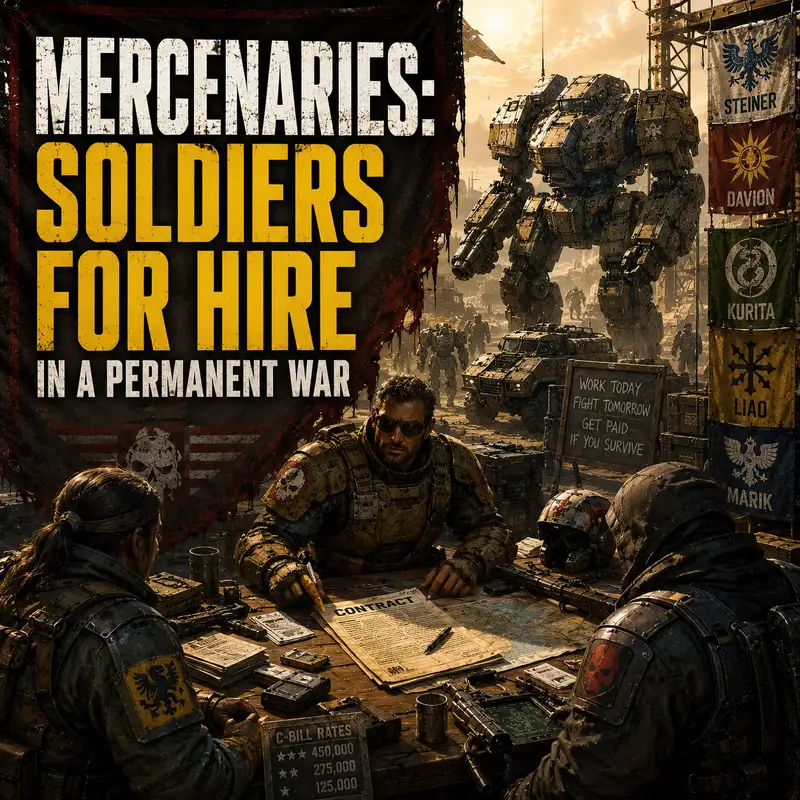
Mercenaries: Soldiers for Hire in a Permanent War
The contract promises three months of garrison duty, full transportation, reasonable base pay, and half the battlefield salvage. It appears generous until the commander finds that the employer controls operations, combat losses are excluded, and extraction depends on available transport. The unit may be paid to defend the world, ordered into an attack it did not plan, and left behind if the DropShip captain receives different instructions. A mercenary contract decides more than payment. It determines who controls the force, who carries the risk, and who leaves when the shooting stops.
A mercenary is a soldier serving under contract rather than permanent allegiance to the government employing that soldier. In BattleTech, the term usually describes an organized military command that owns or controls its equipment, recruits its personnel, negotiates its service, and attempts to survive from one employer to the next. The command may be a single BattleMech lance with rented transport, or a combined-arms regiment with armor, infantry, aerospace support, technicians, medical personnel, and ships of its own. It may be disciplined, desperate, honorable, criminal, or several of those during different accounting periods.
Mercenaries exist everywhere because the states of the Human Sphere face more military obligations than their standing forces can meet. Borders stretch across hundreds of star systems. Pirate raids appear where regular troops are absent. Rebellions, succession disputes, corporate conflicts, and regional wars create sudden demands for trained units. Moving a House regiment to one crisis may expose three other worlds. Hiring mercenaries adds combat power without permanently supporting another formation. The state purchases time and flexibility. The mercenary assumes the uncertainty the state prefers not to keep on its own payroll.
Governments hire mercenaries for missions ranging from respectable to deniable. They guard factories, train militias, escort convoys, suppress piracy, reinforce armies, raid infrastructure, and hold quiet sectors so regular troops can move elsewhere. A skilled command may provide expertise a local military lacks. A less reputable command may be chosen because officials want a mission completed without the national army's insignia appearing in the report. Deniability is rarely complete. It only needs to last long enough for the responsible minister to explain that the contractor exceeded its authority.
The people who enter mercenary service are equally varied. Some are veterans leaving a national military with useful skills and limited civilian prospects. Some inherit a BattleMech and discover that ownership includes maintenance bills. Some are dispossessed pilots looking for another cockpit. Others belong to units abandoned by a collapsing state, defeated army, or reorganized government. Political refugees may fight for the only employer willing to accept them. Adventurers seek independence, professionals seek better pay, and opportunists seek access to weapons. Idealists sometimes believe a private command can choose its wars more carefully than a government can. The contract market eventually tests every one of those beliefs.
Mercenary service long predates the Succession Wars, but the collapse of the Star League created the conditions for it to become a central institution. When the Star League Defense Force departed with Aleksandr Kerensky, not every formation joined the Exodus. Some remained in the Inner Sphere and entered private service rather than submit to a Great House. The Eridani Light Horse preserved its lineage from the Star League army across centuries of contracts. Other commands emerged from national forces, planetary militaries, noble households, and survivors who possessed combat equipment but no state willing or able to support them.
The First Succession War created demand on a scale no peacetime market could have supplied. The Great Houses needed troops quickly, while regular armies suffered catastrophic losses and entire regions changed hands. Independent commands could reinforce fronts, fill depleted garrisons, or raid without waiting for new regiments. The same destruction that increased demand also produced more mercenaries. Defeated soldiers, stranded units, and displaced MechWarriors had weapons but no secure future. The Inner Sphere turned military collapse into a labor market, then spent the next several centuries ensuring that market remained busy.
A functioning market required more than employers and armed people willing to negotiate. Both sides needed a way to judge the other. A government wanted to know whether a command could actually field the machines listed in its proposal, whether it obeyed orders, and whether it had abandoned previous contracts. A mercenary wanted to know whether an employer paid on time, provided promised supplies, respected command rights, and arranged transport home. Without trusted information, every agreement became a private gamble conducted between parties whose principal qualifications included access to heavy weapons.
ComStar supplied the institutional answer by creating the Mercenary Review Board in the year twenty-seven eighty-nine. The Board registered commands, brokered contracts, tracked reputations, and arbitrated disputes. ComStar's communication network gave its judgments reach across much of the Inner Sphere. A command that took an advance and disappeared could find future employers warned. A government that refused payment could develop a reputation that made capable units demand better terms or decline its contracts. The system did not eliminate betrayal, but it made denial more costly.
Galatea became the great hiring center known as the Mercenary's Star. Commanders went there seeking work, while House representatives and corporate agents went there seeking forces. Hiring halls, repair facilities, training areas, banks, brokers, recruiters, and less formal businesses grew around the trade. A unit could rebuild, recruit, and negotiate in one place. It could also spend money while waiting for a contract, which gave negotiations a useful sense of urgency. A commander with three months of payroll remaining bargains differently from one whose technicians have begun asking whether the spare parts can be sold.
ComStar presented the Board as a neutral service, and much of its value depended on that perception. The organization also gained information about units, employers, movements, and contracts throughout the Inner Sphere. Neutral arbitration and institutional influence were not mutually exclusive. By monitoring the mercenary trade, ComStar could help stabilize it while learning who was hiring whom, for what mission, and with what equipment. A communication monopoly does not need to command every regiment directly when it can observe the paperwork that sends those regiments to war.
The contract remains the heart of mercenary survival because every broad promise must become a specific obligation. The document identifies the mission, duration, location, payment, support, transportation, salvage, and command. It may establish bonuses for combat, penalties for failure, rules for extending the term, and procedures for arbitration. The most dangerous wording is often not openly hostile. It is vague. Defend the region may mean protect one installation or patrol an entire continent. Support as available may mean the employer has ammunition until its own regiments need it.
Command rights determine how much control the employer exercises. Independent command gives the mercenary commander broad freedom to decide how to accomplish the mission. A liaison arrangement places an employer's representative with the unit to monitor performance and communicate priorities. House command puts the mercenaries beneath the employer's operational direction. Integrated command can divide the unit or place its elements inside larger formations. Greater employer control may produce better coordination, but it can also subject the command to officers who neither understand its capabilities nor pay the repair bills after using them.
Transportation terms can matter more than base pay. BattleMechs do not walk between stars. A mercenary command needs JumpShip passage and DropShip capacity, along with docking access, cargo handling, and schedules that match the operation. A unit owning its transport possesses unusual freedom, but ships require crews, maintenance, and money. A unit relying on the employer may reach the battlefield cheaply and discover that departure depends on the employer's priorities. The phrase transportation provided should always be followed by questions about direction, timing, capacity, and whether damaged equipment is still considered cargo.
Support rights decide who pays when military activity begins consuming equipment. Armor must be replaced. Ammunition must be replenished. Vehicles need parts and fuel. Pilots require medical care, and technicians require tools, facilities, and time. A contract may cover routine maintenance while leaving battle damage to the unit, or replace lost equipment only under narrow conditions. A generous monthly payment can vanish after one engagement if the employer does not share those costs. The fusion engine may operate for years. The payroll, missile bins, and medical ward are less patient.
Salvage is the most famous term because it can transform a struggling command. A disabled enemy BattleMech may provide a replacement chassis or components unavailable locally. Salvage can also be divided by percentage, exchanged for payment, or reserved to the employer. The word does not mean the mercenary may claim everything visible after combat. The unit must hold the field, recover the equipment, establish legal ownership, transport it, and repair it. A hundred-ton wreck on the wrong side of a retreat route is not an asset. It is scenery with an excellent resale value.
Generous salvage rights often compensate for weak pay or limited support. That trade can be sensible when the enemy fields equipment worth recovering and the unit has the recovery vehicles, technicians, and transport to exploit success. It can be a trap when the employer expects the mercenaries to fight a superior force and collect payment from whatever remains. The contract may promise wealth because the employer does not expect the command to survive long enough to dispute the calculation. In mercenary finance, optimism is frequently listed under anticipated assets.
Reputation gives a command leverage because employers are purchasing confidence as much as firepower. A strong record can produce better pay, greater command independence, and access to important contracts. Reputation includes battlefield performance, discipline, reliability, treatment of civilians, and behavior when a mission goes badly. A commander who completes difficult assignments without destroying the unit becomes valuable. One who wins spectacularly while breaching every agreement may attract employers who intend to breach agreements of their own.
The employer has a reputation as well. Mercenary officers compare notes about delayed payments, manipulated objectives, poor intelligence, and missing transport. A government may be powerful enough to force one command into an unfair arrangement, but repeated abuse changes the market. Experienced units avoid the employer, demand larger advances, or insist on outside arbitration. The state is then left with commands too desperate, inexperienced, or unscrupulous to refuse. Mistreating mercenaries can save money on one contract and lower the quality of every contract that follows.
The Draconis Combine's Death to Mercenaries edict showed how quickly political power could overwhelm professional custom. Issued by Coordinator Takashi Kurita during the Fourth Succession War, the policy called for captured mercenaries to be killed and drove reputable commands away from Combine service. The edict grew from political anger and the bitter conflict with Wolf's Dragoons, but its consequences extended beyond one feud. The Combine reduced its access to experienced private forces and taught mercenaries that legal recognition could disappear when a ruler needed an enemy. Contract law remains strongest when governments still find it useful.
Wolf's Dragoons demonstrated the opposite source of mercenary power. They arrived in the Inner Sphere in the year thirty oh five with five BattleMech regiments, advanced equipment, and a carefully concealed Clan origin. Over the following decades they served multiple Great Houses, learned their militaries from inside, and became the standard against which other commands were measured. Their performance gave them influence beyond any ordinary contractor. It also made them a political actor. A command large enough to affect a war cannot remain merely hired help, no matter how carefully its invoices are prepared.
After receiving Outreach in the year thirty thirty, the Dragoons developed the world into a new center for the mercenary trade. Training grounds, repair facilities, hiring halls, and the Dragoons' own reputation drew employers and commands away from Galatea. When ComStar lost political credibility during the Clan Invasion, the old Mercenary Review Board gave way to the Mercenary Review and Bonding Commission. Outreach became the commission's center, and mercenary ratings were commonly associated with the Dragoons. The market had moved from an institution controlled by ComStar to one influenced heavily by its most powerful participant.
Famous commands can distort the image of ordinary mercenary life. The Kell Hounds possessed wealth, political connections, elite personnel, and a reputation earned in major wars. The Gray Death Legion rose from disaster, fought across the Succession Wars, and became tied to the recovery of the Helm memory core. The Northwind Highlanders carried regimental traditions older than many states. These units could shape campaigns and speak to rulers. Most mercenaries operated on a smaller scale, accepted less glamorous work, and disappeared from history after one failed contract, one lost DropShip, or one payroll they could not meet.
The strongest commands were rarely collections of BattleMechs alone. They maintained technicians, infantry, armor, aerospace assets, intelligence specialists, medical personnel, and administrative staff. Some possessed DropShips or access to dedicated transport. They trained replacements, managed inventories, negotiated with manufacturers, and cultivated patrons. Their commanders had to be military leaders, employers, diplomats, and financial managers. A colonel might plan a planetary defense in the morning and decide which damaged BattleMech to sell in the afternoon. The second decision could determine whether the first was possible.
Ownership inside the unit can be complicated. One pilot may own a family BattleMech and receive a larger share of earnings. Another may operate company property and draw salary. Technicians may be permanent employees, partners, dependents, or local hires. Investors may hold claims against equipment. Officers may have signed personal guarantees to obtain transport. When losses occur, the command must decide whose machine receives scarce parts and whose contract will not be renewed. Unit cohesion becomes harder when the repair bay is also the balance sheet.
Casualties create obligations that no salvage clause resolves cleanly. A wounded pilot may require months of treatment. A dead technician takes knowledge that cannot be ordered from a warehouse. Dependents still need support. Replacement personnel must be recruited, trained, and integrated into crews that survived the last engagement together. A commander who treats people as interchangeable may preserve short-term finances and destroy long-term effectiveness. Veteran mercenary units survive partly because they build communities strong enough to endure the periods when the company cannot pay everyone what was promised.
Permanent war does not guarantee permanent profit. Demand rises during major conflicts, but so do losses, transport costs, and competition for supplies. The Clan Invasion created urgent work while destroying commands that met technologically superior forces before the Inner Sphere understood what it faced. The Jihad devastated units, hiring centers, and the institutions that supported the trade. Later peace and disarmament reduced available contracts. The collapse of the hyperpulse generator network disrupted communications, banking, reputation records, and arbitration. Mercenary markets depend on conflict, but they also depend on enough order for contracts to mean something.
The ilClan era has again created opportunity through fractured borders, weakened states, and new military emergencies. It has also produced new efforts to control the market. Clan Sea Fox, with its commercial networks and growing role in interstellar communications, established the Mercenary Bonding Authority as an alternative to a weakened and distrusted commission system. The names and administrators change, but the need remains the same. Employers and armed contractors require a third party capable of holding funds, recording performance, and making betrayal more expensive than compliance.
Law and reputation do not settle the moral question. A legal contract may order a raid against infrastructure civilians need to survive. A government may describe resistance fighters as bandits and hire outsiders to suppress them. A corporation may call striking workers insurgents. Mercenaries can refuse, renegotiate, or expose such missions, but refusal carries financial cost and may strand the unit. Others accept and later claim they only performed the work specified. A signature can define responsibility between employer and contractor. It cannot erase responsibility for what happens to the people under the weapons.
Mercenary commands have defended civilians, resisted atrocities, exposed conspiracies, and fought for causes their employers had abandoned. They have also looted, changed sides, broken contracts, and disguised piracy as military service. The category does not determine character. It creates incentives and pressures. A reputable unit understands that discipline protects both civilians and future business. A criminal unit may rely on fear until a stronger employer or rival decides the command has become inconvenient. The difference between mercenary and pirate is partly legal recognition, but law follows behavior only when someone has the power to enforce it.
No mercenary is completely independent. The employer defines the mission. Creditors influence what risks the unit can accept. Transport owners determine where it can travel. Suppliers determine what it can repair. Bonding authorities influence which contracts remain available. The unit's own personnel can refuse orders, resign, or lose confidence in command. A famous colonel may negotiate with princes, but the company still depends on a technician finding an actuator seal before deployment. Independence in the Human Sphere usually means having several institutions to bargain with instead of only one.
That limited independence is also the profession's appeal. A national soldier serves the state that recruited them. A mercenary command can sometimes choose among employers, refuse a cause, preserve its own traditions, and carry its identity across borders. Long-serving units become families, military communities, and political constituencies in their own right. Some remain with one patron for generations and become private only in legal status. Others change employers often enough to acquire enemies in every direction. Choice exists, but it narrows whenever the repair bills arrive before the offers.
Mercenaries remain soldiers for hire in a permanent war because fragmented states need military flexibility and experienced fighters need institutions capable of turning skill into survival. The arrangement lets governments shift cost, risk, and blame onto forces they do not permanently own. It lets commanders preserve units outside any single dynasty's service. Between them stands the contract, attempting to convert violence into obligations precise enough to price and strong enough to trust.
The commander who signs that contract is committing more than a lance of BattleMechs. The signature binds pilots, technicians, ship crews, families, creditors, and the reputation inherited from everyone who served before them. Victory may satisfy the employer, secure the objective, and fill the salvage yard. Only after the armor is counted, the wounded treated, the transport confirmed, and the accounts settled will the unit learn whether it truly won. A mercenary survives not by fighting every battle offered, but by ensuring that the command still exists when the next contract arrives.