Nuclear Fire, Dead Worlds, and the End of Restraint
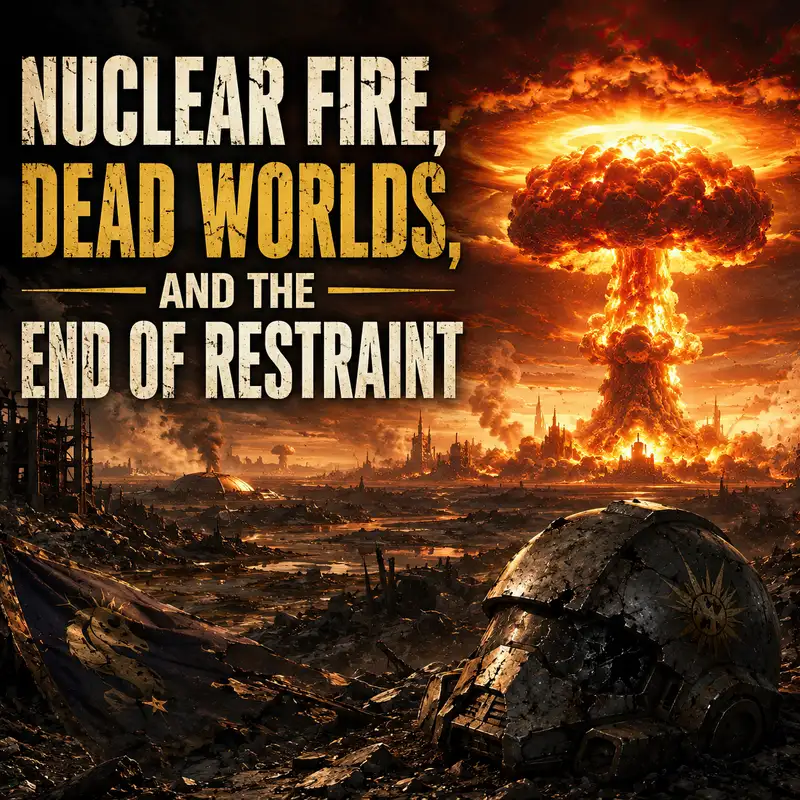
On the eighteenth of March, twenty-seven eighty-five, Lyran bombers and artillery struck the city of Calcutta on Bolan. Their target was a Free Worlds League assault battalion dug into the urban area. The attack destroyed the battalion, flattened much of the city, and killed more than twenty thousand civilians. Colonel Salam Tutt, commanding the defense, answered with a decision that would define the war before its formal declarations had even been issued. He armed strategic nuclear weapons and ordered his surviving troops to pin the Lyrans in place. The Lyran commander saw what was happening, pulled back what he could, and brought WarShips into the exchange. The nuclear fire did not decide who should rule the Star League. It decided what the Great Houses were willing to destroy while arguing about it.
When the fighting on Bolan ended, the Lyran Commonwealth held the planet, but the prize had been mutilated. Mumbai, Calcutta, Quetta, and Peshawar were gone. The Overwatch fortress had been erased from orbit. The continent of Sabari and its surrounding islands had been devastated. Estimates placed the civilian dead somewhere between three and eight million. Both sides could defend their choices in military language. The Free Worlds League denied the enemy intact fortifications and trapped formations. The Lyrans prevented their troops from being consumed by a defender’s nuclear ambush. Each decision was understandable inside the next few minutes of battle. Together, they created a result no rational government would have selected as a peacetime objective: conquest of a world whose people, cities, and value had been burned away.
The central failure was not that the rulers of the Inner Sphere had never considered rules for war. They possessed one of the most elaborate codes humanity had written. The Ares Conventions had emerged in the year twenty-four twelve after the destruction of Tintavel demonstrated what happened when planetary warfare escaped political control. The agreement restricted nuclear attacks on inhabited worlds, placed severe limits on orbital bombardment, protected surrendering forces, and created procedures for investigating violations. The Conventions were imperfect. They sometimes made limited wars easier to begin, and powerful states found exceptions when convenient. Even so, they established a shared expectation that military necessity did not excuse every available weapon. The First Succession War did not begin in ignorance of restraint. It began after leaders decided restraint was an advantage they could not afford to grant their enemies.
The legal position was already weakened. The Star League had set the Conventions aside during the Reunification War and never truly restored their authority. Yet their language still represented civilized conduct, and House militaries continued to invoke them when it suited political and operational needs. Bolan stripped away even that fragile habit. Captain-General Kenyon Marik had authorized nuclear use by his own forces. After the Lyran response, he declared that the enemy had made the Conventions irrelevant and that the Free Worlds League was therefore free to answer without limits. The other Successor Lords followed the precedent. It was a useful piece of legal theater. Every ruler could describe unrestricted warfare as retaliation. No ruler had to admit that retaliation had become policy. There was also no neutral government left with the authority or force to tell any of them otherwise.
The collapse of enforcement mattered more than the wording of any treaty. The First Lord was gone. The High Council had dissolved the Star League. Aleksandr Kerensky had taken most of the Star League Defense Force into exile, and the remaining troops were being recruited into House service. The Terran Hegemony, which had once served as political center and military balance, was being partitioned. Interstellar communications were damaged, and every ruler claimed the same supreme office. Under those conditions, a violation could not be judged by an authority accepted by all sides. It could only be answered by another state. Retaliation became investigation, verdict, and sentence in one package. That system favored the commander with the fastest delivery vehicle, not the government with the strongest legal argument.
The Great Houses also possessed arsenals built for a richer and more technically capable age. They had WarShips able to dominate orbit, aerospace fighters capable of delivering strategic weapons, large nuclear inventories, and specialists trained in chemical and biological warfare. Their militaries inherited the infrastructure of the Star League era at the same moment their political institutions lost the ability to control it. Later generations would fight with irreplaceable BattleMechs and a shrinking number of JumpShips. The first generation of the Succession Wars still had enough advanced equipment to destroy advanced equipment at scale. That distinction is essential. Restraint failed not only because leaders were ambitious, but because they had both the means and the confidence to believe destruction could be kept one-sided.
A nuclear weapon could be described as tactical when aimed at a regiment, a fortress, or a spaceport. The label did not make the effects tactical. A BattleMech battalion might occupy a few kilometers of frontage, but the blast, thermal pulse, fires, radiation, and shattered infrastructure extended far beyond the machines being targeted. On a naturally habitable world, the damage could ruin a region. On a marginal colony dependent on atmosphere processors, sealed agriculture, imported filters, or carefully managed water systems, a smaller strike could threaten the entire population. Military planners drew circles around targets. Civilians lived inside the systems connecting those circles. Once commanders treated planetary support networks as part of the enemy war machine, there was little left on an industrial world that could be considered safely civilian.
WarShips made the danger worse. A fleet that controlled orbit could attack fixed installations without fighting through every ground defense. Shipyards, command bunkers, power stations, DropShip ports, and massed formations could be struck within minutes. Naval officers could also employ weapons whose effects were far greater than those available to most ground units. The temptation was obvious. An orbital strike might save months of campaigning and thousands of friendly troops. It also placed the fate of a city in the hands of a commander viewing it through sensors, maps, and targeting data. Distance did not remove responsibility. It simply made the order easier to issue before anyone had to walk through what remained.
The most consequential target was often not an army at all. Kenyon Marik directed his forces to destroy infrastructure so opponents could not replace weapons, and the other states adopted the same logic. A BattleMech factory depended on machine tools, power grids, transport hubs, skilled workers, and suppliers scattered across several worlds. A shipyard depended on specialized metals, electronics, trained crews, and orbital construction facilities. Destroying one node could disrupt an entire chain. The strategy promised a quick advantage because rebuilding took longer than bombing. It also encouraged every rival to attack first. A factory spared today might produce the machines used against you next year. In that calculation, preserving the future looked dangerously similar to helping the enemy.
Industrial targets were rarely isolated from civilian survival. A fusion plant powering a weapons complex might also run hospitals and water treatment. A terraforming station might maintain the climate while supporting military agriculture. A purification facility might serve a garrison and several million residents. Commanders could therefore classify a life-support system as a legitimate target without explicitly ordering the death of the population. The distinction was administratively convenient and physically meaningless. If replacement parts could not arrive because JumpShips were being destroyed and trade routes were collapsing, a damaged water plant became a delayed strategic weapon. The people died later, beyond the battlefield report, which did not make them less dead.
By the year twenty-seven eighty-eight, much of the war had shifted toward fast raids behind enemy lines. These operations were often too small to occupy a world and too brief to defeat its entire defense force. They did not need to. A raiding group could destroy a technical archive, wreck a production line, contaminate a reservoir, or cripple a spaceport and depart before heavier reinforcements arrived. The attacker avoided the cost of governing the population and left the defender with the cost of keeping that population alive. This was warfare optimized for denial rather than possession. It rewarded the unit that could inflict permanent damage in a few hours. A successful raid was measured by what the enemy could no longer build, repair, transport, or sustain.
Helm showed how quickly denial could become punishment. In twenty-seven eighty-eight, Draconis Combine forces invaded the Free Worlds League world while searching for a suspected Star League Defense Force cache. When the cache could not be found before League relief forces threatened the operation, the Combine prepared to withdraw. The military purpose had failed. Coordinator Minoru Kurita nevertheless approved an order to punish the population. The task force carried out the Ghost Rain protocol, using WarShip fire and nuclear weapons against major settlements. Some of the warheads were cobalt-jacketed, intended to spread long-lasting radioactive contamination. Durandel, Freeport, Helmdown, and Port Wayland were destroyed. Roughly ten million people died in the bombardment, and many tens of millions more died afterward from cold, starvation, social collapse, and the destruction of basic services.
Cobalt-jacketed weapons deserve particular attention because they reveal the purpose of the operation. Their value was not greater accuracy against a BattleMech regiment. The added material was intended to contaminate the ground and prolong the danger after the fleet departed. On Helm, the target was no longer simply a cache, a militia, or a transportation hub. The continued suffering of the world was part of the desired effect. Punishment had become strategy. The order also demonstrated how the succession claims distorted military judgment. A ruler who presented himself as the lawful First Lord was deliberately reducing the citizens he claimed to rule into refugees and casualties. The contradiction did not stop the bombardment. It merely shaped the propaganda used to explain it.
Inglesmond offers an even colder example of destruction defeating conquest. The world was wealthy, industrialized, and strategically attractive. That made it a prize for the Draconis Combine, the Federated Suns, and the Lyran Commonwealth. It also made every important installation a target. Competing forces used scorched-earth tactics and nuclear weapons in a struggle that consumed more than eleven gigatons of nuclear yield. The Combine finally secured the planet in twenty-seven eighty-nine. Ten years later, it abandoned Inglesmond because the useful salvage had been stripped from radioactive craters that had once been industrial centers. A state had won the world, emptied it of value, and then left. The campaign’s operational success produced a strategic asset with a negative balance sheet and a population condemned to nuclear winter.
The survivors on Inglesmond did not receive the protection normally associated with victory. Communities hid, maintained radio silence, and tried to avoid both contamination and the attention of salvage forces. Some remained alive long after official surveys treated the planet as lost. Their existence complicated claims to abandoned property and salvage rights. The state that had fought to possess Inglesmond had stronger incentives to search for machinery than to restore civil society. This is one reason the phrase dead world can mislead. A dead world was not always biologically sterile. It might still contain families, isolated settlements, and damaged ecosystems. What had died was the organized relationship between the population and the interstellar state that claimed the system on a map.
Dove followed the same logic from another direction. During the Star League era, its aerospace manufacturing complex was among the most productive outside the Sol system. That capacity made Dove strategically important and heavily defended. In twenty-eight twelve, the Draconis Combine invaded with fast-moving BattleMech forces. The Lyran defenders used nuclear weapons in an attempt to halt them. Combine forces answered with nuclear and chemical attacks. The struggle did not preserve the aerospace complex for either side. By twenty-eight fifteen, ComStar classified Dove as a dead world. The designation was an administrative sentence after a military one. A planet once valued because it could build the machines of interstellar war had been attacked so thoroughly that it could no longer support the society needed to build anything.
The pattern extended across the frontiers. Free Worlds League retaliation struck Altoona, Duantia, and Myrrdin with nuclear and chemical weapons aimed at environmental support and industry. Fighting around Rochers followed the same scorched-earth logic. Tactical nuclear use on Ilion damaged life-support systems so severely that the world was eventually evacuated. Brownsville never recovered from nuclear bombardment. Haddings, already scarred by the Amaris Civil War, suffered further nuclear and chemical attacks, while fear of lingering biological agents drove people away from its cities. These were not identical events, and the surviving records differ in detail. Together, they show that dead worlds were not created by one unusually cruel commander or one uniquely brutal House. They were produced by a shared method of war.
Chemical and biological weapons lacked the visual clarity of a nuclear flash, but they could be just as effective at destroying a society. Chemical agents contaminated buildings, soil, equipment, and water. Biological weapons could move beyond the original target through people, animals, food stores, or transportation networks. Their effects were difficult to measure quickly and even harder to reverse when laboratories and hospitals had also been destroyed. A commander might seize a city and discover that occupation required protective equipment, quarantine, medical specialists, and supplies the campaign had not brought. The weapon could deny the ground to both sides. On a sealed habitat or a world with a fragile biosphere, contamination turned the environment itself into a continuing combatant.
The largest casualty figures came after the dramatic weapons had already detonated. Burns, trauma, and radiation sickness demanded advanced medical care at precisely the moment hospitals lost power and transport. Food distribution failed when ports, warehouses, and vehicles were destroyed. Refugees crowded into regions that had not been prepared to support them. Planetary governments lost records, communications, police, and the ability to coordinate relief. Trade might have replaced damaged equipment, but the same war was eliminating JumpShips, merchant traffic, and safe routes. On Helm, the bombardment was only the opening phase of the disaster. Cold and hunger continued the killing long after the attacking fleet had left the system.
This delayed death made responsibility easier to disguise. A military report could count the enemy regiment destroyed and classify the water plant as collateral damage. It did not have to follow the children who became sick months later or the communities that froze during the next winter. Political leaders could announce that civilian casualties were regrettable while continuing the strategy that made them inevitable. Each House also circulated accounts of enemy atrocities, usually accurate enough to inspire anger and selective enough to avoid examining its own orders. The result was not moral confusion. It was moral compartmentalization. Every government understood what unrestricted warfare did. Each insisted that its own survival required doing it first, doing it in reply, or doing it more effectively.
Weapons of mass destruction did not solve the strategic problem that began the war. No nuclear exchange made one ruler the accepted First Lord. Orbital bombardment could destroy a capital, but it could not make four rival dynasties recognize the attacker’s legitimacy. Chemical agents could empty a defensive position, but they could not create a stable administration afterward. Biological contamination could deny an industrial world to an enemy while also denying its factories to the victor. The weapons were excellent at removing pieces from the board. They were poor at producing the political settlement the rulers claimed to seek. Their repeated use therefore narrowed everyone’s options without bringing the war closer to a durable conclusion.
They remained attractive because commanders operated on several fronts and judged results in shorter timeframes. A general who preserved an enemy shipyard might face its output before a diplomatic settlement ever arrived. A fleet commander who refused orbital fire might lose troops and be replaced by someone less hesitant. Communications delays meant that local officers often faced crises before updated instructions could cross interstellar distance. Intelligence was incomplete, and every state expected its rivals to exploit weakness. Under those conditions, restraint required confidence that the enemy would reciprocate. The First Succession War offered almost no reason for such confidence. The safer choice for an individual command was often the more destructive choice for the Human Sphere.
The political leadership had opportunities to halt the escalation. The Successor Lords could have declared certain targets immune, restored neutral inspections, protected JumpShips and life-support systems, or punished commanders who attacked populations. Doing so would have required each ruler to accept limits while claiming unlimited authority. It would also have required cooperation with governments officially described as rebels or usurpers. Instead, atrocity became evidence that the enemy could not be trusted, which was then used to justify the next atrocity. The argument was circular, but it was strategically useful. It allowed every House to condemn unrestricted warfare in principle while practicing it as an exception. After enough exceptions, the exception was the war.
Restraint returned only after destruction changed the economics of violence. WarShip fleets disappeared into battles they could not replace. Shipyards, technical schools, archives, and specialized factories were ruined. Interstellar transport contracted. Advanced equipment became inherited property rather than routine production. By the Third Succession War, commanders increasingly avoided destroying the BattleMechs, JumpShips, and factories they hoped to capture because those assets had become too rare to waste. An informal honor system grew from scarcity and mutual self-interest. That was not the moral victory the Ares Conventions had promised. Humanity relearned limits because it was running out of the machines, knowledge, and worlds required to ignore them.
The nuclear fire of the First Succession War was not an eruption of primitive rage inside an advanced civilization. It was advanced civilization applying careful military logic without an accepted political limit. Each strike promised to save troops, deny production, punish resistance, or prevent an enemy’s future advantage. Many achieved those immediate purposes. Collectively, they killed billions, shattered trade, erased industries, and turned inhabited systems into names that vanished from later maps. The Great Houses did not burn the future because they failed to understand the weapons. They burned it because every ruler believed the future would belong to the House that destroyed the other Houses’ share first. What remained on the dead worlds was the final answer: no one inherits what no one is willing to preserve.