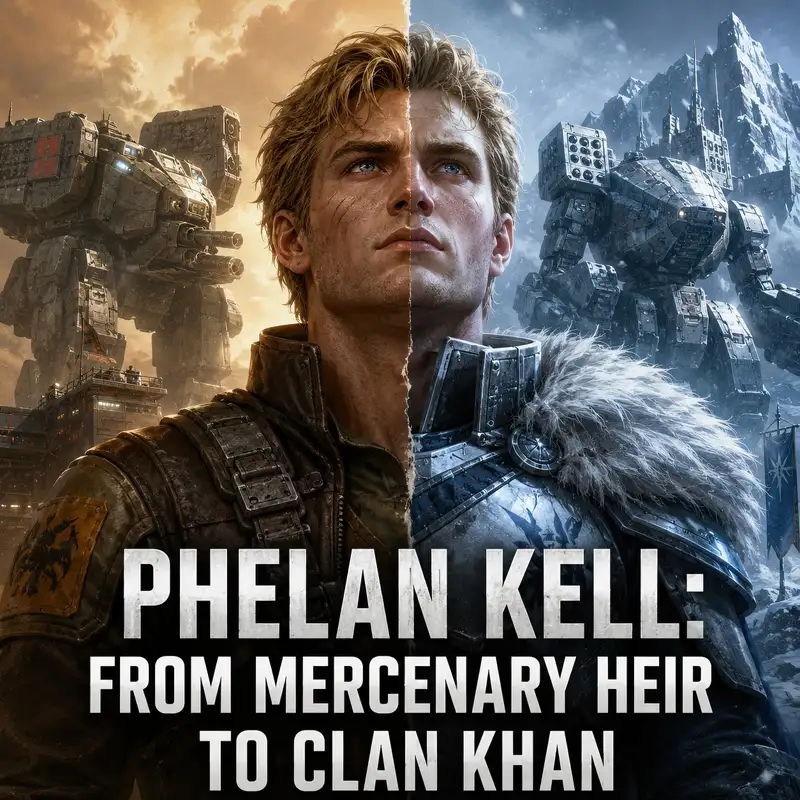
Phelan Kell: From Mercenary Heir to Clan Khan
On the thirteenth of August in the year thirty forty-nine, Phelan Kell’s Wolfhound lay wrecked on a pirate world called the Rock. He was eighteen years old, badly wounded, and surrounded by machines no Inner Sphere intelligence service could identify. The warrior who defeated him, Vlad of Clan Wolf, treated the young mercenary as captured property. Neither man understood the full consequence. The prisoner came from the Kell Hounds, but his mother’s family also carried a blood connection to one of Clan Wolf’s most powerful lineages. The bondsman was not merely useful. Under Clan law, he could become a rival.
Phelan’s rise from mercenary heir to Clan Khan looks impossible when reduced to a list of promotions. He moved from expelled academy cadet, to Kell Hound MechWarrior, to prisoner, bondsman, Clan warrior, Bloodnamed officer, saKhan, and finally Khan in less than a decade. That rise was not a reward for piloting skill alone. It came from his unusual upbringing, his ability to interpret two military cultures, and the political plans of Ulric Kerensky. Phelan became powerful because Clan Wolf needed someone who could understand the Inner Sphere without despising it and understand the Clans without merely imitating them.
He was born in the year thirty thirty-one to Morgan Kell and Salome Ward. Morgan was already one of the most famous mercenary commanders in the Human Sphere. Salome connected Phelan to another tradition, one he would not fully understand until his captivity. Part of his childhood was spent on Outreach among Wolf’s Dragoons, where he trained in an environment that resembled a Clan sibko more than an ordinary noble household. Natasha Kerensky knew him there. Long before the Clan invasion, Phelan had been exposed to discipline, competition, and military customs descended from the very society that would later capture him.
Being raised around famous soldiers did not make him easy to command. At the Nagelring on Tharkad, Phelan was considered talented but rebellious rather than exceptional. During a severe blizzard, he learned that a school bus had been trapped by an avalanche. He took a BattleMech without authorization, found the children, and used the machine’s fusion engine to provide heat. The rescue saved lives, but his medical supplies were inadequate and some children died. At the hearing, Phelan refused to concede that obeying regulations would have produced a better result. The academy expelled him.
The incident revealed the strength and weakness that followed him for the rest of his career. Phelan would act when institutions hesitated. He would also become openly hostile when those institutions questioned his methods. The first trait made him effective in emergencies. The second made him difficult in any room containing senior officers, formal procedure, and furniture that could survive an argument. Morgan Kell gave him a place in the Second Kell Hounds, where battlefield performance mattered more than academy diplomacy.
Phelan piloted a Wolfhound named Grinner and served with a reconnaissance force hunting pirates in the Oberon region. The mission appeared routine by Kell Hound standards. The pirates were dangerous, but known. Clan Wolf was neither. The Wolves were conducting the opening operations of the invasion and had already destroyed much of the local opposition when the Hounds encountered them. Phelan attempted to transmit images of the unknown OmniMechs. Vlad’s Timber Wolf defeated him before that warning could change the battle.
The Clans regarded captured personnel as potential bondsmen. A bondcord marked service owed to the captor until the prisoner earned release, adoption, or another fate. This was not prisoner-of-war status as the Inner Sphere understood it. It was an institution through which useful enemies could be absorbed. Phelan was wounded, interrogated, and subjected to drugs that forced him to reveal what he knew about Successor State militaries. His captors gained valuable intelligence. Phelan gained his first direct lesson in how Clan claims of honor could coexist with methods that felt very different from honorable treatment.
Ulric Kerensky claimed Phelan as his bondsman because the young mercenary understood the societies Clan Wolf was invading. Phelan knew House militaries, mercenary practices, and the political habits hidden behind official unit tables. He could explain why an Inner Sphere commander might refuse a formal challenge, conceal forces, or sacrifice a position to preserve transport. Clan warriors often interpreted such actions as cowardice or treachery. Phelan could translate them into strategy. Ulric did not mistake the prisoner for an equal. He recognized a resource the other Khans did not possess.
The greater surprise came from Phelan’s ancestry. His mother descended from Michael Ward. Michael’s son Jal had left with Aleksandr Kerensky’s Exodus and became the founder of the Ward Bloodname. Clan society treated Bloodnames as controlled legacies connecting current warriors to the original founders. Phelan was a freeborn outsider, but he was also a legitimate descendant of the same family line. That made him eligible to challenge for the Ward name under circumstances Clan Wolf could not dismiss simply by calling him barbarian.
Eligibility did not guarantee acceptance. Clan society ranked trueborn warriors above freeborns and placed military legitimacy inside a system of breeding programs, trials, and inherited genetic prestige. Phelan threatened several assumptions at once. He had not been raised in a Clan creche. He had not survived a standard sibko. He carried a famous Inner Sphere surname and the attitude of someone who had already been expelled by one elite institution. Every advancement would therefore become both a military test and a political argument.
Ranna Kerensky was assigned to help teach him Clan customs and prepare him for service. She initially regarded the work as an unpleasant obligation. Phelan was recovering from wounds and interrogation, knew little of Clan etiquette, and showed no instinct for accepting contempt quietly. Their relationship eventually became deeply personal, but its first military importance was instructional. Ranna forced him to learn the rules well enough to survive them. Phelan learned that Clan ritual was not decorative. Bidding, trials, bonds, and formal challenges distributed authority and resources across the warrior caste.
He soon began advising Ulric during the invasion. When Clans competed for the right to attack a target, Phelan could estimate what the defenders would actually do rather than what a Clan warrior expected them to do. He helped Ulric understand how to outbid rivals without creating a force too small to sustain the campaign. This suited Ulric’s wider approach. Clan Wolf advanced faster than its rivals not simply because its warriors were skilled, but because its commanders protected supply lines, prepared depots, and worked with conquered populations. Phelan’s knowledge fit a strategy already more practical than most Clan planning.
His decisive opportunity came after Tyra Miraborg rammed her damaged aerospace fighter into the bridge of the WarShip Dire Wolf. The collision killed ilKhan Leo Showers and devastated the command area. Phelan helped rescue Ulric and Vlad from the wreckage. He had saved two men who represented opposite futures for Clan Wolf: Ulric the Warden strategist and Vlad the ambitious Crusader rival. The act gave Ulric grounds to move Phelan from useful bondsman toward warrior status.
Phelan still had to prove that he could fight by Clan standards. Natasha Kerensky and Ranna helped prepare him for a Trial of Position, the combat test that determined whether a candidate entered the warrior caste and at what rank. He fought in a specially configured Dire Wolf called Lone Wolf. The machine gave him extraordinary firepower, but the trial was designed to expose judgment as much as marksmanship. Phelan passed and became Phelan Wolf, an adopted warrior of Clan Wolf. He had not simply changed uniforms. He had entered a society that defined citizenship, authority, and personal worth through military success.
The Warden philosophy gave that new identity a political direction. Wardens believed the Clans existed to protect the Inner Sphere rather than conquer it. That did not make them modern liberal reformers. They still accepted caste hierarchy, ritual combat, and the superiority of Clan institutions. Phelan embraced Wardenism because it offered a purpose that could reconcile his new obligations with the people he had come from. He could serve Clan Wolf without accepting that his father, the Kell Hounds, and billions of Inner Sphere civilians were merely subjects awaiting proper masters.
Natasha tested that usefulness on Gunzburg in December of the year thirty fifty-one. She bid only Phelan to secure the world. Instead of turning the assignment into a demonstration of personal glory, he negotiated with Tor Miraborg, a veteran leader of the Free Rasalhague Republic. Phelan explained the strength approaching the planet and the cost of resistance. Tor surrendered, preserving his troops and population. Clan Wolf gained the world without consuming ammunition, armor, or transport capacity. The victory was bloodless because Phelan understood both the Clan demand for submission and the Inner Sphere commander’s responsibility to people beyond his own reputation.
Success on Gunzburg raised his standing and intensified opposition from warriors such as Vlad and Loremaster Conal Ward. Phelan was no longer a curiosity. He was becoming Ulric’s political instrument and Natasha’s proof that Clan Wolf could absorb ability from outside its breeding system. To Crusaders and trueborn traditionalists, every victory made the precedent more dangerous. If a freeborn mercenary could become a Wolf warrior and outperform Clan-trained rivals, then ancestry and education did not explain everything the warrior caste claimed they explained.
The death of Cyrilla Ward opened a Bloodright, one of the limited positions carrying the Ward Bloodname. Phelan entered the Trial of Bloodright and faced candidates from several warrior specialties. The contest demanded more than one BattleMech duel. It tested unaugmented combat, aerospace conditions, urban fighting, and tactical adaptability. Conal attempted to manipulate the process against him. The interference was discovered, but the hostility behind it was already obvious. Phelan was being asked to prove his worth inside a contest whose administrators feared what his victory would mean.
The final round took place on Tukayyid in May of the year thirty fifty-two. Phelan fought in his rebuilt Wolfhound, now upgraded with Clan technology and still called Grinner. Vlad faced him in an Adder. The machines captured the rivalry neatly. Vlad represented the trueborn Ward tradition as Clan Wolf had defined it for generations. Phelan entered in an Inner Sphere design transformed by Clan industry. He defeated Vlad and became Phelan Ward. The mercenary heir had won one of Clan Wolf’s most prestigious names by using a machine born in the society the invasion was meant to subdue.
The timing made the victory even more consequential. Clan Wolf had just secured both of its objectives on Tukayyid, the only invading Clan to do so, but Khan Garth Radick was dead. Natasha Kerensky rose to senior Khan. Clan Wolf then elected Phelan as saKhan, its second elected leader, while he was still not yet twenty-one. Conal, disgraced for interfering in the Bloodright, was forced to nominate him. Ulric now had two Wolf leaders familiar with the Inner Sphere: Natasha through decades with Wolf’s Dragoons, and Phelan through birth, mercenary service, and captivity.
The promotion was meteoric, but it was not accidental. Ulric was preparing Clan Wolf for a political struggle that battlefield victories could not settle. The Truce of Tukayyid halted the invasion for fifteen years. Crusader warriors saw the truce as a theft of purpose and promotion. Wardens saw time in which the Inner Sphere could recover and the Clans might reconsider conquest. Phelan’s presence in the leadership made Clan Wolf better able to defend the truce, but it also made him a visible target for every warrior who believed Ulric was weakening the Clan from within.
Phelan’s position demanded harder choices than the heroic version of cultural reconciliation suggests. During the Red Corsair crisis in the year thirty fifty-five, Conal Ward became part of a conspiracy intended to break the truce and restart the invasion. Phelan worked beside the Kell Hounds to stop it. After Conal was captured, Phelan killed him and presented the act as a Circle of Equals. The decision removed a traitor and protected the truce, but it also showed how thoroughly Phelan had learned to use Clan forms for political ends. He had become a bridge between cultures, not an innocent observer standing above them.
The final test came in the year thirty fifty-seven. Clan Jade Falcon accused Ulric of genocide, arguing that the Tukayyid truce had wasted generations of Clan warriors bred for conquest. The Grand Council convicted him. Ulric answered with a Trial of Refusal conducted on a scale so large that it became the Refusal War. His plan was severe. Clan Wolf’s Crusaders and Clan Jade Falcon would tear one another apart, delaying any renewed invasion. Phelan would preserve the strongest Wardens, Clan Wolf’s genetic legacies, and enough equipment to rebuild.
Phelan wanted to remain with Ulric and Natasha. They ordered him to leave. Obedience in this case required abandoning the warriors who had sponsored his rise while they entered battles they did not expect to survive. Phelan’s forces fought early actions to preserve the deception that all of Clan Wolf remained committed to the Trial. Then they broke away toward the Inner Sphere, carrying personnel, records, genetic material, ships, and roughly a third of the Clan’s surviving equipment. This was not a retreat by frightened survivors. It was a planned extraction of an entire political faction.
The movement required the skills Phelan had learned in both lives. Clan discipline kept the column organized. Mercenary experience emphasized transport, repair capacity, and the need for a destination willing to accept armed refugees. The Warden Wolves reached Morges, where Jade Falcon forces followed them. The Kell Hounds arrived to help. Phelan’s former command and his adopted Clan fought together against the enemy trying to erase both his political future and Ulric’s strategy.
Ulric and Natasha died during the Refusal War. Vlad survived and helped create a new Crusader Clan Wolf from the wreckage left behind. The Jade Falcons declared Phelan’s followers abjured, cutting them off from Clan society and attempting to strip their legitimacy. Phelan could no longer rely on the Ward Bloodname he had fought to win. At precisely that moment, Ulric’s final legal maneuver arrived.
Before the war, Ulric had used his authority as ilKhan to create a new Bloodname: Kell. The order was postdated and granted to Phelan so that abjuration could not remove the name on which his leadership depended. Phelan Ward became Phelan Kell again, but the familiar surname now carried standing inside Clan law. Evantha Fetladral nominated him as Khan of the exiled Wolves, and the surviving Wardens elected him. Ulric had not merely saved a man’s rank. He had turned an Inner Sphere family name into the legal foundation of a Clan.
Morgan Kell granted the exiles territory on Arc-Royal. There, Phelan faced a problem more difficult than winning a Trial. His people had suffered severe losses, possessed little independent manufacturing, and had only a limited pool of trained replacements. Some complete units and stragglers reached them, while Kell Hound salvage and supplies kept frontline OmniMechs operating. New sibkos would take years to mature. In the meantime, the exiles used freeborn warriors more readily than traditional Clans preferred because ideology does not replace casualties.
The social challenge was equally serious. Many lower-caste Clanspeople saw opportunities in an Inner Sphere society that treated them with greater legal equality. Many warriors feared that comfort and contact would dissolve Clan identity. Inner Sphere neighbors saw the exiles as useful defenders against Jade Falcon and as descendants of the same invaders who had conquered hundreds of worlds. Phelan could not simply merge the Wolves into the Kell Hounds, and he could not recreate Homeworld Clan society without the institutions that had supported it. Clan Wolf-in-Exile had to become a third thing.
Phelan’s leadership remained recognizably Clan. During Operation Bulldog in the year thirty fifty-nine, he confronted the Sixth Jaguar Dragoons on Labrea. Rather than destroy the Cluster through a larger conventional battle, he challenged its commander, Logan Moon, to a formal duel. Phelan won and absorbed most of the Smoke Jaguar formation intact. The solution used Clan law, preserved trained personnel, and strengthened an exile force short of replacements. It was ritual combat applied to a logistical problem, which may be the most Phelan Kell solution possible.
His relationship with Ranna followed the same pattern of adaptation without simple rejection. Clan warriors did not define marriage and family as the Inner Sphere did. Genetic legacies were assigned through breeding programs intended to produce future sibkos. Phelan withheld his legacy until Ranna earned a Bloodname, allowing their genes to be paired only when both could be honored together. The choice used a Clan institution while expressing a personal loyalty that Clan culture often discouraged. Their first sibko produced three warriors.
For decades, Phelan defended the Arc-Royal region, cooperated with Inner Sphere rulers, and preserved an exiled Clan that neither the Homeworlds nor Vlad’s Wolves considered legitimate. He fought Jade Falcon incursions, participated in the struggle against Katherine Steiner-Davion, and helped keep Arc-Royal a military shield rather than merely a refuge. His authority depended on balancing three constituencies: Clan warriors who expected a Khan, Inner Sphere allies who expected a dependable commander, and the Kell family whose name now carried meaning in both systems.
Phelan died in the year thirty-one oh eight during a Jade Falcon raid on Arc-Royal. The Falcons intended to destroy an important factory and the people around it. Phelan led three sibkos to intercept them. He was the only fatality in the engagement. The academy cadet once expelled for taking a machine into a blizzard had become an aging Khan who still placed himself between younger people and a preventable death. The institutions around him had changed. The instinct had not.
Phelan Kell became a Clan Khan because he was never simply converted from one identity into another. He learned Clan law well enough to win its trials, accepted its discipline, and believed in the Warden purpose. He also carried mercenary pragmatism, Inner Sphere loyalties, and a refusal to let ritual replace responsibility. Ulric Kerensky recognized that combination and built a political future around it. Phelan Kell became Phelan Wolf, then Phelan Ward, and finally Phelan Kell again. Each name marked a different institution claiming him. His lasting achievement was creating one command in which all of them could survive.