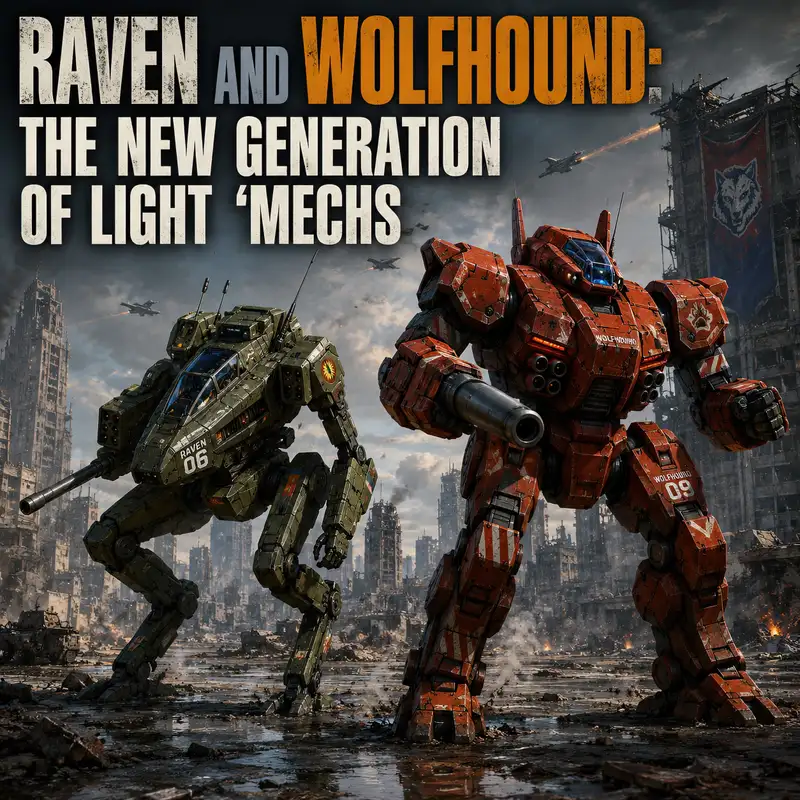
Raven and Wolfhound: The New Generation of Light ’Mechs
The Raven carried seven and a half tons of experimental electronic warfare equipment that promised to confuse enemy sensors and guide friendly fire. The Wolfhound carried five lasers and no ammunition at all. One was too ambitious for the technology of its moment. The other succeeded because its designers used familiar components with unusual discipline. Both weighed thirty-five tons. Both appeared during the final years of the Succession Wars. Together, they marked a change more important than any single weapon. The Great Houses were no longer merely repairing inherited machines. They were beginning to design new BattleMechs for problems their own armies had identified.
That change was not inevitable. By the early thirty-first century, centuries of war had destroyed factories, technical schools, research archives, and the industrial relationships needed to produce advanced military systems. Many regiments survived by rebuilding BattleMechs older than the states that owned them. A new design required more than a drawing board. It required engines, armor, actuators, targeting systems, trained workers, secure suppliers, and a government willing to risk scarce money on something that might fail. The Raven and Wolfhound came from different political cultures, but each was an argument that decline did not have to be permanent.
Their shared weight concealed completely different ideas about combat. The Raven was intended to improve the performance of an entire formation. Its value came from information, electronic interference, and target designation. The Wolfhound was designed to hunt specific enemy BattleMechs and destroy them through range control, armor, and sustained laser fire. A Raven commander asked what the rest of the battalion could do with better awareness. A Wolfhound pilot asked whether a Jenner or Panther could be forced into the wrong engagement. One machine tried to multiply friendly power. The other tried to concentrate its own.
The Capellan Confederation had strong reasons to pursue a force multiplier. It faced larger neighbors, limited strategic depth, and a military that could not afford to match every enemy regiment machine for machine. Capellan planners therefore invested in methods that might make smaller formations more effective. Electronic warfare offered an attractive possibility. The Star League had once fielded systems capable of disrupting sensors, finding concealed units, and coordinating precision attacks. Much of that capability had become lostech. Capellan researchers attempted to recreate the Guardian electronic countermeasures suite without possessing the full industrial and scientific foundation that had originally made it practical.
The resulting equipment worked, but it was enormous. The experimental suite weighed seven and a half tons and could not be fitted conveniently into an existing light BattleMech. Hellespont Industrials answered by designing a new chassis around the electronics. The Raven one X entered experimental service in the year thirty twenty-four. That sequence is important. The designers did not create a scout and then add useful sensors. They created a carrier for an electronic warfare system, then fitted the remaining engine, armor, and weapons around it. The Raven was built from the inside out, with the mission equipment determining almost every other compromise.
The original Raven was a thirty-five-ton machine with a standard fusion engine and a maximum speed of roughly eighty-six kilometers per hour. It had no jump jets and carried only four tons of armor. Its weapons consisted of two medium lasers and a six-tube short-range missile launcher. Twelve heat sinks were more than adequate for that modest armament. The machine could defend itself against other scouts and light vehicles, but it was not intended to win a prolonged fight. Much of its mass and internal volume belonged to electronics whose battlefield effect could not be measured by counting weapon barrels.
Capellan doctrine envisioned the Raven standing apart from the hardest fighting. It would locate targets, degrade enemy electronic warfare, and help artillery or infantry missile teams strike with greater accuracy. Experimental Ravens were often attached at battalion level as an additional member of the command lance rather than distributed throughout the regiment. That placement reflected both scarcity and uncertainty. Senior commanders wanted the machine close enough to influence the battle and important enough to protect. It also meant that one fragile light BattleMech carried a disproportionate share of the formation’s hoped-for technological advantage.
The equipment did not fulfill those hopes. It was too heavy, insufficiently sophisticated, and vulnerable to damage that could interfere with the Raven’s communications and targeting systems. More fundamentally, electronic warfare does not create victory by itself. Jamming is useful only if friendly units understand what the enemy can no longer see. Target identification matters only if artillery, missiles, or maneuver forces can act on the information. The Raven arrived before the Capellan military possessed all the mature equipment, communications procedures, and trained personnel needed to turn its signals into a consistent operational advantage. The prototype was not useless. It was incomplete as a system.
The Capellans nevertheless fielded the machine. Ravens appeared covertly with elite formations before the Fourth Succession War and were pressed into broader service when the Federated Suns offensive placed the Confederation under extreme pressure. The war exposed the prototype’s limitations. A Raven could support a prepared defense, but it could not reverse the collapse of a front by confusing a few sensors. Its thin armor and lack of jumping mobility made escape difficult once enemy forces located it. Many examples were captured as Capellan units were defeated, isolated, or forced to abandon equipment during the loss of entire worlds.
The Federated Suns reached a revealing conclusion after examining those captured machines. In the year thirty thirty, many were converted into the Raven two X. Technicians removed the bulky electronic warfare suite, installed a large laser, and added substantially more armor. The result was a more conventional light combatant. That refit was not proof that electronic warfare lacked value. It was proof that the original package did not justify the weight, maintenance, and tactical burden it imposed. The Federated Suns preferred a machine that could shoot and survive using technology its technicians already understood. The future had been captured, inspected, and temporarily replaced with a larger laser.
The Raven’s designers had been early rather than entirely wrong. The Helm Memory Core and the technological renaissance of the following decades restored information about advanced engines, armor, sensors, and electronic systems. Hellespont returned to the concept with equipment that could finally fit the mission. The Raven three L entered production on Sian in the year thirty forty-eight. It was faster than the prototype, reaching roughly ninety-seven kilometers per hour, and used an extralight engine and ferro-fibrous armor to free mass for electronics. The machine still did not jump, and its protection remained limited. Its real improvement was that the support systems now worked together.
A Guardian electronic countermeasures suite could disrupt hostile sensors and help protect nearby friendly units. A Beagle active probe helped the Raven locate concealed troops and machines. Target acquisition gear allowed the pilot to designate an enemy for guided artillery, including Arrow Four missiles. A Narc missile beacon could attach a homing signal to a target, improving the effectiveness of compatible friendly missiles. None of these systems was magical. Terrain, line of sight, communications, enemy countermeasures, and pilot skill still mattered. What changed was that the Raven could now create several different kinds of advantage from one position.
That made the three L less an individual weapon than a mobile node in a combined-arms network. A Raven detecting a hidden tank could pass the location to a lance commander. The pilot could mark a fortified position for artillery or place a Narc beacon on a BattleMech that friendly missile carriers were prepared to engage. Its jamming could complicate an enemy’s targeting while Capellan units repositioned. The machine became most valuable when commanders planned around it before the battle. A Raven assigned to a unit without compatible missiles, responsive artillery, secure communications, or trained operators was carrying expensive equipment whose potential remained largely theoretical.
Its conventional weapons remained two medium lasers and a six-tube short-range missile launcher. That was respectable for self-defense, but every serious exchange endangered systems more valuable than the damage the Raven could inflict. Four and a half tons of ferro-fibrous armor did not provide much margin, and the Inner Sphere extralight engine made side-torso damage especially dangerous. Cellular ammunition storage protected the missile reloads from turning one internal hit into a complete catastrophe, which was a welcome improvement. The pilot’s best tactical decision was often to identify the enemy, support the formation, and leave direct combat to machines designed to absorb it.
The Raven also imposed a maintenance burden unlike that of an ordinary scout. Its electronics required calibration, specialized components, and technicians who understood how the countermeasures, probe, target designator, and communications suite interacted. The Narc launcher needed dedicated ammunition, while the units exploiting its beacons had to carry compatible missiles. Target acquisition gear was useful only when artillery crews and command networks could respond in time. The extralight engine reduced mass but increased both cost and vulnerability. A Raven was therefore not simply purchased. It had to be integrated into an organization capable of keeping its sensors aligned and its reports useful.
Later variants extended the concept rather than abandoning it. The Raven four L added Capellan stealth armor and improved energy weapons while retaining the electronic warfare package. Other models altered missiles, networking equipment, or reconnaissance systems for different formations. The chassis also influenced later Capellan machines, including the Men Shen OmniMech, the Sha Yu, and eventually the Raven Two. The Raven’s legacy was not that every version succeeded. It was that Capellan industry kept treating battlefield information as something a BattleMech could actively shape rather than merely receive.
The Wolfhound began with a less abstract complaint. Draconis Combine Panthers and Jenners had repeatedly caused trouble for Lyran forces. The Jenner could move quickly, jump across obstacles, and deliver a dangerous close-range laser attack. The Panther carried a particle projection cannon capable of threatening heavier targets from useful range, then used jump jets to reach protected firing positions. Existing Lyran light forces often struggled to catch one and survive the other. After the success of the Hatchetman development program, Archon Katrina Steiner directed TharHes Industries to create a light BattleMech specifically able to hunt both Kuritan designs.
The Wolfhound one entered service in the year thirty twenty-eight. It used a standard two hundred ten fusion engine to reach roughly ninety-seven kilometers per hour. It had no jump jets, but it carried seven and a half tons of armor, close to the practical maximum for a thirty-five-ton chassis. A large laser in the right arm provided the main striking weapon. Three medium lasers faced forward from the torso, and a fourth covered the rear. Almost every major component was conventional and available within Lyran industry. The design was new, but it did not depend on a technological breakthrough to function.
Its weapons arrangement created a deliberate engagement plan. Against a Jenner, the Wolfhound could use the large laser at ranges where the Kuritan machine’s shorter-ranged weapons were less effective. If the Jenner closed, the Wolfhound had the armor and medium lasers to survive and answer. Against a Panther, the Wolfhound could use superior ground speed to reduce the value of the Panther’s particle projection cannon and force a closer exchange. The Panther’s jump jets complicated that approach, especially in broken terrain, but the Wolfhound could choose routes and distances more effectively than many heavier Lyran machines. It was designed around enemy behavior, not an abstract ideal.
The all-energy armament gave the Wolfhound excellent logistical endurance. It did not need missile reloads or autocannon ammunition, and a unit could remain in the field as long as technicians, cooling systems, armor supplies, and the fusion plant held together. Heat was the limiting resource. Ten single heat sinks could not dissipate the output of the large laser and all four medium lasers while the machine maneuvered aggressively. A disciplined pilot used the large laser during the approach, shifted to the forward medium lasers at close range, and fired everything only when the tactical result justified the heat. The rear laser was insurance, not an invitation to become surrounded.
Survivability received unusual attention. The heavy armor made the Wolfhound difficult to destroy by light BattleMech standards, and the design incorporated a full-head ejection system developed with Federated Suns assistance. That system could protect a pilot in environments where a conventional ejection seat was less useful, including hostile atmospheres or vacuum. It also reflected the wider Davion-Steiner relationship taking shape before the creation of the Federated Commonwealth. The Wolfhound was a Lyran machine, but its pilot-protection system showed how political cooperation could appear inside a chassis long before bureaucrats finished integrating entire armies.
The Kell Hounds received the first machines for combat testing, followed by Wolf’s Dragoons. Both commands offered experienced pilots, respected technicians, and enough independence to report what the design actually did rather than what its manufacturer hoped it did. The Wolfhound entered combat during the Fourth Succession War and performed especially well against the Panther and Jenner. Its success came from consistency. It had enough speed to force an engagement, enough range to shape the approach, enough armor to survive a mistake, and enough close-range firepower to finish the fight. None of those qualities was revolutionary alone. Their balance was.
The War of thirty thirty-nine reinforced that reputation. Wolfhounds suffered comparatively low losses, leaving the Draconis Combine with only a limited number of captured examples to study. The Combine did not simply copy the machine. Its industry developed the Wolf Trap as a dedicated response. That sequence is one of the clearest signs that the Wolfhound had succeeded. Enemy commanders had adjusted tactics, and enemy engineers had begun spending money. A BattleMech becomes strategically significant when it changes procurement decisions on the other side of the border.
The design still had serious limitations. Without jump jets, a Wolfhound could be outmaneuvered by Jenners or Panthers using cliffs, buildings, forests, and broken ground. It was fast for a thirty-five-ton machine, but it could not catch the quickest twenty-ton scouts in open terrain. Sustained maximum fire overwhelmed its cooling system, and its large laser lacked the reach of the Panther’s main gun. Against heavy BattleMechs, the Wolfhound’s armor bought time rather than equality. It was a scout hunter and striker, not a miniature line unit. Commanders who used it as a cheap substitute for a medium BattleMech usually discovered why weight classes still mattered.
The technological renaissance improved the Wolfhound without changing its philosophy. The Wolfhound two entered service in the year thirty fifty-two with an extended-range large laser and double heat sinks. It retained four medium lasers, strong armor, and the same basic speed. The new model could engage from farther away and recover from heavy laser use more efficiently. Retooling delayed production, so the variant arrived too late to shape the opening stages of the Clan invasion or the decisive stand at Tukayyid. The improvement was real. The calendar was less cooperative, as military calendars frequently are.
Phelan Kell’s Wolfhound, Grinner, gave the design one of its most famous encounters. In August of the year thirty forty-nine, Phelan was fighting pirates on the world known as The Rock when Clan Wolf appeared. His Wolfhound was destroyed and he was captured, introducing one Inner Sphere pilot to an enemy whose machines exceeded even the newest House designs. The episode exposed the limits of the Wolfhound without diminishing it. Clan Wolf later rebuilt Grinner with Clan technology after Phelan entered the warrior caste. The chassis that had failed against the invasion was considered worth restoring, because its basic concept remained sound even when its components were outclassed.
Production eventually expanded beyond TharHes on Tharkad to Arc-Royal MechWorks. Later variants carried extended-range particle projection cannons, light particle projection cannons, improved engines, advanced armor, and electronic warfare equipment. Some traded protection for range or speed. Others preserved the original balance more closely. The Wolfhound remained easy to maintain and well regarded because the core design did not depend on one fragile trick. It could absorb new technology as it became available while still performing the same essential mission: find enemy light forces, control the engagement, and deny them the freedom to harass heavier formations.
The Raven and Wolfhound therefore represented two forms of renewal. The Raven showed that the Inner Sphere could attempt a machine built around information, even before it fully recovered the technology to make that attempt successful. Its prototype failed to deliver the expected advantage, but the idea survived until industry caught up. The Wolfhound showed that innovation did not require lostech. Careful analysis of enemy tactics, standard components, strong armor, and a coherent weapons plan could produce a new BattleMech that worked immediately. One design waited for the future. The other proved the present had been underestimated.
Their logistical differences were just as revealing. A Wolfhound could operate with almost any formation able to repair a conventional BattleMech and supply replacement armor. Its lasers reduced ammunition demands, and its tactical contribution was easy to understand. A Raven needed a force organized to exploit electronic information, guided weapons, and coordinated fires. Its value increased as the sophistication of the surrounding unit increased. This made the Wolfhound easier to distribute and the Raven potentially more transformative. The Wolfhound improved a lance by being a capable fighter. The Raven improved a battalion only when the battalion learned to fight differently.
The two machines also challenge the simplest stereotypes about their states. The Lyran Commonwealth, famous for industrial wealth and heavy BattleMechs, produced one of the most balanced light hunters of its age. The Capellan Confederation, often described only through political intrigue and desperation, pursued a sophisticated electronic warfare concept that other states had not yet matched. Neither project was free of politics, institutional limits, or procurement risk. Both nevertheless showed governments trying to learn from battlefield problems rather than merely repeating inherited doctrine.
The old light BattleMechs survived because factories had produced them in vast numbers and generations of technicians knew how to keep them moving. The Raven and Wolfhound mattered for a different reason. They proved that the Great Houses could once again identify a current military problem, design a new chassis around it, and improve the result through production experience. The Raven turned sensors and coordination into a weapon once technology made the promise practical. The Wolfhound turned disciplined engineering into a hunter without waiting for a miracle. The new generation began when the Inner Sphere stopped asking only how to preserve the machines it had and started deciding what the next machine should be.