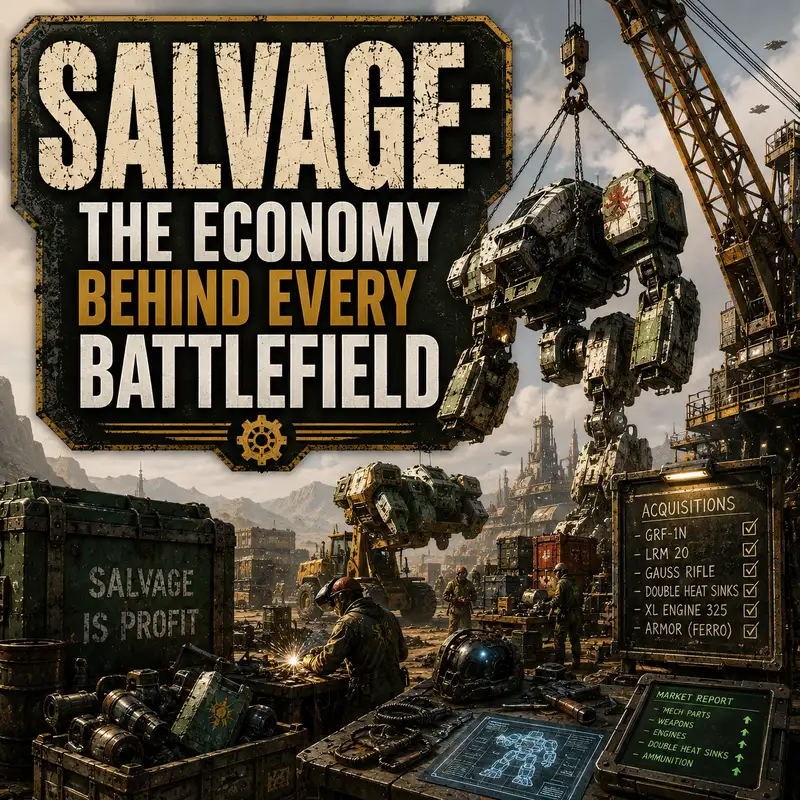
Salvage: The Economy Behind Every Battlefield
A mercenary commander can win the battle and still discover that the contract was a defeat. The enemy has withdrawn, three hostile BattleMechs lie disabled in the valley, and the command’s own machines are running on patched armor and borrowed parts. Then the employer’s liaison opens the salvage clause. The House claims the intact heavy machine, the mercenaries receive a damaged light chassis, and the technicians are told that anything not recovered before nightfall belongs to the counterattacking force. No one fires another shot, but the argument may determine whether the unit can accept another contract, replace its losses, or make payroll. In BattleTech, salvage is not an afterthought to combat. It is how battlefield destruction becomes military power, industrial raw material, and tomorrow’s order of battle.
Salvage begins with a simple fact. Expensive military equipment does not always vanish when it is defeated. A BattleMech may lose a leg, suffer a ruined gyro, or shut down after its pilot ejects. A tank may throw a track while leaving its engine and weapons intact. An aerospace fighter may make a forced landing. Even a wreck that will never fight again can contain armor, actuators, heat sinks, electronics, ammunition, and weapons worth recovering. The battlefield becomes a temporary warehouse of damaged assets, and the army controlling it gains choices. It can repair equipment, strip it for parts, sell it, study it, return it to an ally, or deny it to an enemy. The value lies less in the wreck itself than in what a capable organization can make from it.
The word destroyed can be misleading. A machine may be tactically destroyed because it can no longer influence the fight, yet remain economically valuable. An immobilized BattleMech with an intact center torso might be hauled away and rebuilt. A chassis with catastrophic structural damage may still surrender several usable components. A weapon torn from a ruined arm may be worthless if its housing is shattered, or precious if the damage stopped a few centimeters away. Condition matters at the system level, and trained technicians must judge it. Fire, water, ammunition explosions, contamination, deliberate demolition, and careless recovery can all turn a valuable prize into scrap. Salvage requires technical discrimination. The question is not merely whether something survived. The question is what survived, whether it can be removed safely, and whether the recovering force has the skills and facilities to use it.
Before any of that can happen, someone must hold the ground. The side that leaves the battlefield usually leaves the wreckage with it. A retreating force may tow away disabled machines, load wounded crews, and destroy anything it cannot move. A pursuing force may have to choose between chasing the enemy and securing the field. That choice can be operationally decisive. Pursuit might complete the victory, but every kilometer gained can leave recovery teams farther behind. Stopping to collect wrecks preserves combat strength, yet grants the enemy time to regroup. A commander claiming salvage rights without security, engineers, transport, and time has acquired a legal theory rather than equipment. Possession depends on controlling the area long enough for technicians to work, and battlefield control is rarely as permanent as the victory report suggests.
Recovery crews enter after the celebrated part of battle, though not always after the danger. They bring heavy trucks, winches, cranes, flatbeds, cutting equipment, power tools, diagnostic systems, fire suppression gear, and portable lighting. Engineering vehicles clear routes and stabilize ground. Infantry or armored escorts secure the perimeter. Technicians isolate power systems, unload live ammunition, inspect damaged structure, and decide whether the machine can walk, must be towed, or should be stripped in place. A medium BattleMech may fit onto a dedicated recovery trailer. A heavier machine can require multiple vehicles, specialized equipment, partial disassembly, or assistance from another BattleMech. Time matters. Weather can close roads, mud can immobilize the recovery vehicles, and an enemy counterattack can turn a repair site into a second battlefield occupied by people whose most dangerous weapon is usually a cutting torch.
The first obligation is not profit. It is survival. Crews search for wounded personnel, trapped pilots, unexploded ordnance, fuel leaks, unstable structures, and fires. A cockpit may contain an injured MechWarrior whose rescue takes priority over removing a valuable targeting system. Friendly machines are normally recovered as unit property, not treated as enemy salvage simply because they were abandoned during the fight. That distinction matters because a mercenary company that lost title to its damaged BattleMechs whenever a pilot ejected would not remain a company for long. Once people and friendly equipment are secured, the recovering force can evaluate enemy materiel. Even then, triage continues. An intact engine that can be removed quickly may outrank a complete chassis buried in rubble. Salvage work rewards judgment under pressure, not the ability to point at the largest wreck.
For mercenaries, the most important salvage decision may have been made months earlier, during contract negotiations on another world. Contracts can grant full salvage, deny it, divide it by percentage, or establish exchange arrangements under which an employer retains captured equipment while compensating the hired unit according to agreed terms. The language varies by era, employer, regulator, and negotiating power. A famous command with its own transport can demand terms that a newly formed company cannot. Employers may reserve strategic systems, intelligence material, prototypes, or equipment belonging to their own forces. They may also insist on the right to inspect the field before anything is removed. Generous salvage rights sound attractive, but only the definitions reveal who selects the prizes, who establishes their value, who pays recovery costs, and when ownership actually transfers.
Employers and mercenaries approach that clause from different financial positions. A Great House may view salvage as a way to recover an operation’s cost. It supplied transport, fuel, ammunition, intelligence, and access to the battlefield. It may also need captured machines to rebuild regular regiments. The mercenary command sees the same wreckage as replacement inventory. Contract pay must cover salaries, dependents, maintenance, medical care, training, travel, DropShip expenses, debt, and the parts that keep aging equipment functional. Cash can pay a technician, but it cannot create a compatible gyro on an isolated world. A command may therefore accept lower direct payment in exchange for stronger salvage terms. The employer calls that compensation. The mercenaries call it the difference between surviving the next campaign and becoming a cautionary entry in a hiring hall database.
Not every captured BattleMech is a good prize. A rare assault chassis may look magnificent on the battlefield and ruinous on the maintenance ledger. It may require unobtainable parts, scarce ammunition, unavailable transport capacity, or technicians trained on unfamiliar systems. A familiar medium machine with common components may be worth more to a practical commander. Condition matters as much as reputation. So do compatibility, supply, and time. A captured weapon that matches six machines already in service can support the whole unit. A unique component may become dead weight until it is sold. Salvage valuation is therefore not a beauty contest conducted among famous designs. It is a calculation of what can be repaired, transported, maintained, exchanged, or converted into cash before the command’s obligations come due.
The most valuable salvage is often absent from the unit roster. Armor plate, myomer bundles, actuators, heat sinks, control systems, communications gear, sensors, pumps, bearings, seals, and replacement electronics keep existing machines alive. Ammunition must be inspected and may not match the launchers or autocannons a unit operates. Engines and gyros are valuable, but removing and installing them demands time, equipment, and skilled labor. Technicians may strip a wreck down to labeled assemblies, record serial numbers, test components, and pack them for transport. What looks like a dead BattleMech can become months of spare parts. Salvage teams therefore do not merely tow complete machines. They create an inventory. The command that knows what it recovered, where it is stored, and which systems it supports has gained combat power. The command with an undocumented pile of metal has gained a future argument.
Repair introduces compromise. A damaged machine rarely returns unchanged. Replacement parts may come from another variant, another manufacturer, or another era of production. Mounting points must be adapted. Wiring must be rerouted. Armor may be applied in sections from different suppliers. A weapon lost in battle may be replaced by whatever is available rather than what the original design intended. At the extreme, technicians assemble FrankenMechs from major sections of different chassis, producing machines that embody ingenuity, desperation, and several maintenance manuals that disagree with one another. These repairs may work for years, but every deviation creates burdens. The pilot must learn the altered balance and weapon arrangement. The technicians must remember which standards apply to which section. Salvage preserves combat strength, but it can also turn a tidy supply system into a museum that must deploy on forty minutes’ notice.
The Succession Wars made salvage culturally central because destruction outpaced replacement across much of the Inner Sphere. Factories, shipyards, research centers, and skilled workforces were lost. Some worlds retained major industry and new BattleMechs never disappeared, but production was uneven and many units could not expect prompt factory replacement. Machines remained in service through repeated rebuilding, inheritance, capture, and recapture. A BattleMech could carry a family name while containing components installed by several owners and manufactured in different states. Under those conditions, battlefield wreckage was not merely discounted equipment. It was one of the few available sources of systems that no local plant could produce. The era’s famous technological decline was experienced by technicians as a daily search for substitutes, donor machines, and one more component that could be made to fit.
Regular armies depend on salvage as surely as mercenaries do. House forces operate recovery companies, maintenance battalions, depots, and technical services that determine how many damaged formations return to combat. Captured enemy equipment may refill depleted ranks, but it also yields intelligence. Engineers can examine armor composition, weapon performance, communications systems, manufacturing marks, software, and field modifications. Serial numbers may reveal where a machine was built or which unit previously operated it. Unusable equipment can expose supply relationships and technological priorities. Commanders may order wrecks destroyed to prevent that exploitation. A withdrawal plan therefore includes decisions about what can be evacuated, what must be disabled, and what must be demolished. Denying salvage can be almost as important as taking it, particularly when the abandoned system contains a prototype or a capability the enemy has not yet mastered.
The value of a wreck changes with history. During periods of technological scarcity, a functioning advanced component can be more valuable than the machine carrying it. After the recovery and spread of lost technologies, some once-rare systems become easier to replace while others remain tightly controlled. The arrival of the Clans transforms salvage into both an economic prize and an intelligence objective. Captured Clan equipment offers extraordinary performance, but early Inner Sphere units face problems of compatibility, ammunition, maintenance knowledge, and supply. A salvaged weapon is not a permanent advantage if it cannot be repaired after the next battle. Research, battlefield experience, and industrial adaptation gradually make some captured technology more useful. The pattern repeats across eras. Salvage value is never fixed. It depends on what a society understands, what its factories can reproduce, and what its logisticians can keep operating.
Once removed from the field, salvage enters a wider market. Military depots rebuild equipment for their own forces. Mercenary commands trade components among themselves. Brokers, repair yards, planetary governments, manufacturers, and arms merchants buy damaged machines or sell refurbished ones. Hiring centers such as Galatea and later Outreach connect military labor with technical services and equipment markets. On less regulated worlds, trade passes through smugglers, pirates, corrupt officials, and dealers who consider provenance a problem for the next owner. A salvaged BattleMech can be sold whole, broken into parts, exchanged for a more supportable design, pledged against debt, or retained as the foundation of a new lance. Each transaction spreads battlefield consequences far beyond the planet where the machine fell. A defeat on one frontier can supply a mercenary company fighting three states away.
Markets require ownership, and ownership creates disputes. Two allied units may claim the same wreck. A local government may assert that all abandoned military equipment belongs to the state. An employer may value a captured machine far below the mercenaries’ estimate before exercising exchange rights. A commander may remove weapons before the official inspection and describe them as necessary battlefield repairs. ComStar’s Mercenary Review Board and later institutions could broker contracts and judge disputes, but enforcement still depended on records, reputation, and political power. A unit known for concealing salvage may find future contracts scarce. An employer known for rewriting claims after the battle may discover that only desperate commands will sign. Reputation functions as credit in the mercenary economy, and salvage disputes can damage it faster than a poor tactical performance.
Winning title to a machine does not move it across a star system. Salvage must be transported from the battlefield to a secure depot, then perhaps to a spaceport and into a DropShip. A complete BattleMech occupies a valuable bay, while components consume cargo space, handling equipment, packaging, and manifests. A command may have rights to more tonnage than it can lift. The employer may offer transport at a price that makes the prize less attractive. A damaged DropShip or missed departure window can force crews to abandon equipment they legally own. Interstellar logistics therefore places a hard limit on battlefield wealth. A commander claiming every wreck may simply be selecting what will be left behind. The practical question is not how much salvage was awarded. It is how much useful equipment reaches the unit’s next repair facility before the next contract begins.
Salvage sites are dangerous long after the shooting slows. Ammunition may cook off without warning. Damaged capacitors and power systems can injure technicians. Buildings can collapse around buried vehicles. Mines and unexploded shells remain where the battle placed them. Retreating troops may booby-trap valuable equipment or leave demolition charges designed to kill the people who attempt recovery. Procedures call for inspection, isolation, and explosive ordnance work because haste can destroy the prize and the team. Command pressure still encourages haste. A counterattack may be hours away, and the most valuable components often take the longest to remove. Salvage leaders must balance speed against safety while working for commanders who can see the value of an intact particle projection cannon more clearly than the technician standing beside an uncertain ammunition bin.
BattleMechs attract attention, but the salvage economy includes the entire combined-arms force. Tanks provide weapons, engines, armor, electronics, and sometimes complete vehicles that are easier to restore than a BattleMech. Aerospace wreckage may contain advanced avionics even when the airframe is lost. Artillery, communications vehicles, field kitchens, medical equipment, engineering machinery, and trucks can matter more to endurance than another damaged combat chassis. Fuel, ammunition, repair tools, and spare parts captured from an enemy depot may sustain operations immediately. Civilian machinery can also be requisitioned, purchased, or stolen, though those words describe very different legal and moral acts. An army that only counts captured BattleMechs misunderstands its own needs. The glamorous prize may lead the victory parade. The recovered trucks are what allow the parade to reach the next town.
Salvage changes tactics before the first shot. Commanders may prefer disabling fire when capture is possible, though combat rarely permits such control. Pilots may target legs to immobilize a BattleMech, then discover that doing so exposes them to greater danger than destroying it outright. Units may fight to retain a field because their own disabled machines are there. Raiding forces often plan around limited recovery time and may destroy what they cannot carry. Defenders can trade space for time, withdraw, then return before salvage teams finish. Recovery assets themselves become targets because destroying the enemy’s cranes, trucks, and technicians reduces the value of every future victory. The tactical map contains two objectives. One is the enemy force. The other is the collection of damaged people and machines that both sides hope to possess when the firing ends.
At the operational level, salvage determines whether losses are temporary or permanent. A regiment that suffers heavy damage but recovers its pilots, chassis, and repairable systems may rebuild. A force that loses fewer machines but abandons the field may emerge weaker. This is why casualty figures alone can misrepresent a campaign. The location of the wrecks, the availability of technical personnel, the security of supply routes, and the time before the next engagement all matter. A commander can win repeatedly while consuming equipment faster than recovery crews can restore it. Another can retreat repeatedly while preserving enough assets to remain dangerous. Salvage is not a substitute for production or sound logistics, but it changes the rate at which combat power disappears. In a long war, that rate may matter more than the result of any single engagement.
There is also a human meaning hidden beneath the accounting. Many BattleMechs are inherited property, symbols of family standing, or core assets of mercenary commands built over generations. Recovering one can preserve a livelihood and a unit’s identity. Losing one can end a career even when the pilot survives. Enemy salvage carries another story. The machine being stripped may have been someone else’s inheritance, and its cockpit may have been opened only minutes earlier to remove the dead or wounded. Technicians must turn that scene into parts because their own people need functioning equipment. The process is practical, necessary, and emotionally untidy. BattleTech’s salvage economy works because human beings learn to see a ruined war machine as both the remains of a violent encounter and a collection of components required for the next one.
Salvage is the economy behind every battlefield because it connects tactical control, technical skill, contract law, transportation, industry, and survival. It rewards the force that can secure the ground, organize recovery, evaluate damage, defend a claim, and move the useful pieces to where they are needed. It explains why a mercenary commander may value a salvage clause over higher monthly pay, why armies risk personnel to recover wrecks, and why machines survive for centuries in forms their designers never intended. The battlefield does not stop producing consequences when the weapons fall silent. Under floodlights and guard posts, technicians begin deciding which parts of the defeat can be repaired, which parts of the victory can be carried away, and what both sides will be able to field when they meet again.