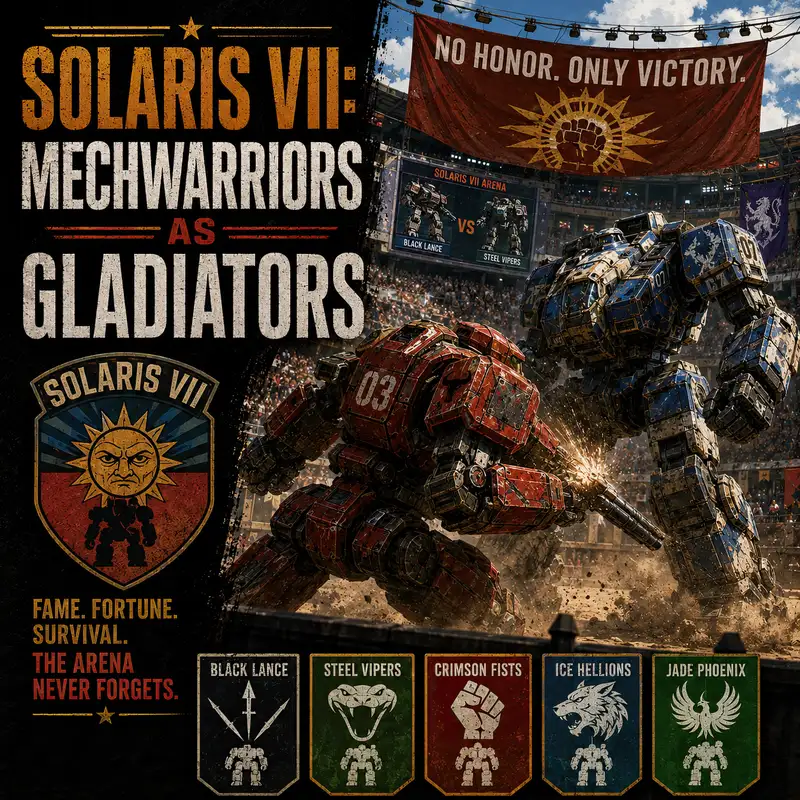
Solaris VII: MechWarriors as Gladiators
A Solaris MechWarrior could reach the point where surrender was the sensible military decision and the disastrous financial one. The BattleMech might still be standing, but an actuator was gone, armor had opened over the engine, and another direct hit could kill the pilot. A stable contract might also place a surrender bond worth more than the warrior could repay. Ejecting preserved a life. Continuing protected the career, the license, and the people whose salaries depended on the next match. Solaris Seven turned that choice into entertainment, transmitted it to millions, and opened another round of betting before the wreckage had cooled.
That was the central contradiction of the Game World. Solaris Seven presented BattleMech combat as sport, but almost nothing about it was harmless. The machines were military weapons. The ammunition was often live. The pilots brought habits learned in war, and some returned to war after the crowd learned their names. Around them stood an economy of stable owners, technicians, broadcasters, bookmakers, sponsors, manufacturers, criminals, and political agents. The arenas did not remove warfare from politics and commerce. They concentrated both inside reinforced walls and sold admission.
The games began with industrial competition rather than ancient ritual. Solaris was already a heavily industrialized world during the Star League, with BattleMech factories and testing grounds that made it useful to manufacturers. In the year twenty-six ninety-five, a Phoenix Hawk and a Sentinel fought in front of Star League representatives as competing companies demonstrated their products. The purpose was procurement. The spectacle followed. Planetary broadcasts attracted viewers, viewers attracted betting, and betting gave promoters a reason to schedule another contest. A weapons trial became a sporting event because everyone involved discovered a different way to profit from it.
Solaris also offered neutral ground for warriors who wanted to settle disputes without starting another formal campaign. Mercenaries trained there, while Gunslingers and Ronin used the world during the First Hidden War. By the time of the Amaris Coup, Solaris duels were already famous beyond the planet. The collapse of the Star League did not end them. It made them more valuable. As states lost technology and standing forces shrank, a world able to repair BattleMechs, test pilots, and broadcast combat possessed an asset that could survive changes in flag.
Survival was not guaranteed. Solaris had originally belonged to the Free Worlds League, then turned toward the Lyran Commonwealth during the First Succession War. Free Worlds League retaliation included nuclear bombardment. In the year twenty-eight twenty, the WarShip Despiser struck the world after a failed ground raid, killing thousands and burning the Xolara region. Four years later, the Solaris Act made the planet formally independent under Lyran protection. The arrangement was politically convenient. The Lyrans gained influence over an industrial and cultural prize, while Solaris preserved the appearance of a neutral stage where every Great House could participate.
That arrangement shaped Solaris City. The capital developed six principal districts. The International Zone claimed no single Great House identity, while the Black Hills leaned toward the Federated Suns, Cathay toward the Capellan Confederation, Silesia toward the Lyran realm, Montenegro toward the Free Worlds League, and Kobe toward the Draconis Combine. Residents of those districts could retain citizenship in the states they identified with. Exiles, political misfits, agents, and ambitious expatriates therefore lived beside one another in a city where national rivalry had its own restaurants, police forces, criminal organizations, and BattleMech stables.
Beneath the city ran tunnels large enough to move BattleMechs between repair yards, the spaceport, and the arenas without sending them through ordinary traffic. That infrastructure was essential. A fifty-ton machine cannot quietly take a side street, and a damaged assault BattleMech tends to delay the morning commute. The tunnels also created concealed movement routes, storage areas, and repair spaces that later became militarily important. Solaris City was designed to support spectacle, but the same system could support street fighting, smuggling, and resistance.
The five Open Class arenas gave the games their most recognizable geography. Boreal Reach used environmental controls and holographic systems to create changing conditions, including the arctic setting that gave it its name. The Factory converted an industrial plant into an urban maze of halls and heavy structures. Ishiyama, the Iron Mountain, forced warriors through tunnels and caverns where sensors, patience, and close-range weapons mattered more than elegant long-range plans. The Jungle recreated humid tropical terrain inside a massive structure. Steiner Stadium offered a comparatively open floor and protected large crowds behind advanced barriers.
These environments ensured that a champion needed more than accurate gunnery. A pilot who dominated the open floor might become lost inside Ishiyama. A long-range configuration could be terrifying at Boreal Reach and nearly useless when the Jungle forced contact at short distance. Heat management, footing, sensor interpretation, and the ability to read terrain became part of the performance. Arena designers could change the problem faster than a military procurement office could issue a revised manual. The crowd wanted variety. The MechWarrior had to survive it.
Solaris maintained a ladder from small local arenas to the Open Class. More than a hundred venues across the planet supported different machine weights and levels of prestige. Unknown pilots might begin in lower-class matches or in the Reaches outside Solaris City. Successful fighters accumulated wins, reputation, and access to better opponents. At the top stood the annual Grand Tournament, traditionally a single-elimination field of one hundred twenty-eight elite MechWarriors. The winner received a major purse, but the championship also opened the more valuable doors of title defenses, broadcasting contracts, endorsements, and merchandise.
The most common duel continued until one machine was destroyed, disabled, or surrendered. Other events included team matches, grand melees, challenge bouts, leagues, and later specialized competitions. Some promoters staged BattleMech races, capture-the-flag contests, or even machine-scale sports. Tanks, aerospace fighters, infantry, and battle armor also found audiences. Solaris was famous for BattleMech gladiators, but the business understood a basic truth about entertainment. Once spectators agree to watch armored vehicles fire live ammunition at one another, the programming schedule can become remarkably flexible.
Most MechWarriors did not manage that career alone. They joined fighting stables owned by wealthy patrons and run by stablemasters. A substantial stable might employ ten to forty pilots, along with technicians, trainers, promoters, administrators, and security personnel. Some warriors owned their BattleMechs. Others leased a machine, shared one, or depended entirely on the stable. In exchange for salary, training, repairs, licensing help, and arranged matches, the stable took part of the fighter’s direct revenue. Broadcasting and merchandising rights could be even more important, and contracts often favored the organization that had financed the career.
The stable system could turn opportunity into dependency. A dueling license was expensive, especially at the higher classes. When the stable paid for it and retained ownership, leaving became difficult. A surrender bond could encourage a damaged pilot to keep fighting after sound judgment recommended withdrawal. Young people entered internship programs that taught piloting, technical work, promotion, or management, then owed years of service. Better stables offered genuine training and fair support. Worse ones treated MechWarriors as replaceable components attached to expensive machines. Cooperatives emerged as an alternative, allowing independent fighters to share costs and bargaining power.
The technician was the least visible person in the arena and often the one who determined whether the star appeared at all. Arena machines absorbed damage at a pace that would alarm a line regiment. Armor had to be replaced, actuators rebuilt, sensors recalibrated, weapons inspected, and heat systems tested before the next booking. A stable that could not repair quickly lost matches, revenue, and ranking. The pilot received applause for a daring maneuver. The technical crew received a new list of parts required by morning. Solaris never entirely solved that imbalance, though it built an industry around it.
Arena combat also encouraged unusual BattleMech design. Many fighters used ordinary military models, but successful stables modified them for specific venues and opponents. Close-range weapons, reinforced armor, jump jets, melee systems, and experimental equipment could matter more than battlefield endurance. Small firms produced limited runs of machines intended for the circuit. Prototype weapons appeared because Solaris offered manufacturers a live-fire test with excellent telemetry and an audience. A device that lacked the reliability for a campaign might still survive a ten-minute duel, which was sometimes enough for the sales department.
This made the arenas valuable to military powers. Solaris tested pilots, machines, and technologies under pressure. It also produced misleading lessons. A duel rewards individual initiative, immediate aggression, and careful knowledge of one opponent. A campaign rewards coordination with infantry, armor, artillery, aerospace forces, reconnaissance, and supply. An arena fighter can plan around a known boundary and a sealed exit. A battlefield commander must worry about civilians, hidden reserves, ammunition convoys, and whether the DropShips will still be available after sunset. The skills overlapped, but they were not identical.
Employers still came to Solaris looking for talent. A successful gladiator had demonstrated nerve, machine control, and the ability to function while being watched by millions. Such a warrior could become a valuable mercenary recruit or return to a national military with sharpened dueling skills. The employer also risked hiring a celebrity accustomed to personal freedom, special treatment, and tactics designed for the camera. Solaris produced excellent MechWarriors. It did not automatically produce obedient lieutenants. Any hiring officer who confused applause with unit cohesion eventually received a practical correction.
The best fighters understood that performance was part of combat. They cultivated colors, nicknames, entrances, rivalries, and recognizable machines. Audiences followed personalities as much as technical skill. A warrior who could win dramatically was worth more than one who won quietly. That pressure encouraged dangerous behavior, but it also created tactical deception. A pilot could build a reputation for aggression, then use an opponent’s expectation against them. On Solaris, public image became another weapon system, maintained by promoters and occasionally repaired with the same urgency as the BattleMech.
Gambling tied the entire structure together. Official betting terminals tracked sanctioned matches, and odds eventually accounted for both the machine and the pilot after earlier systems proved easy to manipulate. Underworld bookmakers offered other wagers and other methods of collection. Fixed fights, substituted pilots, sabotage, skimmed purses, and attacks outside the arena remained recurring threats. The Solaris Civic Council and dueling authorities regulated licenses, health checks, and cheating, but the money involved guaranteed continuous attempts to evade them. The official system was transparent enough to protect confidence, not pure enough to eliminate corruption.
Gray Noton became the clearest early symbol of what Solaris rewarded. He returned from mercenary service in the year thirty fifteen with a Rifleman that many observers considered a poor choice for the highest arenas. He then held the championship for seven years, a record that endured. His machine became known as Legend-Killer, and so did he. Noton’s career proved that pilot skill, preparation, and tactical understanding could overturn assumptions about chassis prestige. His later work as an information broker also revealed the less public Solaris. Arena fame created contacts, access, and credibility that could be converted into intelligence and political influence.
Justin Allard used that same world as both battlefield and cover. Disgraced and exiled in public, he rebuilt his career under the name Justin Xiang. With financial help, he purchased a battered Centurion and transformed it into Yen-Lo-Wang. Replacing its standard autocannon with a much heavier close-range weapon gave him a surprise advantage against opponents who prepared for the machine they thought they knew. He won the championship in the year thirty twenty-seven. His rise demonstrated the arena’s essential formula. Technical modification, intelligence, theater, and piloting skill mattered together.
A generation later, Kai Allard-Liao brought Yen-Lo-Wang back to Solaris after fighting the Clans. He held the championship in the years thirty fifty-five and thirty fifty-six, and many expected him to challenge Noton’s record. Instead, he returned to military and political responsibilities. Kai’s success showed that a truly exceptional battlefield MechWarrior could dominate the circuit. His departure showed the difference between championship and command. Solaris could offer fame, wealth, and personal clarity. It could not remove the wars waiting beyond the jump points.
The Clan invasion changed the population around the games. Rasalhague refugees and expatriates formed a major community on Solaris, though they never received a formal district of their own. Some fought for stables associated with other states and directed earnings toward relief efforts or resistance behind Clan lines. Their presence made the circuit more than a contest of personal ambition. An arena purse could support displaced families. A famous fighter could represent a conquered culture. The same broadcast that sold advertisements could carry a political identity across occupation borders.
The line between arena rivalry and state conflict finally collapsed in the year thirty sixty-two. Davion supporters and Lyran loyalists had spent years treating Solaris City as a symbolic battlefield for the failing Federated Commonwealth. A championship confrontation involving Michael Searcy and Victor Vandergriff spilled beyond Steiner Stadium. House-aligned stables and cooperatives formed improvised combat groups, and BattleMechs fought through districts built around those same loyalties. Peacekeeping forces failed to contain the violence. The Solaris riots became an early battle of the Federated Commonwealth Civil War because the city had already organized politics into armed teams.
The riots exposed what had always been present beneath the sport. Stables possessed combat-ready machines, trained pilots, technicians, communications, secure compounds, and established chains of loyalty. The underground tunnels allowed movement between districts. Promoters knew how to shape public opinion, while broadcasters could turn a duel into a political narrative. When civil authority fractured, the arena system generated makeshift battalions almost immediately. It lacked the discipline and support of a regular army, but it did not lack weapons.
The Word of Blake learned the same lesson after invading Solaris in June of the year thirty sixty-eight during Operation SHOWTIME. The occupiers expected to seize a famous world at a moment when its regular protection had weakened. Instead, free agents and stables formed the Solaris Home Defense League. Arena MechWarrior Erik Gray emerged as an important leader. The resistance initially suffered from the ordinary problems that spectacle had concealed. It needed ammunition, transport, infantry weapons, spare parts, and secure communications. Courage was available in abundance. Logistics required theft, bargaining, and improvisation.
In the year thirty seventy, resistance fighters used repair vehicles to move infantry and Dispossessed MechWarriors against Blakist supply caches in the International Zone. Captured ammunition, parts, and BattleMechs kept the campaign alive. Local criminal organizations supplied equipment when cooperation served their interests. By the following year, the Home Defense League was fighting to retake Solaris City. Some lower-class arenas reopened even while the war continued, and gladiators left the resistance to resume scheduled bouts. Solaris had commercialized war for centuries. It was not going to let an actual occupation interfere longer than necessary.
The resistance eventually drove the Word of Blake from the city and then from the planet, though the retreating occupiers destroyed the hyperpulse generator station. The victory cost lives, industry, and trust in institutions that had collaborated with the occupation. Afterward, refugees crowded damaged districts, organized crime gained control over parts of the recovery system, and the old patchwork of district governments was replaced by stronger planetary administration. The games returned because they were economically indispensable, not because the wounds had closed.
The Lyran government later insisted on retaining Solaris even as nearby regions entered the Republic of the Sphere. Arena revenue mattered more than the ruined military industry, and rebuilding focused heavily on restoring the circuit. By the year thirty eighty-five, the world had broadly recovered, but new problems followed success. Too many mercenaries arrived seeking work, matches, or machines. Those who failed sometimes preyed on outlying settlements. Solaris could create opportunity, but it also attracted armed people whose plans ended at the employment office.
Clan Wolf took control of Solaris by the middle of the thirty-second century and allowed the games to continue. Clan warriors publicly disdained much of the circuit’s showmanship, yet the arenas offered something familiar beneath the advertising. They provided controlled tests of individual combat skill. Wolf contenders entered to challenge the so-called pseudo-warriors, then used the games to evaluate and recruit talent. Some gladiators were brought into the Clan military. Others were claimed as bondsmen through Trials conducted in the arenas. Solaris adapted again by translating entertainment into the language of its newest rulers.
When much of the Wolf military departed for Terra in the year thirty-one fifty-one, unrest grew on Solaris. Raiders in black-painted BattleMechs struck warehouses near the International Zone and escaped before the Wolf constabulary could respond. Arena fighters were suspected. Whether every pilot came from the circuit mattered less than the capability on display. A world built to maintain private combat machines, move them through hidden routes, and reward independent warriors had produced a ready source of resistance once again.
Solaris Seven made MechWarriors into gladiators by turning military skill into a marketable identity. The arena offered money, machines, rehabilitation, recruitment, and sometimes a second life to warriors who had lost their place elsewhere. It also shifted risk downward. Stable owners, broadcasters, sponsors, and bookmakers could profit from a pilot’s courage without sharing the cockpit. The crowd saw a champion. Behind that champion stood technicians working through the night, administrators protecting contracts, families depending on salaries, and medics waiting for the barrier doors to open.
The Game World mattered because its battles were never only games. The arenas tested technology, trained warriors, moved political money, amplified national rivalries, and created armed institutions outside ordinary militaries. When peace held, those institutions produced entertainment. When government failed, they produced militias, vendettas, and street wars. Solaris did not civilize BattleMech combat. It taught society how to package it, regulate it, sponsor it, and cheer at the correct moment. The gladiator entered the arena alone, but the entire Human Sphere was always standing just beyond the glass.