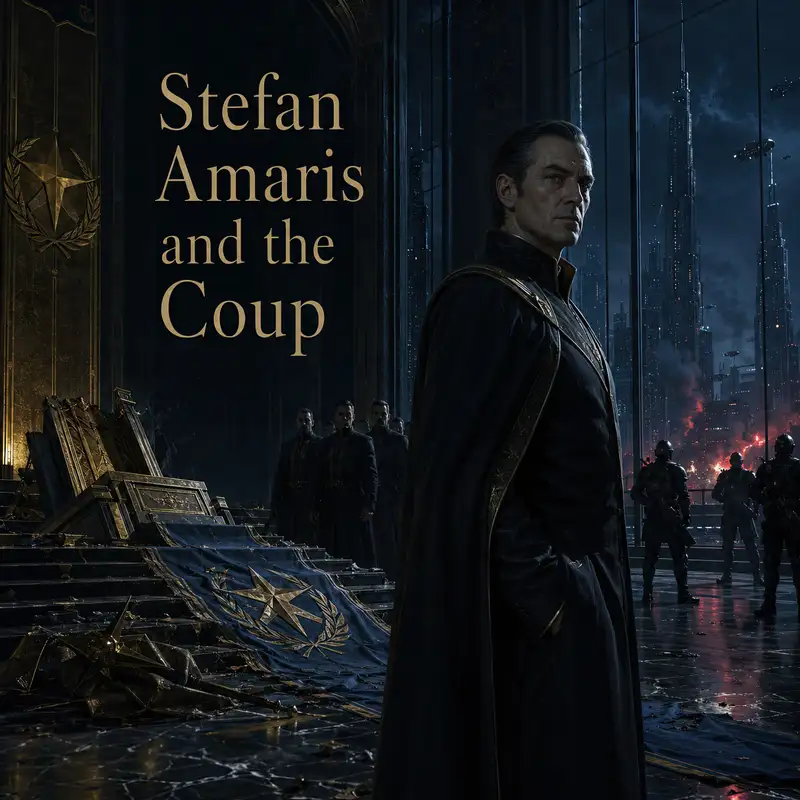
Stefan Amaris and the Coup
The first decisive targets were not the Star League throne or Richard Cameron’s palace. They were hyperpulse generator stations, naval jump points, barracks, and the underground fortresses known as Castles Brian. Across the Terran Hegemony, troops from the Rim Worlds Republic were already standing beside those targets with access badges and orders authorizing their presence. When the attack began, many defenders did not face an army breaking through the perimeter. They faced the allied garrison already inside it. Stefan Amaris carried a laser pistol into the palace. His more important weapon was permission.
The coup of the twenty-seventh of December, twenty-seven sixty-six, was one of the most successful opening operations in interstellar history. In a matter of hours, Amaris forces seized most of the Terran Hegemony and decapitated the Cameron government. That success did not come from one moment of betrayal. It came from years of political cultivation, military expansion, intelligence penetration, and logistical preparation. The central question is how the ruler of a Periphery state placed enough force inside humanity’s most heavily defended realm to capture it before the Star League Defense Force could respond.
Stefan Ukris Amaris was born in the Rim Worlds Republic on the twenty-eighth of August, twenty-seven seventeen. His mother, Cynthia Amaris, ruled the Republic. His father, Stefan Gorienko, was an Inner Sphere industrialist. Amaris grew up inside a dynasty whose history mixed court politics, assassinations, coups, and a deeply cultivated grievance against House Cameron. Family teaching presented the Reunification War as humiliation imposed by Terra and the Great Houses. The young heir was not merely told that the Amaris family had lost power. He was taught that history had created a debt he might someday collect.
The Rim Worlds Republic gave him more than resentment. It was the strongest of the established Periphery states in several important respects. It possessed an educated workforce, military academies, a significant defense industry, and unusually close ties to the Terran Hegemony. House Amaris had ruled with Cameron support before, during, and after the Reunification War. Those relationships gave Republican politicians, officers, contractors, and intelligence personnel access that another Periphery government would never have received. The same political order the Amaris family resented had also trained it to operate inside Terran institutions.
Later histories often reduce Stefan Amaris to a violent madman, which makes the coup harder to understand. A madman might pull the trigger. He does not usually coordinate the movement of divisions, secure commercial contracts, cultivate officials, manipulate a sovereign, and synchronize attacks across more than a hundred star systems. Amaris was theatrical, vindictive, and increasingly cruel. He was also patient, observant, and exceptionally skilled at showing different people the version of himself they were prepared to trust. His greatest talent was not deception in the simple sense. It was making other people believe that helping him served their own interests.
By the middle of the twenty-eighth century, the Republic had the foundations for military expansion. Restrictions imposed after earlier crises had weakened, while the government used domestic industry and connections to Hegemony arms suppliers to acquire advanced equipment. By twenty-seven sixty-five, the Rim Worlds Army was organized into twenty-four divisions, supported by a large reserve and extensive mercenary employment. Its administrative structure imitated the Star League Defense Force, which simplified later operations beside federal units. Amaris was not building a force capable of defeating the entire Star League in open war. He was building one capable of occupying prepared positions before open war began.
His opportunity appeared after the death of First Lord Simon Cameron in twenty-seven fifty-one. Simon’s heir, Richard, was eight years old, recently orphaned, and surrounded by adults who treated him as both sovereign and problem. Aleksandr Kerensky served as regent while also commanding the largest military in human history. The Great House rulers used the regency to recover political influence. Court officials competed for access. Richard received ceremony in abundance and honest companionship in short supply. Amaris recognized that the child did not need another lecturer on responsibility. He needed someone who appeared to admire him without reservation.
Beginning in twenty-seven fifty-three, Amaris sent gifts, offered praise, and presented himself as Richard’s loyal friend. He renamed the Republican capital from Apollo to Terra Prime in the young First Lord’s honor. The gesture was extravagant enough to look absurd, which may have helped it work. Richard lived among experienced politicians who spoke carefully and corrected him privately. Amaris behaved as though the boy’s smallest preference carried historical significance. The flattery was not occasional. It became a stable relationship through which Richard increasingly interpreted everyone else’s disagreement.
Amaris did not simply encourage Richard to trust him. He encouraged Richard to distrust the people capable of limiting him. When the young ruler issued Executive Order One Hundred Fifty-Six, demanding the dissolution of the Great House militaries, every House Lord resisted and Kerensky declared the order unenforceable and unlawful. Richard withdrew it in humiliation. Amaris used the failure to reinforce the claim that Kerensky and the council were conspiring against the First Lord. The order had been strategically impossible, but politically useful to Amaris. It isolated Richard from the officials whose skepticism might have exposed the developing threat.
The same method appeared in the Periphery crisis. Richard’s Taxation Edict of twenty-seven sixty-three imposed steep increases, especially on states already denied equal political representation. The resulting anger was genuine. Amaris did not invent generations of resentment toward Star League rule. His agents helped intensify and direct it, while he appeared at court as the one Periphery ruler who remained loyal. Protest became terrorism, refusal became rebellion, and Kerensky was ordered to deploy federal troops across an enormous frontier. Every regiment sent outward weakened the defensive concentration around Terra.
In twenty-seven sixty-four, Richard signed a secret agreement allowing Rim Worlds forces to replace Star League units withdrawn from the Terran Hegemony. On paper, the arrangement solved a manpower problem. The Republic was a Star League associate, Amaris was the First Lord’s friend, and the troops were arriving to defend federal installations. In practice, the treaty converted Amaris’s political influence into military access. Republican formations entered naval bases, communications centers, supply depots, and fortress complexes that would have taken years of fighting to seize from outside.
The deployment grew far beyond the strength publicly reported. Twice as many regiments arrived as some official records acknowledged. By December of twenty-seven sixty-six, the equivalent of sixteen Republican divisions stood inside the Hegemony, supported by mercenary formations and local agents. They outnumbered the remaining Star League troops in the region by roughly two to one. More important, many Republican units controlled or shared access to over half the Hegemony’s Castles Brian. Their officers learned the procedures of the automated Space Defense System and gained entry to the Star League military bureaucracy. Amaris had not surrounded the fortress. He had joined the maintenance staff.
Not everyone accepted the arrangement. On New Dallas, Governor Titus Clay and Major General Carlos Kataga distrusted the arriving Republican forces and refused to hand over the world’s three Castles Brian. They mobilized militia, recalled reservists, and confined the newcomers to minor facilities despite orders attributed to higher authority. Their resistance forced Amaris commanders to improvise when the coup began. New Dallas matters because it shows that Operation Apotheosis was not unstoppable. The plan worked best where officials treated authorization as a substitute for judgment. Where commanders asked why foreign troops required control of every defensive system, Amaris lost his easiest advantage.
Operation Apotheosis was designed as a synchronized seizure rather than a conventional invasion. Special teams would isolate hyperpulse generator stations before wider fighting began. Naval forces would secure zenith and nadir jump points, preventing reinforcement or escape. Garrison troops would take Castles Brian, command centers, and aerospace fields. Other formations would strike barracks and troop transports before crews could mobilize. Local collaborators would keep civil administration functioning and instruct populations to remain calm. The objective was not to defeat every loyal unit immediately. It was to prevent those units from discovering that they were part of the same battle.
Control of communications was essential. On most Hegemony worlds, Republican teams captured the hyperpulse generator intact or disabled it before defenders could send a warning. A world that resisted might still be isolated by removing available JumpShips from the system. Messages carried by courier would take time, and the nearest commander could not know whether neighboring planets had held or fallen. Amaris understood that a force does not need to destroy every enemy headquarters if it can prevent those headquarters from exchanging information. Confusion became a temporary form of firepower.
On Terra, Amaris had a morning appointment with Richard Cameron in the private Audience Chamber at Unity City. He arrived with four bodyguards and passed security without challenge. The visit appeared routine. The gift did not. Richard opened several nested boxes before reaching a jewel-encrusted laser pistol bearing the Amaris crest. Amaris lifted the weapon, aimed at the First Lord, and fired into his head. The murder was brutal, but operationally it was only one signal inside a plan already moving across the Hegemony.
The palace defenses reacted immediately. Automated systems alerted the guards and the Royal Black Watch, whose duty was the protection of House Cameron. Amaris sealed the chamber and used controls Richard had shown him during earlier visits. Outside Unity City, the elite Fourth Amaris Dragoons moved to link with the conspirators inside the palace. Major Hanni Schmitt led the Black Watch to stop them. Her understrength force delayed a full regiment and inflicted serious losses on the Gorst Flats. When conventional attacks failed to dislodge the loyalists, Amaris forces used a tactical nuclear weapon. Access had opened the capital. Nuclear fire completed what surprise could not.
Across the Hegemony, Republican forces struck with even less restraint. Nuclear and chemical weapons hit bases, barracks, orbital facilities, and units still aboard transports. Some loyal formations were destroyed before their officers understood who had attacked them. Others received broadcasts claiming Richard remained alive and would be killed if resistance continued. Soldiers who surrendered under that threat were frequently disarmed, forced to dig graves, and executed. The coup’s elegance existed in its planning. Its execution depended on terror wherever planning failed.
By the end of the opening day, Amaris claimed control of ninety-five of the Terran Hegemony’s one hundred and three worlds. That figure describes political and communications control more accurately than complete military pacification. Some garrisons remained in underground fortresses. Isolated naval groups escaped. Special forces and militia units moved into rural areas. Civilians hid soldiers, sabotaged supply routes, or waited to discover which government would still exist when the next ship arrived. Amaris had captured the Hegemony’s nervous system. Many of its muscles continued fighting independently.
Caph demonstrated both the precision and fragility of the plan. The Republican garrison expected to seize the world’s communications and capital without serious difficulty. Several Star League battalions, including elite special forces, happened to be conducting predeployment training nearby. Their presence was not fully reflected in the assumptions guiding the attack. Fighting destroyed the local hyperpulse generator and turned the planned administrative takeover into a prolonged campaign of ambushes, reprisals, and urban violence. One unexpected training rotation was enough to deny Amaris the clean result his timetable required.
Sabik produced another kind of failure. Republican forces used nuclear weapons against the Castle Brian and a special operations training center, but the underground facilities survived. Loyal troops counterattacked and forced the invaders from much of the planet. Amaris commanders then disabled the hyperpulse generator, removed the system’s JumpShips, and left surveillance vessels behind. Sabik remained unconquered but unable to communicate or move its defenders elsewhere. It was a useful reminder that operational isolation can produce nearly the same strategic effect as occupation, especially when interstellar transportation belongs to the enemy.
Resistance was uneven because Hegemony society was divided. Richard Cameron had alienated many citizens, officials, and officers. Some Terrans initially regarded Amaris as a replacement for an incompetent ruler rather than a foreign conqueror. Planetary leaders cooperated out of conviction, fear, or simple calculation. Bureaucrats continued processing records because food distribution, power systems, and public health could not stop while legitimacy was debated. The coup lasted beyond its first day because Amaris had collaborators as well as soldiers. A government can be decapitated quickly. Administering its worlds still requires people who know where the files are kept.
Amaris understood that House Cameron itself remained a political weapon. Dozens of surviving family members were gathered in the palace and offered a choice between submission and death. The offer was not genuine. When one relative finally agreed to swear loyalty, Amaris killed him anyway. The remaining Camerons rushed the throne and were cut down by guards. The massacre removed potential heirs, hostages, and symbols around whom loyalists might rally. It also destroyed any claim that Amaris had merely replaced a failed sovereign through emergency necessity. He was eliminating a dynasty so that no legal restoration could compete with his own rule.
Violence alone could seize Terra, but Amaris knew it could not provide a legal title. He arranged an election for Director-General of the Terran Hegemony. Potential opponents withdrew after sudden criminal charges or threats against their families. Official results claimed an eighty-five percent turnout and nearly seventy percent support for Amaris. Ballots favorable to him appeared from worlds whose hyperpulse generators had been destroyed or cut off. The votes traveled more efficiently than the communications network, which was one indication that the process had received specialized assistance.
The election was fraudulent, but it was not meaningless. Amaris wanted governors, judges, civil servants, and citizens to possess a document they could cite when choosing cooperation over resistance. He reopened elements of Hegemony administration and presented the new order as a lawful transfer endorsed by the population. Propaganda emphasized Richard’s failures, the restoration of stability, and the promise that the Star League would continue under firmer leadership. Some people believed it. Many more behaved as though it might be true because the nearest Republican regiment was not interested in a constitutional seminar.
In January of twenty-seven sixty-seven, Amaris proclaimed himself emperor. Months passed before he restored enough long-range communication to address Kerensky directly. He ordered the general to continue operations in the Periphery and later offered him a position of immense authority beneath the new regime. The proposal reveals Amaris’s largest miscalculation. He had studied Richard Cameron closely and learned that isolation could make one man dependent. He appears to have assumed that rank, ambition, or concern for order would make Kerensky negotiable in the same way.
Kerensky refused. He ended offensive operations in the Periphery, gathered the Star League forces still loyal to their oath, and moved first against the Rim Worlds Republic. That choice attacked the coup’s strategic rear rather than charging directly toward Terra. The Republic contained Amaris’s factories, training centers, replacement troops, and political base. By twenty-seven sixty-nine, Kerensky had destroyed the state that made the coup possible. He then spent years rebuilding before beginning the liberation of the Hegemony. Amaris had captured the center of the Star League, but he could not compel its greatest army to recognize him.
The Great House rulers also denied him what he needed. None wanted another House to gain the First Lordship, and few wished to strengthen Kerensky enough to dictate the succession. Their caution helped Amaris by denying the general an immediate united coalition. It did not convert the usurper into a legitimate First Lord. The Star League Accords had placed House Cameron above the other dynasties through a structure they had accepted. Amaris possessed no comparable bargain. He had a palace, an army, and a manufactured election. He did not have the consent of the rulers whose cooperation made the League more than the Terran Hegemony with an impressive letterhead.
Operation Apotheosis succeeded because Amaris treated politics, intelligence, and logistics as parts of one military plan. Richard’s friendship produced signatures. The signatures produced deployments. The deployments produced access. Access produced intelligence, local superiority, and control of the Hegemony’s defenses. Communication seizures prevented isolated garrisons from coordinating. Nuclear and chemical weapons crushed resistance where surprise failed. Propaganda and collaborators kept essential administration functioning. No single component explains the result. The coup worked because each layer protected the next one until the moment of attack.
Its greatest strength also became its strategic weakness. Amaris built the operation around capturing systems that already existed. He seized fortresses, codes, ministries, and communications nodes designed by House Cameron. He did not create an accepted political order able to replace the Camerons after they were gone. Once Kerensky refused him and the Great Houses withheld recognition, every captured installation became something he had to defend against the people who understood it best. The coup gave Amaris an extraordinary opening position in a war he had not prepared to win quickly.
His motives remain a mixture of family grievance, Periphery resentment, and personal ambition. Amaris presented himself as the avenger of states humiliated by the Star League. The surviving evidence also shows a man determined to sit above the Great Houses, not to create equal representation for the Periphery. He did not free the Territorial States. He used their unrest to move the Star League Defense Force out of position, then demanded obedience from the same political order he claimed to oppose. Historical injury helped justify the plan. The throne remained the objective.
The human cost began before Kerensky launched the long reconquest. Families in the Hegemony woke to find their protectors dead, their communications silent, and foreign troops controlling the public offices. Republican soldiers discovered that a garrison mission had been preparation for mass murder. Civilians were forced to choose between resistance, collaboration, and survival with almost no reliable information. Worlds that had experienced centuries of peace became fortresses, prisons, and battlefields. Amaris captured the Hegemony largely intact because he wanted its wealth. He then made its population pay for every difficulty in holding it.
Stefan Amaris was not merely the man who shot Richard Cameron. He was the architect of a campaign that transformed personal influence into strategic access and strategic access into the near-instant seizure of a state. His failure came from mistaking that achievement for the conquest of the Star League itself. The League was not only Terra, its fortresses, or the Cameron throne. It was an agreement among rival powers and a military institution whose loyalty he could not inherit by occupying the palace. The jeweled pistol ended a life. The signed orders admitting Amaris troops into the Hegemony ended an age.