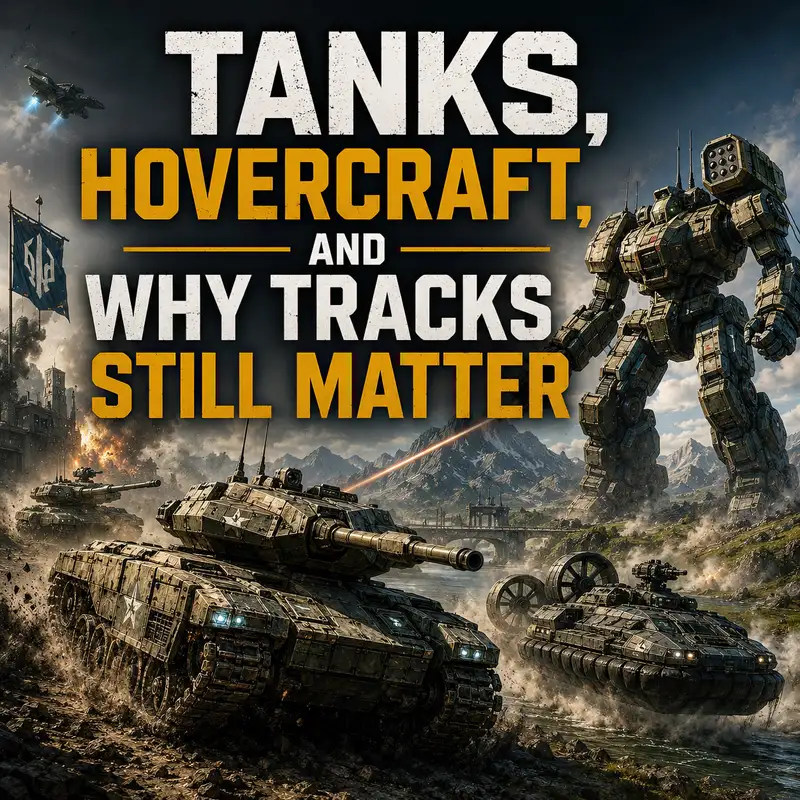
Tanks, Hovercraft, and Why Tracks Still Matter
The reconnaissance report contained one reassuring sentence: no enemy BattleMechs had been detected. The attacking company entered the valley expecting militia and a few armored cars. Instead, tracked tanks opened fire from reverse-slope positions, missile carriers launched from behind the tree line, and hovercraft raced across the flooded flats toward the ammunition convoy. By sunset, the attackers still owned more BattleMechs. They no longer owned the bridge, the supply column, or much confidence in the word only.
Combat vehicles endure in BattleTech because armies do not fight with prestige alone. BattleMechs are flexible, powerful, and culturally dominant, but they are also expensive machines built around fusion engines, gyros, myomer, neurohelmets, and specialized production. Tanks and hovercraft can carry many of the same weapons while using simpler structures, larger crews, and industrial methods available on far more worlds. They are not inferior BattleMechs. They are a different answer to the problem of putting firepower where a government can afford to place it.
The category includes everything from light reconnaissance vehicles to hundred-ton armored fortresses. Some use tracks, wheels, or lift fans. Their hulls may carry turrets, fixed weapons, infantry compartments, artillery, sensors, command equipment, or a deeply concerning quantity of ammunition. What unites them is that movement, protection, and firepower are arranged around a vehicle chassis rather than an articulated BattleMech skeleton.
Economics explains much of their survival. A state that can build one advanced BattleMech may be able to build several conventional combat vehicles for the same industrial investment. Exact comparisons vary by design, engine, and era, but the larger force-structure truth remains. Vehicles let a government defend more roads, cities, depots, and border worlds than a BattleMech-only army could cover. The map contains more objectives than any realm possesses famous machines.
Training follows the same pattern. A tank usually divides work among a commander, driver, gunner, and other crew members as required by the design. Each person learns a demanding specialty, but the vehicle does not depend on one MechWarrior coordinating every major function through a neurohelmet. Armored units can train crews in larger numbers, replace individual specialists, and build experience through repeated collective drills. The disadvantage is equally clear. A crew is a team inside a confined hull, and one casualty can damage the entire team’s rhythm.
Tracked vehicles remain the foundation of many armored forces because tracks provide a broad, mechanically direct connection to the ground. The engine turns a transmission, the transmission drives sprockets, and linked track sections move around road wheels to pull the hull forward. The arrangement is old and well understood. It is also understandable to mechanics on worlds that may have lost the ability to manufacture a BattleMech gyro several centuries earlier.
Tracks spread the vehicle’s weight across a larger area than ordinary wheels and provide strong traction on soil, snow, mud, broken pavement, and moderate slopes. They are not immune to bogging, and no sensible driver assumes that a swamp has signed a neutrality agreement. Even so, a tracked tank can cross terrain that channels wheeled vehicles onto roads and defeats hovercraft with rocks, trees, walls, or abrupt elevation changes. That freedom is less dramatic than a BattleMech stepping across a trench. It is still the reason the tank arrives.
The movement system is also relatively tolerant of ordinary abuse. Track links, road wheels, suspension units, and drive components can be replaced individually. Crews and maintenance teams may repair a broken run under field conditions, provided the enemy allows enough time and distance. A thrown or severed track can immobilize the tank instantly, and damage to the front or side of the running gear is a constant threat. Reliability does not mean invulnerability. It means the failure is familiar enough that someone brought the correct tools.
A tracked hull can carry substantial armor and heavy weapons without devoting mass to lift fans or extreme speed. It can settle behind earthworks, use the crest of a hill, or occupy a prepared firing position with only its turret exposed. Its low silhouette can be harder to see and hit than a BattleMech on the same ground. The tank gives up the BattleMech’s elevated view. In exchange, much of the vehicle can disappear behind a very ordinary pile of dirt.
Turrets give tanks another practical advantage. A rotating turret lets the main battery cover a wide arc while the hull protects its route and presents stronger frontal armor. Not every weapon is turret-mounted, and the turret ring itself is a vulnerable mechanical system. Still, the arrangement lets a tank defend a position without turning its entire motive system toward each new threat. A BattleMech twists at the waist. A tank rotates the part containing the reason everyone is shooting at it.
The Manticore Heavy Tank shows how much capability a conventional tracked chassis can carry. Its classic arrangement combines a particle projection cannon, long-range missiles, short-range missiles, and a medium laser on a sixty-ton fusion-powered vehicle. The weapons give it useful options from the opening exchange through close combat. It is slower and less adaptable to broken terrain than many BattleMechs of similar mass, but it can anchor a line, support infantry, and punish anything that treats the word tank as reassurance.
The Demolisher takes specialization further. The original heavy tank mounts two class twenty autocannons in its turret. It is slow, short-ranged, ammunition dependent, and almost incapable of pretending to be subtle. In a city, a pass, or a prepared ambush, those weaknesses become easier to manage. Any BattleMech entering the correct firing lane faces two weapons capable of removing enormous sections of armor in one exchange. The Demolisher does not need to chase the enemy if the enemy must cross the street it already covers.
Other tracked designs turn the same basic platform toward fire support. A Schrek carrier mounts three particle projection cannons and snipes from a low profile. Long-range missile carriers place large launch batteries on inexpensive hulls and depend on spotters, concealment, and protection from raiders. Short-range missile carriers wait for an enemy to enter an ambush zone and then release a quantity of missiles that tends to simplify the local command situation. These vehicles are powerful because they specialize. They are vulnerable for the same reason.
Specialization works because armies operate formations rather than isolated machines. A missile carrier does not need the armor and secondary weapons of a general-purpose BattleMech if scouts find the target, infantry protects the position, and other tanks hold the approach. A cheap gun carrier can spend most of its mass on the gun because someone else is responsible for reconnaissance and close defense. The resulting vehicle may look badly designed when examined alone. The formation is the design.
Hovercraft solve a different problem. Large lift fans create a cushion of air beneath the hull, while propulsion systems drive the vehicle across the surface. Because the craft rides above the ground, it can move rapidly over flat land, marsh, shallow obstacles, and open water without changing from one motive system to another. Roads are useful but not mandatory. Rivers that stop tracked formations may become avenues of advance.
Speed is the hovercraft’s armor, reconnaissance tool, and primary argument for existence. A light hover tank can cross a wide front, inspect routes, deliver sensor data, and withdraw before a slower enemy can trap it. Heavier hovercraft can exploit a flank, attack artillery, raid supply columns, or reinforce a threatened sector. Their movement forces commanders to defend areas that would otherwise appear protected by distance or water. A bridge is less decisive when the enemy has brought vehicles that do not need it.
The J. Edgar Light Hover Tank represents the fast scout and skirmisher. It carries useful short-range weapons on a twenty-five-ton chassis whose main protection is movement. The Condor Heavy Hover Tank brings more mass and a broader striking role while retaining the speed expected of a hovercraft. The tiny Savannah Master pushes the same philosophy toward its most economical extreme. None wants a stationary exchange with a heavy tank. Their purpose is to decide where the exchange begins and leave before the other side completes its opinion.
Hovercraft are especially effective on plains, deserts with firm open surfaces, coastal regions, river networks, and worlds covered by broad wetlands. They can screen a moving force across a frontage that would require many slower vehicles. They can transport scouts, electronic-warfare equipment, or direct-fire weapons to unexpected positions. A commander with several fast hover platoons can threaten more objectives than the unit can physically attack, forcing the defender to guess which report matters.
The air cushion creates serious limitations. Dense woods, rubble, steep slopes, narrow streets, large rocks, and heavy industrial debris interfere with the skirt and the flow of air beneath the hull. A BattleMech can step over an obstacle. A tracked vehicle can often climb or crush through it. A hovercraft must go around, slow sharply, or accept a collision between delicate motive equipment and terrain that has no maintenance budget.
Skirts, lift fans, intakes, and control surfaces are vulnerable to damage. Small fragments and minor hits that would merely scar a tracked hull can reduce lift, spoil handling, or force a hovercraft to slow. Dust, sand, vegetation, ice, and debris burden the fans and filters. Losing propulsion at high speed is dangerous on any vehicle. Losing lift over deep water adds an unusually short recovery window. Hover crews learn that the same system letting them ignore the river can make the river very important again.
Hovercraft also sacrifice payload efficiency for speed. Lift equipment occupies mass and internal volume that a tracked vehicle can devote to armor, ammunition, or weapons. The faster the craft, the more engine and propulsion it needs. Some designs carry alarming firepower by accepting very light protection. Others use more armor and become less exceptional at the reason hovercraft were selected in the first place. The designer is always negotiating among speed, survivability, and the desire to mount one more weapon.
This is why hovercraft never make tracks obsolete. Hover units dominate movement on the terrain they prefer. Tracked units function across a wider range of bad ground, carry heavier loads efficiently, and hold positions with greater confidence. A hovercraft is often the better raider. A tracked tank is usually the better anchor. The two systems are not competing for one universal role. They divide the battlefield according to terrain, mission, and how much maintenance support the commander can keep nearby.
A combined armored force might use hovercraft to scout, screen, and strike exposed support units while tracked tanks advance along the main axis. The hover elements find the enemy and force it to turn. The tracked elements bring armor and sustained fire to the point that matters. Artillery and missile carriers support from behind. Infantry clears terrain and protects the vehicles from battle armor. BattleMechs reinforce the decisive sector or cross obstacles that stop the rest. Each arm makes the others harder to defeat.
BattleMechs retain important advantages. They can negotiate broken ground, change elevation, use arms and torso movement, and remain combat-capable after types of motive damage that would immobilize a vehicle. Their fusion endurance, environmental sealing, sensor height, and flexibility make them valuable across varied planetary conditions. A BattleMech can step over the trench a tank must breach and continue after losing an arm. Those advantages help explain the machine’s military prestige. They do not make a BattleMech economical enough to guard every fuel depot.
Combat vehicles have their own vulnerabilities. Tracks, wheels, and skirts are exposed near ground level. A mine, artillery fragment, or well-placed shot can produce a mobility kill without penetrating the main armor. Turrets can jam. Drivers can be injured. Sensors and stabilizers can fail. A tank may still possess an intact engine and full ammunition while becoming unable to move or bring the gun onto target. Armor protects the crew and equipment only while the vehicle remains oriented and the enemy is prevented from choosing another angle.
Crew survival is a harsh part of the comparison. A BattleMech cockpit is armored and equipped with an ejection system, although ejection is never safe. A tank crew sits lower, closer to ammunition, fuel, transmission components, and the effects of penetrating fire. Some vehicles include escape systems and ammunition protection, while others reflect the economy of the era in less comforting ways. A destroyed tank may represent several trained people lost at once. Cheap hardware does not make the crew inexpensive to its families or unit.
Power plants shape both performance and logistics. Fusion-powered tanks can support major energy weapons and operate without the daily appetite of a conventional fuel engine. They are also expensive and technically demanding. Internal-combustion and fuel-cell vehicles are easier for many worlds to manufacture and maintain, but they require fuel distribution and may need additional power equipment for large energy weapons. Ballistic and missile systems remain natural choices because their destructive energy travels in the ammunition rather than being generated entirely aboard the vehicle.
That ammunition becomes the armored regiment’s daily burden. Autocannon shells, missile reloads, machine-gun belts, and specialty munitions must be delivered in the correct type. A cheaper vehicle may consume more cargo every hour it fights. Fuel, track links, filters, road wheels, fans, skirts, lubricants, and replacement electronics follow behind. The image of a tank company is a line of armored hulls. The working organization is a much longer line of trucks.
Transport between worlds creates another limit. Combat vehicles still occupy DropShip capacity, require loading equipment, and need crews and support personnel carried with them. A state can produce thousands of tanks and still be unable to move them all to a threatened border. Planetary forces therefore matter enormously. Local armor can defend a world without consuming interstellar lift, freeing mobile BattleMech regiments for offensive operations and emergencies.
This makes tanks central to garrisons and militia. A world may not possess a BattleMech factory, but it may have steel production, engine works, electronics plants, and workers capable of assembling tracked vehicles. Even modest tanks can patrol routes, protect cities, support infantry, and create defensive depth. Invaders must locate and defeat them rather than merely destroying the handful of BattleMechs listed in the intelligence summary.
The Succession Wars strengthened this role. As factories, technical schools, and supply networks were destroyed, advanced BattleMechs became difficult to replace. Many worlds could still produce conventional engines, armor plate, tracks, and familiar ballistic weapons. Armored regiments filled gaps that no ruler could cover with inherited BattleMechs alone. The vehicles were less glamorous. Glamour does not improve manufacturing tolerances.
Technological recovery did not end their importance. Double heat sinks, advanced armor, Gauss rifles, electronic networks, and improved missiles appeared on combat vehicles as well as BattleMechs. The Clans used many vehicles in second-line roles, while Clan Hell’s Horses placed greater emphasis on combined arms. Inner Sphere armies answered superior Clan machines partly by fielding depth, prepared positions, artillery, infantry, and armored vehicles in numbers the invading forces could not ignore.
Advanced technology can make a tank extraordinarily dangerous, but it does not change the basic employment problem. A Gauss carrier still needs a firing position. A networked vehicle still needs the network. Stealth armor still requires maintenance. A modern hovercraft still dislikes a forest placed across its route. Technology increases capability. Terrain and logistics retain veto authority.
Tracked vehicles are also natural platforms for missions that do not justify a BattleMech chassis. Armored recovery vehicles tow damaged equipment. Engineering tanks clear mines and obstacles. Mobile headquarters carry communications and staff. Air-defense vehicles protect columns. Artillery vehicles move heavy guns. Armored personnel carriers deliver infantry. These machines rarely defeat a BattleMech in a duel because a duel is not their assignment.
Urban fighting gives tracks another reason to remain. Streets, rubble, collapsed walls, and prepared barricades constrain every vehicle, but a tracked hull can push through debris, pivot in confined space, and use buildings for cover. Heavy tanks can guard intersections where their weapons dominate short firing lanes. Infantry must still search the structures around them, because a tank without dismounted support is a large object surrounded by windows. The tracks carry the weapon into the city. Combined arms keeps it alive there.
On open ground, hovercraft may seize the initiative while tracked tanks provide the line that cannot be ignored. Near rivers and coastlines, hover units can bypass crossings and raid the rear. In mountains, forests, and industrial zones, tracks regain the advantage until the terrain becomes so broken that BattleMechs or infantry must lead. The correct motive system is therefore a geographical decision as much as a technical one.
Commanders get into trouble when they confuse the most visible weapon with the entire force. A BattleMech company may defeat the enemy’s BattleMechs and then discover tanks holding the roads, hovercraft striking the rear, and infantry still controlling the objective. The opposite mistake is equally dangerous. A mass of inexpensive vehicles cannot simply drive into open ground against skilled BattleMechs and expect arithmetic to absorb every tactical failure. Numbers create options only when doctrine uses them.
Recovery and repair reveal the final difference. A disabled BattleMech is often worth a major effort because the chassis, pilot, and components are difficult to replace. A damaged tank may be recovered, repaired, cannibalized, or abandoned according to a colder calculation. That apparent expendability can make armored forces resilient at campaign scale. Losing one vehicle hurts. Replacing it does not require finding another inherited family machine and the person trained to balance it through a neurohelmet.
The valley ambush succeeded because each vehicle performed the task its motive system supported. Tracked tanks remained concealed, absorbed return fire, and held the approaches. Missile carriers used the cover behind them. Hovercraft crossed water and distance to attack the supply column. None needed to defeat every BattleMech personally. They defeated the operation that made those BattleMechs useful.
Tracks still matter because war requires more than the machine best able to cross difficult ground or win a celebrated duel. It requires weapons that can be built in quantity, crews that can be trained, positions that can be held, and vehicles that can work on imperfect worlds with imperfect supply. Hovercraft add speed where the terrain permits it. BattleMechs add flexibility where the mission demands it. The tracked tank endures because most armies still need something heavy, reliable, and armed waiting on the road the enemy eventually has to use.