Task Force Serpent and the Road to Huntress
The commander who designed the road to Huntress did not reach its end. On January second, in the year thirty sixty, Marshal Morgan Hasek-Davion was found dead in his cabin aboard the WarShip Invisible Truth. His fleet was less than two hundred light-years from Clan Smoke Jaguar’s homeworld, beyond any friendly hyperpulse generator and too deep into the operation to turn back safely. The assassination removed the task force’s political center at the exact moment secrecy made outside guidance impossible.
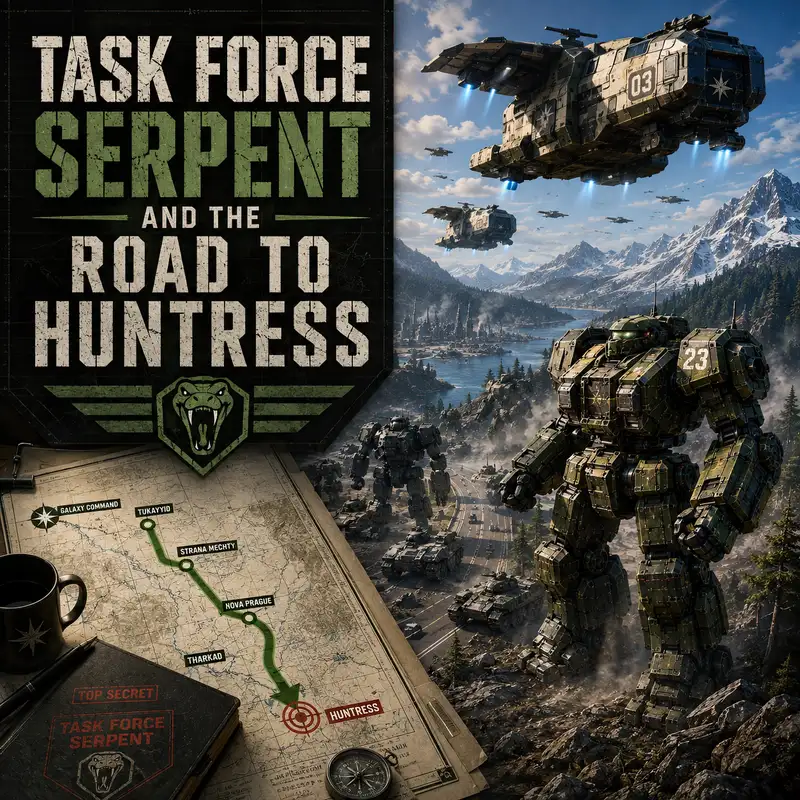
Task Force Serpent had been created to do something no Inner Sphere army had attempted since Aleksandr Kerensky’s Exodus. It would move a multinational invasion force through the Deep Periphery, follow the Exodus Road into Clan space, strike Huntress without warning, and destroy the institutions that allowed Clan Smoke Jaguar to make war. Operation Bulldog would drive the Jaguars from their occupation zone. Serpent would attack the place that trained their warriors, stored their genetic legacies, manufactured their equipment, and gave the Clan a home to which defeated forces could retreat.
The plan became possible in November of the year thirty fifty-eight, when Anastasius Focht presented intelligence supplied by the Smoke Jaguar defector Trent. Trent knew the route connecting the Inner Sphere to the Clan Homeworlds and identified Huntress as the Jaguar capital. Morgan immediately recognized the strategic opportunity and volunteered to command the expedition. Destroying Huntress while Bulldog attacked the occupation zone would force the Jaguars to defend two fronts separated by roughly a thousand light-years, with neither front able to reinforce the other quickly.
The Second Star League approved a force large enough to destroy a planet’s military system but small enough to conceal. Roughly fifty-five thousand personnel assembled around more than a thousand BattleMechs, vehicles, and aerospace fighters. Ninety-eight DropShips and twenty-seven JumpShips and WarShips carried them, including seven WarShips in the original escort. On paper, the ground force amounted to about ten regiments. In practice, its governments had spent centuries preparing to fight one another.
The Eridani Light Horse provided the largest single contingent and General Ariana Winston, Morgan’s deputy. The First Kathil Uhlans came from the Federated Commonwealth. The Second Sword of Light represented the Draconis Combine. The Eleventh Lyran Guards, Knights of the Inner Sphere, Northwind Highlanders, Com Guard Second Division, Second St. Ives Lancers, Fourth Drakøns, and Kingston’s Legionnaires added different doctrines, equipment standards, and political loyalties. Special operations teams came from Draconis Elite Strike Teams, Federated intelligence, ComStar, and Theodore Kurita’s nekakami.
The task force gathered on the barren training world of Defiance in early thirty fifty-nine. For months, the units practiced combined operations, boarding actions, combat drops, and command procedures. A Lyran and a Kuritan commander might use different reporting systems for the same ammunition shortage. Mercenary officers expected independence, while Com Guard officers came from a centralized culture. Serpent could not afford to discover those differences after a DropShip opened over Huntress.
Logistics determined nearly every feature of the mission. Beyond the Outworlds Alliance, the fleet would have no regular depots, no repair yards, and no friendly communications network. Every failed Kearny-Fuchida drive could strand the DropShips attached to it. Every replacement part, medical supply, missile reload, and liter of water had to be carried from the beginning or recovered along the route. The force was large enough to fight a campaign and too far from home to replace anything important.
Secrecy created a second burden. The fleet could not send routine reports or request updated intelligence without risking discovery. Once it entered the Deep Periphery, its commanders would not know whether Bulldog had begun, whether the Jaguars had reinforced Huntress, or whether political events had altered the mission. Serpent was therefore operating from a plan written months earlier against an enemy whose situation would continue changing. Communication is the lifeblood of an army. Serpent deliberately severed its own circulation to remain hidden.
The expedition departed Defiance on May first, in the year thirty fifty-nine. It crossed the Federated Commonwealth, passed through the Outworlds Alliance, and entered the Deep Periphery on July nineteenth. From that point, Trent’s route replaced ordinary navigation. The voyage became a sequence of jumps into systems where no friendly station could confirm the next coordinate. Crews recharged drives, inspected seals, rationed stores, and watched small mechanical problems acquire strategic importance. The road to Huntress was not one dramatic leap. It was months of machinery continuing to function.
On December fifteenth, the expedition encountered a Clan Ghost Bear convoy in an unnamed system. The meeting threatened the entire mission. If even one Bear vessel escaped, the Clan Homeworlds could be warned before Serpent reached Huntress. Morgan used Clan law to contain the danger, issuing a Trial of Possession for the opposing fleet. The Ghost Bear commander accepted, turning an unexpected contact into a battle whose terms encouraged the convoy to remain and fight.
The engagement became known as the Battle of Trafalgar. Serpent’s WarShips and boarding teams destroyed or disabled the Bear escorts, captured an Invader-class JumpShip, and took the Whirlwind-class destroyer Fire Fang as salvage. They also captured a Broadsword DropShip, OmniFighters, OmniMechs, supplies, and hundreds of warriors and lower-caste personnel. The victory added an eighth WarShip, while captured records helped Inner Sphere crews develop methods for using WarShips in direct support of ground operations.
The prisoners created a problem no targeting computer could solve. Morgan allowed those willing to swear a bond oath to enter task-force service. Others were left with supplies on a habitable world, with a promise that someone would return if Serpent survived. The decision combined military necessity, Clan custom, and the practical impossibility of guarding a large hostile population aboard ships already crowded with troops. It also showed what the expedition had become. Serpent was carrying its own law because no recognized government could reach it.
Less than three weeks later, Morgan was dead. The first medical judgment suggested heart failure. Further investigation found a fast-acting poison in the scotch he had drunk. A technician named Lucas Penrose was identified as the assassin and killed before he explained who had sent him or why. Later suspicion fell in several directions, but the surviving record does not settle the question. The task force knew only that its commander had been murdered from inside one of the most secure fleets ever assembled.
Ariana Winston formally assumed command on January tenth. She had led the Eridani Light Horse and possessed the experience and standing to hold the coalition together, but she inherited Morgan’s plan without his political authority. Turning back would require another journey of many months, expose the fleet after its secrecy had already cost lives, and leave Bulldog without the blow against Huntress. Continuing meant attacking a Clan capital after an assassin had demonstrated that Serpent’s own security was compromised. Ariana chose to continue.
The following day, the fleet intercepted an old microwave transmission sent by Aleksandr Kerensky during the original Exodus. Traveling at the speed of light rather than through a hyperpulse generator, the message had crossed space for centuries. Serpent heard it only because Morgan’s death had delayed the fleet. Kerensky spoke of leaving the Inner Sphere and hoped his descendants might someday return as protectors. The coalition was following his road to destroy one group of those descendants. History had provided commentary, though not operational guidance.
The attack began on February nineteenth with the covert insertion of Draconis Elite Strike Teams. The frigate Haruna entered the Huntress system using stolen identification codes and released the captured Broadsword DropShip Stiletto. Pretending to conduct an unscheduled supply transfer, the Stiletto placed the commandos on the surface and then staged a crash in the Dhuan Swamp. The teams moved toward Mount Szabo, where the Jaguars controlled the planetary command network and the Reagan space defense system.
On March fifth, only hours before the main fleet arrived, the commandos penetrated the Mount Szabo complex. They destroyed or disabled the control centers needed to direct the orbital defenses. Their success did not eliminate every weapon around Huntress, but it blinded the coordinated system that could have attacked Serpent while its JumpShips and DropShips were most vulnerable. Thousands of troops depended upon several small teams reaching the correct rooms before a fleet appeared above them.
Serpent jumped into the zenith point and found a Smoke Jaguar heavy cruiser, two corvettes, DropShips, and OmniFighters waiting in-system. The Inner Sphere ships issued no batchall. This was not a raid intended to gain honor or salvage. The naval force had to be destroyed before it could warn other Clan worlds or tear through the invasion transports. Serpent won the engagement and eliminated the three Jaguar WarShips, but the Fox-class corvette Rostock was lost. Orbital access had been purchased, not granted.
The ground assault began on March twelfth. Task-force units struck military installations scattered across Huntress rather than concentrating on one capital. Training centers at Lootera, New Andery, Bagera, and Abysmal were targeted alongside manufacturing sites near Myer and Pahn City. Other formations moved against Mount Szabo and the Smoke Jaguar genetic repository. The plan reflected the mission’s purpose. Capturing the government complex was insufficient. Serpent had to dismantle the physical system that produced new Jaguar warriors and equipped them.
The fighting immediately revealed gaps in the intelligence. Northwind Highlanders, Knights of the Inner Sphere, and Kingston’s Legionnaires encountered ProtoMechs, compact combat machines larger than battle armor and smaller than conventional BattleMechs. Serpent had prepared for OmniMechs and Elementals, not a new weapons program being tested on the Jaguar homeworld. Elsewhere, the Eleventh Lyran Guards met resistance strong enough to require orbital fire from the captured Fire Fang. The road had delivered the army. It had not delivered complete knowledge of what waited at the end.
Despite those surprises, the initial assault succeeded with extraordinary speed. Major objectives were seized in less than a day, training cadres were overwhelmed, factories were captured or disabled, and the surviving Jaguar commander withdrew forces into the Black Shikari Jungle. Serpent took possession of the genetic repository and large quantities of military data. For a brief period, the coalition controlled the homeworld of the Clan that had destroyed Edo and terrorized the Draconis Combine frontier.
Victory created an argument. Some commanders wanted to preserve captured factories and technology. Their orders required them to destroy Huntress’s war-making capacity. Ariana enforced the mission. Facilities were stripped where possible and then demolished. The decision reduced the chance that the Jaguars could rebuild, but it also damaged an inhabited world whose lower castes had little influence over Crusader policy. Strategic necessity and collective punishment stood uncomfortably close together.
Serpent’s greatest danger was now information it did not possess. Operation Bulldog had advanced far faster than expected and driven major Jaguar formations out of the Inner Sphere. Those troops needed somewhere to retreat and refit. Huntress was the obvious destination. The same secrecy that allowed Ariana to achieve surprise prevented her from learning that defeated enemy units were moving toward her position. Serpent had captured the homeworld just as the homeworld became the rallying point for the surviving touman.
On March nineteenth, a Smoke Jaguar fleet under Galaxy Commander Hang Mehta arrived at the zenith point with three WarShips, five JumpShips, and troop-carrying DropShips. Serpent’s damaged naval force moved to intercept. The Star League ships destroyed the Jaguar WarShips, but the victory was ruinous. The Starlight was lost with all hands in a collision. The Emerald was destroyed, the Antrim was damaged beyond field repair, and nearly every surviving vessel took damage. Several Jaguar DropShips broke through and continued toward the planet.
The naval battle created a brutal exchange. Serpent had prevented the Jaguars from taking control of the system, but it had not stopped the counterinvasion. Its own transport and escort capacity was now badly weakened. A ground army can survive losing BattleMechs if replacements and evacuation remain possible. On Huntress, the fleet was the only road home. Every damaged WarShip and JumpShip reduced not merely firepower, but the number of people who might leave if the planet could no longer be held.
The Jaguar DropShips reached Huntress on March twenty-sixth under Star Colonel Paul Moon. Later that day, the Black Lion-class WarShip Streaking Mist appeared at a pirate point and delivered additional forces led by Khan Lincoln Osis. Nearly two Galaxies’ worth of experienced warriors now attacked troops exhausted by the voyage and the first conquest. They knew the terrain, possessed surviving local support, and understood that the destruction beneath them threatened the existence of their Clan.
The counterattack retook Lootera and divided Serpent’s formations. Coalition units fell back toward the Dhuan Mountains, the swamps, and isolated defensive pockets. Ammunition consumed during the invasion could not be replaced from factories the task force had just demolished. Medical facilities filled. Damaged BattleMechs were cannibalized to keep others moving. The campaign’s original assumption had been that Huntress would be defended mainly by second-line and training forces. The attackers were now facing veterans driven from the occupation zone and fighting for their society’s survival.
Some task-force commanders argued for evacuation. Ariana refused to abandon the mission, and the damaged fleet made an orderly withdrawal uncertain in any case. Loading thousands of troops into DropShips while enemy formations controlled parts of the planet would expose the transports during ascent. Leaving would also allow the Jaguars to reclaim surviving stores, genetic material, and command facilities. Serpent therefore remained on Huntress, not because the position was secure, but because retreat might destroy the expedition without preserving its strategic effect.
Special operations continued attacking the Jaguar command structure. Artillery critically wounded Paul Moon, who was captured. Theodore Kurita’s nekakami destroyed a secondary command center and seriously injured Lincoln Osis, forcing his evacuation to Strana Mechty. These actions disrupted leadership and denied the Jaguars a clean victory. They did not stop the pressure on the ground. A Clan can lose a Khan and still possess warriors, ammunition, and local knowledge sufficient to destroy an exhausted regiment.
Ariana fought from her Cyclops while directing the defense. During the counterattack, a Summoner known to Inner Sphere troops as a Thor destroyed the Cyclops’s cockpit and killed her. Serpent had now lost both of its senior commanders, one to assassination on the road and one to enemy fire on the objective. Andrew Redburn inherited command of a task force whose units were being reduced faster than headquarters could combine the survivors.
By March thirtieth, the expedition was approaching destruction. Formations that had arrived as regiments were functioning as battalions or companies. Coalition distinctions mattered less because survivors were grouped wherever they could hold a line. The Jaguars had also suffered badly, but they were still attacking and expected more forces to reach the homeworld. Serpent had accomplished its assigned demolition and captured the planet once. Neither achievement guaranteed that anyone would live to report it.
Then a new fleet appeared at the Huntress zenith point. Operation Bulldog had completed its Inner Sphere campaign ahead of schedule, allowing Victor Steiner-Davion to lead a relief force along the route to Huntress. His arrival on March thirtieth did not instantly end the ground battle. The fleet still had to cross the system, protect its transports, and place fresh formations on the surface. For ten more days, Serpent’s survivors had to hold knowing that relief was visible on sensors and still millions of kilometers away.
The Bulldog reinforcements landed on April ninth. Fresh Star League units attacked the remaining Jaguar positions, and most surviving Smoke Jaguar warriors chose death in combat over surrender. The combined force secured Huntress and ended the immediate threat to Task Force Serpent. Lincoln Osis and a small remnant escaped to Strana Mechty, but the Clan no longer possessed an occupation zone, a functioning homeworld military base, or the institutions required to rebuild its former strength.
The cost bordered on destruction. A force equivalent to ten regiments had been reduced to less than two, with casualties around eighty percent. Morgan and Ariana were dead. WarShips and DropShips had been destroyed, and several units survived mainly as names attached to scattered personnel. The First Kathil Uhlans and Fourth Drakøns were eventually disbanded. The Eridani Light Horse and Royal Black Watch entered the permanent Star League structure. There were too few survivors to restore everything that had departed.
Salvage became part of the settlement. Each participating command received enough captured equipment to rebuild beyond its original authorized strength, while remaining matériel was pooled and sold to support survivors and the families of the dead. The arrangement was practical and revealing. Huntress had contained advanced technology worth fortunes, but no distribution formula could replace trained crews, commanders, or the years consumed bringing the force there. The expedition returned richer in machines and poorer in nearly everything that made those machines useful.
Task Force Serpent succeeded because it treated the road to Huntress as part of the battle. The coalition trained before departure, carried its own logistics, protected secrecy, adapted after Trafalgar, used special operations to blind planetary defenses, and brought enough naval power to force entry. It nearly failed because that same secrecy denied current intelligence, because the route prevented reinforcement, and because victory on Huntress drew the surviving Jaguars toward the very army least able to absorb another campaign.
The expedition also exposed the moral weight of destroying a Clan rather than defeating one of its armies. Huntress held factories and training centers, but also scientists, technicians, laborers, families, and children raised inside institutions they had not designed. The Star League targeted Smoke Jaguar’s ability to make war after years of invasion and atrocity. That purpose did not make every person beneath the bombardment responsible for Edo, nor did it make the destruction experienced by lower castes less real.
The road to Huntress changed the balance of the Clan conflict because it proved the Homeworlds were reachable. The Clans had built their invasion around the belief that distance protected their own society while exposing the Inner Sphere world by world. Serpent reversed that relationship. A coalition assembled from old enemies crossed the same gulf, struck a Clan capital, survived the return of its frontline warriors, and left Smoke Jaguar without a secure place from which to recover.
Its victory was not the work of one commander, and the mission’s two principal commanders did not live to see the relief force land. It belonged to navigators who carried a fleet through unmarked systems, technicians who kept century-old WarShips operating, boarding teams at Trafalgar, commandos beneath Mount Szabo, medical crews in the Dhuan Swamp, and battered units that held for ten days after help appeared in the system. The road to Huntress ended among wrecked transports and exhausted survivors who had proven that Clan space was not beyond reach, only beyond rescue.