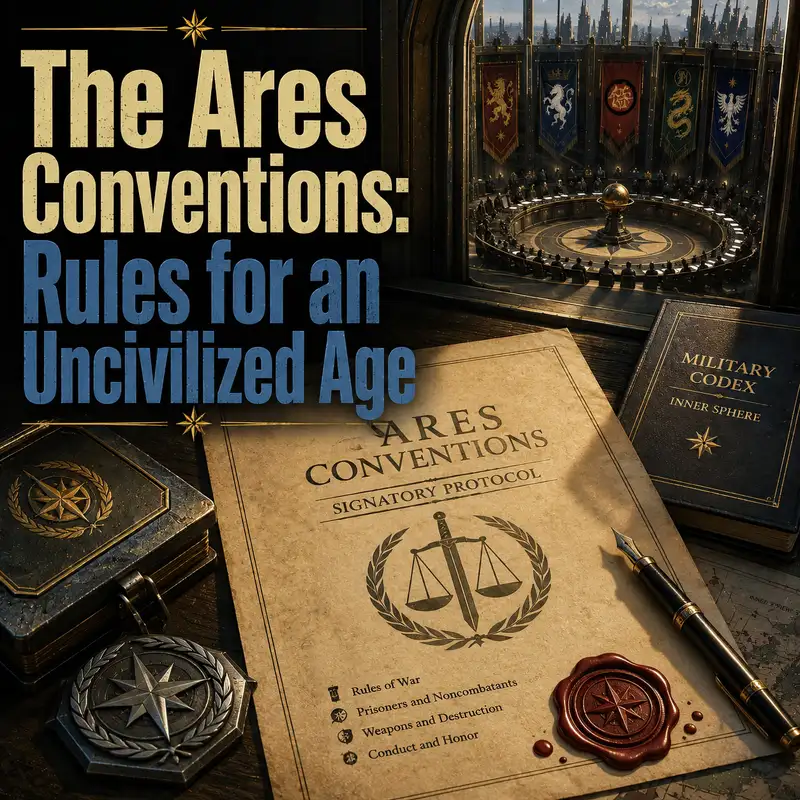
The Ares Conventions: Rules for an Uncivilized Age
The armored assault on Tintavel was supposed to recover a disputed world. It began with conventional tanks advancing into the city of New Mitla and ended with both armies using weapons of mass destruction. Streets became firing lanes, civilian facilities became rubble, and the planetary systems that kept the population alive began to fail. More than three hundred thousand people were killed or injured before the Free Worlds League and Capellan Confederation withdrew. Within a few years, the world itself was abandoned. Tintavel had not been conquered. It had been converted into evidence.
The rulers who gathered afterward on the planet Ares faced a problem larger than one ruined colony. The new interstellar states had learned how to send fleets and armies across dozens of light-years, but they had not agreed on what those forces were permitted to do after arrival. A local commander could escalate from artillery to orbital fire, from orbital fire to nuclear weapons, and from military targets to the infrastructure supporting an entire population. The central question was whether law could restrain war between governments that still considered war a normal tool of policy.
The Age of War had begun only fourteen years earlier, in the year twenty-three ninety-eight. Border disputes, dynastic claims, commercial competition, and territorial ambition had drawn the Great Houses into overlapping conflicts. Communications were slow. Orders traveled aboard courier ships and could arrive weeks after conditions changed. Commanders often possessed broad discretion because no distant capital could supervise every decision. That discretion was useful when a campaign required initiative. It was dangerous when frustration, fear, or wounded prestige encouraged escalation. The weapons existed. The political limits did not.
Tintavel showed how quickly those conditions could combine. The world had once belonged to the Free Worlds League before falling under Capellan control. League forces returned in the year twenty-four twelve intending to recover it. Capellan defenders avoided a clean field battle and used hit-and-run attacks from populated areas. League troops pushed into the cities. The fighting destroyed transport, utilities, hospitals, and other civilian systems. Capellan forces employed small nuclear weapons. League forces answered with chemical agents. Each side could explain why the previous enemy action had made its own response necessary. That is how escalation usually sounds while it is happening.
Chancellor Aleisha Liao responded with an aggressive diplomatic campaign. Her role carried an unavoidable contradiction. The Capellan Confederation had participated in the destruction, and its troops had committed brutal acts in other border fighting. Aleisha was not speaking from a position of innocence. She was speaking from the position of a ruler who had seen what unrestrained war could cost her own state. Her proposal did not ask the powers to disarm or renounce conquest. It asked them to agree that some methods damaged the victor almost as badly as the defeated.
The conference met in New Olympia on Ares. Director-General Judith Cameron committed Terran Hegemony forces to protect the delegations, allowing the Hegemony to present itself as a neutral guarantor rather than another ambitious power. Ten governments were invited. Their leaders and representatives arrived with different wars, fears, and grievances already in mind. Agreement on the general principle came easily. No ruler wished to defend the destruction of another Tintavel in public. Agreement on the details proved harder, because each delegation wanted restrictions that limited its enemies without obstructing its own preferred methods.
Aleisha’s initial proposal reportedly ran about eighty pages. Negotiation expanded the finished treaty to three hundred and twenty pages, containing six main articles and eighteen appendices. The growth was not simply bureaucratic excess, although several generations of lawyers would have found it encouraging. Every added definition answered a suspicion. What counted as a city? When did a civilian facility become a military target? Who qualified as a uniformed combatant? How far from a planet did a nuclear weapon have to be before its use became lawful? The delegates were writing rules for war while assuming that every other signer would search for an advantageous interpretation.
Eight governments signed on the thirteenth of June, twenty-four twelve. They included the Terran Hegemony, Capellan Confederation, Free Worlds League, Federated Suns, Lyran Commonwealth, Draconis Combine, Rim Worlds Republic, and Principality of Rasalhague. This was broader than an agreement among the five Great Houses. It was an attempt to establish a common military language across most of the major powers then operating in the Inner Sphere. The signatures did not create mutual trust. They created a framework governments could invoke when trust failed.
Two invited states refused. The Taurian Concordat distrusted Capellan intentions and regarded Aleisha’s proposal as hypocritical while Capellan forces were conducting a violent border conflict against Taurian worlds. The United Hindu Collective declined for a different reason. Its leaders feared that a code regulating warfare would legitimize warfare. Their objection was not that the rules were too weak or too strong. It was that a government able to describe a campaign as lawful might find it easier to begin one. That warning became one of the most important judgments made at the conference.
Article One addressed nuclear arms. It prohibited nuclear attacks against civilian targets or planetary targets, and against military targets within seventy-five thousand kilometers of a planet. The restriction did not ban every nuclear weapon in every circumstance. Nuclear use in deep space remained possible, and the treaty’s distance requirements mattered. This distinction reflected military reality. Governments were unwilling to abandon weapons that could destroy hostile WarShips or transport formations far from a world. They were willing to recognize that a nuclear strike close to a planet could turn an operational decision into a permanent environmental disaster.
Article Two restricted orbital bombardment. WarShips could not simply fire on a planet because a target existed somewhere below. Bombardment was limited to vital military objectives located away from populated areas. The article recognized the enormous imbalance between a vessel in orbit and people on the surface. A naval commander could deliver firepower without crossing the terrain, defenses, or civilian neighborhoods that complicated a ground assault. The rule did not eliminate orbital support. It forced commanders to justify the target and consider what surrounded it.
Article Three established a universal symbol of surrender and truce, a white field marked with a red letter S. Signatories agreed to recognize it and respect forces displaying it properly. The symbol seems like a small administrative detail beside nuclear weapons, but surrender only works when both sides understand the signal and believe it will be honored. Without that confidence, surrounded troops continue fighting because laying down their weapons may only make them easier to kill. A reliable surrender procedure could save soldiers, preserve equipment, shorten sieges, and prevent commanders from destroying a position they could otherwise accept intact.
Article Four protected safe passage under a recognized sign of truce. It applied to movements such as medical evacuation, humanitarian work, and the transfer of noncombatants, while also defining conduct that could void the protection. This was necessary because safe passage created an obvious temptation. A commander might use protected vehicles to move intelligence, ammunition, or armed personnel. The treaty therefore offered protection and described how that protection could be lost. It was a practical bargain. Humanitarian corridors required trust, but the delegates did not mistake trust for an unlimited resource.
Article Five dealt with civilians and urban warfare. It rejected attacks on civilian targets and discouraged fighting inside cities unless a legitimate military objective was located there. Even then, commanders were expected to limit collateral damage. This was one of the treaty’s most important provisions and one of its largest openings. Spaceports, communications centers, government buildings, factories, and power stations were often located inside or beside cities. A defender could place forces near them. An attacker could declare them military objectives. The article established a presumption against urban battle, but it could not remove the military value of urban terrain.
Article Six prohibited the research, development, production, and use of chemical and biological weapons. Its reach went beyond battlefield employment. The signers recognized that maintaining such programs created dangers even before a weapon was used, including accidents, unauthorized release, and the constant incentive to answer an enemy program with one of their own. The accompanying definitions were strict enough to restrict agents far less destructive than the chemicals used on Tintavel. The governments accepted a broad ban because persistent contamination could outlast every regiment involved and punish populations that had no influence over the original dispute.
For civilians, the distinction could be the difference between evacuation and extermination. A protected hospital, marked transport, or declared corridor did not guarantee safety, but it gave officers on both sides a procedure to follow and subordinates a reason to question an unlawful order.
The appendices carried much of the treaty’s real weight. They defined combatants, uniforms, civilians, civilian property, military targets, surrender procedures, hostile acts, weapons of mass destruction, investigations, translations, and intelligence activity. They even addressed proxy contests, simulations, sporting events, and duels as alternatives to larger battles. That may sound theatrical, but a ritualized contest could resolve a limited claim without requiring a fleet to bombard a city. The treaty’s authors were trying to place a ladder between diplomacy and mass destruction, with several steps that allowed rulers to retreat without admitting complete defeat.
Those definitions also exposed people who did not fit neatly into either protected category. Uniformed soldiers received the rights and obligations of combatants. Recognized civilians received protection from deliberate attack. Pirates, irregulars, covert operatives, and armed groups without accepted status occupied more dangerous ground. The treaty’s legal precision could protect people inside its definitions while leaving others outside them. This was not an accidental problem. Every state feared enemy agents disguised as civilians, and every state valued its own ability to support irregular forces when convenient.
The conventions possessed no permanent interstellar police force able to arrest a Great House ruler. Enforcement depended on reputation, reciprocal restraint, diplomatic pressure, and boards of inquiry. Neutral observers could investigate violations, but the accused government still possessed armies, fleets, and lawyers of its own. The Terran Hegemony increasingly served as the neutral participant in these inquiries. That gave the Hegemony influence greater than the number of divisions involved. A government trusted to judge other states’ conduct acquires access, information, and political credit. Judith Cameron’s security mission on Ares became the beginning of a useful diplomatic position.
For field commanders, the rules changed planning. A target package now required more than identifying something worth destroying. Staff officers had to consider location, civilian density, weapon type, surrender procedures, and the likelihood of later investigation. Ground forces could be ordered to isolate an urban objective rather than flatten it. WarShips might have to withhold fire and allow a slower assault. Medical corridors required coordination. Intelligence officers had to distinguish a genuine protected movement from deception. Law became another operational constraint, like weather, fuel, or transport capacity.
The conventions worked often enough to matter. Wars between signatories generally caused fewer civilian deaths and less economic destruction than the uncontrolled campaigns that preceded them. Cities, factories, farms, and transport networks were more likely to survive a change of government. Defeated troops had a better chance of surrendering. Victorious governments inherited worlds that could still produce food and revenue. Restraint was humanitarian, but it was also economically rational. A conqueror gains little from capturing a population that has been killed and an industrial base that has been reduced to contaminated foundations.
The rise of the BattleMech after the year twenty-four thirty-nine fit naturally into this regulated style of warfare. BattleMechs could concentrate force against military formations without requiring the indiscriminate destruction of an entire region. Their pilots also became associated with a revived language of chivalry, personal combat, and controlled battle. In the year twenty-four sixty-five, the Terran Hegemony proposed an addendum defining BattleMechs within the treaty system. The last major signature was secured in twenty-four seventy-two. The machine did not create honorable war, but it became the most visible instrument of a culture trying to describe organized violence as disciplined and limited.
That culture altered the frequency of war. A ruler who believed an enemy might destroy cities with nuclear weapons had reason to tolerate an insult. A ruler who expected a bounded campaign against designated military targets faced a lower apparent risk. Border claims that might once have remained frozen could now be tested through raids, duels, or limited invasions. The United Hindu Collective’s warning proved accurate. By making war less catastrophic, the conventions made it more politically usable. They reduced the cost of each conflict while helping create a system in which conflicts occurred again and again.
The shifting borders required governments to normalize conquest. Laws increasingly defined how residents of captured worlds would become subjects or citizens of the new state. The Free Worlds League’s Liberation Act of twenty-four forty-eight was one example. Such measures could protect people from statelessness and establish legal rights after occupation. They also made territorial acquisition easier to administer. The conventions did not order states to conquer. They helped create a political environment in which conquest could be presented as a regulated transfer of authority rather than the destruction of a society.
The treaty’s largest weakness appeared whenever a government found someone outside its protection. During the Rim War, beginning in twenty-four eighteen, the Capellan Confederation fought the Taurian Concordat, which had refused to sign. Chancellor Arden Baxter treated the conventions as nonbinding against a nonsignatory. Capellan forces used nuclear and chemical weapons during the conflict. The legal argument was brutally simple. The Concordat had rejected the treaty and therefore could not claim its protection. A code intended to establish civilized conduct had become conditional on paperwork completed by the enemy.
Civil wars created another gap. The conventions governed war among signatory states more clearly than violence within one of them. Governments could classify rebels as criminals rather than lawful combatants. Rebel forces could reject the authority of a treaty signed by the government they were trying to overthrow. The Davion Civil War demonstrated how internal conflict could become more destructive than regulated fighting between established powers. The legal category of the opponent shaped the protection available to everyone living near the battlefield.
Even between signatories, compliance depended on interpretation. A commander could claim that a factory was vital, that a city concealed a military objective, or that the enemy had misused a truce symbol. Investigations occurred after the damage. Political allies could excuse one another, while rivals could use an inquiry as another weapon. The conventions did not remove bad faith. They forced bad faith to produce a memorandum. That was still an improvement over unrestricted fire, but it could not make a government obey when leaders believed survival, victory, or dynastic prestige required violation.
The Terran Hegemony benefited from the system more consistently than any other power. Serving on investigative commissions allowed it to present itself as a reliable intermediary. Its diplomats gained experience managing disputes among states that distrusted one another. Over time, that neutral role helped the Cameron dynasty build the relationships and prestige later used to negotiate the Star League. The conventions therefore produced an institutional consequence beyond battlefield restraint. They created repeated occasions for the Great Houses to accept Hegemony involvement in matters touching sovereignty and war.
The Star League eventually discarded the treaty it had inherited. In the year twenty-five seventy-nine, during the Reunification War, the League adopted an addendum rescinding the conventions. The Periphery states resisting incorporation were not all signatories, and Star League leaders wanted fewer restrictions on a campaign intended to compel submission across a vast frontier. Some commanders continued to follow the old principles, and the Free Worlds League forces operating against the Magistracy of Canopus showed notable restraint. The legal protection itself, however, had been removed by the government claiming to establish a universal order.
At the beginning of the First Succession War, Captain-General Kenyon Marik formally renounced the conventions, and the other Successor Lords followed. The consequences demonstrated what the old rules had prevented. Nuclear attacks, orbital bombardment, and the destruction of industrial and scientific centers helped turn a struggle over the Star League throne into a collapse of interstellar civilization. The conventions had never eliminated ambition. They had placed barriers between ambition and the fastest methods of mass destruction. Once those barriers were removed, every House could argue that restraint would only advantage an enemy willing to ignore it.
Later generations revived parts of the old code without restoring the original treaty. During the Third Succession War, an informal system known as the Honors of War encouraged surrender, limited destruction, and the preservation of scarce technology. The motive was often practical rather than noble. JumpShips, factories, trained technicians, and functioning BattleMechs had become too valuable to destroy casually. Even so, the language of Ares remained shorthand for civilized conduct. Commanders invoked rules written centuries earlier because the alternative had already been tested and found ruinously efficient.
The Ares Conventions did civilize warfare, but only in a narrow and important sense. They protected many civilians, preserved infrastructure, created workable rules for surrender, and restrained weapons capable of killing far beyond a battlefield. They did not prevent conquest, resolve dynastic claims, or punish a ruler determined to find a loophole. Their deepest contradiction was that they made war less destructive and therefore easier to use. The rulers at Ares built a fence around barbarism. They saved lives on worlds that might otherwise have become another Tintavel, then spent the next century treating the space inside that fence as acceptable ground for politics.