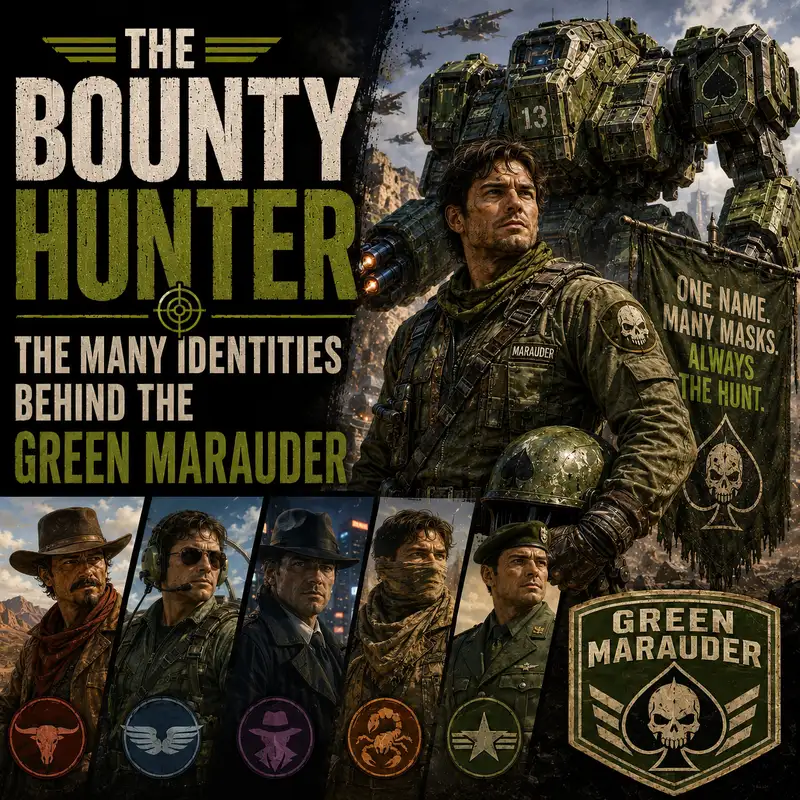
The Bounty Hunter: The Many Identities Behind the Green Marauder
On Benjamin in October of the year thirty thirty, Michi Noketsuna ended a vendetta and gave away a legend. He turned over the green armor, the famous BattleMech, the operational funds, and a battered manuscript known as The Tradition to his associate Vic Travers. Noketsuna did not die in the transfer. He simply stopped being the Bounty Hunter. Travers stepped into the role, inherited its enemies and contacts, and continued as though the masked figure had never changed. The handoff reveals the central truth behind the green Marauder. The Bounty Hunter was not one immortal MechWarrior moving through centuries of war. It was an office, a tradecraft system, and a carefully maintained threat passed from one dangerous person to another.
That distinction explains why attempts to identify the Bounty Hunter usually produce more confusion than certainty. The green paint, credit symbols, armored suit, and modified BattleMech created a public identity stronger than the private name inside the cockpit. Employers did not need a biography. Targets did not receive one. They needed to believe that the figure approaching through the smoke had completed impossible contracts before and would do so again. Some holders were calculating professionals. One used the mantle to settle a personal debt. Another had begun as a technician. At least one stole the identity after murdering its owner. The equipment remained familiar while the motives, methods, and even the gender of the wearer changed.
The first stories appeared during the decade beginning in the year twenty-nine twenty. A masked warrior in a green Warhammer began hunting notorious MechWarriors across the Inner Sphere and Periphery. The earliest Bounty Hunter generally killed rather than captured, but many of the targets were violent criminals whose removal made the stranger look like a frontier avenger rather than a hired executioner. High-value bounties brought money, and money brought better information, transport, and maintenance. Copycats soon appeared because anonymity is attractive when a reputation can be borrowed without paying the original owner. The first green Warhammer eventually vanished from public view, leaving no confirmed name behind it and no reliable account of whether the pilot retired, died, or deliberately prepared a successor.
A green Warhammer and an unusually protective combat suit appeared again in the year twenty-nine fifty-seven. The gap, the equipment, and later changes in behavior strongly suggest that this was another person, though the surviving record does not prove the exact handoff. By the twenty-nine eighties, the Bounty Hunter was no longer consistently operating alone. Temporary partners became a recognizable team, usually several elite MechWarriors in similarly painted machines. The target list also widened. Criminal pilots gave way to officers, nobles, engineers, scientists, and business leaders whose principal qualification was that somebody wealthy wanted them removed. Credit symbols appeared on the BattleMechs. The message was direct. Justice might be discussed after payment cleared.
That darker incarnation demonstrated the value of terror and the cost of abandoning limits. In the year twenty-nine ninety-six, stories placed the Bounty Hunter on Markesan, killing two Federated Suns generals and taking military equipment as salvage. The team then persuaded an inexperienced mercenary unit to carry them toward Draconis Combine space in exchange for a promised contract. Once safely across the border, the Bounty Hunter reportedly murdered the mercenaries, sold their BattleMechs, and sold their DropShip. Whether every detail survived accurately is difficult to prove, but the story became part of the brand. A target facing the green machines had to assume that surrender, neutrality, and prior cooperation offered no protection.
The most famous green BattleMech entered the legend through betrayal. In June of the year thirty fourteen, the Bounty Hunter operated near Wolf’s Dragoons on Nova Roma during the Marik Civil War. Natasha Kerensky, then a lieutenant in the Dragoons, received word that a ravine had been checked and was safe. Her lance entered and found loyalist forces waiting. Most of the lance was destroyed. Kerensky ejected and was knocked unconscious. The Bounty Hunter recovered her Marauder and later made it his signature machine. The official record identifies a Griffin as his BattleMech during the incident. Later rumors claimed Kerensky somehow took his Warhammer in return, but she never supported that version.
The Marauder mattered because it carried two stories at once. It was already a respected seventy-five-ton command and fire-support BattleMech, with a silhouette recognizable at a distance. It was also stolen from one of the most feared MechWarriors alive. Painted bright green and marked with currency symbols, it became a moving insult to Natasha Kerensky and a warning to everyone else. The Hunter rebuilt it repeatedly. One configuration traded speed for jump capability, heavier armor, improved heat control, and additional long-range energy weapons. A later refit added a Gauss rifle and extended-range particle projection cannons. The exact weapons changed with technology and damage. The visual message did not.
The armor was almost as important as the BattleMech. The Bounty Hunter wore a customized green full-body combat suit derived from advanced Star League equipment, providing protection outside the cockpit while concealing the wearer’s face and build. During the technological decline of the Succession Wars, some of its more sophisticated systems no longer functioned, but later generations restored capabilities as lost technology returned. The suit allowed the Hunter to meet clients, board vessels, enter hostile facilities, and appear before witnesses without surrendering the private identity beneath the legend. During at least one transfer, The Tradition was carried within the armor itself. The result was a standardized human silhouette to accompany the standardized green machine. A successor did not have to resemble the predecessor. The armor taught observers to overlook the differences.
Kerensky and the Bounty Hunter met again on Le Blanc in the year thirty twenty-six, when an attempt to trap her failed but two of her MechWarriors were killed. One year later, both found themselves abandoned by their employers on Benet the Third. Survival required the two enemies to cooperate. They fought their way free and departed on Kerensky’s DropShip after the Hunter destroyed a tracking station that could have prevented escape. The alliance did not become friendship. It demonstrated professional calculation. A feud could be suspended when the transport problem became more urgent than revenge. After Benet the Third, that particular Bounty Hunter disappeared, leaving the Marauder, the armor, or at least the identity available for another chapter.
After the battle on Misery and as the Fourth Succession War unfolded, Michi Noketsuna took the mantle with the approval and assistance of people connected to Wolf’s Dragoons. His purpose was unusually specific. He wanted vengeance for Minobu Tetsuhara, whose destruction followed the betrayal of the Dragoons by Warlord Grieg Samsonov and other Combine officials. Noketsuna was accompanied by Vic Travers, Dechan Fraser, and Jenette Rand. He often piloted an Orion rather than the Marauder, which is an important reminder that the person, the machine, and the persona were never identical. The green Marauder was the most visible symbol, but the Bounty Hunter used whatever equipment best supported the contract.
Noketsuna killed Samsonov and delivered the warlord’s severed head to Tetsuhara’s family in January of the year thirty thirty. The gift was not welcomed. Later that year, Noketsuna captured an agent named Panati on Benjamin and unexpectedly took Theodore Kurita into custody as well. Theodore recognized the legitimacy of Noketsuna’s vendetta, allowed Panati to be executed, and then recruited Noketsuna for service to the Draconis Combine. The vendetta had reached its end. Noketsuna transferred the Bounty Hunter’s property and tradition to Travers that same night. Revenge had used the mask, but the mask did not have to retire when revenge was satisfied.
The Tradition was the mechanism that made succession possible. It was more than a diary, though it contained the accumulated experiences of previous holders. It preserved contacts, methods, operational lessons, and the practical knowledge required to locate protected targets across interstellar distances. The transfer could include the armored suit, a signature BattleMech, the modified DropShip, a share of the war chest, and introductions to people who could arrange information or employment. The new Bounty Hunter inherited a functioning enterprise rather than a costume. A green paint scheme without intelligence, money, and transport would produce a colorful corpse. The Tradition ensured that the next wearer began with more than reputation.
The organization behind the mask was deliberately compartmented. Three to five trusted associates often accompanied the Hunter, receiving generous shares because loyalty was cheaper than betrayal only when loyalty was properly funded. A chief technician might know the true identity and later become a candidate for succession. The wider technical staff and DropShip crew knew less, and they could be replaced when the mantle changed hands. The Hunter’s modified Mule-class DropShip, Le Blanc, carried BattleMechs, ammunition, stores, repair capacity, and room for salvage. The public saw one green Marauder. Operationally, the threat included pilots, technicians, intelligence brokers, medical support, spare parts, and a vessel able to leave before the target’s allies arrived.
Vic Travers turned that system into the longest clearly identified tenure behind the mask. He eliminated competing bounty hunters when they became obstacles, though he occasionally discovered that buying them off created less repair work. In the year thirty forty-five, his team landed on Marduk near a training company of the Sixth Benjamin Regulars to seize an officer named Rej Mori. Mori fled in a Dragon and was brought down by the light Wasp known as Sheridan’s Ghost, while the rest of the green team defeated his company. The contract succeeded because the Hunter controlled the landing point, timing, escape routes, and supporting pilots. The famous heavy BattleMech was only one part of the trap.
The Clan invasion offered Travers targets carrying better equipment and a reputation nearly as intimidating as his own. He reportedly defeated Clan warriors in several duels and captured a Smoke Jaguar Mad Cat, which he modified for his methods. Some associates did not survive, and the old Marauder may have been lost during the same period. The Bounty Hunter disappeared after a mission on Rasalhague in the year thirty fifty-one, possibly because Travers had been badly injured. For thirteen years the identity produced no confirmed public operations. The pause shows that the mantle could be preserved by inactivity. Continuing while wounded, understrength, or compromised would have turned mystery into evidence and prestige into an obituary.
The Bounty Hunter returned in the year thirty sixty-four, though observers could not be certain whether Travers had resumed operations or a successor had already taken over. That uncertainty was useful. A state intelligence service might compare voice patterns, tactical preferences, physical movement, and associates. A frightened target generally saw green armor and stopped conducting historical analysis. The brand allowed a new holder to benefit from old victories while forcing enemies to consider several possible capabilities at once. It also allowed the Hunter to change machines. Mad Cats, Marauder the Second BattleMechs, Grasshoppers, Griffins, and other customized BattleMechs appeared without ending the association with the original green Marauder.
Travers’ final major contract demonstrated both the sophistication and the moral emptiness of the enterprise. George Hasek hired him to capture Kai Allard-Liao alive. Kai was among the finest MechWarriors in the Human Sphere and commanded forces capable of making a direct seizure ruinously expensive. The Bounty Hunter therefore attacked the problem through family and information. His organization captured Hector Calvin, used that pressure to locate Calvin’s son, and followed the trail to Kai’s teenage daughter Melissa, who was living under a false identity. The team seized her and then offered Kai a duel in exchange for her safety.
Kai accepted and lost. The Bounty Hunter departed with the contractual target, then released Melissa after reaching safety as promised. The operation is often remembered as a duel between extraordinary MechWarriors, but the duel was only the final controlled step. Intelligence identified the vulnerable relationship. Diversionary attacks displaced defenders. The team isolated the hostage, fixed the time and place, and denied Kai the freedom to use his battalion. Travers did not defeat a stronger military formation. He designed a situation in which its strength could not be used. The method was effective, carefully limited once the agreement was made, and still an abduction of a child to compel her father.
The man known as Walt Urizeman represented another path into the role. His real name remained uncertain, and he used several aliases before becoming the Hunter. He began as an exceptional BattleMech technician, served in the Federated Commonwealth military, and later worked with mercenary commands. After losing his own machine, he became Travers’ personal technician. He learned the organization from the repair bay outward, developed into a capable MechWarrior, handled contacts, and rose to second-in-command. By the year thirty seventy-two, he had inherited the mantle. The succession showed what the tradition actually valued. Marksmanship mattered, but so did maintenance, planning, discretion, and the ability to keep several dangerous professionals paid and moving.
Urizeman entered a long association with Chandrasekhar Kurita during the Jihad, an unusual commitment for a persona that normally advertised independence. He recovered a strategically valuable journal, fought Word of Blake agents for possession of it, and helped save Kurita during the attack on Arcturus in the year thirty seventy-three. He also killed one of his own associates after discovering the man had been unknowingly used as a tracking device. The decision was brutal, yet consistent with the organization’s deepest rule. The identity and mission came before any individual member. The Bounty Hunter could reward loyalty generously because the response to compromise was final.
That continuity broke when Kendali Morris, a Manei Domini operative, killed the current holder and took the armor for herself. She used the Bounty Hunter identity first as operational cover and then as a possible refuge while the Word of Blake collapsed. Morris worked alone, remained silent in public, and accepted contracts against former Blakist targets. The disguise concealed her face, but not her behavior. Earlier Hunters had used associates, verbal misdirection, and a recognizable mixture of calculation and theater. Morris moved and fought differently. Investigators recognized that a new person was inside the armor, and the Republic of the Sphere eventually exposed her. The mask could transfer reputation. It could not perfectly transfer personality.
After another period of uncertain activity, a man calling himself Michi Fraser emerged during fighting on Misery in the year thirty-one thirty. The name itself appeared constructed from Michi Noketsuna and Dechan Fraser, suggesting access to the hidden history. He stole a Legionnaire, defeated a full Combine lance, and conducted further hit-and-run operations before returning in a Marauder. Whether every public appearance belonged to the same man remained uncertain, which was partly the point. Michi Fraser treated identity as a layered defense. Even the name offered information and misdirection at the same time. He later selected a successor, attempting to restore an orderly handoff rather than leave the armor to whoever could steal it.
The orderly handoff failed. Jonathan Yurei Kamimori murdered the chosen successor and took the Bounty Hunter identity. Jonathan was a highly skilled pilot, infiltrator, hacker, and killer, but he lacked the limits that had kept most earlier holders focused on contracts. He operated alone and used the mantle while pursuing assassinations, manipulation, and private obsessions. His crimes were not proof that every Bounty Hunter had secretly been a sadist. They showed the danger of a reputation detached from the internal discipline that created it. The green armor gave Jonathan access and fear. It could not make him a professional.
Jonathan infiltrated Katana Tormark’s circle, fought beside the Dragon’s Fury, penetrated the Draconis Combine under false identities, and left investigators a trail designed to waste their time. He eventually abandoned the armor and directed Republic investigator Richard Thereon to a cache on Misery containing the disassembled suit and a body. Even that apparent ending refused to settle the question. Published accounts leave room for false identities, substituted corpses, and the possibility that Michi Fraser had survived behind another name. The transfer had become less like retirement and more like counterintelligence conducted by people who considered death certificates a form of creative writing.
A possible impersonator appeared in the year thirty-one forty-seven, piloting a War Crow in Bounty Hunter colors along the Davion-Liao border. The sighting was never firmly tied to the established line of succession. By the years thirty-one fifty and thirty-one fifty-one, however, the mantle was active again. The newest Hunter sometimes operated alone and sometimes with associates named Kyudo, Annie, and Kolbitr. Their machines deliberately echoed the legend, including a Warhammer, Griffin, Mad Cat, Loki the Second, Marauder, and Marauder the Second. When several green machines entered the field together, even observers who understood the succession could not know which cockpit held the actual Hunter.
That uncertainty was more useful than any single BattleMech configuration. The original Marauder had been rebuilt, replaced, imitated, and possibly destroyed. Later machines carried better armor, sensors, electronic warfare systems, and weapons, but the old silhouette remained cultural ammunition. Popular entertainment created fictional versions of the Bounty Hunter that further blurred the record. Copycats copied the paint. Enemies invented encounters to excuse defeat or enhance status. Employers had reasons to exaggerate success, and survivors had reasons to explain why resistance had been impossible. The legend became an intelligence fog generated by both deliberate deception and ordinary human storytelling.
The many identities behind the green Marauder survived because the Bounty Hunter was never merely a pilot. The mantle combined a recognizable symbol, accumulated tradecraft, reliable logistics, selective succession, and the fear produced by uncertainty. Each wearer changed it. Noketsuna made it an instrument of vengeance. Travers made it a durable enterprise. Urizeman proved a technician could inherit the cockpit. Morris demonstrated that the identity could be stolen. Jonathan showed what happened when the symbol outlived professional restraint. By thirty-one fifty-one, the green machines still appeared, but the true weapon was the question they carried onto the battlefield. The person inside could die. The target could never be certain that the Bounty Hunter had.