The ComStar Schism and the Birth of the Word of Blake
The order arrived while ComStar soldiers were still dying on Tukayyid. Shut down the hyperpulse generator network. Seize the stations. Isolate the Great Houses until their governments accepted ComStar authority. On worlds occupied by the Clans, technicians and guards were told to rise against warriors who had conquered entire regiments. The same institution that was fighting to save Terra was also trying to place the Inner Sphere under its control. Before the shooting stopped on Tukayyid, ComStar had revealed that it contained two incompatible ideas of salvation.
That contradiction explains the ComStar Schism. The split was not simply a quarrel between conservatives and reformers. It was the collapse of a system that had spent centuries presenting secrecy as virtue, monopoly as neutrality, and political manipulation as guardianship. The Battle of Tukayyid gave ComStar its greatest public victory. Operation SCORPION exposed the private doctrine behind that victory. The killing of Primus Myndo Waterly then forced every member of the Order to decide which ComStar had been legitimate.
Jerome Blake had founded ComStar after the fall of the Star League to preserve interstellar communications, protect technical knowledge, and keep Terra outside the wars of the Successor States. Those practical goals acquired a religious structure under his successor, Conrad Toyama. Procedures became rituals. Security became doctrine. The preservation of knowledge became a claim that ComStar alone understood when humanity was ready to receive it. Over generations, many personnel came to believe that the Order was not merely maintaining civilization. It was preparing to inherit civilization after the Great Houses exhausted themselves.
That belief did not make every acolyte a conspirator. Most ComStar personnel operated communications equipment, maintained archives, treated patients, or kept isolated stations functioning. Their daily work was real and essential. Yet the institution above them also contained ROM, an intelligence service that monitored both foreign governments and ComStar’s own members, and the Com Guards, a hidden military built from preserved Star League equipment. ComStar could provide a message, inspect the sender, manipulate the recipient, and deploy a BattleMech to protect the building. Neutrality had become a remarkably well-armed administrative condition.
Myndo Waterly embraced the most militant interpretation of ComStar’s mission. During the Clan invasion, she initially saw the invaders as a tool. ComStar could administer conquered worlds, preserve its stations, and allow the Clans to weaken the Successor States. That calculation changed when Anastasius Focht learned that the Clans intended to take Terra. Waterly authorized Focht’s challenge, and the Com Guards prepared for Tukayyid. Focht planned an attritional defense against enemies whose honor culture and supply system favored shorter campaigns. Waterly prepared a second operation behind his back.
Operation SCORPION began on May first, thirty fifty-two, the same day the battle opened on Tukayyid. Waterly ordered a general communications interdiction across the Inner Sphere. Hyperpulse generator traffic would stop until the Great Houses accepted ComStar as the administrative power within their realms. In the Clan occupation zones, ComStar personnel were expected to overthrow local garrisons and seize control of the worlds they had helped administer. Waterly did not intend to influence governments from the shadows any longer. She intended to convert communications dependence into direct political submission.
The plan was strategically grand and operationally hollow. Most of the Com Guards were concentrated on Tukayyid, leaving too few troops to enforce Waterly’s demands elsewhere. Clan garrisons remained formidable, and the Clans possessed portable communications systems that reduced their dependence on fixed ComStar stations. The Successor States had forces near many compounds and understood what permanent interdiction could do to command, trade, and civilian government. Waterly was attempting a nearly simultaneous seizure of the Inner Sphere without the troops, transport, local support, or secure communications needed to manage the seizure.
She also lacked secrecy. Sharilar Mori, Precentor of Dieron and Waterly’s intended successor, had long served as an agent of the Draconis Combine. Mori warned Theodore Kurita, who passed the warning to Hanse Davion after their cooperation against the Clans at Luthien. It did not make the Great Houses fully prepared, but it prevented the paralysis Waterly expected. Mori then concealed the full scale of SCORPION’s failure from Waterly. By the time the Primus understood how badly events had gone, commanders and station chiefs across the Inner Sphere were already choosing whether to obey, resist, defect, or simply survive.
The results were disastrous. Great House troops seized many ComStar stations before the Order could establish control. Clan forces suppressed uprisings in their occupation zones. Communications personnel who had spent their careers claiming neutrality suddenly found themselves treated as enemy agents. Some obeyed Waterly. Some refused. Some were imprisoned by local authorities regardless of what they had done, because trust had become a luxury. ComStar won on Tukayyid and lost much of the political capital that victory should have produced. It had stopped the Clans for fifteen years while proving to every government that its communications monopoly could become a weapon without warning.
Focht returned to Terra as the commander who had preserved the Inner Sphere from immediate Clan conquest. He also returned to discover that Waterly had used his battle as cover for a coup against nearly every major state. The soldiers under his command had paid heavily for Tukayyid. Their victory depended on preparation, stockpiles, disciplined command, and shattered divisions holding prepared ground. SCORPION threatened to turn that sacrifice into the opening act of a war ComStar could not win. Focht concluded that Waterly had to be removed.
On June sixth, Focht and Mori confronted the Primus. Waterly rejected their challenge and moved to have Focht replaced as Precentor Martial. Focht shot her in the back of the head with a needle pistol. Official ComStar history claimed that Waterly had resigned and died four days later from a cerebral hemorrhage. The truth was an extrajudicial killing followed by a cover story. Focht may have prevented another catastrophic order, but he also established the reformed ComStar through the same secrecy and coercion he said he intended to end.
Focht placed members of the First Circuit in protective custody, a phrase that sounds more reassuring when the people being protected are free to leave. Within a week, the First Circuit elected Sharilar Mori as Primus. Mori was capable and committed to redirecting ComStar away from Waterly’s program. She was also a foreign intelligence asset elevated after a military commander killed her predecessor. The reformers therefore possessed a strong case against the old doctrine and a deeply compromised method of taking power. Their opponents would use both facts.
Focht then presented the First Circuit with writings attributed to Jerome Blake. He said a vision of Blake had drawn his attention to a cornerstone in the Hall of History, where he found a technical document explaining that ComStar should distribute knowledge rather than bury it beneath mysticism. Most of the First Circuit accepted the discovery and the need for reform. Later evidence complicated the authenticity and interpretation of these materials. At the time, what mattered politically was that Focht had produced a founding text that challenged the authority of generations of doctrine.
Mori and Focht began turning ComStar toward a more open and less religious institution. They curtailed the internal structures used to enforce spiritual conformity, reduced the authority of ritual specialists, and presented the Order as a communications service and guardian of knowledge rather than humanity’s destined ruler. ComStar shared more information with the Great Houses and later opened historical records. Focht made military movements more transparent and accepted limits on ComStar’s exclusive control of mercenary regulation. The reforms were practical attempts to rebuild trust, but they also stripped status from people whose careers rested on the old system.
For a believer formed inside pre-schism ComStar, secularization was not a change in office policy. The white robes, invocations, grades, rituals, and interpretations of Blake’s words had organized an entire life. ROM had punished deviation, which encouraged obedience, but coercion alone does not explain the depth of belief. Generations had learned that maintaining a hyperpulse generator was sacred work and protecting knowledge justified sacrifice. Some Com Guard veterans had just watched comrades die on Tukayyid under that spiritual framework. They returned to find senior leaders declaring that parts of the faith were superstition and parts of its history were manipulation.
Demona Aziz became the principal voice of resistance. As Precentor of Atreus and a member of the First Circuit, she represented ComStar’s interests in the Free Worlds League. Aziz considered Waterly’s death a coup, Focht’s documents fraudulent, and Mori’s reforms a betrayal. She left Terra with loyal staff and returned to Atreus, where she warned Captain-General Thomas Marik that ComStar was fighting an internal war. Her accusation was powerful because it contained more than propaganda. Focht had killed the Primus, detained the governing council, and installed a new direction under military pressure.
Aziz used loyal ROM personnel to transmit an appeal to hyperpulse generator stations across the Inner Sphere. Those who rejected secularization were invited to join her in exile. The message turned the communications network into the battlefield of the schism. Station by station, personnel had to choose between the recognized Primus on Terra and a movement claiming that Terra itself had been captured by heretics. Some decisions were theological. Others were shaped by commanders, family ties, fear of ROM, local politics, or the simple fact that remaining at a hostile station had become dangerous.
Mori chose not to block the departures. She feared that arrests and forced disarmament would ignite a civil war inside an organization already weakened by Tukayyid and SCORPION. Thousands of acolytes, adepts, technicians, intelligence personnel, administrators, and soldiers made their way toward the Free Worlds League. Some Com Guard defectors brought BattleMechs and other equipment. They did not arrive as an undifferentiated mass of fanatics. They arrived as trained specialists carrying institutional knowledge, security clearances, personal grievances, and the conviction that the organization they had served had been stolen.
Allowing them to leave reduced immediate violence on Terra, but it transferred capability to the opposition. A communications order cannot be rebuilt quickly after losing veteran technicians. An intelligence service cannot replace networks simply by issuing new passwords. A BattleMech division requires transport, maintenance crews, ammunition, recovery vehicles, and command staff, all of which defectors understood. Mori avoided fighting in the corridors of ComStar compounds. She also permitted a rival institution to depart with enough people and equipment to become something more dangerous than an exile community.
The man ruling the Free Worlds League as Thomas Marik granted the dissidents sanctuary. His own position contained one of ComStar’s more remarkable secrets. The ruler known publicly as Thomas was a double installed after the real Thomas Marik had been taken into ComStar custody years earlier. The double nevertheless governed as Captain-General and had interests of his own. He had little reason to restore ComStar’s monopoly after SCORPION. The League needed reliable communications, and the refugees needed territory, protection, and income. Political convenience proved more useful than shared theology.
During Operation SCORPION, the Free Worlds League had seized ComStar stations within its borders. Those stations still required trained personnel, replacement parts, administration, and wider network access. Marik reached an agreement with the exiles. They would operate the League’s hyperpulse generator system, and the League would provide sanctuary and a landhold on Gibson. This arrangement gave Marik leverage against Terra while keeping interstellar messages moving. It also gave the new movement a revenue stream backed by one of the largest economies in the Inner Sphere. Faith had acquired a service contract.
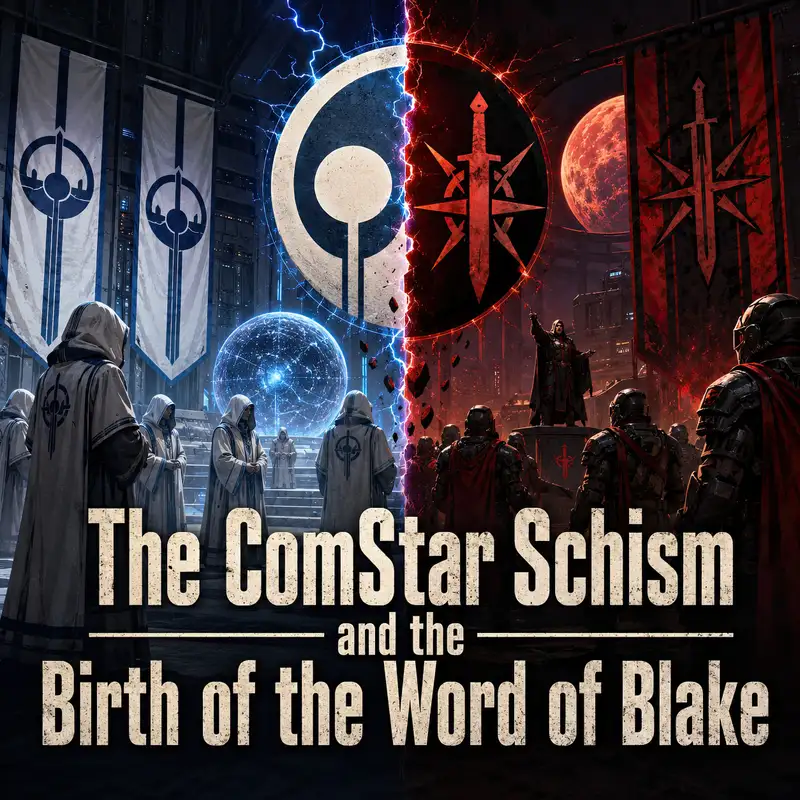
On Gibson, the exiles adopted the name Word of Blake. The choice claimed that they, not Mori’s ComStar, preserved the authentic teaching of the founder. Their headquarters was no temporary camp. It became an administrative center, a training base, a political court, and a military position protected by Free Worlds League sovereignty. The Word could charge for communications, recruit from disaffected ComStar personnel, and present itself as a legitimate competitor rather than a band of fugitives. Its survival no longer depended on persuading Terra to reverse the reforms.
The early Word of Blake was divided from the beginning. Some members wanted the old ComStar restored with its hierarchy and mission intact. Some favored accommodation with the Great Houses while preserving the faith. Others believed the schism proved that corruption had infected the entire Inner Sphere and that harsher measures were necessary. There were isolationists, institutional conservatives, ambitious officials, wounded veterans, sincere technicians, and radicals who treated compromise as apostasy. They agreed that Mori and Focht were illegitimate. They did not agree on what should replace them.
That lack of unity did not make the Word harmless. Its militia began with a little more than four divisions, organized largely along familiar Com Guard lines and initially focused on defending Gibson. The force was modest beside a Successor State military, but it had advanced equipment, veterans, and a secure base. Its soldiers understood ComStar doctrine, communications procedures, and the habits of the Com Guards they might one day fight. The schism did not create two armies from nothing. It divided one military institution and allowed both halves to keep studying the other.
The division of ROM was equally important. A large portion of ComStar’s intelligence personnel, contacts, methods, and internal security culture followed the exiles. This gave the Word access to agents who understood how to intercept messages, manipulate records, build cover identities, and identify vulnerable personnel inside ComStar stations. It also ensured that the new organization inherited the old Order’s habit of treating dissent as infiltration. An exile movement built around betrayal tends to discover traitors everywhere, and ROM had centuries of procedures available for finding them whether they existed or not.
Secular ComStar retained Terra, most of the wider communications network, the recognized Primus, and the prestige of Tukayyid. It also inherited damaged relationships, budget losses, depleted Com Guards, and a public record that now included an attempted seizure of the Inner Sphere. The Great Houses negotiated new service arrangements and demanded greater oversight. ComStar surrendered exclusive control of mercenary regulation to a broader commission. Programs in distant regions were cut as money and personnel disappeared. The schism was theological at the top, but its costs were paid in closed facilities, reduced services, and unemployed staff.
The two organizations now competed over legitimacy as much as territory. Mori’s ComStar argued that it had recovered Jerome Blake’s original purpose from centuries of distortion. The Word argued that Focht had manufactured evidence after murdering the lawful Primus. ComStar could point to the disaster of SCORPION as proof that the old doctrine had become dangerous. The Word could point to the coup on Terra as proof that the reformers were hypocrites. Each side possessed enough truth to sustain its own narrative and enough secrecy to distrust any evidence offered by the other.
At first, open war remained limited. ComStar continued carrying some Blakist traffic, and Word-operated stations still passed messages into the broader network. The arrangement was commercially sensible and politically brittle. Blakist personnel tampered with ComStar transmissions, while radical cells began attacking or sabotaging stations to discredit the secular Order. ComStar intelligence watched the exiles and attempted to penetrate their ranks. What had begun as an argument over doctrine became a contest over message integrity, revenue, recruits, and control of infrastructure. In a communications monopoly, even punctuation can become a hostile act.
Why did Mori and Focht not destroy the movement before it consolidated? Their military options were worse than they appeared. The Com Guards had suffered terrible casualties on Tukayyid and still had to enforce the truce line against the Clans. An assault into the Free Worlds League would violate Marik sovereignty, threaten communications, and confirm claims that the reformers ruled through force. Arresting every conservative within ComStar would require the very inquisitorial methods the reforms rejected. Letting the dissidents leave was rational in the immediate crisis. It was also strategically expensive.
Focht’s decision is easier to criticize with knowledge of what the Word later became. In thirty fifty-two, the future was not fixed. A violent purge might have produced scattered terrorist cells, destroyed stations, and a war with the Free Worlds League. Negotiated exile offered a chance for ComStar to reform without internal bloodshed. The failure was not simply that Focht allowed believers to depart. It was that ComStar underestimated how quickly skilled exiles could combine faith, intelligence networks, military assets, territorial protection, and communications revenue into a durable rival state within a state.
The consequences appeared within six years. The Word used its League base, income, sympathizers, and covert capabilities to prepare a return to Terra. In thirty fifty-eight, it captured humanity’s homeworld and expelled secular ComStar from the center of the network. That later victory did not emerge from religious passion alone. It rested on the material foundation built during the schism: trained personnel, functioning stations, political sanctuary, hidden supporters, and an opponent that had allowed the split to remain administratively connected long after trust had vanished.
The Jihad that followed years later should not be treated as inevitable from the moment Aziz reached Atreus. The early Word contained competing factions, including members who sought recognition and accommodation rather than universal war. Radicalization required additional struggles, leaders, resources, prophecies, covert programs, and political shocks. Yet the schism created the conditions in which those forces could operate. It preserved the old doctrine outside the reforms, placed it beyond ComStar’s direct control, and gave its adherents institutions capable of turning belief into policy and policy into armed force.
The ComStar Schism therefore began with more than a religious disagreement. Operation SCORPION proved that the Order’s claim to guard humanity could become a plan to rule it. Focht answered that danger with assassination and a coerced transfer of power, compromising the reform before it began. Mori’s secularization forced personnel to choose between institutional obedience and the faith that institution had taught them. Aziz converted their rejection into an exile movement, and Thomas Marik supplied the territory and contract that made the movement permanent.
ComStar’s victory on Tukayyid saved the Inner Sphere from immediate Clan conquest, but it also destroyed the circumstances that had kept ComStar united. The old Order could no longer be a secret church, a neutral communications service, an intelligence power, and an undeclared government without those roles colliding. One successor chose reform while retaining many of the old tools. The other chose the old faith while learning to operate as an independent political and military power. The same hyperpulse generators continued carrying humanity’s messages. The people operating them no longer agreed on who had the right to decide humanity’s future.