The Eridani Light Horse: The SLDF Regiment That Never Forgot
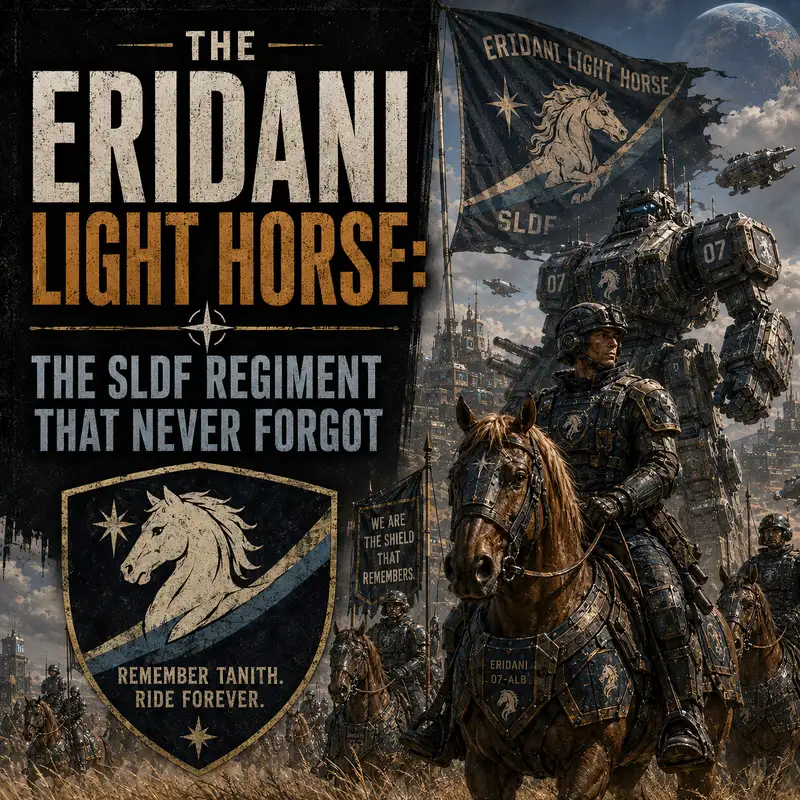
One flagpole remained empty. The other carried the Eridani Light Horse colors at half-mast. Most mercenary headquarters displayed the employer’s banner beside the unit standard, a reminder of who was paying for ammunition. The Light Horse wrote a different arrangement into its contracts. The vacant pole marked the Star League that had fallen, while the lowered colors marked a command still in mourning. Centuries after the last First Lord and the departure of Aleksandr Kerensky, that empty space remained part of the unit’s military routine.
The Eridani Light Horse did not preserve the Star League by pretending nothing had changed. It hired itself to Successor States, fought their wars, moved families between borders, and rebuilt machines with whatever industry survived. Its officers made compromises and sometimes answered brutality with brutality. What separated the Light Horse from other former Star League troops was the decision to turn memory into an institution. Ranks, ceremonies, contract clauses, doctrine, and archives reminded each generation that it had inherited obligations older than its current employer.
The command began in the year twenty-seven oh two as the Third Regimental Combat Team of the Star League Defense Force. It contained four major formations: the Seventy-first and One Hundred Fifty-first Light Horse regiments, and the Nineteenth and Twenty-first Striker regiments. This was not simply a group of light BattleMechs. Star League light horse and striker formations were designed for reconnaissance, rapid response, breakthrough exploitation, raiding, and operational maneuver. BattleMechs worked beside vehicles, aerospace support, infantry, engineers, and a transportation system capable of moving the force before an opponent could organize a heavier response.
That doctrine shaped the command’s personality. The Third Regimental Combat Team valued information, speed, and controlled violence. Its soldiers could strike isolated positions, screen larger armies, supply resistance forces, or convince an opponent that surrender was preferable to being surrounded by a formation already operating behind the front. By the late Star League era, the unit had become known for what might be called battlefield diplomacy. Raiders and insurgents sometimes surrendered to the Light Horse rather than face the Draconis Combine authorities who would follow. Negotiation worked because everyone understood what happened if negotiation failed.
The name Eridani Light Horse came from a political confrontation in the year twenty-seven forty-nine. After the command’s senior officer was assassinated amid corruption in the Rasalhague district, the Third Regimental Combat Team occupied major cities in its area of responsibility. Forces sent against it were defeated near the city of Eridani on Trondheim. A sympathetic journalist compared the unit to spirited stallions scattering clumsy cattle. The resulting embarrassment helped force action against the assassins, and the nickname remained.
That independence became more dangerous after Stefan Amaris seized Terra. Colonel Ezra Bradley understood that the Light Horse could not defeat the Usurper’s armies by itself. He used the command for raids, reconnaissance, disruption, and support to isolated resistance forces. The Horsemen avoided worlds protected by the strongest space defenses, struck weaker garrisons, and helped carry supplies to civilians and Star League troops still holding out. This was light horse warfare at interstellar scale. The objective was not to seize every planet. It was to make occupation more expensive and prepare the ground for the army that would eventually return.
The cost arrived at Talitha in May of the year twenty-seven seventy-one. A traitor revealed the Nineteenth Striker Regiment’s planned raid on Amity City. Instead of an exposed target, the regiment encountered three heavy enemy formations and was destroyed. The loss became one of the defining memories of the command. A place remained for the missing regiment in later ceremonies, distinguished retirees could be symbolically inducted into its ranks, and the dead were remembered whenever senior leaders gathered. The Light Horse did not replace the Nineteenth for almost three centuries. It carried the absence as part of the order of battle.
The surviving regiments joined the liberation of the Terran Hegemony and fought in the campaign that reclaimed Terra. Their claim to Star League lineage was therefore not a costume adopted after the fact. The unit had served the League during its final crisis, lost a regiment to Amaris, supported isolated defenders, and entered the Hegemony campaign under the original Star League Defense Force. When later Horsemen spoke about the old army, they were preserving records created by people who had actually fought under its command structure. That gave the tradition authority. It also made the decisions after victory more painful.
In the year twenty-seven eighty-four, Kerensky ordered the Star League Defense Force to leave the Inner Sphere. The Eridani Light Horse returned to the Rasalhague region and considered the order. Most of the command stayed. Only a small number of personnel departed with the Exodus. The decision did not come from rejection of Kerensky’s service. The Horsemen believed their attachment to the people and worlds they had defended outweighed their obligation to follow him into the unknown. They chose a collapsing political order over a commander they respected because their duty had become tied to a place.
On the day of the Exodus, the unit lowered its standard and left the Star League flagpole bare. The ceremony became an annual act of remembrance. The commander read Colonel Bradley’s message explaining why the Third Regimental Combat Team had remained. The Star League anthem was played slowly, and the flag was lowered again. Later commanders used the title brevet general, emphasizing that leadership of the regiments was entrusted rather than permanent. The ritual reminded each commander that the unit existed before the current contract and expected to exist afterward.
Survival made independence difficult almost immediately. The Successor Lords competed to claim the title of First Lord, and every remaining Star League formation represented military power that someone wanted controlled. Minoru Kurita threatened the Light Horse’s trade and supply access until it accepted a defense arrangement with the Draconis Combine. The agreement demonstrates the limit of moral autonomy when families require food and fusion engines require parts. The Horsemen could preserve a bare flagpole. They still needed ports, factories, and markets located inside somebody else’s territory.
The relationship ended after the Kentares Massacre exposed what the Combine under Jinjiro Kurita had become. The Light Horse prepared to leave. On Sendai, local authorities seized dependents connected to the Eighth Recon and Fiftieth Heavy Cavalry battalions and threatened to kill them unless the soldiers surrendered. The families were executed. The two battalions returned and conducted a week-long campaign against the officials and military forces responsible. Their commanders later offered their resignations for acting without orders. Colonel Bradley refused them. Sendai remained a warning about dependence, law, and vengeance.
The command relocated to the Free Worlds League and served there through much of the First and Second Succession Wars. That service paid for transport, maintenance, and the protection of families. It also placed the Horsemen inside campaigns driven by dynastic interests far removed from the League they mourned. They remained useful because their reconnaissance, combined-arms mobility, and experienced staff could do more than win isolated BattleMech engagements. They could raid supply networks, exploit breakthroughs, and remain organized during the long operational movements that repeatedly broke less disciplined units.
Mercenary life still eroded the organization. Disputes over leadership and the kind of work the command would accept produced a major fracture in the twenty-ninth century. Colonel William Bronson and his supporters separated from the core and eventually became Bronson’s Horde. The remaining Horsemen moved into the Periphery under Major Johnson and reached a point where soldiers farmed to support the community. Star League tradition could tell them which missions were dishonorable. It could not manufacture replacement armor or pay a JumpShip captain.
In the year twenty-eight seventy-two, the Light Horse accepted service with the Lyran Commonwealth after negotiating terms intended to protect its integrity and provide a home for its dependents. The command established itself around New Karlsruh on Auldhouse and served House Steiner for more than a century. It did not become a Lyran regiment. Its employer received combat power, while the Horsemen retained their own command system, history, and expectation that an unacceptable order could end the relationship. That balance worked until repeated friction with Lyran leadership made the arrangement less useful to both sides.
When the contract finally ended around the turn of the thirty-first century, the Light Horse entered Federated Suns service. House Davion made effective use of its mobility, sometimes dividing the brigade into battalion-sized forces for diversionary raids that became larger operations when local conditions allowed. The Horsemen gained generous bonuses and access to a powerful military-industrial base. They also became increasingly tied to Davion supply, education, and strategic planning. Independence improved when the employer respected professional judgment, but dependence did not disappear merely because the relationship was comfortable.
By the year thirty twenty-five, the Light Horse possessed a substantial transportation and support organization, including its own JumpShips, DropShips, technicians, and supply personnel. That infrastructure was as important as any famous BattleMech. A mobile regiment without transport is a garrison awaiting new ownership. The Horsemen could disperse, raid, reunite, and move families because generations had preserved a logistical system alongside the combat units. Their doctrine survived the technological decline of the Succession Wars because it depended on staff work and movement as much as advanced equipment.
The defense of Hoff against Wolf’s Dragoons showed the difference. The Dragoons inflicted severe losses, but the Light Horse refused to offer a simple battle that could be decided by superior concentration. It used movement, delay, local knowledge, and repeated repositioning to keep the attackers from securing the planet until Davion reinforcements arrived. Afterward, Horsemen taught Star League and Successor State history at the New Avalon Institute of Science. Few mercenary commands placed battlefield recovery and military historiography inside the same readiness plan. The Light Horse considered both necessary.
Memory did not protect the unit from allied mistakes. During the War of thirty thirty-nine, the Seventy-first Light Horse remained on Fellanin Two while other Federated Commonwealth formations were redeployed through a bureaucratic error. Fresh Draconis Combine troops struck while the regiment was boarding its DropShips. The Seventy-first was nearly destroyed and required almost a decade to rebuild. The brigade commander sent Hanse Davion a furious letter. A unit can survive enemy intelligence and still be defeated by a movement order filed at the wrong headquarters.
By the eve of the Clan invasion, other mercenaries argued that the Eridani Light Horse had become effectively absorbed into the Federated Commonwealth through supply arrangements, educational posts, and long service. The criticism was not entirely unfair. The brigade remained legally independent, but its prosperity depended heavily on one patron. Its old ceremonies helped preserve identity during that dependence. They also sustained a hope that Kerensky’s descendants might someday return and restore the civilization the Horsemen had spent centuries mourning.
The Clans destroyed that hope in the year thirty fifty. Kerensky’s heirs did return, but not as liberators accepting responsibility for the worlds their ancestors had left behind. They arrived as conquerors, armed with superior technology and a political culture that treated the Inner Sphere as a failed inheritance to be seized. For the Eridani Light Horse, the invasion was more than a strategic emergency. It was an institutional crisis. The imagined guardians of the Star League had become the threat against which the command now had to defend the Star League’s descendants.
Brevet General Ariana Winston and her officers requested time to absorb what the invasion meant. Winston still joined senior planning on Sudeten and helped evaluate the strike on Twycross, but the brigade did not rush into combat merely to prove its loyalty. When it returned to operations, it did so against Clan Jade Falcon. On Kikuyu in the year thirty fifty-three, two Falcon Clusters destroyed the Seventy-first Light Horse. The sister regiments rebuilt it by the year thirty fifty-five, and the re-formed Seventy-first resisted later Falcon attacks before joining the liberation of Coventry.
Rebuilding the Seventy-first demonstrated how the Light Horse treated a regiment as more than the people currently assigned to it. A formation could be annihilated in one campaign and restored from survivors, cadres, archives, recruits, equipment, and the support of sister units. The name carried doctrine and obligations forward even when most of the original roster was gone. This could appear sentimental. It was also a practical method of regeneration. New soldiers joined an organization with known standards instead of creating a military culture from empty barracks.
At the Whitting Conference in the year thirty fifty-eight, the leaders of the Inner Sphere re-formed the Star League. They asked the Eridani Light Horse to become the first combat command of the new Star League Defense Force. No honor could have been more carefully designed for the Horsemen. The empty flagpole finally had a government claiming the old name. The appointment also carried a test. If the new League was more than political theater, its first unit would have to accept a mission worthy of the uniform.
That mission was Task Force Serpent. While Operation Bulldog attacked Clan Smoke Jaguar holdings in the Inner Sphere, Serpent traveled along the Exodus Road to Huntress. The Eridani Light Horse was included partly for military value and partly as a message. A surviving command of the original Star League Defense Force would confront the Clans on their own territory and demonstrate that Kerensky’s legacy did not belong exclusively to them. Symbolism, in this case, traveled with ammunition, replacement parts, aerospace escorts, and a very long supply line.
The campaign on Huntress was successful and ruinously expensive. Task Force Serpent struck the Smoke Jaguar homeworld, destroyed critical infrastructure, and helped bring about the Clan’s collapse. The Light Horse lost roughly sixty percent of its combat strength. The Horsemen returned expecting decades of reconstruction. Instead, volunteers flooded the new Star League Defense Force. The brigade rebuilt its existing regiments and created the Nineteenth Cavalry to honor, rather than literally replace, the Nineteenth Striker destroyed at Talitha. The missing regiment’s place had finally produced a new formation without erasing the old loss. The black border around the unit insignia, once a mark of mourning for the fallen League, also came to represent the Horsemen lost on Huntress.
The Second Star League did not last. The Light Horse served in the Capellan and St. Ives conflict, maintained a garrison on Huntress, and discovered that even a prestigious Star League command lacked all the protection it needed. Its transportation division faced hostile WarShip power without comparable naval support. Requests for stronger cover went largely unanswered. The old lesson returned. A flag and a title could provide legitimacy. They could not stop orbital weapons or guarantee that a distant political organization would sustain the forces carrying its name.
When the Jihad began, the brigade was dispersed. The Twenty-first Striker and Nineteenth Cavalry were trapped on Dieron, where Word of Blake nuclear strikes destroyed most of both regiments and their base. The One Hundred Fifty-first was caught at Columbus and annihilated by orbital bombardment. The Seventy-first remained isolated on Huntress, facing repeated Clan challenges until Clan Goliath Scorpion finally defeated it. Many survivors were absorbed into Scorpion formations. The Light Horse had spent centuries preserving the Star League. Its destruction came in separate pieces because no surviving Star League could bring those pieces home.
The command’s legacy did not disappear with the brigade. Survivors and descendants continued in scattered mercenary formations, training cadres, and Clan units shaped by captured Horsemen. One rebuilt Eridani Light Horse regiment later defended Hesperus Two in the year thirty-one forty-five. Its allies withdrew, the defenders were denied shelter inside the industrial complex they had been hired to protect, and surrender failed. The survivors were hunted into the mountains. The contract remained after the support behind it vanished.
Reports of destruction still proved premature. Multiple commands claimed descent from the Eridani Light Horse, though not every claim carried equal evidence. The strongest lineage survived through the Eleventh Recon Battalion. In the year thirty-one fifty-one, Colonel Amelia Donovan gathered several descendant units on Mirach to discuss reunification. A rival commander attempted to turn a simulated battle into an assassination using live weapons and communications jamming. Donovan’s people recognized the attack, mobilized the rest of the battalion, and defeated it. The reunion began with the sort of staff problem the original light horse doctrine had always emphasized: identify what is actually happening before the enemy controls the tempo.
After the plot was exposed, the surviving legitimate groups united and placed the revived Eridani Light Horse under Donovan. She offered the rival unit’s uninvolved personnel a chance to join rather than treating every subordinate as guilty of the commander’s betrayal. The decision echoed the best parts of the old tradition. Loyalty was judged through conduct, a command could be rebuilt from fragments, and institutional continuity mattered more than preserving one officer’s pride. Within days, the reunited force departed on a new Federated Suns contract.
The Eridani Light Horse never forgot, but remembrance was not always comfortable. The unit remembered the Nineteenth Striker and left a space that no easy replacement could fill. It remembered the Star League while serving states that repeatedly violated League ideals. It remembered dependents murdered on Sendai and the danger of placing families in an employer’s hands. It remembered Kerensky, then fought Kerensky’s descendants. It remembered the second Star League after that government dissolved almost as quickly as the first had taken centuries to die.
That memory imposed costs. It encouraged the Horsemen to measure employers against a political ideal that had never been as perfect as later generations imagined. It made the Clan invasion a spiritual shock before it became an operational problem. It could turn old names and symbols into burdens carried by soldiers who had never seen the worlds where the traditions began. Yet memory also gave the command a way to judge orders, rebuild destroyed regiments, educate recruits, preserve combined-arms doctrine, and remain recognizable after almost every physical part of the organization had been replaced.
The empty flagpole was therefore not merely waiting for the old Star League to return. It reminded every employer that one place at headquarters could not be purchased, and every commander that current authority was temporary. The Eridani Light Horse survived as long as it did because memory was carried in contracts, transport rosters, classrooms, ceremonies, and the decisions made after defeat. Governments fell, regiments were destroyed, and even the meaning of Kerensky’s legacy changed. The vacant pole remained, not as proof that the past could be restored, but as a standard against which the present could still be judged.