The Free Rasalhague Republic: Independence Between Giants
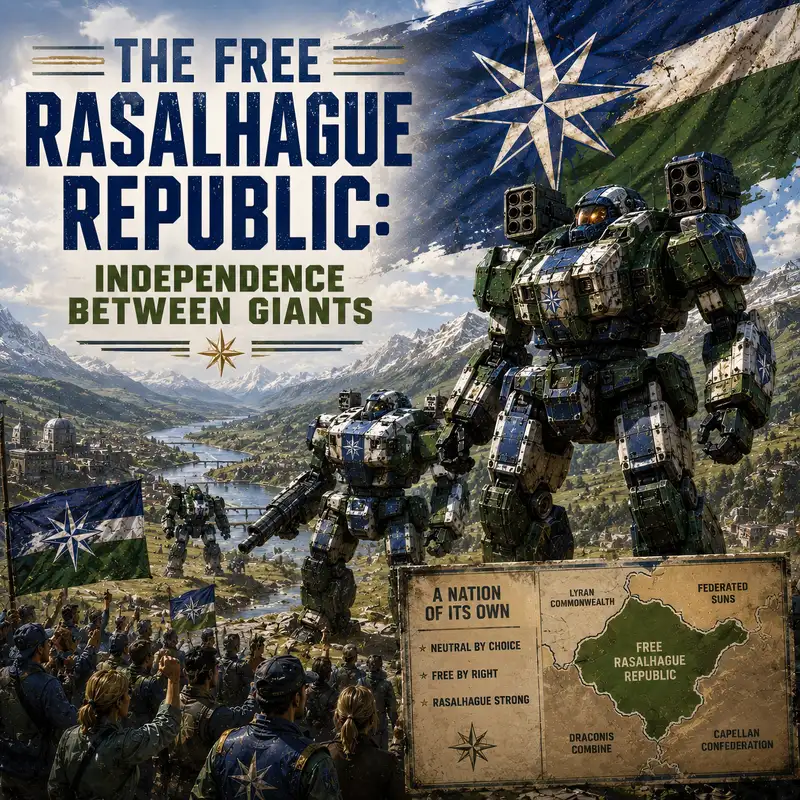
On the thirteenth of March in the year thirty thirty-four, Haakon Magnusson declared that the Free Rasalhague Republic existed. ComStar recognized it almost immediately. The Draconis Combine followed the next day. The Lyran Commonwealth, which had recently conquered many Rasalhague worlds, was then pressured to surrender them to the new state. Independence usually arrives after one empire is defeated or a colonial government is forced to leave. Rasalhague achieved it because its former occupier, its would-be liberator, and the organization controlling interstellar communications all found the arrangement useful. The flag was new. The calculations behind it were not.
That contradiction defines the Republic. Its people had fought for generations to recover a national identity nearly erased by conquest, yet their success depended on bargains made by larger powers. The state was legally sovereign, culturally distinct, and politically more representative than most of its neighbors. It was also a buffer placed between House Kurita and the growing Federated Commonwealth. The central question is not whether Rasalhague was genuinely free. It was. The harder question is whether a small nation can remain strategically independent when its territory matters more to its neighbors than its friendship does.
Rasalhague’s political identity began long before House Kurita. During the late twenty-third century, settlers from Sweden, Finland, Norway, and related communities left Terra for a cluster of cold, distant worlds. They formed the Rasalhague Consortium and later the Principality of Rasalhague, whose leaders were chosen rather than simply inherited. The Principality favored neutrality, local autonomy, and careful development of its worlds. It was not a perfect democracy, and wealthy families retained great influence, but its people developed institutions and traditions recognizably different from the dynastic states forming around them.
That independence ended when the Draconis Combine invaded in the year twenty-three thirty. Conquest took decades rather than months. Rasalhague fighters used guerrilla warfare, local knowledge, and a population willing to shelter resistance groups. The Combine eventually absorbed the region as the Rasalhague Military District, but occupation never became complete assimilation. Kurita authorities promoted migration from other Combine regions, imposed Japanese-dominated administrative culture, and watched native officers closely. Secret societies, underground networks, and periodic revolts persisted. The Combine held the territory. It never fully possessed the loyalty of the people who remembered what had existed before it.
Centuries of Kurita rule also made Rasalhague more complicated than a preserved Scandinavian colony waiting to be uncovered. Japanese settlers and other Combine citizens built lives there. Families blended languages, customs, and loyalties. A hybrid language known as Swedenese emerged from Swedish and Japanese influences. Some Rasalhagians served honorably in the Draconis Combine Mustered Soldiery, even while distrusting the state that commanded them. National identity survived, but it survived through adaptation. The later Republic would present ancient symbols as evidence of continuity, while its actual population carried the marks of centuries spent inside the Combine.
The Fourth Succession War gave the independence movement an opportunity. House Steiner invaded across the Rasalhague frontier, supported by the Tyr resistance movement and a BattleMech regiment of Rasalhague exiles trained and equipped by the Lyran Commonwealth. Local activists supplied terrain knowledge, intelligence, safe houses, and sabotage teams. Many civilians greeted Lyran troops as liberators because those troops were fighting the government that had ruled them for centuries. The cooperation was militarily useful to both sides. Rasalhague patriots wanted a state. The Lyrans wanted worlds, shorter routes, and a weaker Draconis Combine.
Victory exposed the difference. Lyran forces did not capture the entire old Principality, including the capital world of Rasalhague. Administrators from the Tamar Pact treated conquered systems as additions to the Commonwealth rather than territory held for a future republic. Duke Selvin Kelswa’s government arrested Tyr leaders, staged deeply compromised trials, and used police violence against protests. Archon Katrina Steiner reversed some of those actions, but trust had already collapsed. To many Rasalhagians, the Lyrans had replaced the Combine flag without answering the question that mattered: who would govern Rasalhague when the armies left?
Theodore Kurita saw strategic opportunity in that anger. The Draconis Combine had performed poorly in much of the Fourth Succession War, while the alliance between Houses Steiner and Davion threatened to create a vast new superstate. Giving up the rebellious Rasalhague Military District would shorten the Combine’s exposed frontier and place a neutral buffer between Kurita territory and the Lyran half of the Federated Commonwealth. It would also force the Lyrans to release worlds they had just paid heavily to capture. This was statecraft of a very Kuritan sort: sacrifice territory, deny the enemy its victory, and prepare for the next war.
ComStar had its own design, known as Operation Rosebud. Primus Myndo Waterly opposed the rise of the Federated Commonwealth and preferred an Inner Sphere divided into manageable powers. ComStar offered military equipment, intelligence, communications advantages, and other support to Theodore in exchange for his cooperation. Rasalhague independence therefore served three purposes at once. It fulfilled a real national movement. It strengthened the Draconis Combine’s defensive position. It advanced ComStar’s effort to manipulate the balance of power. A just cause and a calculated conspiracy can occupy the same document. History rarely insists that only one motive be present.
Haakon Magnusson gave the arrangement Rasalhague legitimacy. He had opposed Combine repression, endured imprisonment, joined militant resistance, and risen within the Tyr movement. He was not a foreign administrator selected because he looked acceptable on a diplomatic memorandum. He had the history, scars, and political instincts of a man shaped by occupation. When he proclaimed the Republic, ComStar recognized it first and the Combine followed. Katrina Steiner then yielded the Lyran-held Rasalhague worlds rather than appear to deny the independence her government had publicly supported. The Republic was born because resistance made freedom unavoidable and outside strategy made it convenient.
By the year thirty fifty, the Republic controlled eighty-four systems. On a map, that looked substantial. In strategic terms, it remained exposed. Its territory stretched between the Draconis Combine and the Federated Commonwealth, with additional approaches from the coreward Periphery. The Republic had limited depth, several vulnerable borders, and worlds connected by JumpShip routes that an enemy could disrupt faster than the government could replace them. Every major neighbor saw Rasalhague space as a shield, corridor, market, or potential battlefield. Neutrality could reduce immediate hostility. It could not make the geography less interesting.
The government deliberately revived institutions associated with the old Principality. The Elected Prince served as head of state, but the office was not supposed to become a hereditary throne. The Riksdag included world leaders, planetary representatives, clergy, and major business interests. Important positions were directly or indirectly elective, and terms were limited. The arrangement gave ordinary voters more influence than citizens enjoyed in most Successor States, while still granting elites a formal place in government. It was a representative system, but not an uncomplicated one. Business wealth, regional rivalries, and Magnusson’s personal network all shaped who held practical power.
Magnusson’s own legitimacy created another tension. His resistance record and role in independence made him difficult to challenge without appearing to challenge the Republic itself. Christian Månsdottir, commander of the Tyr Regiment and later senior military leader, represented political groups that wanted a harder line toward the Combine and closer relations with the Federated Commonwealth. Magnusson preferred careful neutrality and distributed offices among trusted allies, especially from former Kurita-held worlds. The debate was not simply personal. One side believed survival required accommodation. The other believed accommodation would eventually invite domination. Both positions had evidence behind them.
The first test arrived almost before the new flag had finished being printed. Numerous Draconis Combine units refused orders to withdraw from the ceded worlds. Some officers believed generations of Kurita blood had purchased the territory. Some feared for Japanese communities under a newly empowered nationalist government. Others rejected Theodore’s authority or saw opportunity in the chaos. Marcus Kurita attempted to turn the unrest into a political power base. Theodore declared the rebels ronin, masterless warriors acting against the Combine’s lawful command. The Republic’s independence immediately became a war over whether the Draconis military would obey the Draconis government.
The newborn KungsArmé was not prepared for a campaign against veteran Combine formations. It contained brave soldiers, former resistance fighters, defectors, militia, and the Tyr Regiment, but courage does not produce a functioning staff system overnight. Communications, logistics, command relationships, and training standards were uneven. The government also hired mercenaries under contracts written with more optimism than precision. Some units obeyed the letter of those agreements while avoiding the fighting their employers assumed they had purchased. Rasalhague learned early that a mercenary clause left undefined is usually interpreted by the party with the DropShips.
The Ronin War was won through an uncomfortable coalition. KungsArmé units fought beside loyal Draconis Combine regiments sent by Theodore Kurita, while Lyran officers and Rasalhague veterans helped organize the new army. The former occupier assisted the Republic in defeating soldiers who claimed to be defending the occupier’s honor. The would-be liberator helped train troops for a state it had recently tried to absorb. By the year thirty thirty-five, the rebellions were crushed and the last Combine units withdrew. Rasalhague had defended its independence, but it had needed both neighboring giants to make that defense possible.
Liberation also produced violence that patriotic memory preferred to minimize. After independence, riots and attacks targeted people and institutions associated with Japanese culture. Some civilians were beaten or killed for ancestry, language, or symbols that did not prove any connection to the ronin. The government eventually restored order, but the episode exposed the danger inside national revival. A people can resist cultural repression without every member of the former ruling culture being an oppressor. Rasalhague’s freedom was morally legitimate. Violence against civilians was not made legitimate by placing it beneath the same banner.
The Republic spent the following years building a state while avoiding the attention of states that had already noticed it. Its economy mixed damaged local industry with firms still tied to Draconis corporations and markets. Magnusson encouraged production through incentives, political access, and firm penalties for resistance to government priorities. Industrial output improved, but the defense sector remained limited. The Republic could manufacture some vehicles, weapons, and BattleMech components, yet it still relied on foreign trade and equipment. Economic independence, like military independence, existed in degrees rather than as a switch turned on by declaration.
The KungsArmé became the clearest expression of Rasalhague’s mixed inheritance. Its organization drew heavily from Lyran practice. Its ranks used Swedish titles. Its BattleMech parks combined machines associated with both neighboring powers. A Zeus might serve beside a Dragon, while a Panther screened a Commando. This mixture symbolized reconciliation, but it also gave quartermasters several excellent reasons to lose sleep. Different supply chains, ammunition requirements, replacement parts, and maintenance traditions complicated readiness. The army looked uniquely Rasalhagian because it had assembled the useful remains of two military systems and made them answer to a third.
By the eve of the Clan invasion, the Republic could field roughly fifteen BattleMech regiments, thirty-two armored regiments, and nearly one hundred infantry regiments, supported by planetary militias and a few mercenary commands. That was a serious force for a young state. Years of pirate raids had made many units skilled at reconnaissance, ambushes, rapid response, and small-unit action. The weakness lay above that level. Senior staffs had limited experience coordinating multiregimental campaigns across several worlds. The army had grown faster than its operational tradition. It could fight. It had not yet learned how to manage national survival under sustained invasion.
Neutrality gave the Republic time, but not much of it. During the War of thirty thirty-nine, the very existence of Rasalhague altered the frontier by separating much of the Draconis Combine from the Federated Commonwealth. Magnusson avoided becoming an automatic partner of either side, while factions inside the Riksdag argued over whether caution protected the Republic or left it isolated. The state’s diplomacy worked as long as both giants preferred the buffer to the cost of swallowing it. That was a real achievement. It was also a security policy dependent on other governments continuing to find restraint convenient.
The threat that destroyed the balance did not come from either neighbor. In the year thirty forty-nine, reports arrived from the coreward frontier describing attackers with unfamiliar machines, extraordinary weapons, and customs no intelligence service understood. The Republic lay directly in the invasion paths of Clan Wolf and Clan Ghost Bear. The same geography that had made it a useful shield between Successor States now placed it in front of enemies who did not care about the old balance of power. Rasalhague had prepared for raids, border wars, and pressure from Houses Kurita and Steiner-Davion. It had not prepared for the descendants of the Star League Defense Force returning from beyond known space.
The initial battles were not simply contests between individual BattleMechs. Clan OmniMechs had superior range, accuracy, heat efficiency, and mobility. Elemental battle armor gave Clan forces assault infantry able to move with BattleMechs and survive fire that would destroy conventional troops. Clan aerospace and transport operations maintained a brutal tempo. Just as important, Rasalhague commanders received fragmented reports and had little time to understand what kind of war they were fighting. A regiment defending one world could win a local engagement and still discover that the systems behind it had already fallen.
KungsArmé units often fought with determination and tactical skill. On cold plains, in cities, and around industrial sites, they used mines, artillery, armor, infantry, and ambushes against opponents who expected quick victories. Their problem was not a lack of courage. The Clans could concentrate advanced forces, defeat isolated defenders, and move to the next target before the Republic assembled a coherent operational response. Light Kavalleri and Hussar formations that had been effective against raiders found themselves outranged and destroyed. Reserve units equipped for a familiar Inner Sphere war were committed against an enemy for which their training offered few useful comparisons.
The capital world of Rasalhague fell to Clan Wolf in July of the year thirty fifty. Khan Ulric Kerensky won the right to attack with only three Clusters, a force smaller than many observers believed necessary. Phelan Wolf provided knowledge of the world’s seasonal Fenris plague and of Haakon Magnusson’s likely decisions. Illness weakened defenders just as Clan forces maneuvered through terrain the Republic expected to use as protection. Magnusson departed to preserve the government and continue resistance, taking an aerospace escort that the defenders could ill afford to lose. It was a defensible political decision with an immediate military cost.
General Christian Månsdottir and the remaining defenders fought around Tyr, Ymir, Asgard, and Reykjavik. Clan forces exploited mobility, energy weapons, and precise knowledge of Rasalhague reactions. The final battle devastated Reykjavik, including the governmental center where the Republic had tried to give elected institutions a permanent home. The capital’s fall was more than a lost world. It disrupted command, displaced civilians, and transformed the symbol of independence into occupied territory. A state can continue after losing its capital. It cannot pretend that the loss is merely another adjustment on a staff map.
By the year thirty fifty-two, a republic that had controlled eighty-four systems had been reduced to seven. Clan Wolf and Clan Ghost Bear occupied most of its people and territory. Surviving KungsArmé formations were shattered, reorganized, or concentrated around the remaining worlds. Orestes became the practical center of the rump state. ComStar protection helped keep it alive, which meant Rasalhague’s sovereignty again rested on the commitment of an outside power with its own agenda. The Republic still possessed a government, armed forces, and international recognition. Its freedom was legally intact and strategically hollow.
The Battle of Tukayyid made that contradiction impossible to miss. ComStar selected an agricultural world of the Republic as the site of its decisive trial against the invading Clans. The Com Guards won and imposed a fifteen-year halt on the Clan advance, saving the surviving Republic along with much of the Inner Sphere. Rasalhague civilians, farms, towns, and transport networks paid part of the price for a battle arranged by powers larger than their state. Once again, Rasalhague survived because another institution decided its territory was the right place to solve a wider strategic problem.
Occupation did not erase Rasalhague identity. Most Rasalhagians now lived under Clan rule, especially within the Ghost Bear occupation zone, while the elected government controlled only a small remnant. Clan Ghost Bear gradually learned that governing required more than winning Trials and issuing orders. Rasalhague communities preserved language, religion, local administration, and historical memory. Some resisted. Others negotiated. Many adapted, as their ancestors had under House Kurita. Over time, the conquered population changed the conqueror. The Ghost Bears became increasingly rooted in the Inner Sphere and increasingly dependent on Rasalhague civilians to make their realm function.
That process eventually produced a political union the founders of the Republic could scarcely have imagined. During the Jihad, Ragnar Magnusson, Haakon’s son and a warrior shaped by Clan Ghost Bear, helped open negotiations between the remaining Republic and the Ghost Bear Dominion. In the year thirty-one oh-three, the rump Republic merged with the Bears to form the Rasalhague Dominion. The decision ended the Free Rasalhague Republic as a separate state, but it did not end the political community created in thirty thirty-four. Rasalhague institutions and identity became part of a larger hybrid realm rather than disappearing beneath another occupation government.
The Free Rasalhague Republic was not merely a doomed buffer, and its short independent life was not meaningless. It restored representative government, gave a scattered people a recognized homeland, built an army from former enemies, and proved that centuries of occupation had not erased national identity. It also demonstrated the limit of sovereignty without strategic depth. Rasalhague could choose its leaders and laws, but it could not choose whether great powers considered its territory useful. Its independence was real, its vulnerability was structural, and its greatest victory was that even after the Republic lost most of its worlds, the people between the giants remained Rasalhagian.