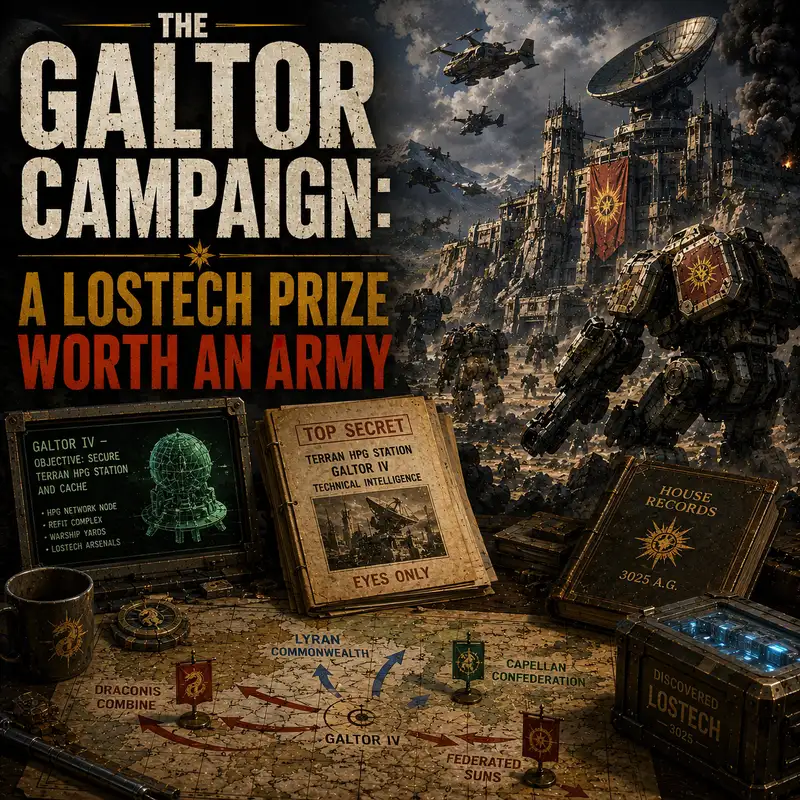
The Galtor Campaign: A Lostech Prize Worth an Army
The first alarm on Galtor the Third was not that House Kurita had taken the bait. Hanse Davion had intended that part. The alarm came when his surveyors reported that the supposed Star League treasure had become real. Several thousand kilometers from the empty installation prepared as a decoy, they had found an untouched military depot. Davion had invited the Draconis Combine to attack a world holding exactly the prize he had falsely advertised. A controlled ambush had become a race for lost technology, and neither side could safely walk away.
The Galtor Campaign was one of the largest and most complicated operations of the late Third Succession War. It ran from late May through September of the year thirty twenty-five and drew in regular regiments, planetary militia, mercenaries, aerospace units, armor, infantry, artillery, and troops fighting on neighboring worlds. The campaign is often remembered as a clever Davion deception that nearly failed. Its deeper importance lies in why the deception became so dangerous. In an age of industrial scarcity, the possibility of an intact Star League depot could justify risking an army.
Galtor the Third had only recently returned to Federated Suns control. House Kurita had taken the planet during the First Succession War and held it for more than a century. The Federated Suns reconquered it in the year thirty twenty-two after costly fighting that left the population and economy badly damaged. Galtor had once been an important agricultural world. Its fertile regions still mattered, especially to nearby systems that depended on dependable food production. The planet was therefore not an empty battlefield waiting for two Great Houses to test a theory.
Its location made the problem worse. Galtor sat close to the Kurita border, with Marduk serving as an important nearby transit and support point. Reinforcements could reach the world only through a limited network of JumpShips, DropShips, recharge schedules, and staging bases. A force on Galtor might receive a hyperpulse message quickly, but troops, ammunition, and repair parts still had to travel the old-fashioned way, which in the Inner Sphere meant very slowly by the standards of an emergency.
In the year thirty twenty-four, Hanse ordered surveys of recently reclaimed worlds for hidden equipment, abandoned bases, and records from the Star League era. The first reports from Galtor pointed toward a promising military site. Further investigation showed that the known installation had already been stripped. Hanse saw an opportunity. If House Kurita believed an untouched cache had been found, it might send valuable formations across the border. Federated Suns forces could then strike those units on ground selected and prepared in advance.
The false depot became the center of the trap. Davion defenders prepared minefields, concealed artillery, observation positions, and a military presence convincing enough to protect the rumor. Information about the supposed discovery was allowed to reach Kurita intelligence through channels Hanse knew or suspected were compromised. The plan depended on several judgments being correct. The Combine had to believe the report. It had to send a force large enough to matter but small enough to defeat. Davion reinforcements had to arrive on time. The enemy had to attack the place Hanse wanted attacked.
The first assumption worked rather too well. The Draconis Combine did not dispatch a cautious reconnaissance group. It assembled a major operation supported by five BattleMech regiments and substantial additional forces. Empty or lightly loaded DropShips accompanied the invasion so recovered matériel could be carried away. The attackers also struck Marduk and created pressure elsewhere along the border, complicating Davion movement and flooding command channels with competing demands. House Kurita was not merely reaching for a rumor. It was building the transportation and isolation plan required to remove the prize.
Coordinator Takashi Kurita made one decision that weakened the operation before the first landing. He divided senior authority between Warlord Syovo Yorioshi of the Benjamin Military District and Warlord Grieg Samsonov of the Galedon Military District. Takashi had political reasons. An officer who recovered a major Star League cache could gain enormous prestige, and the Coordinator had little reason to allow one ambitious subordinate to claim all of it. Shared command protected the throne from a triumphant warlord. It did considerably less to protect the campaign from two warlords who disliked one another.
Yorioshi and Samsonov brought capable formations. The Benjamin Regulars were experienced border troops. The Galedon Regulars added further weight, while later reinforcements included the Amphigean Light Assault Groups and the Kismet Battalion of the Seventh Sword of Light. The weakness was not a shortage of courage or machines. It was divided purpose. Each commander watched the enemy, the cache, and the other commander. Requests for support could be judged not only by military need but by who would receive credit if the operation succeeded.
The Davion plan was also unraveling. Elements of the Thirty-third Avalon Hussars were delayed in transit, and a transport disaster on Marduk destroyed troops and damaged support facilities. Units intended to form a concentrated ambush were scattered across the approach routes and nearby worlds. Only part of the expected force was ready on Galtor. The Twelfth Vegan Rangers, local militia, mercenaries, and the Galtor Irregulars could fight, but the carefully arranged trap no longer possessed the comfortable margin its designer had imagined.
Then the survey team found the real depot roughly three thousand kilometers from the decoy. The discovery reversed the meaning of every preparation. The empty installation could still draw the initial attack, but the Federated Suns now had to defend a second site that had not been fortified for a major campaign. Hanse could not simply reveal the deception and abandon the world. Doing so would hand House Kurita a genuine Star League facility, vindicate the invasion, and potentially alter the military balance along the entire border.
The precise inventory of the real depot receives less attention in the surviving campaign accounts than the struggle to possess it. That uncertainty is instructive. Neither side needed a complete list before acting. An intact Star League site might contain BattleMechs, weapons, armor, spare parts, technical records, machinery, or merely enough specialized components to restore machines that had been waiting years for repair. In thirty twenty-five, even standard matériel stored in good condition had strategic value. The possibility of advanced lostech made the risk easier to justify and much harder to limit.
The invasion opened on the twenty-fifth of May. Kurita troops descended toward the false depot while other forces attacked across the wider region. The early advantage belonged to the Combine. Its aerospace strength interfered with Davion movement and protected the landings. The defenders were separated by distance, terrain, and the need to guard several objectives at once. Margrave Sheridan Douglass and General Sir William Dobson had to defend the decoy, the real depot, New Derry, New Wuhan City, transportation routes, and a civilian population already recovering from the previous war.
The 782nd Davion Guards Auxiliary held the false site. Its infantry and artillery sat within concentric minefields designed to slow BattleMechs and expose them to fire. The position performed exactly the task Hanse had assigned it. It delayed the Third Benjamin Regulars and made the supposed cache appear valuable. It also became isolated when mobile Davion forces were forced back. The auxiliary troops were destroyed rather than rescued. A deception intended to consume enemy regiments first consumed the soldiers used to make it believable.
Davion aerospace pilots provided one of the few immediate answers. The Twenty-second Special Air Squadron struck the Benjamin Regulars while their BattleMechs were slowed in the minefields. The squadron continued flying at an exhausting rate throughout the campaign, covering retreats, contesting the air around the real depot, and supporting later counterattacks. Its effort showed why the battle cannot be understood as a procession of BattleMech duels. The side controlling the sky could punish stalled columns, protect DropShips, and determine whether reinforcements reached the ground in fighting condition.
The Thirty-third Avalon Hussars launched an aggressive counterattack against the Seventeenth Benjamin Regulars. The Hussars were understrength and still waiting for elements delayed by the broken transportation plan. Even so, they nearly converted the enemy's concentration around the decoy into an operational disaster. Kurita reinforcements stabilized the line before the Hussars could finish the work. The attack failed to destroy the invasion force, but it prevented the Combine from turning its first success into an immediate collapse of Davion resistance.
From that point, the campaign fragmented. The false depot had served its purpose but no longer decided the war. Fighting spread toward the real installation, the Wagnall Plain, New Wuhan City, New Derry, and the approaches connecting them. A regiment successful in one area could be irrelevant to another objective several hundred kilometers away. Commanders had to decide whether to reinforce a city, protect the depot, recover damaged BattleMechs, or preserve a route for units still arriving from off-world.
The local Galtor Irregulars paid heavily for those decisions. Their formations included troops descended from resistance groups that had fought Kurita occupation and forces raised after the Davion reconquest. Much of their equipment was old, and their losses became catastrophic as they were assigned to objectives no regular army could leave uncovered. They defended the real depot, New Wuhan, and other positions while elite formations maneuvered around them. The cache drew attention because its machines might survive for centuries. The militia defending it could not expect the same consideration.
New Derry became a battle inside the battle. The Fifth Galedon Regulars attacked in several columns through industrial ruins and urban approaches. Most were stopped, but one penetrated toward Elliot Park, threatening Davion command and supply facilities. A mobile reserve prevented immediate disaster. The engagement demonstrated the limits of heavy firepower in a city. BattleMechs could force streets and dominate open intersections, but infantry, engineers, local guides, and functioning communications decided whether an advance remained coherent after it entered damaged neighborhoods.
The struggle also consumed technical personnel. Damaged Kurita formations pressed technicians into emergency defensive roles, and many were killed. The Combine later compelled captured Federated Suns technicians to work on equipment. Both actions revealed the contradiction at the heart of the campaign. The armies were fighting for a depot because technical capacity had become precious, while using scarce technical workers as infantry or coerced labor because the immediate battlefield crisis allowed no better answer. Lostech was not merely hardware. It was the ability to understand, repair, and reproduce hardware.
During the middle phase, additional Kurita formations arrived and attempted to reach the real depot. The First and Second Amphigean Light Assault Groups advanced across rolling ground that disrupted their formation. The First moved too far ahead and became isolated. The Second had to extract it, consuming time and combat strength while the Kismet Battalion of the Seventh Sword of Light pushed toward the Star League site. The Combine possessed enough units to threaten several objectives, but not enough unity to make every movement support the same decisive result.
The Kismet Battalion reached the real depot and occupied it. This was the moment the original Davion trap came closest to becoming a strategic defeat. A Kurita formation was physically inside the prize, while Davion forces remained stretched across cities, plains, and damaged support routes. Yet Kismet's success also placed it at the end of a narrow advance. Holding the installation required relief, aerospace support, transport, and an open route for removing anything found inside. Capturing a warehouse is not the same as extracting its contents through an active planetary campaign.
Marduk therefore mattered as much as any single fight on Galtor. The initial Kurita attack had disrupted the staging point and restricted Davion reinforcement. A battalion of the Thirty-third Avalon Hussars later conducted a violent combat drop against Moroushi's Independent Assault Battalion. The defenders expected an attack but were not prepared for the Hussars to descend so close to their position. Moroushi's force was crushed, and the route through Marduk reopened. The action did not win Galtor by itself. It restored the possibility of winning it.
The Twelfth Vegan Rangers helped exploit that possibility. Their Alpha Regiment had been one of the strongest Davion-aligned formations available when the campaign began. The Rangers struck between Kurita units, relieved pressure on battered defenders, and supported the counterattack around the real depot. Like many mercenaries, they were fighting for an employer while also preserving their own equipment, personnel, and future contracts. Their effectiveness came from balancing those interests better than several state formations managed to balance prestige and command.
House Davion's counterstroke concentrated regulars, militia, mercenaries, and aerospace support against Kismet before the Combine could establish a secure corridor. The battalion of the Seventh Sword of Light fought from the depot but was crushed. The ancient installation remained in Davion hands. The result was tactically decisive at the site and operationally incomplete across the planet. Kurita forces still threatened New Derry, and Davion formations had suffered losses severe enough that one more well-coordinated offensive might have reversed the outcome.
That offensive never became coordinated. Samsonov continued manipulating deployments to strengthen his own position and weaken Yorioshi's claim to success. Yorioshi eventually withdrew the Sixth and Seventeenth Benjamin Regulars from Galtor rather than continue operating inside the arrangement. His departure removed formations the invasion could not replace at the precise moment Davion reinforcements were reaching the theater. Takashi's decision to divide glory had divided responsibility as well. When the plan failed, each warlord had evidence that the other deserved the blame.
The Fourth Crucis Lancers arrived and changed the balance. Joined by the Bremond Draconis March Militia, they struck the command elements of the Fifth Galedon Regulars and nearly trapped Samsonov. Most of his command company was destroyed, though the warlord escaped. Elsewhere, surviving Kurita formations fought hard enough to take New Derry and kill General Dobson, whose Dahar militia was effectively destroyed. The city fell at the moment the larger campaign was becoming untenable, a tactical success achieved after the route to strategic success had already closed.
Samsonov ordered the remaining Combine forces off-world. The retreat ended major operations on the twenty-seventh of September. House Kurita had failed to take Galtor or carry away the real depot. House Davion retained the world and the Star League site, but the victory bore little resemblance to Hanse's original design. The Federated Suns had intended to ambush a limited raiding force. It instead survived a multi-regiment invasion through improvised reinforcement, local sacrifice, mercenary skill, aerospace endurance, and the enemy's failure to maintain unity of command.
The casualty figures attached to individual formations show how narrow the outcome was. The Thirty-third Avalon Hussars, the Galtor Irregulars, the Dahar militia, and several Kurita regiments emerged shattered or nearly destroyed. Technical crews, infantry, tankers, pilots, and civilians paid alongside the MechWarriors most often named in campaign histories. New Derry and other communities became battlefields because the armies needed roads, repair areas, command posts, and access to the depot. The lostech survived because much of the world around it absorbed the damage.
Hanse's deception was clever, but it was not a clean strategic masterpiece. He correctly predicted that House Kurita would respond to the rumor of a cache. He underestimated the scale of that response, and his own movement plan failed before the invasion fully developed. The discovery of the real depot was bad luck in the narrow sense, but the larger danger came from assuming a complex ambush would remain under control after interstellar transportation, rival intelligence services, and enemy initiative entered the problem.
The Combine plan was stronger than its final result suggests. Its commanders isolated Galtor, attacked the reinforcement network, gained early aerospace advantages, and committed enough transport to remove the cache. Several Kurita formations performed effectively under difficult conditions. The failure arose at the level connecting battle to campaign. Shared command produced competing efforts, successful advances outran support, and political rivalry denied isolated units the help their tactical achievements had earned.
Was the depot worth an army? In the economy of thirty twenty-five, the answer could reasonably appear to be yes before the fighting began. An intact Star League installation might return BattleMechs to service, supply irreplaceable components, reveal technical methods, or deny the same advantages to an enemy. A single production line or archive could influence several future campaigns. Lostech promised something no ordinary captured world could guarantee: the ability to replace a portion of what centuries of war had consumed.
After Galtor, the answer became less comfortable. Neither state gained enough immediate advantage to justify the formations destroyed or crippled there. House Davion kept the cache, but it also spent soldiers and equipment that could not be restored simply by opening warehouse doors. House Kurita lost the prize and damaged some of its best troops. The campaign demonstrated that lost technology had become valuable partly because armies had already destroyed the industrial system that once made such technology common.
The civilians of Galtor received the harshest version of that lesson. Their world had been occupied, reconquered, and then turned into a trap by the government that had liberated it. The Combine invasion was responsible for attacking the planet, but Davion planning deliberately made Galtor attractive as a target. The people living near New Derry, New Wuhan, the Wagnall Plain, and the military sites did not choose the intelligence operation. They inherited its minefields, bombardments, destroyed crops, displaced families, and another round of reconstruction.
The Galtor Campaign became one of the final major battles conventionally associated with the Third Succession War. It did not end the rivalry between Houses Davion and Kurita, and it did not restore the technological foundation of the Star League. It showed instead how the late Succession Wars had changed the meaning of military value. A depot could be worth several regiments because no one knew when another would be found. The same scarcity meant those regiments could not be replaced after being spent.
Hanse Davion set out to use lostech as a fiction that would pull enemy troops into a trap. The real cache trapped everyone. House Kurita could not ignore the possibility of recovering it. House Davion could not abandon it after inviting the attack. Local commanders could not protect it without sacrificing cities, militia, technicians, and elite formations. Galtor was won by the Federated Suns, but the campaign's defining image is not a triumphant army opening an ancient vault. It is two damaged states counting surviving machines beside a depot from an age when replacing them had once been routine.