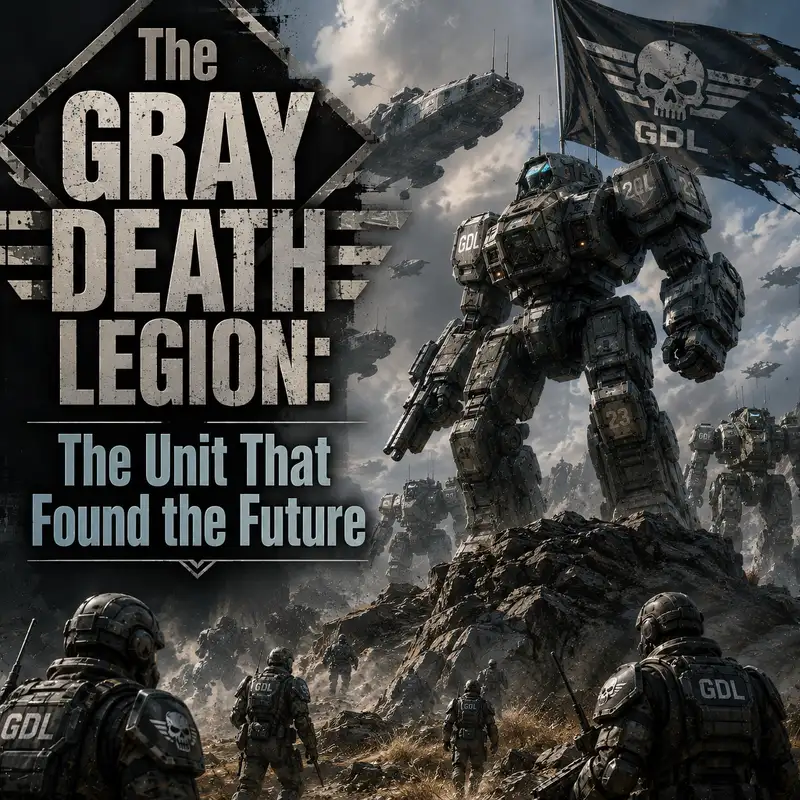
The Gray Death Legion: The Unit That Found the Future
The most valuable object inside the Star League fortress on Helm was not a BattleMech. It was a library. On the first of April in the year thirty twenty-eight, technician Alard King worked to copy that library while Free Worlds League troops blasted their way through the mountain around him. The Gray Death Legion was outnumbered, exhausted, branded as war criminals, and fighting inside a facility designed to destroy itself rather than surrender its secrets. The unit’s immediate problem was escape. The object being copied would reshape the next generation of war.
That contradiction explains why the Gray Death Legion found the future. The Legion did not begin as a research institution, a Great House army, or a guardian of Star League knowledge. It began as survivors with damaged machines, improvised transport, and more enemies than reliable paymasters. Yet the habits required to keep such a command alive prepared it to recognize what the Helm Memory Core meant. Grayson Carlyle’s soldiers had learned to distrust official stories, preserve useful people, adapt equipment, and share risk across BattleMechs, infantry, technicians, and civilians. On Helm, those habits became decisive.
The unit’s origins lay on Trell One in the year thirty twenty-four. Carlyle’s Commandos, the small mercenary force led by Grayson’s father, had been shattered during an attack tied to Duke Hassid Ricol of the Draconis Combine. Grayson was left behind on a hostile world with no functioning command to inherit. He assembled local resistance, captured enemy BattleMechs, recruited former opponents, and turned scattered survivors into the Trellwan Lancers. The campaign taught him that ownership of a machine mattered less than the ability to put the right pilot inside it and keep it moving.
Lori Kalmar embodied that lesson. She first appeared as an enemy MechWarrior, but Grayson recruited her after her capture. She became his executive officer, later his wife, and helped turn survivors into a durable command. The early Legion was built through persuasion as much as victory. Its members came from different worlds, services, and loyalties. The unit could not depend on inherited regimental tradition. It had to create one while already under fire.
After Trell One, the new Gray Death Legion went to Galatea in search of work. It arrived with a handful of BattleMechs, infantry, technicians, and almost no financial margin. Six months of waiting pushed the command toward disbandment. The contract that saved it came from the Verthandi Revolutionary Council. The job was limited on paper. The Legion would train local rebels in anti-BattleMech warfare for nine hundred hours and avoid direct combat. That arrangement lasted until reality reviewed the contract and rejected most of its assumptions.
The DropShip Phobos was badly damaged while running the blockade around Verthandi. With no easy route off-world, the Legion could not simply complete its training schedule and leave. Its people converted the crippled vessel into a steam-powered oceangoing ship and moved it across the Azure Sea toward repair facilities. BattleMechs fought beside guerrillas. Infantry learned to attack machines many times their size. Technicians became strategic assets. The campaign was improvised, combined arms, and dependent on civilians who understood the terrain better than any off-world commander.
Verthandi established the Legion’s reputation and revealed its command culture. Grayson accepted that a contract written before landing could become militarily impossible. He committed the unit to the rebellion because training alone would not protect the people who had hired him or restore the transport needed to escape. The choice carried political and financial risks, yet it showed the Legion’s tendency to judge obligations by conditions on the ground. Employers might prefer a cleaner definition of service. Battlefields rarely cooperate.
The success on Verthandi brought a larger contract from the Free Worlds League. For more than a year, the Legion conducted raids and offensive operations against the Capellan Confederation. It struck communications centers, depots, mines, industrial sites, and BattleMech facilities. The command grew into a more capable combined-arms formation and improved its transport. By early thirty twenty-eight, it had earned both a strong reputation and a landhold on Helm, granted by Captain-General Janos Marik as part of the payment for service.
Helm did not look like a reward designed to change history. It was a cold, glaciated world with scattered farming communities, little industry, and vast stretches of mountain, desert, and ice. Its largest landhold, Helmfast, offered the Legion something mercenaries rarely possessed: a home for soldiers, technicians, and families. The planet’s poverty was almost reassuring. There appeared to be little worth stealing. That conclusion had already been reached once before, and it had been catastrophically wrong.
During the final years of the Star League, Helm had served as a military storage world. The Forty-second Engineering Brigade had expanded natural caves beneath the Nagayan Mountains into a fortified underground complex. Major Edwin Keeler, unable to evacuate the stored equipment as the League collapsed, hid the cache and added a field library containing scientific and technical knowledge. He believed the coming wars threatened not only weapons, but the accumulated understanding that allowed civilization to build and maintain them.
In the year twenty-seven eighty-eight, Minoru Kurita’s forces invaded Helm in search of those stores. They found no visible depot and concluded that the equipment had been removed. The failure did not spare the planet. Nuclear weapons and orbital bombardment devastated its population centers and killed most of its people. The hidden complex survived beneath the mountains. For centuries, the ruins above it helped confirm the false assumption that there was nothing left to find.
By the time the Gray Death Legion received Helm, several groups suspected otherwise. Duke Hassid Ricol was searching for the missing Star League matériel. ComStar’s intelligence service had concluded that the cache probably existed and might contain a library core. That possibility threatened far more than control of a few old BattleMechs. ComStar’s influence depended partly on its communications monopoly and partly on managing technological recovery. A freely distributed Star League library could weaken both.
Precentor Emilio Rachan was assigned to remove the threat. His superiors authorized covert action and expected an incident that would discredit the Legion. Rachan escalated that policy into mass murder. He allied with Lord Garth, Duke of Irian, who wanted the weapons for his own political ambitions. Their plan was direct in purpose and elaborate in execution. The Legion would be framed as criminals, stripped of its landhold, and replaced by a noble more willing to let the conspirators search Helm.
The trap was prepared on Sirius Five, the final target of the Legion’s campaign. Life there depended on sealed cities because the outside atmosphere was lethally cold and toxic. After the planet surrendered, Lord Garth arrived early, relieved the Legion, and ordered Grayson to travel to the capital world of Marik for honors. Once the mercenaries departed, conspirators destroyed the domes protecting Tiantan. Roughly twelve million civilians died as the atmosphere entered the city.
The killers then produced the evidence needed for the second part of the operation. BattleMechs and a DropShip were painted to resemble Gray Death equipment. Staged recordings made it appear that the Legion had destroyed Tiantan after accepting surrender. The accusation was credible because the real unit had just fought on the world and had already left the scene. The images spread faster than any explanation Grayson could offer. A military reputation built over years was turned into proof of atrocity in a matter of hours.
The Legion did not yet know what had happened, but Grayson recognized that the orders and communications around Sirius Five did not make sense. Rather than continue to Marik, where an arrest was waiting, he redirected the command toward Helm. That decision saved the mobile force from immediate capture. It also carried the Legion directly into the next stage of the conspiracy. House Marik troops had already landed on the world, seized key settlements, attacked Helmfast, and killed or captured many of the dependents and personnel left behind.
The returning Legion was not fighting for an abstract fief. It was trying to reach families, recover prisoners, preserve transport, and understand why its employer had become its enemy. That confusion shaped the first battles. Gray Death personnel had incomplete information, while attackers shown repeated images of Tiantan believed they were hunting mass murderers. The conspiracy worked because honorable people could be made to act on false evidence.
The Legion’s internal security also failed. Harris Graff, a Free Worlds League agent serving among its MechWarriors, had helped the conspirators place charges at Tiantan. On Helm, he enabled the capture of a Gray Death DropShip and threatened the unit’s ability to evacuate. The betrayal was especially dangerous because transport was the command’s strategic lifeline. A mercenary company without a DropShip can still win a firefight. It cannot choose what happens after the victory.
Grayson escaped the initial trap with a reduced force and began treating the campaign as an intelligence problem. He recovered old maps, moved through difficult terrain, contacted agents in Helmdown, and tried to reconstruct events from fragments. The Lyran and Federated Suns representatives he reached knew about Tiantan but did not believe his claim of innocence. Their caution was understandable. The available evidence showed Gray Death machines at the massacre, while Grayson offered suspicion, missing messages, and a unit currently shooting at Free Worlds League troops.
A raid against a League mobile headquarters finally produced the break the Legion needed. Graff was captured and revealed that ComStar was involved and that the real objective lay beneath Helm. The massacre, the invasion, and the effort to remove Grayson as legal landholder all pointed toward the missing Star League depot. The accusation against the Legion had not been designed merely to destroy a mercenary rival. It was a property transfer conducted with explosives and several million unwilling witnesses.
The next revelation was equally uncomfortable. Alard King, Grayson’s personal technician, admitted that he also served Duke Hassid Ricol. Ricol had been responsible for the attack that destroyed Grayson’s father’s command on Trell One. He was an old enemy, a Combine noble, and one of the few people on Helm who understood what the Legion was facing. Grayson made a temporary alliance with him because Lord Garth and Rachan possessed greater forces and shared control of the immediate battlefield.
The arrangement was not friendship. Ricol wanted a portion of the cache. Grayson needed BattleMechs, DropShips, intelligence, and a way out of the system. Each side understood that the other had separate interests. That clarity made the alliance more reliable than several recent promises from supposed friends. Mercenary history contains many inspiring partnerships. Some of the most useful begin with both parties carefully counting the other side’s weapons.
Using ancient maps and clues recovered from Helmfast, the Legion identified an entrance in the Vermillion Valley. A massive stone slab concealed the approach to the underground complex. Grayson initially expected to blast through it, but the old files contained an access code. The door opened without triggering the installation’s immediate defenses. Beyond it lay warehouses, repair facilities, internal transit routes, and military equipment preserved from the Star League era.
The discovery created a tactical advantage before it created a technological one. The complex extended beneath the mountains and included a transportation network that allowed the defenders to shift forces rapidly. Grayson used those routes to ambush larger formations approaching from outside. BattleMechs, infantry, vehicles, and technicians all had roles. The Legion could not defeat the entire invading force in a conventional stand-up engagement, so it made the terrain and the hidden infrastructure compensate for its lack of numbers.
Even then, the stored weapons could not solve the immediate problem. Old BattleMechs required inspection, crews, ammunition, and time. A warehouse full of military hardware is not the same thing as an operational regiment, especially when enemy forces are already at the door. The most valuable discovery was the field library. It contained the context needed to understand scientific and technical records that the Successor States had preserved only in fragments.
Grayson realized that this was why ComStar wanted the find suppressed. The weapons could strengthen one ruler. The library could strengthen every state, university, hospital, factory, and engineering school able to read it. It functioned as a Rosetta Stone for Star League knowledge. Documents that had survived without essential definitions, procedures, or supporting theory could now be interpreted. The core offered pathways back to advanced military systems, but also to medical treatments, environmental purification, and planetary engineering.
As League forces closed in, Grayson ordered King to copy the archive. The decision changed the objective of the battle. Holding the complex was no longer necessary if the information could leave it. The Legion’s mission became a withdrawal operation built around data rather than territory. BattleMechs held passages. Infantry guarded access points. Technicians worked the core. DropShip crews prepared for evacuation. The most important payload on Helm weighed less than the machines fighting to protect it.
Rachan took direct control of the assault and ordered troops to force entry. He intended to seize the core, eliminate witnesses, and destroy the facility. In doing so, he exposed the conspiracy to some of the Free Worlds League officers carrying out his orders. One ComStar adept, Larabee, rejected what he learned and informed Colonel Julian Langsdorf. Langsdorf had already questioned the mission. Presented with testimony and evidence, he arrested Lord Garth and other conspirators rather than continue serving a private plot disguised as lawful command.
The ancient installation had its own final judgment. Its builders had trapped it against unauthorized entry. Forcing the doors activated a failsafe tied to the complex’s reactor. While the Legion and Ricol’s forces evacuated with copies of the library and a fraction of the stored equipment, the underground facility began to destroy itself. Rachan died inside the complex he had tried to control. The weapons cache vanished with him, leaving the smaller and more consequential prize outside the mountain.
The Legion was cleared of the Tiantan accusations, but vindication could not restore the city or return the dead on Helm. ComStar publicly disavowed Rachan and portrayed him as a renegade. That description was only partly true. He had exceeded his instructions and horrified even senior ComStar leaders through the scale of the massacre. He had not invented their desire to suppress the memory core. His crime was the extreme expression of an existing policy, followed by a failure too public to hide.
Grayson’s response to the core was as important as its recovery. The Legion did not sell one exclusive copy to the highest bidder or surrender the archive to a single House. It made multiple copies and used free traders to spread them beyond any one government’s control. Copies reached the Successor States, universities, Janos Marik, Duke Hector Stewart, and eventually major research institutions. Ricol received one for his assistance. Distribution became a form of defense. Once the knowledge existed in enough places, destroying it became nearly impossible.
ComStar tried. Its agents interfered with dissemination, and one covert strike targeted the New Avalon Institute of Science while masquerading as Capellan Death Commandos. The attempt failed. By then, the problem was no longer one data core in one fortress. It was a network of scholars, engineers, officers, merchants, and governments making new copies and comparing what they learned. ComStar could destroy a laboratory. It could not easily recreate the secrecy that existed before Helm.
The technological renaissance did not occur overnight. A library core could explain Star League systems, but it could not instantly rebuild factories, train engineers, or create rare materials. Many surviving plants had spent centuries producing simplified equipment. Restoring advanced technology required capital, experimentation, tooling, and a new generation of specialists. The core opened doors. Someone still had to construct the building behind each one.
Its influence nevertheless reached far beyond weapons. The military effects were the most visible because double heat sinks, advanced armor, improved engines, and other recovered systems changed BattleMech design. The deeper effect was educational. The core connected isolated fragments of knowledge and gave researchers a common foundation. Better medicine, water purification, atmospheric processing, and environmental work followed the same recovery. The future found on Helm was not merely a better way to destroy a BattleMech. It was a better chance to sustain the worlds that built them.
The timing mattered. The Fourth Succession War began in the same year the core was recovered. The states of the Inner Sphere were about to redraw borders while entering a period of renewed research and production. By the time the Clans invaded in the year thirty fifty, the Successor States still faced a severe technological disadvantage, but they were no longer trapped completely in the decline of the early Succession Wars. The Helm core did not make them equal to the Clans. It helped make adaptation possible.
The Gray Death Legion’s later history reinforced the character revealed at Helm. The unit continued to emphasize combined arms, technical improvisation, and the value of infantry beside BattleMechs. During the Clan invasion, Grayson again responded to superior technology by changing methods rather than pretending courage could close every gap. The Legion helped develop and employ Inner Sphere battle armor and won an important victory on Pandora. Finding the future had not made the command dependent on one discovery. It confirmed its habit of learning faster than circumstances deteriorated.
That habit did not make the Legion immortal. Grayson eventually died, and the original command was effectively destroyed on Hesperus Two in the year thirty sixty-five. Nearly a century later, his descendants revived the name. Yet the unit’s importance had already escaped the limits of its roster. Armies could be rebuilt or destroyed. The knowledge released from Helm had entered institutions the Legion would never command and worlds its soldiers would never see.
Calling the Gray Death Legion the unit that found the future is therefore accurate, but incomplete. Major Keeler preserved that future. Alard King copied it. Soldiers and technicians bought the time. Free traders carried it. Scientists and engineers turned information into working systems. Grayson Carlyle’s decisive contribution was understanding that the discovery mattered most when no one could own it completely.
The Legion reached Helm as accused criminals trying to save their families and escape their former employer. It left with its name restored, much of its home destroyed, and a library that made centuries of lost knowledge usable again. The weapons in the mountain were consumed. The copies survived. That was the real victory. A mercenary command found the future because, at the moment when every powerful institution wanted control, it chose distribution instead.