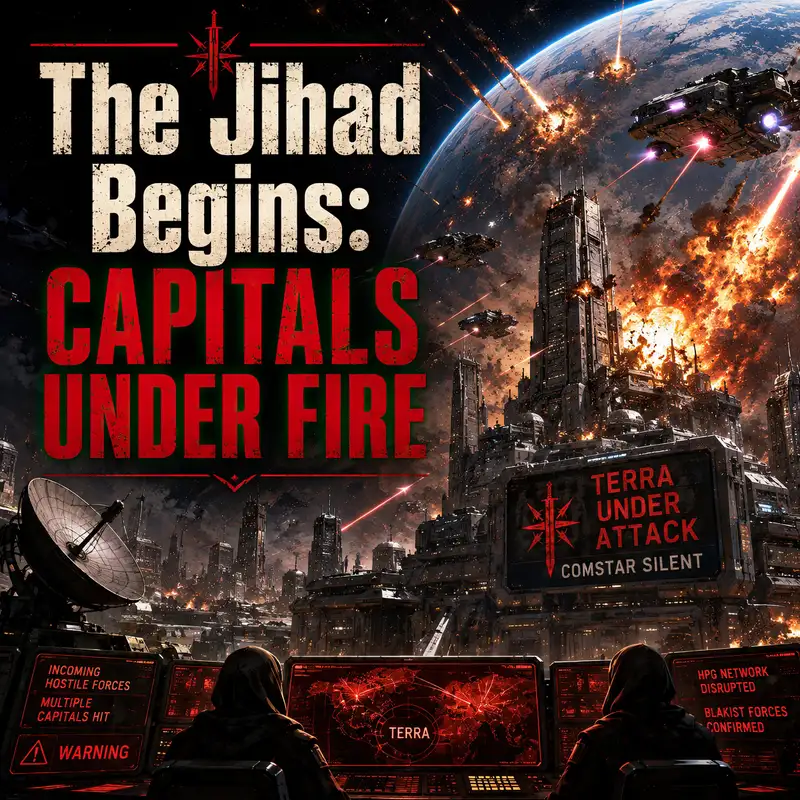
The Jihad Begins: Capitals Under Fire
The first shot at Tharkad was supposed to be a warning. It came from a WarShip the Lyrans had believed lost for more than two centuries, firing over the capital that bore its class name. The blast did not force Archon Peter Steiner-Davion to reverse his government’s decision. It damaged the city, helped trigger the destruction of an aging nuclear power system, and buried soldiers and civilians beneath the ruins. Within minutes, a demonstration of strength had become the opening image of the Jihad.
On December fifth, thirty sixty-seven, the Word of Blake struck Tharkad and New Avalon, the capitals of the Lyran Alliance and Federated Suns. The attacks followed the dissolution of the Second Star League, but they were not improvised by officers who had received bad news and found loaded weapons nearby. Fleets had been positioned, targets studied, ground forces prepared, and political demands written in advance. The Word intended to shock two major governments into restoring the League. Instead, it taught them that Blakist diplomacy now arrived behind capital-class guns.
Capitals were obvious targets because they concentrated authority, communications, military headquarters, industry, and symbolism. They were also dangerous targets for the same reason. A strike against a border world might be treated as a regional emergency. A strike against a capital becomes a test of whether the state still exists. Leaders who might negotiate over policy cannot easily negotiate over whether their own capital should remain under bombardment. The Word wanted fast political obedience. It selected targets almost guaranteed to produce national resistance.
Both worlds were unusually vulnerable. The Federated Commonwealth Civil War had ended only months earlier after savage campaigns on New Avalon and Tharkad. Veteran formations had been shattered, reorganized, or sent elsewhere. WarShip fleets had suffered losses. Cities and transport networks were still being repaired. The Blakists looked at this exhaustion and saw an opportunity. Exhausted states, however, are not always compliant states.
The opening operation carried another revealing contradiction. Some of the Blakist ships had originally been placed to support the political future the Word expected. Once admitted to the Star League, the Word could reveal hidden naval assets as guardians of the member states. At Tharkad, it intended to return the recovered Lyran battlecruiser Invincible as a magnificent gift. Near New Avalon, three Blakist WarShips waited to announce themselves as new defenders of the Federated Suns capital. When the League collapsed, the gifts remained in position. Only the instructions changed.
That prepositioning created operational surprise. A WarShip crossing interstellar space is difficult to hide once an enemy knows where to look, but a vessel already inside the system can move before distant reinforcements are summoned. Conference traffic gave additional cover around Tharkad. Naval sensors and civilian observers detected objects that did not fit the expected pattern, yet the reports produced no effective response. Intelligence had found pieces of the threat without assembling them into a reason to act.
The Invincible was chosen with deliberate care. It was the last known survivor of the Tharkad class, a massive Lyran battlecruiser that had disappeared during the Second Succession War. The Word recovered and restored it in secret. Returning the vessel would have displayed technical skill, generosity, and respect for Lyran history. Turning its guns on Tharkad displayed something else. The weapon meant to prove the Word belonged inside the new Star League became the instrument used to punish a government for allowing that League to die.
Peter Steiner-Davion refused to yield to the implied threat. The Invincible fired what the Blakists treated as a warning shot against Tharkad City. Capital weapons are poorly suited to rhetorical subtlety. The bombardment devastated part of the city and contributed to a catastrophic failure beneath the Triad, the center of Lyran government. Structural damage sent snow and ice into an old liquid-sodium cooling system. The resulting reactor disaster was initially reported as a nuclear attack, an understandable conclusion for anyone watching a capital disappear behind fire and debris.
The distinction mattered historically, but not much to the people trapped nearby. The Word had not detonated a nuclear warhead in that first strike. It had fired a capital weapon close enough to a vulnerable reactor complex to produce a disaster with many of the same immediate consequences. Radiation, fire, collapsed infrastructure, severed communications, and panic did not wait for investigators to decide which technical description was most accurate. A warning is normally intended to clarify choices. This one destroyed the environment in which orderly choices could be made.
The bombardment also tore into military formations already damaged by civil war. The core of the Eleventh Arcturan Guards was caught in the destruction. Survivors were buried or scattered, leaving the fragmented Twenty-fourth Lyran Guards as the most important organized force immediately available around the city. The Blakists followed orbital fire with ground action. Their hidden Thirty-seventh Division, the Purity of Truth, moved to secure Tharkad City and its spaceport while wearing colors associated with the recently dissolved Star League Defense Force.
That appearance was part propaganda and part operational camouflage. The Word wanted to present its soldiers as agents restoring lawful interstellar order rather than foreign occupiers. The Thirty-seventh was also a veteran formation trained for harsh conditions and counterinsurgency. It defeated the Twenty-fourth around the spaceport and drove much of the surviving resistance underground. On a briefing map, the capital had been secured. On the ground, armed Lyrans had simply stopped forming convenient lines for orbital observers to count.
Peter survived and refused to dissolve the Royal Guards as a military identity, even when the surviving Guards no longer functioned as complete regiments. Personnel from the Twenty-fourth and other shattered commands fought in small formations, protected the Archon, and maintained the idea that lawful Lyran authority still existed. That decision had practical and symbolic value. An occupation can capture ministries and broadcast towers. It has more difficulty proving that a government has vanished while the recognized ruler remains alive and armed somewhere beyond the next snow-covered ridge.
Tharkad’s climate favored those who knew it. Deep cold punished exposed infantry, drained power systems, and complicated maintenance. Resistance fighters used industrial ruins, mountain routes, civilian shelter, and local knowledge to survive beneath Blakist aerospace and orbital superiority. The same weather forced the occupiers to protect depots, heated facilities, transport corridors, and repair sites. The Word captured the capital quickly. It then inherited the less elegant problem of operating it.
The Blakists responded to resistance with increasingly severe counterinsurgency. Civilian centers and industrial sites were threatened or destroyed as examples. The policy could suppress movement in one district while creating recruits in another. It also undermined the original political demand. The Word had claimed it was restoring order after irresponsible rulers dissolved the Star League. Each bombardment made the occupation look less like restoration and more like collective punishment. The Invincible could dominate the sky, but it could not make the people beneath it consider the government legitimate.
New Avalon faced a different opening battle. Three Blakist WarShips had waited in the outer system: the heavy cruiser Herald of Justice, the frigate Red Angel, and the destroyer Divine Forgiveness. Their original mission was to appear as guardians after the Word entered the Star League. Once the Federated Suns withdrew, they were ordered to discipline the realm instead. The names remained reassuring. Naval fire-control solutions are less influenced by naming conventions than public-relations departments generally hope.
Two Fox-class corvettes, the Antrim and Bryceland, moved to intercept. They were outmatched by the Blakist flotilla and had little prospect of defeating it through a conventional exchange. Their crews chose collision attacks. The two ships crippled and destroyed the Herald of Justice through suicidal ramming, sacrificing themselves to remove the largest attacker. It was a tactical success purchased at the cost of both defending ships and most of the people aboard them.
The sacrifice did not stop the attack. The Red Angel and Divine Forgiveness retained enough power to bombard Avalon City, suppress aerospace defenses, and cover the descent of nearly a division of ground troops. This demonstrated the difference between defeating part of a fleet and controlling the orbital environment. The defenders destroyed the Blakist flagship. The Blakists still possessed the position from which they could decide when large formations moved through the atmosphere and which ground concentrations received fire from above.
The Thirty-first Word of Blake Militia Division landed on Albion and advanced through the farmlands toward Avalon City. The Purity of Faith was freshly equipped but inexperienced compared with many of the soldiers defending the capital. Its mission required speed. The division had to exploit the shock of bombardment, seize government and military sites, and present the Federated Suns with a completed occupation before reinforcements could arrive. A capital assault rewards momentum. It also punishes every delay because the defender is fighting beside its own headquarters, depots, and surviving population.
New Avalon’s defenders were formidable on paper and badly damaged in reality. The First Davion Guards remained the core of the defense. The Fifth Donegal Guards and Tenth Lyran Guards had survived the civil war but were severely understrength. The Second New Avalon Institute of Science Cadet Cadre and the New Avalon Cavaliers added personnel and advanced equipment around the institute. Many of these troops had fought one another or served opposing political loyalties only months earlier. They now faced an enemy that made their previous dispute seem unexpectedly manageable.
Orbital bombardment struck the institute area and shattered the Cavaliers and cadets before they could contribute as intact formations. The New Avalon Cavaliers had grown from survivors associated with Team Banzai and drew every member from the institute community. Their equipment and technical knowledge made them dangerous. It also concentrated them around a target the Blakists had every reason to attack. The same institution that supplied the unit’s strength fixed its location for enemy planners.
The survivors were absorbed into larger formations, but the loss shows why capital defense cannot be measured only by BattleMech numbers. New Avalon contained academies, laboratories, factories, and specialists accumulated over generations. Orbital fire could destroy pilots and machines while also killing instructors, engineers, medical teams, and the people responsible for rebuilding what remained. The attack was consuming both present and future combat power.
On December eleventh, the understrength Tenth Lyran Guards met the Thirty-first at McCarel Farm. The Tenth had only a fraction of its former strength, but its veterans understood that the Blakist advance depended on supply. They punched through a screening force and attacked three large land trains carrying matériel for the drive on Avalon City. The Thirty-first had numbers and support from Grandin’s Crusaders, a mercenary command hired locally for the fight. Concealed infantry helped break part of the Lyran attack, and the Tenth was forced back after inflicting damage.
The battle was not a clean victory for either side. The Tenth suffered losses it could not replace, yet its attack delayed the Thirty-first long enough for Marshal of the Armies Jackson Davion to organize Avalon City’s defense. The Blakists retained their advance but lost the schedule on which the operation depended. Supply columns rarely receive ceremonial portraits, though campaigns become remarkably interested in them when ammunition, food, coolant, and medical stores stop moving. Farmer McCarel received a less abstract lesson when the fighting destroyed about half his crops.
The delay allowed the First Davion Guards and other survivors to establish a coherent defense. The Thirty-first entered weeks of combat against veterans who knew the ground, possessed local support, and understood that no evacuation would preserve the political meaning of the capital. The Blakist division was well equipped but had not been prepared for a prolonged contest against soldiers hardened by the civil war. By the end of December, the defenders had forced it off the planet.
That result looked like a Federated Suns victory, and at the tactical level it was. The capital had not fallen. The attacking division had been ejected. The government and defenders continued to function. The operational situation was less encouraging. The Blakist WarShips remained in the system, maintained aerospace superiority, and imposed a blockade. Reinforcements could not simply land at the nearest spaceport. Every DropShip approach became a naval problem, and every concentration of defenders risked observation from orbit.
New Avalon therefore entered a peculiar siege. The Federated Suns controlled the surface while the Word controlled much of the space above it. Neither condition was sufficient by itself. Ground troops could prevent occupation but could not remove the blockade. WarShips could destroy installations and intercept transports but could not search every city, mountain, and tunnel. The opening attack failed to secure the planet and succeeded in preventing the defenders from returning to normal operations. That was not the quick political result the Word had demanded, but it was enough to keep the capital bleeding.
The contrast with Tharkad is instructive. There, the reactor disaster, shattered garrison, and seizure of the spaceport allowed the Thirty-seventh to establish an occupation that immediately faced resistance. On New Avalon, the defenders destroyed the first ground assault but remained trapped beneath hostile naval power. One capital was occupied without being pacified. The other was defended without being relieved. Both attacks produced campaigns measured in years rather than surrender within days.
Orbital fire made the opening possible, but it could not solve the political problem. WarShips could eliminate fixed defenses, devastate headquarters, and make large troop movements prohibitively dangerous. They could not identify every loyal official, repair local utilities, distribute food, or distinguish an unarmed civilian from a resistance courier. Every capital weapon used near a city also increased the cost of reconstruction for whichever side eventually claimed victory. The Word possessed extraordinary means of coercion and no reliable method for converting destruction into consent.
Communications failures magnified the shock. Hyperpulse traffic was disrupted, reports arrived late or contradicted one another, and rumors of nuclear attacks spread faster than verified assessments. Commanders elsewhere could not immediately determine whether the strikes were isolated punishments, the beginning of a general offensive, or part of a larger internal collapse. The Word understood the network better than any opponent and benefited from the uncertainty. It could move local forces while distant governments were still trying to establish which capitals remained capable of answering.
Luthien showed that the opening crisis was not limited to direct Blakist bombardment. Its hyperpulse generator stopped transmitting on December nineteenth. Two days later, the Black Dragon Society launched a coup using traitorous elements of the Second Sword of Light and allied forces. The conspirators captured the Voice of the Dragon compound, attacked loyal formations, and overran the Imperial Palace on New Year’s Day. The capital of the Draconis Combine fell into civil conflict before a conventional Blakist occupation force had secured it.
The loyal Otomo, Izanagi Warriors, and other defenders fought troops wearing the uniforms of their own state. That made identification, communications security, and command authority as important as armor protection. Some members of the Second Sword remained loyal and resisted their own commander, while surviving defenders tried to preserve the ruling Kurita line and escape encirclement. The Black Dragons did not need to defeat the entire Draconis Combine. They needed to fracture the capital faster than distant loyal forces could understand what had happened.
Blakist naval and ground forces entered the struggle at the beginning of thirty sixty-eight, publicly presenting intervention as an effort to restore order and support lawful Kurita authority. The declaration satisfied almost no one. Loyalists distrusted the Word’s motives, and the Black Dragons had no intention of surrendering their gains. The result was a three-sided war in which each faction considered the other two illegitimate. Luthien did not fit a simple plan of Blakist invasion followed by occupation. It fit the wider Jihad much better: secrecy, factional manipulation, compromised communications, and several armies claiming to be the lawful solution.
The three capitals revealed three versions of the same strategic error. At Tharkad, the Word tried to compel a ruler by destroying the city around him. At New Avalon, it tried to seize a capital with one inexperienced division while relying on orbital power to compensate for insufficient troops. At Luthien, it entered an internal coup and assumed that superior force would allow it to define which side represented order. In each case, Blakist leaders mistook the ability to create a crisis for the ability to control its outcome.
For civilians, the distinctions among coercion, occupation, blockade, and coup were less useful. Utilities failed. Food distribution stopped. Hospitals received casualties faster than replacement supplies. Families tried to determine which roads were open and which uniforms could be trusted. Industrial workers became military assets because they could repair vehicles or restore power. Farmers became part of the logistical map because armies consumed food even when governments stopped functioning. A capital under fire remained a city full of people, not merely a symbol beneath a targeting reticle.
The opening attacks did achieve important military results. They isolated national leadership, destroyed experienced units, exposed hidden Blakist WarShips and divisions, and forced several states to divert resources toward their political centers. The Word demonstrated that it could operate across multiple theaters and strike targets thought secure from direct attack. It also revealed enough of its hidden strength to make every future Blakist promise less credible. Surprise is a resource that can be spent only once, and the Word spent much of it proving that no capital was protected by distance or diplomatic status.
Politically, the attacks were disastrous. Peter Steiner-Davion did not restore the Star League. The Federated Suns did not reverse its withdrawal. The Draconis Combine did not accept Blakist arbitration. Instead, the capitals became centers of national resistance and evidence for every government that the Word’s stated purpose could not be separated from its willingness to use orbital force. Even states with grievances against one another now had a reason to treat Blakist control of Terra and the communications network as a common strategic danger.
The Jihad began with capitals under fire because the Word believed political legitimacy could be produced through shock. Tharkad, New Avalon, and Luthien showed the opposite. A WarShip could break a reactor, a division could seize a spaceport, and conspirators could capture a palace. None of those actions made the attacked population accept the authority behind them. The first month gave the Word battlefields, blockades, and occupied ground. It also gave its enemies the one form of unity the dissolved Star League had failed to preserve: agreement on who had to be resisted.