The Mackie: The First BattleMech
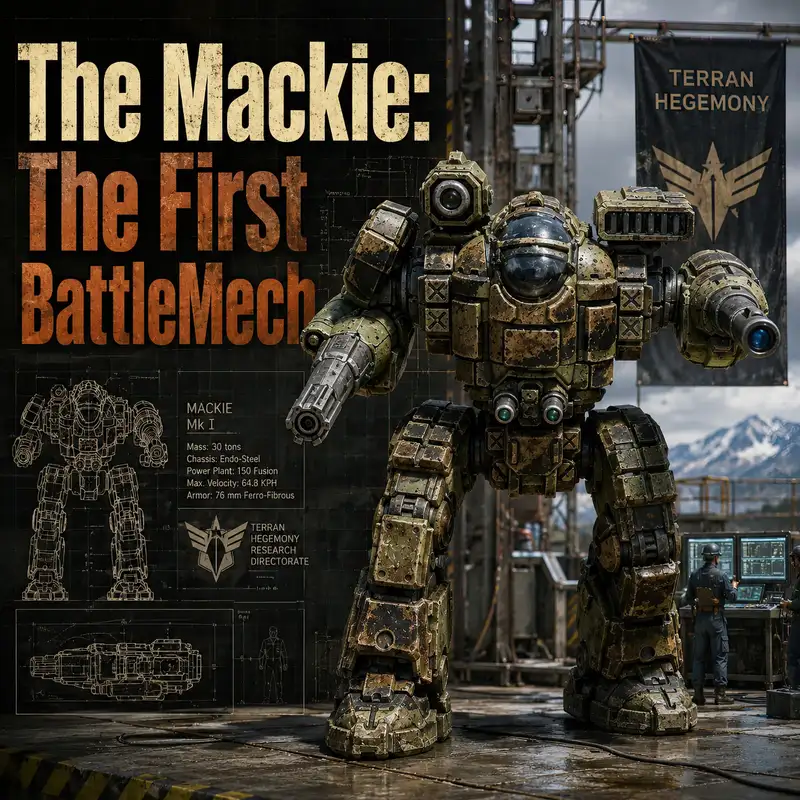
The four Merkava heavy tanks waiting at the Yakima Firing Center had no crews. Remote controls would drive them across the range, aim their weapons, and give the new machine a target that could shoot back without putting four tank crews inside the test. On the fifth of February, twenty-four thirty-nine, Colonel Charles Kincaid brought the prototype forward. It weighed one hundred tons, stood on two armored legs, and combined systems that had never before been trusted together in combat. When the firing stopped, all four tanks were wrecked and the prototype remained standing. The Terran Hegemony had not merely built a larger armored vehicle. It had demonstrated the first true BattleMech.
The machine was called the Mackie, and its importance can be misunderstood when viewed from later centuries. Beside an Atlas, a Marauder, or a Clan OmniMech, the first Mackie looks crude, oversized, and inefficient. That comparison is accurate and almost entirely beside the point. The Mackie was not designed to defeat machines that had not yet been invented. It was designed to prove that a single pilot could control an armored, fusion-powered, bipedal weapons platform across terrain that restricted conventional vehicles. Its achievement was not perfection. Its achievement was that the system worked at all.
The Mackie emerged during the Age of War, when the Terran Hegemony and the Great Houses were learning to mobilize entire interstellar states for repeated conflict. The Hegemony did not possess the largest population or the broadest territory. Its advantage was technology. Director-General Jacob Cameron understood that the realm needed a military edge strong enough to discourage larger neighbors and preserve Terran influence. Better tanks and WarShips mattered, but they offered improvements within familiar categories. The BattleMech project promised something more dangerous: a new category of ground weapon that competitors would initially have no direct answer for.
The project did not begin with a weapons designer sketching a giant soldier in armor. It began with industrial technology. In the year twenty-three fifty, Doctor Gregory Atlas and a classified Hegemony program called Operation Musclebound refined myomer, an artificial fiber that contracts when electrical current passes through it. Myomer allowed machines to move through jointed frames with strength and flexibility that ordinary motors and hydraulic systems could not easily match. Civilian WorkMechs followed, lifting cargo, working mines, and performing construction on worlds where skilled labor and heavy equipment were scarce. The military looked at those machines and reached the predictable conclusion that anything able to carry industrial tools could probably carry weapons.
Turning a WorkMech into a BattleMech required far more than attaching armor and a cannon. The frame had to absorb recoil, impacts, and the constant stress of walking under combat load. A fusion engine had to provide power without turning the machine into an unmanageable furnace. A gyroscope had to keep the chassis upright while the ground, weapons, and enemy all tried to move it in different directions. Sensors had to translate the battlefield into information one pilot could understand. Most difficult of all, the control system had to connect human balance and machine movement closely enough that the BattleMech would not fall every time the pilot changed direction.
The neurohelmet provided that connection. It read elements of the pilot’s brain activity and helped the machine interpret balance, posture, and intention while conventional controls handled movement and weapons. Later MechWarriors would regard the neurohelmet as standard equipment. Kincaid wore an experimental system whose risks were not fully understood. Later accounts indicate that the early helmet damaged his nervous system, producing deterioration that eventually ended his combat career. The first BattleMech therefore carried a human cost even before an enemy soldier faced one. The program had solved enough engineering problems to pass a test, but not every problem had been solved safely.
The prototype was designated the M S K five S. Its one hundred ton mass was partly a statement of confidence and partly an admission that early components were inefficient. The available technology demanded space, structural strength, and generous weight allowances. Designers also needed room for diagnostic equipment and systems that had not yet been miniaturized through generations of production. Building the first machine at the upper end of the later BattleMech weight scale gave the engineers margin. It also produced a vehicle that could survive mistakes. A lighter prototype might have been elegant. An armored laboratory the size of a small building was more likely to return useful data.
Its weapons reflected the Hegemony’s best available technology. A prototype particle projection cannon gave the Mackie a powerful energy weapon at useful battlefield range. An autocannon five provided a conventional gun whose ammunition imposed a supply burden but whose heat was easier to manage. A large laser covered closer engagements. Seventeen heat sinks attempted to control the waste heat from the engine and energy weapons. Twenty tons of primitive armor protected the chassis, although the early material provided less protection for its weight than later armor. Nothing about the package was subtle. The designers were trying to prove several revolutionary systems at once and had wisely chosen not to make compactness another requirement.
The Mackie could reach roughly fifty-four kilometers per hour. That was not exceptional beside many tanks, and it was slow by the standards of later light and medium BattleMechs. Speed alone, however, was not the breakthrough. The Mackie could step over obstacles, negotiate broken ground, and change its posture in ways a tracked vehicle could not. It could bring heavy weapons across terrain where roads, bridges, and prepared positions no longer determined every movement. The machine had no jump jets and was not suited to reconnaissance or rapid exploitation. Its role was closer to a mobile assault platform that could keep advancing after conventional heavy armor encountered ground it could not use.
That mobility did not eliminate logistics. A one hundred ton machine required specialized maintenance, trained technicians, recovery equipment, spare actuators, replacement myomer, armor, and ammunition for the autocannon. It had to reach another planet aboard interstellar transport, then descend in a DropShip able to carry it. A damaged leg could immobilize an investment larger than many conventional units. The Mackie concentrated combat power in one pilot, but it also concentrated cost and maintenance risk in one chassis. The BattleMech was never independent of the army supporting it. It merely made that support easier to forget while the machine was moving.
The Yakima trial was designed to answer whether the prototype could fight, not whether it could replace an army. The remote-controlled Merkava Mark Six tanks represented a familiar Hegemony heavy armored vehicle. They could maneuver and fire, but they had no crews making adaptive decisions and no infantry, artillery, engineers, or aerospace support around them. The Mackie’s victory was therefore not a neutral comparison between every possible tank force and every possible BattleMech force. It was a controlled demonstration. Even so, the result mattered. The machine walked under combat conditions, found targets, fired multiple weapon types, remained upright, and survived. Every later debate began after those facts had been established.
Kincaid’s performance helped turn the demonstration into a political event. He was already an experienced Hegemony officer with a strong record in armored warfare, which made him more than a technician operating unfamiliar equipment. He understood what the Merkavas could do and how their crews would normally fight. His selection was also aided by family influence and close connections to the Cameron establishment, a reminder that even the first MechWarrior program included politics alongside aptitude. Favoritism may have opened the cockpit. It did not make the machine balance, aim, or endure weapons fire. Kincaid still had to prove that a human being could control it.
Jacob Cameron responded by driving the Hegemony toward mass production. The effort strained the government’s budget and came close to exhausting the realm’s finances. Factories had to build frames, engines, armor, sensors, weapons, gyroscopes, and myomer to standards that had never existed before. Training programs had to create MechWarriors and technical crews. Doctrine had to be written for a weapon whose capabilities were still being discovered. This was the less glamorous revolution behind the Mackie. A successful prototype becomes a military system only when industry can produce it repeatedly and the armed forces can keep it operating away from the test range.
The production model, the M S K six S, altered the prototype’s weapons and protection. Its autocannon ten delivered a heavier conventional strike than the earlier gun. Two medium lasers replaced the single large laser for close fighting. The particle projection cannon remained the principal energy weapon. Improved armor gave the same broad mass of protection more useful battlefield resilience, while fifteen heat sinks handled the machine’s thermal load. The cockpit was still unusually heavy, and the overall design remained primitive. The production Mackie was not a refined second-generation BattleMech. It was the first prototype converted into something a regiment could actually issue.
Its weapons created practical choices for the pilot. The particle projection cannon could strike hard without consuming ammunition, but repeated fire generated substantial heat, especially with the early weapon. The autocannon offered a second heavy attack with a different logistical cost. It needed shells, but it allowed the pilot to maintain pressure while managing the heat produced by the energy weapons. The medium lasers became valuable when an enemy closed inside the comfortable range of the larger systems. A Mackie pilot could not simply fire everything continuously. The machine rewarded deliberate sequencing, range control, and an awareness that the cockpit would become steadily less hospitable as heat accumulated.
The design’s armor and mass made it a natural breakthrough weapon. It could approach fortified positions, absorb punishment, and return fire while lighter forces maneuvered around it. Its arms also gave it physical options unavailable to most armored vehicles. A BattleMech that reached a tank line could kick, strike, or simply use its mass to make the encounter extremely unfair. Yet the Mackie was too slow to chase fast raiders and too expensive to scatter across every defensive position. It worked best where commanders could identify a decisive point, support the machine properly, and force the enemy to confront it.
The Hegemony kept the new weapon secret while it expanded production and prepared units. The first true battlefield test came on Styx in June of twenty-four forty-three. A Draconis Combine raiding force approached the industrial city of Barbados with a company of heavy tanks and supporting infantry. The Hegemony’s Eight Hundred First Heavy Armored Regiment committed a lance of Mackies. Kincaid took part, while Lieutenant Colonel Amanda Cunningham led the main BattleMech action and later received the official credit he declined. The encounter moved the Mackie from proving ground success to combat history.
Terrain made the difference visible. The plains outside Barbados had become muddy, restricting the Combine’s tracked armor. The Mackies were not fast, but their legs allowed them to move with far less difficulty across the ground. They closed, concentrated fire, and broke the raiding force without losing a BattleMech. The result did not prove that four Mackies would defeat every armored company under every condition. It proved that the machine’s mobility was operationally real. The same terrain that protected the city by slowing the attackers gave the BattleMechs freedom to maneuver and choose their engagements.
Styx also exposed the strategic effect of surprise. The Combine raiders had planned for tanks, infantry, fortifications, and the ordinary problems of seizing industrial facilities. They had not planned for one hundred ton walking machines that could cross the mud and deliver heavy fire from several directions. Once word escaped, that advantage began to shrink. Every Great House now knew the Hegemony possessed a weapon that could overturn assumptions about ground warfare. Intelligence services did not need to be told what to do next. The question was no longer whether to acquire BattleMech technology, but how much money, espionage, and blood the answer would require.
For sixteen years after Yakima, the Hegemony guarded the essential knowledge. Then, in February of twenty-four fifty-five, Lyran commandos struck the Hegemony’s Mackie facility on Hesperus Two during Operation Prometheus. Colonel Simon Kelswa and twenty-five commandos fought their way into the plant and escaped with enough information to reproduce the technology. The raid mattered more than stealing one BattleMech. A captured machine could be examined, but the plans revealed manufacturing methods, tolerances, control systems, and the industrial sequence needed to build another. The Hegemony had lost the monopoly behind the Mackie.
The technology spread rapidly after that. The Federated Suns obtained BattleMech knowledge through negotiation and payment. The Draconis Combine took what it needed in another commando operation. The Free Worlds League gained expertise through a defecting specialist, and the Capellan Confederation acquired the technology in turn. Each state then developed machines suited to its own industry and military ideas. The Mackie had been intended to secure the Hegemony’s advantage. Instead, its existence began an arms race in which every major government concluded that the only acceptable answer to a BattleMech was another BattleMech.
That arms race quickly made the original design look old. Later BattleMechs were smaller, faster, more specialized, and built with components refined through experience. Some served as scouts. Others provided fire support, conducted raids, or carried assault firepower more efficiently than the Mackie. Conventional armor also adapted through heavier guns, improved mobility, anti-BattleMech tactics, and combined-arms doctrine. The Mackie did not make the tank obsolete. It forced the tank to operate in a battlefield where an enemy might step across ground that had once protected its flank.
The Hegemony continued improving its first machine rather than discard it. Late twenty-fifth-century versions replaced primitive systems with standard components and increased close-range firepower. The M S K seven A carried an autocannon twenty, retained the particle projection cannon, added another large laser, and used additional heat sinks and better armor. It was a brutal assault configuration, although firing its major energy weapons still demanded discipline. Later rebuild programs produced many local variations, which was possible because the Mackie’s oversized, rugged frame had room for modification.
The M S K nine H represented the mature Hegemony militia version. It carried two particle projection cannons, a heavy autocannon twenty, two medium lasers, improved ammunition protection, and an active probe useful for locating hidden threats. The configuration reflected a change in mission. The Mackie was no longer the Hegemony’s unmatched frontline wonder. It had become a durable militia and anti-insurgency platform whose crews could defend important worlds with a chassis technicians already understood. This was not glamorous employment, but military organizations often value a familiar machine that starts reliably over a superior machine they cannot obtain in sufficient numbers.
Production continued until the Amaris Civil War, more than three centuries after the first trial. That longevity came partly from symbolism and partly from utility. The Mackie represented the Cameron state’s greatest technological achievement, but it also remained rugged, maintainable, and heavily armed when properly upgraded. Forces loyal to Stefan Amaris encountered old Mackies in stubborn Hegemony defenses, and the ancient machines suffered heavily. When Aleksandr Kerensky led the Star League Defense Force into exile, available accounts suggest that roughly one hundred Mackies accompanied the fleet. The first BattleMech had survived long enough to leave the Inner Sphere with the army built around its descendants.
A few examples endured even deeper into history. In the early thirty-first century, Black Widow Company forces encountered two degraded prototype-pattern Mackies whose aging myomer limited their movement. The First Fusiliers of Oriente retained another until it entered a museum in thirty forty-two. During the defense of Robinson in thirty sixty-two, the local battle academy committed every serviceable machine it could find, including a Mackie with only its particle projection cannon functioning. None of these survivors represented modern combat efficiency. They represented the extraordinary persistence of a machine built with enough structure, space, and repair tolerance to remain salvageable for centuries.
The Jihad produced an even stranger return. Desperate governments revived primitive BattleMech construction under the label RetroTech because simplified designs could be manufactured where advanced production had been damaged or lost. New Mackies appeared for a time from emergency facilities. Centuries of progress had not made the original concept competitive with advanced machines, but catastrophe had changed the standard. A crude BattleMech available now could be more useful than an elegant design whose factory no longer existed. Later, Defiance Industries hand-built several Mackies to mark the seven hundredth anniversary of the first trial, turning an emergency weapon into a deliberate act of historical memory.
The Mackie’s reputation should therefore be judged against the problem it was built to solve. It was not fast, compact, or economical. Its early systems were hazardous, its weapons produced difficult heat loads, and its mass imposed severe transport and maintenance demands. A modern commander choosing among mature designs would rarely select the original Mackie on efficiency alone. The engineers of twenty-four thirty-nine did not have that choice. They needed to prove that myomer, fusion power, armor, weapons, gyroscopic balance, sensors, and a human pilot could function as one combat system. The Mackie proved it under fire.
Its deeper revolution was organizational. One MechWarrior could direct firepower and protection that previously required several vehicles and crews, but that pilot depended on an entire industrial and logistical institution. The machine increased the battlefield influence of the individual while making the state behind that individual more important than ever. It also helped create a new military elite. MechWarriors became associated with expensive machines, specialized training, personal reputation, and eventually dynastic service. The armored knight of interstellar warfare began with a cockpit crowded by experimental equipment and a pilot whose neurohelmet was quietly injuring him.
The first BattleMech did not end conventional warfare. It did not make infantry irrelevant, remove the need for aerospace control, or solve the problem of moving armies between planets. It changed the relationship among terrain, firepower, manpower, and political power. At Yakima, the Mackie destroyed four tanks. At Styx, it proved that the result could be repeated against a real enemy. At Hesperus Two, its stolen plans ensured that every Great House would build an answer. The machine’s greatest victory was therefore also the end of its uniqueness. The Mackie succeeded so completely as a proof of concept that the Human Sphere spent the next seven centuries trying to build something better.