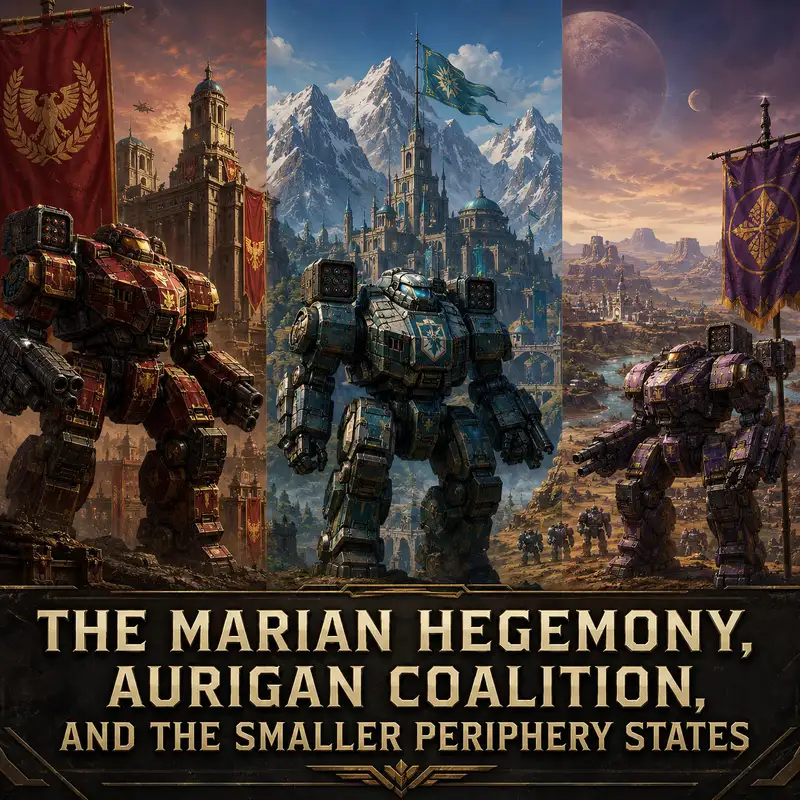
The Marian Hegemony, Aurigan Coalition, and the Smaller Periphery States
A government can claim twenty-two star systems and still depend on a handful of JumpShips owned by one transport cartel. That was the practical weakness at the heart of the Aurigan Coalition. Orders, tax revenue, replacement parts, mercenary pay, and food shipments all moved through the same scarce interstellar network. If those ships stopped, the capital could issue decrees for months without changing events on the frontier. The Coalition had a ruler, a council, noble houses, and soldiers. What it lacked was enough strategic depth to survive a prolonged civil war.
That problem defines the smaller states of the Periphery. Declaring independence is the easy part. Remaining independent requires transport, revenue, trained administrators, reliable troops, political legitimacy, and neighbors willing to accept the new flag. A small state may possess excellent MechWarriors and still fail because it cannot move them. It may win a campaign and collapse under occupation costs. It may survive a major war simply because no one considers it worth invading. Size matters, but organization, geography, restraint, and luck often matter more.
The Periphery is therefore not a single frontier culture. It contains constitutional republics, dynastic monarchies, trade federations, military protectorates, religious communities, pirate realms, isolated research colonies, and settlements that barely appear on contemporary maps. Some are poor. Some possess valuable mines or advanced repair facilities. Some are older than several Inner Sphere institutions. Others exist only because a distant government stopped answering messages. The Marian Hegemony and Aurigan Coalition show two very different ways a small realm can attempt to become a state.
The Marian Hegemony began in the year twenty-nine twenty with a mineral discovery rather than a revolution. Johann Sebastian O'Reilly went to Alphard searching for lost Star League technology and found an immense deposit of germanium. Germanium was essential to the interstellar economy because JumpShip cores and other advanced systems depended on it. O'Reilly used the fortune to hire mercenaries, establish a colony, and protect the location of the deposit. A prospector had acquired the financial basis for sovereignty. The next step was persuading everyone else that his private holding was a country.
O'Reilly drew on his fascination with ancient Rome. He styled himself Imperator, divided society into patricians, plebs, and slaves, and created institutions with Latin names. The Roman imagery gave refugees and hired soldiers a shared identity that did not depend on a common homeworld. It also justified a rigid hierarchy with O'Reilly at the top. For nearly a century, the Hegemony remained closer to a well-financed bandit kingdom than a respected power. It survived because Alphard was valuable enough to support armed protection, yet distant enough that larger states had more urgent concerns.
Marius O'Reilly began turning that armed holding into a durable realm. During the Fourth Succession War and the Andurien conflict, nearby powers were distracted and trade routes became vulnerable. Marian privateers and raiders profited. Marius spent part of that wealth on public education, light industry, military benefits, and the Collegium Bellorum Imperium, a war college opened in the year thirty thirty-two. The method was morally compromised but strategically coherent. Plunder funded institutions, and those institutions reduced the need for plunder. The Hegemony was slowly converting predation into taxation, training, and production.
The Roman model was never harmless pageantry. Patricians possessed the strongest political rights and dominated the officer corps. Plebs were citizens but occupied a lower social position. Slaves were legally treated as property. Class generally passed from parent to child, although military success, wealth, or patronage could permit movement. Male citizens owed years of compulsory service. Private schools for patricians could rival the best in the Periphery, while public education for plebs depended heavily on the priorities of the current ruler. The Hegemony built cohesion by assigning every person a place, including people denied the right to choose one.
Sean O'Reilly intensified those divisions after taking power in the year thirty forty-eight. He abandoned the title Imperator and proclaimed himself Caesar, turning the state's official inspiration from the Roman Republic toward the Roman Empire. He expanded conscription, strengthened the armed forces, suppressed opponents, and built a personal power base inside the legions. Expansion became a source of land, status, and military employment. It also gave the regime a way to direct domestic frustration outward. A ruler who promises glory can postpone arguments about rights, at least until casualty lists return home.
The first major target was the seven-world Lothian League. Marian privateers and auxiliaries weakened its hired defenders before the main invasion in the year thirty fifty-four. The League fell, but occupation proved harder than conquest. Lothian resistance forced the Second Legion into a grinding counterinsurgency. Replacements arrived while civilian casualties and punitive operations fed the rebellion. The Hegemony had captured planets without securing consent. That is a familiar operational problem, though the Latin terminology made the paperwork more decorative.
Sean sent his son Julius to command the troubled occupation. Julius rejected the endless cycle of reprisals and negotiated with resistance leader Elena Logan. The agreement reduced violence and gave Lothian interests a place in the new order. Julius then led Marian forces against the Illyrian Palatinate, defeating one mercenary command and buying off another. He returned to Alphard in the year thirty sixty-three as a successful general, overthrew his father, and took the title of Caesar. His political legitimacy came from the army, conquest, and his ability to end a war his father had prolonged.
Julius introduced reforms without abandoning expansion. He created the Plebian Tribunate, gave field commanders greater discretion, improved representation for conquered populations, and restored the title Imperator as the professional head of the armed forces. These changes made the Hegemony more governable and reduced some abuses. They did not make it egalitarian. The Caesar remained dominant, the Senate favored patricians and senior officers, slavery continued, and conquered worlds remained under Marian power. Julius understood that repression alone was inefficient. His alternative was a more competent imperial system, not the end of empire.
The Marian military reflected that mixture of professionalism and theater. Its legions were divided into cohorts, maniples, and five-machine centuries rather than the four-machine lances common in the Inner Sphere. Light centuries scouted and screened. Medium formations maneuvered around the enemy. Heavy elements delivered the decisive blow. The structure gave Marian troops a common doctrine and identity, while the war college produced officers capable of more than parade-ground imitation. The legions could combine BattleMechs, vehicles, infantry, battle armor, and limited aerospace support. Their persistent weakness was not courage. It was the ability to move and sustain forces across interstellar distances.
The Hegemony developed strong mining, refining, petrochemical, salvage, and repair industries. Marian technicians became respected for returning damaged machines and spacecraft to service. Local firms eventually produced combat vehicles, weapons, and BattleMechs. Yet the realm could not simply manufacture every JumpShip or DropShip it needed. That limitation placed a hard ceiling on expansion. A Caesar could raise another cohort more easily than he could create the transport fleet required to supply it. The difference between a regional army and an interstellar power is often found in a shipyard rather than a BattleMech factory.
Marian ambition repeatedly tested that ceiling. The Hegemony fought the Circinus Federation, occupied neighboring territory, survived the Word of Blake Jihad, and rebuilt its military industry after severe losses. It also learned that conquered populations could remain hostile for generations. The Lothian League eventually regained a form of independence. Other provinces required garrisons that consumed troops and supplies. Each victory increased the frontier that had to be defended. The Roman model encouraged rulers to treat expansion as proof of legitimacy, while logistics continued submitting objections in a less ceremonial language.
That pattern reappeared in the middle of the thirty-second century. Marian forces seized worlds from the fragmented Free Worlds League and raided Canopian territory. Early success encouraged wider operations. Counterattacks then cut off forward units, destroyed isolated formations, and pushed the Hegemony out of several gains. The legions fought hard, but courage could not shorten the supply routes or make local populations cooperative. The Hegemony remained a serious regional state. It was also a reminder that a small power can become strong enough to start wars beyond its ability to finish.
The Aurigan Coalition developed from a nearly opposite tradition. Its founders did not possess one great mineral fortune or one dominant army. In the year twenty-eight seventy, seven noble houses formed the Aurigan Trade Partnership to improve commerce and mutual defense across the Reach. The arrangement depended on the JumpShips of the Gwendor-Dorwinion Cartel. Those vessels connected agricultural worlds, industrial centers, and noble domains that could not support regular interstellar traffic alone. The partnership existed because cooperation made trade possible. It remained fragile because the same transport shortage made central government difficult.
In the year twenty-nine ten, Keona Arano transformed the partnership into the Aurigan Coalition. The new state eventually claimed twenty-two systems and was ruled by a High Lord or High Lady working with the Founding Council. The Coalition blended hereditary authority with negotiated power among the major houses. Its culture drew on Polynesian traditions, Spanish Catholicism, Pakistani Islam, and the mixed history of Taurian and Capellan settlement. Agriculture provided self-sufficiency, while Mechdur supplied much of the region's manufactured goods. The state was real, but most great powers considered it too small to recognize. Only the Magistracy of Canopus treated it as a sovereign nation.
The Coalition's constitutional balance worked while the houses believed compromise served them. It failed when border tensions with the Taurian Concordat demanded a unified policy. Aurigan leaders negotiated over worlds the Taurians had abandoned but still claimed. The Founding Council blocked some efforts at settlement, while Santiago Espinosa argued that the High Lord needed direct control over the member systems. The dispute was not simply democracy against dictatorship. It concerned whether a loose coalition could act quickly enough to survive beside a much larger neighbor.
High Lord Tamati Arano the Second and his wife died in a JumpShip accident in the year thirty twenty-two. Their daughter Kamea inherited the throne and rejected Espinosa's proposal for centralized rule. Espinosa responded with a coup. The Directorate dissolved the elected portion of the council, intimidated the remaining houses, took hostages, and nationalized the formerly feudal military. Kamea was believed dead. The new regime solved the problem of divided command by eliminating most limits on command, which is an efficient solution until the population begins shooting at the efficiency.
Kamea survived and built the Arano Restoration with covert Canopian support, loyal house formations, and mercenaries. The Directorate received Taurian assistance, including experienced pilots and heavy BattleMechs. The civil war from the year thirty twenty-two to thirty twenty-five was therefore local in scale but international in support. Battles over spaceports, food supplies, fortifications, and industrial worlds mattered as much as duels between famous machines. Mercenaries gave Kamea a mobile and experienced striking force, but every advance still depended on transport, repair, political alliances, and the willingness of liberated houses to follow her.
The Restoration defeated the Directorate and returned Kamea to Coromodir. Victory did not restore the old Coalition. Two founding houses had been effectively destroyed, several worlds were devastated, the military required rebuilding, and armed Directorate loyalists remained active. Kamea retained much of the centralized structure created by her enemies, including a unified military and extraordinary executive power. The choice was understandable. A ruler emerging from civil war rarely rushes to surrender the tools that won it. It also meant the restored government resembled the Directorate more than its supporters wished to admit.
By the beginning of the Fourth Succession War in the year thirty twenty-eight, outside powers no longer treated the Aurigan Coalition as an important functioning state. Many Reach worlds faded from interstellar maps, and the precise fate of the government remains unclear. Later reports of vessels carrying Arano markings suggest that some political or dynastic continuity may have survived. They do not establish that the old twenty-two-system coalition recovered. Kamea won her throne, but the war had consumed the transport, trust, institutions, and economic connections that made the throne worth holding.
The Aurigan story also requires a continuity distinction. The Coalition was created for the Harebrained Schemes BattleTech computer game. A later official sourcebook brought House Arano, the Reach, and the broad events of the Restoration into core continuity. The game itself remains an apocryphal source, so every mission, battlefield detail, and player-specific event is not automatically canonical. The distinction does not diminish the setting. It clarifies which version is being discussed and prevents a successful campaign mechanic from becoming an unquestioned historical fact.
The Marian Hegemony and Aurigan Coalition represent opposite dangers. The Marians built a centralized state capable of mobilizing resources, then repeatedly overextended that machinery through conquest. The Aurigans created a cooperative state that protected local power, then failed to act coherently when crisis demanded unity. Neither model was doomed from the beginning. Both became vulnerable when political structure and military requirements stopped matching. Smaller Periphery states survive when they understand the difference between the government they admire and the government their geography can support.
The Fronc Reaches offers one more balanced example. Its worlds began as the New Colony Region, jointly settled by the Magistracy of Canopus and Taurian Concordat. The Colonial Marshals served as both law enforcement and defense, resolving disputes among settlers who did not always share customs or loyalties. After neglect and political tension with the parent states, the region declared independence in the year thirty sixty-six. The Marshals gave the new government an institution already trusted across several worlds. Fronc later expanded trade, trained foreign officers, attracted refugees, and developed local BattleMech production. Independence succeeded because administration and security existed before the declaration.
The Rim Collection followed a different path. Six former Rim Worlds Republic planets created a representative democracy in the year thirty forty-eight after generations of poverty and pirate attacks. The mercenary command Able's Aces offered immediate defense and trained local militias. Instead of remaining a temporary hired shield, the Aces became integrated into the Collection's institutions. Trade, agriculture, repair work, and later germanium revenue supported gradual growth. The Collection survived the Jihad partly because it was too small to attract major enemies and partly because its leaders refused Word of Blake entanglements. In the year thirty-one forty-eight, it joined neighboring worlds to form the larger Timbuktu Collective.
The Filtvelt Coalition emerged because the Federated Suns could no longer protect its distant border during the Jihad. Worlds facing Taurian attacks and pirate raids seceded in the year thirty seventy-two, formed a citizen militia, introduced a draft, and retained whatever military experience remained locally. The new state suffered defeats and lost territory, but it cooperated with neighbors on intelligence and anti-pirate operations. Its survival did not prove that secession was painless. It proved that a neglected population may prefer an imperfect local government that answers the alarm to a prestigious distant government that sends condolences.
The Calderon Protectorate was born from a related crisis of legitimacy. Taurian colonists and soldiers broke with Protector Grover Shraplen in the year thirty sixty-six, rallying around the Calderon line and the belief that the Concordat had abandoned its own constitutional principles. The Protectorate built a regency, preserved local rights, and resisted pressure to join atrocities committed during the wider Taurian war. It later helped broker peace and acquired a damaged WarShip renamed the Redemption for anti-piracy patrols. The vessel gave the small state unusual influence, but its greater strength came from presenting itself as the Taurian government its citizens believed should have existed.
Not every organized Periphery realm becomes a legitimate state. The Circinus Federation combined settled worlds, political offices, military formations, and piracy. Its rulers depended heavily on the Black Warriors and other armed groups whose income came from raiding. Cooperation with the Word of Blake brought weapons and temporary protection, but also tied the Federation to a catastrophic war. Circinus was destroyed in the final violence of the Jihad. The difference between a state and a bandit kingdom is not ceremonial rank. It is whether institutions can provide security and lawful exchange without requiring a continuous supply of victims.
The smaller states also reveal how easily survival can be mistaken for weakness. The Lothian League and Illyrian Palatinate relied heavily on mercenaries and were conquered by Marian legions, yet resistance continued long after formal defeat. The Mica Majority, Niops Association, isolated colonies, and independent worlds followed other strategies, including obscurity, specialization, and limited contact. Some communities survived because they possessed nothing worth the cost of invasion. Others survived because attacking them threatened trade routes or provoked stronger patrons. A map label can conceal a sophisticated calculation about how not to become someone else's campaign objective.
Across these realms, military power begins below the level of the BattleMech regiment. It begins with a functioning customs office, a reliable recharge station, trained technicians, local courts, a militia roster, and a government able to pay transport crews. BattleMechs matter because pirates and neighbors understand force. They cannot replace the network that tells the machines where to deploy and keeps them operational after arrival. The most durable smaller states linked their armed forces to institutions the population already used. The least durable treated armed force as a substitute for those institutions.
The Marian Hegemony proved that a small Periphery realm could build industry, professional legions, and a powerful identity from a prospector's fortune. It also showed how hierarchy and conquest could turn strength into permanent resistance. The Aurigan Coalition proved that trade and shared defense could unite scattered worlds, but that noble compromise could fail under pressure and civil war could destroy what restoration recovered. Fronc, Filtvelt, Calderon, and the Rim Collection survived by matching ambition to resources more carefully, though none escaped crisis or contradiction.
On the Periphery frontier, sovereignty is not the flag above a palace or the title printed beside a ruler's name. It is the next food convoy arriving on schedule, the militia answering an alarm, the technician finding a replacement actuator, the court settling a dispute, and the population deciding that this government is still worth defending. Small states disappear when those connections fail. They endure when ordinary institutions make independence more useful than the alternatives.