The Outer Reaches Rebellion and the Collapse of the Alliance
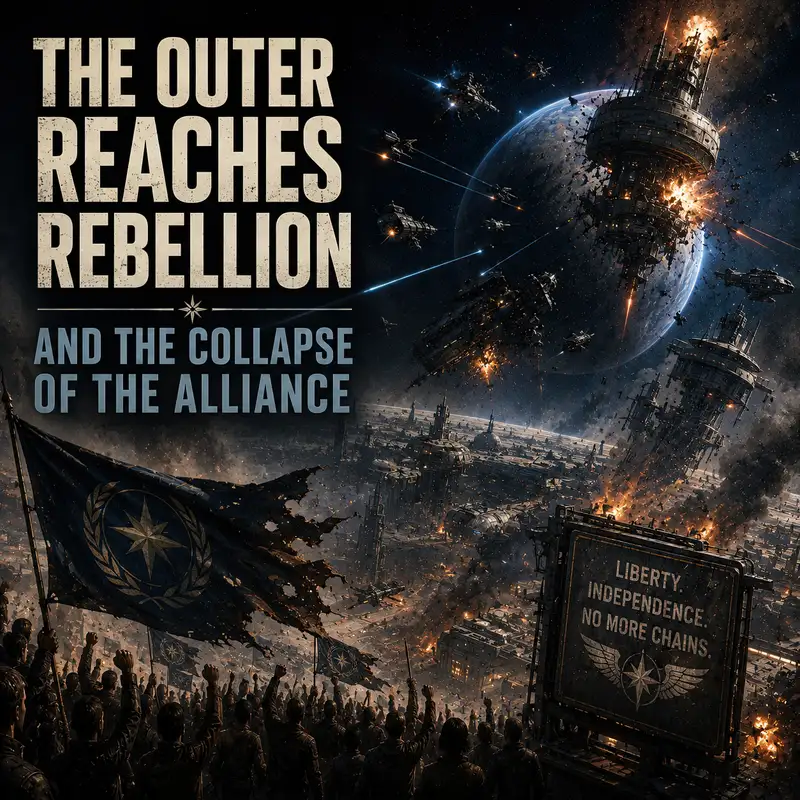
On the world of Freedom, the Terran Alliance government found a new way to tax marriage. Colonial Governor Ardath Rathill required residents to pay a mandatory dowry into his office before he would issue a legal marriage permit. It was not the largest burden imposed on the colony, nor the first abuse attributed to its administration. It was simply the demand that made obedience more humiliating than resistance. Early in the year twenty-two thirty-six, Freedom declared independence. A dispute that could have been treated as evidence of corrupt government was instead treated as a test of whether Terra still ruled the stars.
The Outer Reaches Rebellion began with local anger, but it destroyed the political assumptions holding the Terran Alliance together. The Alliance believed that the technology used to reach hundreds of worlds also gave it the right and ability to govern them. The colonists had learned a different lesson from interstellar expansion. They had survived delayed shipments, slow communications, indifferent officials, and emergencies solved by local decisions. By the time Terra demanded unquestioned loyalty, many communities already possessed the habits of independence. The rebellion became the moment when administrative distance turned into political separation.
Only a year earlier, the Alliance had appeared to stand at the height of its power. The fourth Grand Survey recorded more than six hundred inhabited worlds spread across roughly one hundred twenty light-years. Fewer than three hundred sixty were under firm Alliance control, but the official map did not emphasize that distinction. Parliament saw a vast interstellar domain. Colonial officials saw jurisdictions to regulate and tax. Military planners saw routes that could be patrolled. The people living on those worlds saw a government whose authority arrived more reliably than its assistance.
The grievances varied from planet to planet. Taxes were central, especially when collections supported programs whose benefits remained concentrated near Terra. Alliance-appointed governors often held broad powers and answered to institutions many jumps away. Migration controls restricted who could leave Terra and where new settlements could be established. Commercial charters favored corporations and political interests with access to Parliament. Some colonies objected to corruption. Others objected to requisitions, legal interference, or the simple presumption that a distant capital understood local survival better than the people doing the surviving.
Freedom’s declaration was followed quickly by Denebola. By the time the Alliance organized a response, several additional worlds had joined the revolt and many others were sympathetic. This was not yet a coordinated revolutionary state. The rebel planets did not share a single constitution, army, or strategic plan. Their declarations combined principled demands with local complaints and, in some cases, language that officials on Terra found disorganized or inflammatory. That lack of unity encouraged Parliament to underestimate them. A fragmented opposition looked weak. It also gave the Alliance no single headquarters to capture and no single leader whose surrender could end the crisis.
The ruling Expansionist Party regarded secession as an existential threat. If Freedom could reject an Alliance governor, every colony might renegotiate its obligations at the point of a rifle. Parliament also had legitimate concerns about shipping security, private weapons, and the safety of loyal residents. An interstellar government could not ignore armed challenges to its law. The failure came in how quickly those concerns were translated into collective punishment. Armed vessels blockaded jump points. Troops searched communities, detained colonists, and confiscated weapons. Measures intended to isolate the rebellion instead supplied it with witnesses.
Before hyperpulse generators, news moved aboard ships. That delay might appear to favor the government, because Terra controlled major routes and possessed the larger navy. In practice, it made every action difficult to explain and every rumor difficult to contain. Smugglers and blockade-runners carried reports from system to system. Accounts of arrests, executions, and destroyed communities traveled beside exaggerations and false claims. By the time Parliament issued a denial, the original incident might be months old and several new worlds might already have acted on it. The Alliance had greater communications capacity, but the rebels needed only enough to spread outrage.
In twenty-two thirty-six, Major General Gunther Stein led the Second Interstellar Strategic Combined Assault Force toward Freedom, Ryde, and Sevren. The title suggested an organization designed for decisive interstellar operations. The mission required something more difficult. Stein’s troops had to enter hostile systems, secure jump points, protect transport, land on populated worlds, restore civil authority, and remain long enough for that authority to survive. The Alliance could win battles. It lacked the forces to occupy every rebellious planet while protecting the routes connecting them.
This war occurred two centuries before the first BattleMech. Alliance formations relied on infantry, armored vehicles, aircraft, combat spacecraft, and orbital support. Their machines were less recognizable than those of later centuries, but their operational problems were familiar. Every soldier required transport across multiple jumps. Every vehicle needed fuel, ammunition, and maintenance. Every garrison consumed supplies that might have to pass through sympathetic or openly hostile systems. A government that could move a force to one planet still had to decide what happened when the next five rebelled.
The jump points became natural ambush sites. Armed merchant ships and other improvised rebel craft harassed convoys as they emerged, maneuvered, or prepared to recharge. Local pilots knew the traffic patterns and could blend into commercial movement more easily than Alliance crews could identify hostile vessels. Even unsuccessful attacks forced escorts to slow operations and protect vulnerable transports. A damaged troop carrier or stranded supply ship could delay an entire planetary campaign. Interstellar movement had made rebellion possible, and the same network now punished the government trying to suppress it.
On the ground, Alliance troops faced guerrilla warfare supported by people who knew the cities, countryside, and local infrastructure. Rebels could disperse, hide weapons, attack isolated patrols, and reappear after regular units moved on. The Alliance response increasingly included curfews, searches, mass detention, and scorched-earth tactics. These measures sometimes reduced immediate military risk. They also made neutrality harder to maintain. A farmer whose stores were seized, a merchant whose ship was detained, or a family whose home was searched did not require a detailed theory of colonial sovereignty to decide which side had become the enemy.
Freedom became a symbol because the fighting there exposed the logic of escalation. Jefferson City endured a prolonged siege as the colonial government resisted Alliance forces. Reinforcements from the Twenty-third Alliance Strikers eventually broke the defense with orbital laser fire that destroyed much of the city. Elsewhere on Freedom, the Battle of Summit ended with the killing of more than ten thousand civilians by Alliance troops. The precise reports reaching other worlds varied, but the strategic effect did not. Terra claimed it was restoring lawful order while images and survivor accounts showed ruined communities.
The rebels committed violence of their own. Partisans attacked soldiers away from the front, civilian networks targeted collaborators, and irregular warfare offered few protections to people caught between authorities. Some resistance groups were disciplined. Others used revenge, intimidation, or criminal methods under the language of liberation. Recognizing those facts does not make the conflict morally equal. The Alliance possessed the greater power, claimed legal responsibility for the population, and repeatedly used that power in ways that expanded the revolt. A government may face unlawful resistance and still choose a disastrous response.
The Alliance’s early tactical successes therefore created strategic failure. Troops could seize a spaceport, clear a district, or defeat a poorly armed militia. Each victory required a garrison. Each garrison required shipping. Each occupation generated new intelligence problems and new targets for partisans. When units withdrew to meet another emergency, resistance returned. The campaign became a collection of temporary military successes that could not produce a durable political settlement. The offensive succeeded often enough to consume resources and failed often enough to consume legitimacy.
Colonial cooperation, which Alliance planning had assumed, began to disappear. Some worlds refused to provide troops or supplies. Others delayed shipments, misreported inventories, or allowed volunteers to join the rebels. Planets that had not declared independence still objected to supporting military operations against neighboring communities. Forced requisitions solved immediate shortages while creating additional enemies. The plan assumed secure routes, cooperative colonies, and reliable information. By the middle of the rebellion, those assumptions had achieved a notably efficient collapse.
David Ryan, who led the Ryan Iceship Cartel after his father Rudolph, gave the rebellion something more important than a single army. His commercial network moved weapons, officers, messages, and supplies among rebellious systems. The cartel already understood how to transport immense cargoes across interstellar distances and how to operate beyond the comfortable reach of Alliance supervision. That expertise became strategic power. The rebels did not need to match Terra ship for ship. They needed enough transport to connect local resistance movements faster than the Alliance could isolate them.
Ryan’s support also revealed how dependent the Alliance had become on private infrastructure. Governments could issue orders, but commercial captains knew the routes, schedules, maintenance requirements, and unofficial ports. Colonial economies relied on those same networks for water, machinery, and food. Every attempt to close a route threatened communities that were not yet fighting. Every inspection delayed legitimate cargo. A blockade that looked clean on a map could produce shortages several systems away, creating another population with reasons to blame Terra.
The conflict spread across more than fifty worlds. Major General Stein’s force was stretched between planetary campaigns, convoy defense, garrison duty, and emergency response. Marine losses rose. Equipment wore down. Reinforcements arrived slowly, while every new deployment required Parliament to approve more money and the navy to find more lift. Even a wealthy interstellar state could not ignore the cost of maintaining simultaneous operations across dozens of systems. Distance multiplied every mistake by adding transportation and time.
Morale deteriorated for reasons beyond casualties. Alliance personnel were ordered to fight populations they had been told were citizens of the same political community. Some officers believed the campaign necessary. Others saw corruption and brutality undermining the mission they had been assigned to accomplish. In twenty-two thirty-seven, Captain Robert Davion of the Sixth Colonial Marines deserted and provided equipment and military advice to the rebels. His decision did not decide the war, but it demonstrated that the conflict had begun dividing the institutions sent to enforce unity.
Soldiers stationed far from Terra also developed local loyalties. They depended on colonial technicians, merchants, and families. Some had lived on their assigned worlds for years. When Parliament demanded harsher enforcement, personnel had to choose between formal orders and relationships formed through daily service. Not every garrison defected, and many remained disciplined. The possibility mattered. An interstellar government could transport armed forces to the frontier, but it could not guarantee that years of distance had left their political identity unchanged.
By the autumn of twenty-two thirty-seven, the rebellion had become a military stalemate and a political defeat. The Alliance could still destroy rebel positions and punish individual worlds. It could not restore authority across the outer colonies at an acceptable cost. Supplies were short, vessels were overcommitted, and public support on Terra had collapsed. The Liberal Party called the war unwinnable and blocked additional funding. The Expansionists had framed the campaign as proof of central power. Its continuation was now proving the opposite.
The war ended without a peace conference, surrender document, or formal ceasefire. Alliance forces withdrew because Parliament would no longer sustain them. On some worlds, small garrisons remained. On others, officials departed with whatever records and equipment they could carry. More than fifty planets had fought Terra to a standstill. Military and civilian deaths reached into the hundreds of thousands, and the material cost ran into the tens of billions. No signature marked the end because no single rebellion had been created that could sign for everyone.
The rebels had won independence in the narrow sense that the Alliance could not compel obedience. That victory did not repair cities, restore shipping, or replace the machinery destroyed during the fighting. Some colonies had been dependent on regular imports before the war. Others had lost power systems, transportation hubs, or experienced administrators. Commercial routes remained disrupted. Communities that had rejected Alliance control still needed water, medical supplies, replacement parts, and markets. Political freedom arrived with invoices that the declaration had not itemized.
The change in government on Terra did not produce reconciliation. The Liberal Party replaced the Expansionists and reduced the military commitment, but its solution was withdrawal rather than a negotiated federal relationship. This reflected both principle and exhaustion. Liberals opposed the cost and coercion of colonial rule. Many Terran voters also wanted the frontier removed from the budget. Colonial self-determination and metropolitan indifference can produce the same policy, though the people abandoned usually notice the difference.
The world of Marik illustrated how the rebellion continued reshaping politics after the main fighting declined. Marik had not initially committed itself to either side, but Alliance forces required the planet to support military operations. Requisition and coercion pushed its population toward the dissidents. Senator Charles Marik openly supported the insurrection in twenty-two thirty-seven and declared the world independent the following year. He also encouraged nearby systems to consider collective defense. The Alliance had attempted to prevent secession from spreading. Its campaign taught neighboring worlds why they would need alliances of their own.
In twenty-two forty-two, Parliament passed the Demarcation Declaration. The Terran Alliance recalled most officials and garrisons located more than thirty light-years from Terra. The boundary was strategically understandable. It reduced the government’s commitments to a sphere that could be reached in a single standard jump and concentrated scarce military and administrative resources near the homeworld. It was also an extraordinary admission. The first interstellar government formally abandoned most of the interstellar civilization it had helped create.
The declaration granted independence whether a world requested it or not. Rebel colonies could celebrate. Loyal colonies received the same notice and discovered that years of obedience did not purchase continued protection. Some worlds were prepared to govern and defend themselves. Others had little industry, weak institutions, or economies built around Alliance contracts. A political border moved inward on a map. Beyond it, officials, soldiers, companies, and families had to determine which agreements still existed after the authority guaranteeing them had departed.
The security vacuum appeared before new governments were ready to fill it. Merchant routes that had depended on Alliance patrols now required local escorts. Small worlds negotiated mutual-defense agreements because none could afford a complete navy or standing army alone. Companies hired armed crews to protect cargo. Former Alliance officers sold expertise to communities that had little time to train their own forces. What later generations would recognize as regional states and mercenary institutions began as practical answers to missing patrols, uncertain law, and the possibility that the next arriving ship might carry traders, refugees, or raiders.
Not every Alliance unit returned. On New Avalon, soldiers transferred their loyalty to the colony and helped form the core of its local militia. The Eleventh Terran Rangers entered the emerging mercenary trade. Other personnel joined regional governments, protected commercial interests, or simply remained where their families had settled. The retreat redistributed trained military manpower across the frontier. Terra lost units. The future interstellar states gained the officers and institutions from which more permanent armies could be built.
The Demarcation Declaration also accelerated a second movement away from Terra and the damaged frontier. Colonists who had watched cities burn or supply systems fail sought worlds farther beyond Alliance reach. Some wanted safety. Others wanted revenge, autonomy, or the chance to build societies that could not be abandoned by a distant government because they never depended on that government in the first place. Survivors such as Samantha Calderon and Hector Rowe carried the rebellion’s trauma into the political cultures they later helped create. Their conclusions were not identical, but neither forgot what Terran power had done.
The Terran Alliance did not disappear in twenty-two forty-two. It retained Terra and a reduced core of nearby worlds. Its collapse was therefore political and strategic before it became institutional. The government turned inward, surrendered its claim to most of humanity, and increasingly relied on repression at home. Millions continued leaving. Corruption and instability deepened until the remaining Alliance finally fell in twenty-three fifteen, when James McKenna replaced it with the Terran Hegemony. The state survived for decades after losing the future it had once claimed.
The Outer Reaches Rebellion destroyed the Alliance because it exposed a mismatch between reach and rule. JumpShips allowed Terra to send governors, troops, and tax demands across the stars. They did not provide instant communication, unlimited transport, or local consent. Every occupied world required more forces than the government could sustain. Every punitive action weakened the loyalty needed to govern without those forces. The Alliance possessed the machinery of interstellar power, but not the political structure capable of sharing it.
What emerged from the collapse was not a peaceful collection of independent worlds. Colonies formed regional alliances, raised militias, hired soldiers, competed for routes, and prepared for neighbors whose intentions were uncertain. The rebellion ended one centralized order and opened the path toward many rival states. Some would become the Great Houses. Others would build Periphery realms defined partly by their memory of Terran abandonment. The first interstellar government failed to keep humanity united, but its retreat ensured that every later government would inherit the same argument over distance, authority, and who pays when the center decides the frontier is no longer worth holding.