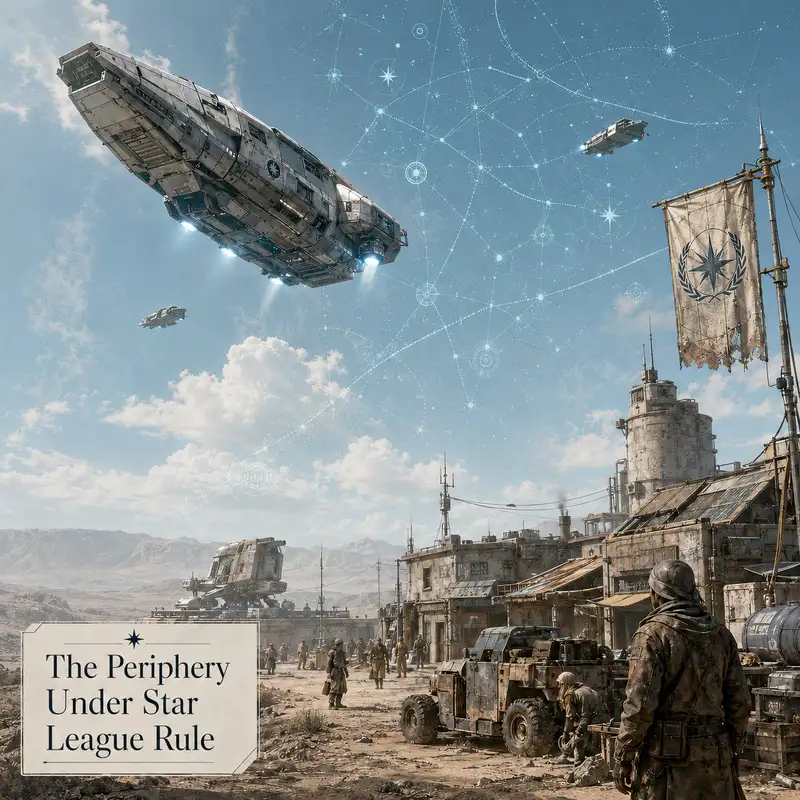
The Periphery Under Star League Rule
The representative from the Periphery could address the Star League High Council, explain the damage a new tax would cause, and ask the rulers of the Inner Sphere to reconsider. Then the voting began, and the representative had no ballot. That was the political arrangement beneath nearly two centuries of Star League prosperity. The Periphery could be heard. It could be administered. It could be taxed, regulated, and required to provide soldiers. It could not vote as an equal on the policies governing its future.
Star League rule brought the major Periphery states real benefits. Piracy declined. Trade expanded. New communications, medical knowledge, education, and industrial investment reached worlds that had previously depended on long and uncertain supply lines. Some regions became wealthier than they had been before the League arrived. None of that changed how the relationship had begun. The Magistracy of Canopus, Taurian Concordat, Outworlds Alliance, and Rim Worlds Republic entered the Star League after being defeated by its armies. Their prosperity developed inside a political order created at gunpoint.
Star League jurisdiction did not reach every remote colony in the same way. Independent settlements and communities farther into the Deep Periphery often lay beyond routine administration. The clearest measure of the system was the treatment of the four major realms formally designated as Territorial States, because they were developed governments before conquest and remained recognizable nations afterward.
The Reunification War ended in the year twenty-five ninety-seven. The four conquered realms became Territorial States rather than full member states. That distinction sounded administrative. It was constitutional. The five Great Houses and the Terran Hegemony sat at the center of the League with voting power. The Territorial States could send representatives to the High Council and present arguments, but they could not cast votes. They were inside the system when obligations were assigned and outside the decisive circle when those obligations were approved.
The peace treaties allowed the Territorial States to retain their governments and conduct many internal affairs. They were also required to pay Star League taxes, contribute soldiers to the Star League Defense Force, and accept federal law. Their legislatures formally ratified fiscal measures, but refusal was difficult when the government proposing the measure also commanded the occupation forces. A legislature may preserve the language of consent while everyone in the chamber understands which WarShip controls the jump point.
In twenty-six oh-seven, the Territorial States received associate-member status. The new label suggested movement away from occupation and gave their participation a more respectable form. It did not provide a vote equal to the Great Houses. The constitutional boundary remained where it had been drawn after the war. Territorial representatives could advise the council, while the House Lords and First Lord made the decision.
Reconstruction began under Periphery Administrators appointed through the Star League bureaucracy. The war had destroyed ministries, transport networks, factories, archives, and local chains of authority. In that environment, the administrators became the highest effective government in each conquered state. Local rule was gradually restored, but the administrators retained authority to overturn laws considered dangerous to League control. They also represented the Territorial States before the High Council. The same official could therefore speak on behalf of a population and veto what its elected government decided.
The conquered realms were expected to bear much of the cost of their own reconstruction. Some Taurian worlds were annexed by neighboring Inner Sphere powers, reducing the territory and revenue available for recovery. Federal officials could point to repaired ports, reopened schools, and restored commerce as evidence of responsible rule. Periphery citizens could point to tax collections and occupation bases as evidence that they were financing the system that had defeated them. Both descriptions could be accurate, which made the grievance harder rather than easier to dismiss.
The experience was not identical across the four states. The Magistracy of Canopus emerged from the war in comparatively good condition because Captain-General Marion Marik had refused the most destructive methods used elsewhere. Military Governor Melissa Humphreys pursued a serious reconstruction program and cooperated with Canopian leaders. Civil government and home rule were restored in twenty-six oh-four, and foreign troops withdrew. The Magistracy entered the Territorial Period with damaged sovereignty but much of its economic and social foundation still intact.
The Taurian Concordat faced a different reality. Its campaign had lasted nearly two decades and had included scorched earth, strategic weapons, destroyed fleets, ruined industry, and enormous loss of life. The precise totals vary across accounts, but the damage reached into nearly every part of Taurian society. Occupation forces remained until twenty-six oh-five. When Star League officials spoke of reconstruction, Taurians remembered that many of the people repairing the damage wore the insignia of the government that had caused it.
The Outworlds Alliance had signed the Peace of Cerberus before the other campaigns ended, but its worlds had still endured massacres, collective punishment, burned settlements, and political dislocation. Star League occupation forces remained until twenty-six oh-seven. The Alliance possessed a weak central government, a strong pacifist tradition in parts of its population, and a frontier spread across many lightly developed systems. Those features made direct resistance difficult. They also made the realm attractive to outside settlers, mining interests, and corporations able to operate where local institutions had little capacity to regulate them.
The Rim Worlds Republic presented the most unusual case. The League had not conquered a united state defending its ruler. It had invaded a republic already in rebellion against Gregory Amaris. After victory, the Star League restored Amaris authority rather than recognize the provisional government that had opposed him. The message was plain. Political legitimacy came from the League’s diplomatic relationships, not necessarily from the population living under the restored government. House Amaris would remember who had returned it to power, and later generations would learn how to turn that relationship against House Cameron.
The first postwar decades nevertheless brought genuine recovery. Star League naval patrols reduced piracy and protected commercial routes. A common currency simplified trade. The hyperpulse generator network shortened communication times across interstellar distances. New water purification systems made marginal settlements more viable. Medical and educational programs improved life on many worlds. A Periphery merchant could reach larger markets, a student could gain access to better technical instruction, and a planetary government could request assistance through institutions that had not existed before the League.
These advantages mattered most where local leaders could adapt them to existing strengths. Canopian medicine, tourism, finance, and entertainment benefited from safer travel and access to Inner Sphere customers. Taurian engineers could study advanced systems and rebuild an industrial base. Outworlds farmers and miners gained markets for products that had previously been too expensive to transport. Rim Worlds manufacturers and academies drew investment through the Amaris family’s connections to Terra. The Golden Age was not an illusion on the frontier. The problem was who controlled the terms on which its wealth was created.
The League’s early economic programs reveal that purpose. Officials organized many Periphery worlds into so-called co-prosperity spheres. Each system was encouraged or compelled to specialize in one industry and import necessities from its neighbors. On paper, specialization promised efficiency. In practice, it also made rebellion easier to punish. A world producing metals but importing food could be subdued by closing a shipping route. Economic integration was being designed as a security system.
The results were poor even before anyone attempted a blockade. Local production disappeared faster than reliable trade could replace it. Shortages spread, output declined, and some worlds experienced famine. The program generated unrest rather than obedience. Expansion of the co-prosperity spheres stopped in twenty-six oh-two, and the system was largely dismantled by twenty-six twelve. The experiment had lasted only a few years, but it revealed the assumption beneath later policy. Star League planners often treated Periphery self-sufficiency as a political threat rather than a source of resilience.
Control shifted toward essential technology. Inner Sphere firms used their capital, scale, and political access to dominate the markets for water purification and power generation equipment. Domestic Periphery producers could not compete and nearly disappeared. Imported systems were often more efficient and raised living standards while the Star League remained stable. They also required replacement parts, trained specialists, and dependable shipping. A world could become more prosperous and less capable of surviving a broken supply line at the same time.
The danger remained hidden because the network worked for generations. A failed component could be replaced. An expert could be brought in from another system. Credit and insurance spread the cost. Citizens born during the Golden Age had little reason to imagine that trade would stop. When the Star League later collapsed, some worlds discovered that the machinery providing water or power depended on industries hundreds of light-years away. Political dependency had been built into physical survival.
Education followed the same double path. League programs increased literacy, expanded libraries, trained teachers, and gave students access to scientific knowledge beyond the capacity of many local systems. During the late twenty-seventh century, reforms also pressed Star League loyalty into daily instruction. Schoolchildren were taught to thank the First Lord and view Terra as the center of human progress. National traditions associated with resistance were discouraged. A classroom could produce a better engineer while also teaching that the engineer’s own grandparents had been wrong to defend their independence.
That pressure encouraged another outward migration. Some Periphery citizens moved deeper into unsettled space to escape taxation, administration, or cultural supervision. At the same time, settlers from the Terran Hegemony and Great House realms moved into the Territorial States. The Outworlds Alliance received large numbers of newcomers and expanded through mining colonies and corporate holdings. The population became more diverse, but many new communities were economically tied to Inner Sphere employers rather than the Alliance government.
Corporate expansion could look like development from one office and extraction from another. A company financed a port, opened a mine, and created jobs. It could also export the most valuable output, pay low local wages, and leave the planetary government responsible for services. Labor protections common in the wealthier member states did not always follow the company into the Periphery. The frontier offered opportunity partly because the political rules were weaker. Prosperity arrived, but a significant share of it boarded the next DropShip outward.
Military service offered another route into the wider League. The Territorial States owed a tithe of personnel to the Star League Defense Force. For some recruits, this meant education, technical training, medical care, regular pay, and service beside people from across the Human Sphere. Many became committed Star League soldiers. Others saw the requirement as another claim imposed by the conqueror. The same uniform could represent professional opportunity to one family and the removal of a son or daughter to another.
Local militaries remained under close scrutiny. The Council Edict of twenty-six fifty limited the forces maintained by member and Territorial States, but the political effect was not equal. The Great Houses possessed voting power, large industries, and numerous ways to hide cadres or reclassify units. The Periphery states had smaller forces and fresh memories of invasion. Restrictions intended to preserve peace therefore looked like a rule ensuring that the governments conquered once could not prepare effectively for a second attempt.
The Magistracy made the best use of the relative peace. Its preserved infrastructure and restored home rule supported roughly a century of wealth and social development. Canopian leaders could point to safer trade and improved services as reasons to work within the League. Resentment toward the Free Worlds League remained, but it was generally less intense than Taurian hatred of House Davion or Alliance anger toward the forces that had devastated its worlds. Cooperation had delivered visible results, which gave moderation something more substantial than a slogan.
Canopian prosperity did not produce political equality. The Magestrix could govern internal affairs, but Canopus still lacked a vote on the council determining taxes, military rules, and Periphery policy. Wealthy businesses benefited more easily than remote communities. As later League policy opened the Territorial States to aggressive Inner Sphere interests, even the most successful Periphery economy found that prosperity offered limited protection from decisions made on Terra. A well-run subordinate state remained subordinate.
The Outworlds Alliance grew extensively during the Star League era. Settlers from the Hegemony, Federated Suns, and Draconis Combine established new worlds, while corporations developed mines and low-cost production. At its height, the Alliance claimed a broad region divided into several administrative provinces. Expansion made the map impressive and the state difficult to govern. Many colonies existed to feed Inner Sphere markets and felt greater loyalty to employers or settler communities than to Alpheratz.
That weakness became visible when the Star League began to fail. Some Alliance regions supported Periphery resistance. Others remained loyal to the League because their populations had arrived under Star League protection and depended on Inner Sphere trade. Rule from Terra had not merely suppressed Alliance identity. It had changed the population and economy until the question of independence no longer produced one answer. Colonial growth had expanded the country while loosening the bonds holding it together.
The Taurian Concordat never reconciled itself so easily. Fewer pirate attacks, new technology, and modest improvements in living standards could not outweigh the memory of invasion, annexation, and occupation. Taurian political culture already valued local sovereignty, civic participation, education, and readiness against outside threats. Star League rule reinforced the belief that the Inner Sphere would use any language, including unity and prosperity, to justify control.
Taurian leaders rebuilt where they could. After restrictions eased, the government consolidated and subsidized military industry, eventually creating Taurus Territorial Industries from smaller firms. Resistance movements also survived, including the Taurian Freedom Army. Some were political organizations, some conducted terrorism, and some received help from outside powers pursuing their own agendas. The Concordat’s grievance was genuine. That did not make every act committed in its name defensible.
The Rim Worlds Republic prospered through a more dangerous accommodation. House Amaris maintained unusually close ties with the Cameron court, and the Republic attracted settlers, investment, military industry, and advanced training. Its rulers benefited from the Star League order while presenting themselves as leaders of a Periphery state. The Republic was not free of anti-League feeling, but its elite had stronger incentives than most to preserve access to Terra.
Those connections also created room for military expansion. The Rim Worlds forces faced fewer effective restrictions in some areas and developed factories, academies, and a growing fleet. By the time Stefan Amaris became close to Richard Cameron, personal friendship and strategic access were intertwined. The state most favored by the League’s political center became the instrument that destroyed it. That outcome was not inevitable, but it was enabled by a system that treated loyalty among ruling families as a substitute for institutional safeguards.
In twenty-seven twenty-two, Council Directive Forty-One promised to remove the last restrictions imposed after the Reunification War. The Periphery Administrators were abolished, and the Territorial States received what was described as greater independence. On paper, the measure corrected a century-old injustice. It also removed officials who had sometimes restrained the worst corporate behavior. Inner Sphere businesses and political patrons moved into the opening with more resources than local governments could match.
The years after the directive produced heavier exploitation, public protest, and stronger secessionist organization. Demonstrations became regular events in several Territorial States. Networks linked activists who had once worked within separate national movements. The Star League had removed a visible symbol of occupation without changing nonvoting status or the economic imbalance beneath it. Independence had been granted in the area where corporations wanted fewer controls, not in the council chamber where the Periphery wanted power.
Fiscal pressure increased again under the final Cameron governments. New taxes were imposed during the early reign of Richard Cameron, culminating in the Taxation Edict of twenty-seven sixty-three. Several Periphery states refused to pay. Richard responded by sending Aleksandr Kerensky and additional Star League forces into the region. By the crisis, the equivalent of ninety-eight divisions stood in the Periphery Military Region. A dispute over revenue had become a military deployment on the scale of a major war.
In twenty-seven sixty-five, New Vandenberg and seventeen other Taurian worlds announced that they were leaving the Star League while remaining within the Concordat. Nicoletta Calderon supported the decision. Rebellion spread beyond the Taurian frontier, and fighting drew much of the Star League Defense Force away from the Terran Hegemony. Stefan Amaris encouraged the crisis and manipulated both sides because he needed Kerensky’s army out of position. His conspiracy mattered. It succeeded because it exploited grievances the Star League had spent generations creating.
The Periphery uprising was therefore neither a spontaneous rejection of prosperity nor merely an Amaris deception. It was the result of conquered states receiving development without equal sovereignty, markets without economic security, education with political indoctrination, and nominal independence without a vote. Many citizens preferred reform to rebellion. Many served loyally in Star League institutions. Others concluded that every peaceful channel ended at the same council table where they could speak and then watch someone else decide.
Star League rule changed the Periphery profoundly. It reduced piracy, expanded trade, improved education, spread technology, and allowed several regions to prosper. It also redirected economies toward Inner Sphere needs, weakened local self-sufficiency, restricted military autonomy, and preserved a constitutional hierarchy between full members and conquered territories. The League did not fail in the Periphery because it provided nothing of value. It failed because it treated those benefits as proof that consent was no longer necessary.
The final irony is that the Star League made the Periphery more connected, educated, and administratively capable. Those same improvements helped people compare conditions, organize movements, circulate grievances, and recognize how little influence they possessed. The system built ports, schools, power plants, and hyperpulse stations, then assumed gratitude would substitute for representation. When the last tax demands arrived, the Periphery remembered the arrangement established after the Reunification War. It had always been allowed to address the council. It had never been allowed to vote.