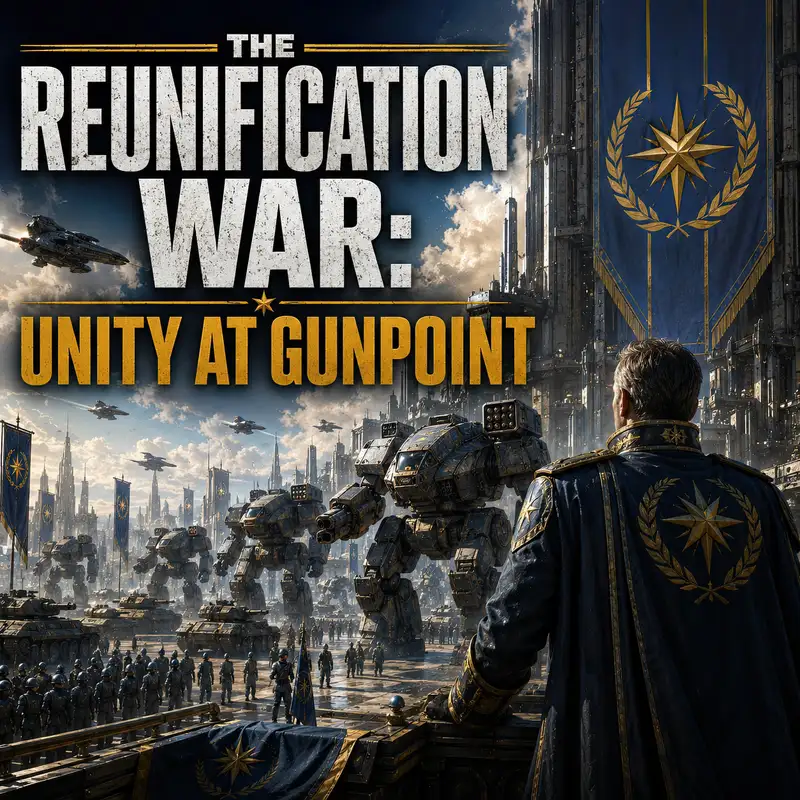
The Reunification War: Unity at Gunpoint
On the second of January, twenty-five seventy-five, Ian Cameron told the Star League Assembly that every human being should accept the benefits of unity freely and openly. The promise sounded generous until he explained what would happen to anyone who declined. The League would extend its protection into every inhabited region, whatever the cost. The next day, Protector Mitchell Calderon placed the Taurian Concordat on a war footing. A political invitation had become a strategic warning, and both sides understood the translation.
Only four years had passed since the Star League was founded. Ian had persuaded the five Great Houses to join through treaties, security guarantees, economic concessions, and dynastic privilege. The major Periphery states had been invited as well, but they saw little reason to surrender authority to a council in which the Inner Sphere dynasties controlled the votes. Their refusal exposed the central contradiction of Cameron’s project. The League claimed to represent all humanity, yet millions of humans had never agreed to be represented by it.
The Reunification War grew from that contradiction, but ideology alone did not load the DropShips. The Great Houses had practical motives. The Federated Suns wanted the Taurian threat removed from its border. The Lyran Commonwealth saw war as a useful distraction from internal problems. The Draconis Combine wanted influence and territory around the Outworlds Alliance. The Free Worlds League feared the economic disruption but could not ignore its obligations. The Capellan Confederation offered limited support while protecting its own position. Ian wanted something all of them needed: a common campaign that would make the new League real.
Tensions had been rising since the League’s birth. In twenty-five seventy-two, massive military exercises along the Periphery border were intended to display Star League strength. Instead, the newly assembled federal formations performed unevenly and suffered embarrassing coordination failures. The Periphery governments were not intimidated. On several worlds, they became more confident that the new army could be resisted. The exercises still gave Ian something valuable. They created bases, supply arrangements, and experience along the exact frontier from which later invasions would begin.
The same year, Star League and Draconis Combine troops entered parts of the Outworlds Alliance under the language of mutual defense. On Santiago, hostility between the garrison and the local population ended in the killing of civilians, including children. The Santiago Massacre became proof to the Alliance that Cameron’s protection could arrive without consent and remain after it had lost legitimacy. In twenty-five seventy-three, a clash between Taurian and Federated Suns vessels at Malagrotta deepened another frontier grievance. Neither incident made war unavoidable. Both made peaceful submission politically impossible.
Ian next tried economic pressure. Tariffs, port fees, and trade restrictions were imposed against Periphery commerce in twenty-five seventy-four. The policy hurt the targeted states, but it also damaged Inner Sphere companies that depended on those markets. Businesses failed, unemployment rose, and the governments applying the pressure began paying for their own sanctions. War now promised several convenient remedies. It could redirect public anger, stimulate military production, secure resources, and blame the Periphery for an economic crisis the League had helped create. Humanitarian language remained useful. So did procurement contracts.
The Pollux Proclamation gave the Periphery three months to accept Ian’s vision. Their representatives answered through the Independent States of the Periphery, rejecting submission and affirming their sovereignty. Ian then issued Directive Twenty-Two, requiring every Star League member to contribute troops and equipment. The League described the coming operation as reunification rather than conquest. The distinction rested on the belief that the Periphery already belonged inside a political order it had refused to join.
The conflict was not one campaign. It was four separate wars against the Taurian Concordat, the Magistracy of Canopus, the Outworlds Alliance, and the Rim Worlds Republic. The Periphery governments had issued a common diplomatic answer, but they lacked a unified command, common logistics, or a single war plan. The Star League could concentrate forces against each frontier while drawing on the industries and militaries of every Great House. Even so, the campaigns lasted far longer than Ian expected because political superiority on a map is not the same as control of jump points, cities, supply routes, and populations.
The invading force was also less unified than its insignia suggested. The Star League Defense Force was still a young institution built around Terran Hegemony formations, new federal corps, and auxiliary units supplied by the Great Houses. Equipment standards differed. Officers brought rival doctrines and political loyalties. Every offensive required WarShips to secure space, JumpShips to maintain the route, DropShips to land troops, and technicians to keep BattleMechs operating far from their factories. Cameron possessed overwhelming resources, but those resources had to arrive in the correct system, under a commander everyone would obey, before the defender destroyed the transports.
The Taurian Concordat presented the hardest military problem. It possessed a capable economy, educated population, significant industry, a professional defense force, and a political culture deeply suspicious of House Davion. When Calderon mobilized, Taurian factories increased production and commanders prepared to fight a stronger enemy through deception, dispersal, and attrition. Their objective was not to defeat the entire Star League in open battle. It was to make invasion so expensive that Cameron’s coalition would lose the will to continue.
The first major Taurian success came before the main ground invasion. In Case Amber, Taurian naval forces manipulated communications and movement patterns to draw a Federated Suns fleet away from its rear. Hidden forces then struck the transport armada at Panpour and ambushed the retreating warships. The Davion force lost more than two dozen WarShips and JumpShips while the Taurians lost only a few vessels. The Federated Suns ground troops remained largely intact, which was of limited comfort because much of the transportation required to move them had been destroyed. An army without lift is a garrison with ambitious paperwork.
General Charles Wexworth opened the main invasion in twenty-five seventy-eight. He advanced cautiously because the League wanted Taurian industry captured rather than ruined, and because Case Amber had demonstrated the danger of assuming technological superiority would compensate for poor intelligence. The first waves met fortified worlds, skilled defenders, insurgency, and determined naval resistance. On some planets, League BattleMechs dominated open ground. On others, terrain, mines, aircraft, infantry, and prepared demolitions reduced those machines to expensive targets moving through somebody else’s plan.
The Taurians mixed conventional defense with irregular warfare. Food stores were burned before capture. Occupied cities produced bombings and assassinations. Poison, concealed artillery, fireships, and attacks by troops in environmental suits complicated every advance. Some Taurian methods endangered civilians and crossed the same moral boundaries their leaders accused the League of violating. That does not erase the imbalance between defender and invader. It shows what happens when a population believes national survival has removed every normal restraint.
The League crossed its own boundaries as frustration grew. At Robsart, heavy naval losses were followed by an orbital bombardment that killed approximately thirty thousand civilians. The attack became a Taurian rallying cry and converted a military setback into years of additional resistance. In twenty-five seventy-nine, Ian Cameron formally abandoned the protections of the Ares Conventions for the war. The League had claimed that its laws represented civilization. It now argued that those laws did not apply when fighting people it had classified as barbarians.
Command changes followed slow progress and rising casualties. General Amalthia Kincaid brought greater precision to the fourth invasion wave and captured several objectives with less collateral damage. Taurian commandos answered with Case Black, drawing League naval forces away while an infiltration team assassinated Kincaid in twenty-five eighty-three. Her death stalled the campaign and demonstrated that the Taurians could strike the command system behind the front. It also opened the way for one of the war’s most destructive officers.
General Amos Forlough had already built a brutal reputation in the Outworlds Alliance. In Taurian space he embraced scorched earth, concealed losses from superiors, and treated destruction as a substitute for political control. Worlds fell more quickly, but discipline deteriorated and resistance hardened. On New Vandenberg, League forces used defoliation and a direct assault against deeply prepared defenses around Harmony. The city was taken only after months of fighting through caves, tunnels, chemical attacks, and fortified positions. Cameron removed Forlough because he had destroyed too much of the industrial base the League intended to inherit. The objection was not only moral. He was damaging the prize.
General Damien Onaga replaced him and returned to a more deliberate strategy. The final approach to the Hyades Cluster required the Star Guard Corps to clear Flannagan’s Nebula, an asteroid and debris field filled with concealed laser batteries. Capital ships, aerospace fighters, and BattleMechs could not solve the problem cleanly. Infantry in environmental suits had to clear positions in zero gravity, one emplacement at a time. It took four years. The most advanced military alliance in human history reached the Taurian heartland through work that was slow, intimate, and lethal.
By September of twenty-five ninety-six, the League was prepared to assault the Hyades Cluster. Protector Marantha Calderon surrendered rather than risk its destruction. She ordered regular forces and resistance groups to stand down across occupied and surviving worlds, then took her own life the following morning. The Concordat had lost the war, but it had proven the cost of conquering it. The campaign lasted nearly two decades, consumed ships and regiments, and left a political memory that no occupation government could erase.
The Magistracy of Canopus fought a very different war. Inner Sphere planners underestimated it because they confused a prosperous pleasure economy with military weakness. The Magistracy Armed Forces fielded experienced formations, mercenaries, and a substantial fleet. Captain-General Marion Marik led the Star League and Free Worlds League forces into the campaign in twenty-five seventy-seven. Early gains were uneven because Canopian garrisons were distributed unpredictably. Some targets were nearly empty. Others were strong enough to punish an invasion force that had planned for a short operation.
Canopian Colonel Adam Buquoy then struck the Star League supply system at Meadowvale. His mercenary force accepted heavy losses to destroy depots and withdraw surviving elements before the League could trap them. The raid did not defeat Marion’s army. It forced her to stop for six months and rebuild the security of her lines. That pause illustrated a fact repeated across the war. The decisive target was often not the BattleMech regiment at the front, but the fuel, ammunition, food, spare parts, and transport schedules behind it.
Marion made a choice that separated the Canopian campaign from the others. She ordered her forces to continue observing the Ares Conventions even after the Star League suspended them. Strategic weapons, indiscriminate bombardment, and attacks on civilian centers remained forbidden. The restriction slowed operations and required more careful planning. It also preserved the infrastructure the League hoped to control and reduced the population’s incentive to fight beyond military defeat. Restraint did not make the invasion legitimate. It made the occupation less destructive.
In twenty-five eighty-three, Marion used the memory of Meadowvale to set a trap. She left a supply flank apparently exposed near Thurrock. The Magistracy struck and found a League flotilla waiting. After two days of aerospace and naval fighting, the Canopian fleet was largely destroyed, ending its ability to conduct major offensive operations. Canopus Four surrendered the following year, though resistance elsewhere continued until twenty-five eighty-eight. The Magistracy entered the postwar settlement damaged but far more intact than the other conquered states. Command policy had shaped the civilian outcome.
The Outworlds Alliance had far less conventional power. Its military included a small militia and roughly a hundred and twenty BattleMechs, many adapted from industrial machines. Its best defense came from politics. The Federated Suns did not want the Draconis Combine expanding through Alliance territory, and Davion leaders valued trade with the region. A secret agreement transferred several Alliance agricultural worlds into Federated Suns protection. Davion troops also arrived unofficially as the Pitcairn Legion, three regiments of experienced MechWarriors under Elias Pitcairn.
The Legion transformed resistance but could not prevent catastrophe. Star League and Combine forces entered the Alliance in twenty-five eighty-one under Amos Forlough. On Budingen, Draconis Combine troops attacked civilians rather than engage the strongest defenders. On Medron, Forlough ordered the execution of one person in ten as a warning. At Haynesville, a League brigade surrendered after being trapped by the Pitcairn Legion and militia fighters. Forlough arrived after the defenders had withdrawn and executed his own commander for cowardice. The campaign had begun to punish anyone who disrupted the official expectation of easy victory.
Atrocities expanded resistance instead of ending it. Alliance civilians learned anti-BattleMech tactics, built new units from captured equipment, and supported the Pitcairn Legion across a scattered frontier. Forlough answered by burning towns and farms. The Draconis Combine and Federated Suns also competed for territory, weakening unity among the invaders while validating Alliance fears that the campaign was partly a land grab. The League possessed overwhelming strength, but its members were still Great Houses calculating what they could acquire while serving a supposedly common cause.
The Alliance counterattack at Tellman Four mauled a major League force and proved that lightly equipped defenders could exploit weather, terrain, and command overconfidence. The victory could not reverse the wider strategic balance, but it destroyed the assumption that the Alliance would collapse on schedule. Forlough was transferred to the Taurian front before he faced meaningful punishment. His replacement stopped the deeper advance, and the Peace of Cerberus ended the campaign in twenty-five eighty-five. Millions of Alliance civilians had already paid for a war against a state that had never possessed the power to threaten the Inner Sphere.
The Rim Worlds campaign was stranger still. First Consul Gregory Amaris had supported Ian Cameron and expected Star League membership to strengthen his dynasty. His own authoritarian policies, including the Manchester Directive and loyalty measures, helped trigger rebellion in twenty-five seventy-five. Workers, soldiers, and political opponents formed the Rim Provisional Government and confined Amaris under guard. He appealed to the Star League for rescue. The League left its ally waiting for twenty years while more urgent campaigns consumed the available troops.
Operation Mailed Fist began in earnest in twenty-five eighty-one. Lyran, Free Worlds League, and Star League formations attacked a Republic defended mainly by conventional armor and infantry. The defenders lacked the BattleMech strength of the Taurians or Canopians, but they possessed numbers, prepared positions, and the advantage of fighting for their own worlds. Progress remained slow. The campaign also became entangled with Lyran internal rivalries and Draconis Combine opportunism. The unified army was still carrying every unresolved political grievance of its member states.
The final drive on Apollo revealed the cost of that friction. Archon Viola Steiner-Dinesen personally attempted a maneuver intended to draw out the defenders and break their line. A communications failure disrupted the plan, and she died from her wounds in twenty-five ninety-five. The Rim Provisional Government surrendered in September of the following year. Gregory Amaris was restored, not because his government had represented the will of the population, but because he had remained Cameron’s recognized ally. Reunification on Apollo meant returning a displaced ruler to power at the end of a foreign invasion.
By twenty-five ninety-seven, the conquered Periphery realms had become Territorial States of the Star League. They could manage many internal affairs and speak before the High Council, but they did not possess equal votes. They paid taxes and contributed soldiers to the Star League Defense Force. The arrangement offered reconstruction, trade, technology, and a place within the wider economy. It also confirmed the Periphery’s original objection. The League had demanded their membership while denying them the political equality enjoyed by the Great Houses.
The war strengthened the Star League in several ways. Its military gained hard operational experience, improved coordination, and learned to sustain campaigns across immense distances. Inner Sphere industry expanded, and access to Periphery resources helped fuel economic recovery. The Great Houses had fought under a common command and could point to victory as proof that the League worked. Yet each campaign also revealed limits. House armies pursued private territorial goals. Commanders applied different standards of conduct. Communications failures killed rulers. Logistics repeatedly determined the tempo more reliably than speeches from Terra.
The Periphery paid the larger price. Worlds lost industry, infrastructure, populations, and experienced leaders. Occupation and migration disrupted local institutions long after the shooting stopped. The Taurian Concordat and Outworlds Alliance carried especially deep resentment toward the states that had invaded them. The Magistracy recovered more effectively in part because Marion Marik had refused the worst methods available to her. That comparison matters. The destruction elsewhere was not an unavoidable product of interstellar war. It was often the result of choices made by commanders and accepted by governments.
Ian Cameron achieved the political map he wanted. Every major human state now stood within the Star League’s system, and the era of open Great House warfare gave way to decades of relative prosperity. The accomplishment was real. So was the coercion that made it possible. The Reunification War did not unite humanity by discovering shared interests. It declared one government universal, treated refusal as rebellion, and used military victory to manufacture consent after the fact.
That is why the war became one of the defining contradictions of the Star League. It created peace among the Great Houses by exporting violence to the Periphery. It defended civilization by suspending the rules intended to civilize war. It promised political inclusion while withholding equal power. The League’s white star eventually became a symbol of order, prosperity, and lost possibility. On the worlds it reunified first, that symbol arrived on the hulls of invasion ships.