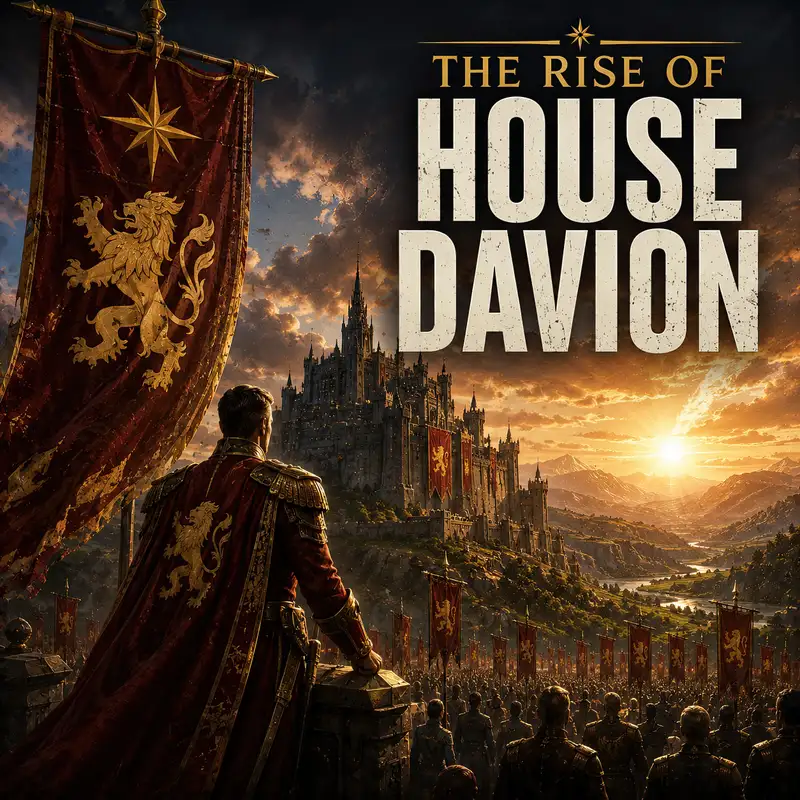
The Rise of House Davion
In November of twenty-four seventeen, Simon Davion entered the High Council chamber on New Avalon carrying news of a military victory and the knowledge that his cousin had ordered him killed. President Edward Davion appeared with his bodyguard. Simon seized a weapon from one of those guards and shot Edward repeatedly. Then he surrendered. The public trial that followed did not end with Simon in prison. It ended with his acquittal, his elevation to the presidency, and, within months, the creation of the office of First Prince. House Davion’s rise reached its decisive moment through an act that looked like murder, revolution, and constitutional reform at the same time.
That scene captures the central contradiction of House Davion. The family became associated with liberty, representative government, and resistance to tyranny. It also converted an elected presidency into a hereditary claim and built a military whose senior officers often owed their careers to New Avalon. The rise of House Davion was neither a simple theft of power nor a clean popular mandate. It was a long process in which one family repeatedly made itself useful during crisis, then used that usefulness to become increasingly difficult to replace.
The story began on New Avalon, a fertile world whose political importance grew from agriculture before it grew from armies. Its early settlers spread farming communities across broad, productive regions and turned the planet into a major supplier of food for nearby colonies. During the decline of the Terran Alliance, New Avalon resisted impossible export quotas in the Grain Rebellion. Local protest, marine defections, and Terran weakness left the world effectively independent. Its citizens learned early that distant governments could demand food more easily than they could understand the harvest producing it.
New Avalon’s politics were dominated by established families, especially the DuValls and the Davions. The Davions owned the powerful commercial concern Avalon Ventures and possessed influence in agriculture, trade, and diplomacy. Jerome Davion served as an ambassador, while his wife, Jennifer DuVall, connected the family to the planet’s ruling political line. Their son Lucien therefore entered public life with advantages that later admirers sometimes described as destiny and later critics would call excellent family placement. Both descriptions contain some truth.
Lucien was not merely a beneficiary of his name. He was soft-spoken, idealistic, and unusually skilled at persuading people who did not begin by agreeing with him. In twenty-three oh seven, his uncle, Prime Minister Martin DuVall, appointed him deputy prime minister and trained him in government. When Martin died accidentally two years later, Lucien was elected prime minister within a week. The transition ended the DuVall family’s direct dominance and placed a Davion at the center of New Avalon’s state machinery.
The timing mattered. The Terran Alliance had collapsed into civil war, and James McKenna had replaced it with the Terran Hegemony. McKenna openly intended to recover worlds Terra had abandoned. To leaders across the Crucis Reach, the Hegemony offered order backed by WarShips, colonial marines, and a political philosophy that did not require local consent. Lucien recognized that New Avalon could not face such pressure alone. He began traveling among neighboring systems, proposing trade agreements and mutual defense before McKenna’s fleets could negotiate one planet at a time.
In twenty-three seventeen, delegates from twenty-three worlds gathered on New Avalon. Lucien proposed the Crucis Pact, a federation in which member worlds would remain partners rather than colonies. Twenty signed that day. The new Federated Suns would coordinate defense, encourage trade, and support worlds facing hardship. A High Council representing the members would govern alongside an elected president responsible chiefly for national defense. Lucien became the first president, but the structure did not yet assume that a Davion would always hold the office.
New Avalon’s food exports gave the pact practical weight. A political speech could promise solidarity. Grain shipments proved it. Worlds that joined gained access to a regional market, emergency support, and a common response to external pressure. New Avalon became the federation’s center because it could feed people, finance shipping, and convene leaders, not because it possessed an unbeatable army. The first Davion state was built as much through warehouses and freight schedules as through constitutional language.
Its military weakness appeared almost immediately. The Muskegon Empire chose to join the Federated Suns, but two of its subject worlds, Emerson and Beten Kaitos, rejected the decision and aligned with the Chesterton Trade Federation. Lucien was obligated to defend the new member. The Federated Suns assembled forces contributed by individual worlds, selected commanders through political agreement, and tried to fight an interstellar campaign without a permanent national army. The arrangement honored local sovereignty. It also produced fragmented command, uneven training, and supply systems that appeared to have met one another shortly before deployment.
Chesterton forces, supported by the Tikonov Grand Union, drove the Federated troops away. The contested worlds changed hands several times, but the conflict ended as a Federated defeat. When the Marlette Association joined in twenty-three twenty-four, it brought another inherited dispute with Tikonov. Lucien’s government gained territory and obligations faster than it gained military competence. He could build coalitions. He was not an effective wartime commander, and each battlefield failure became a personal burden.
Lucien retired in twenty-three thirty-two and died soon afterward. Before his death, he warned his son Reynard that the methods the Davions had used to dominate New Avalon would not govern a larger federation successfully. The warning was perceptive because the family had already begun doing exactly what he feared. Lucien’s brother Charles won election as president and started converting temporary influence into permanent institutions.
Charles understood the military problem with much greater clarity than his brother. The original Crucis Pact expected member worlds to provide troops for specific emergencies. Charles amended the arrangement and created the Federated Peacekeeping Forces, a standing military with common ranks, training, logistics, transport, and central command. Units were taught to identify with the Federated Suns rather than only with their home planets. For a state scattered across light-years, that was essential. A regiment that waited for its planetary government to approve every movement was not a national reserve. It was an armed committee.
The reform also served House Davion. Charles placed many officers from New Avalon in senior positions and built a bureaucracy whose leading officials often owed advancement to his family. The Federated Peacekeeping Forces could move supplies and troops without depending entirely on member governments. That made the state more capable. It also made the presidency more powerful. The same system that protected the federation reduced the High Council’s ability to restrain the people commanding that protection.
Charles died in twenty-three forty, and Lucien’s son Reynard succeeded him. Reynard had served as a colonel and understood both field operations and the political value of appearing beside soldiers. He inherited a military Charles had organized but had not yet proven. In twenty-three forty-four, Reynard used diversionary forces against Mirach while personally leading a reserve strike against Almach. The operation severed Tikonov’s supply route to other contested worlds and transformed a vulnerable frontier into a negotiating advantage.
The victory mattered beyond the systems recovered. It showed member worlds that the standing army could deliver security where the original ad hoc system had failed. Reynard used the result to secure agreements with neighboring Capellan powers and stabilize parts of the border. Military success increased confidence in the Federated Suns, but it also increased confidence in the Davion leading it. The family’s political claim was becoming inseparable from the performance of the national army.
Reynard expanded that relationship for three decades. The personal Davion guard became responsible for protecting the president, while the Federated Peacekeeping Forces developed officers, traditions, and support systems tied to New Avalon. Border campaigns against Capellan states, and later clashes with the Taurian Concordat, gave the military constant work. They also encouraged a strategic culture that viewed hostile neighbors as the normal condition of national life. A family able to manage those threats could present its continued rule as a security requirement rather than an inherited privilege.
When Reynard died in twenty-three seventy-one, his son Etien was accepted as president with little serious dispute. This was a crucial point in the family’s rise. The law still described an elected office. Political expectation now treated the Davion succession as natural. Etien had served in the military and had been wounded in battle, giving him credentials that fit the emerging ideal of a Davion ruler. His first months brought ceasefires, diplomacy, and new member worlds. Then the effects of his injuries and unstable behavior became impossible to ignore.
Etien grew erratic, violent, and increasingly absorbed in personal pleasure. The bureaucracy kept the state functioning while the economy and military momentum weakened. His rule demonstrated the danger of a political system that had begun confusing family continuity with competence. Yet when Etien died by suicide in twenty-three seventy-eight, the High Council did not use the crisis to end Davion control. Its members feared that choosing an outsider would fracture the federation. They selected Etien’s brother Paul.
Paul appeared an unlikely rescuer. He was eccentric, physically unsuited to military service, and better known for scholarship than command. Some council members expected him to become a manageable figurehead. Instead, he proved energetic, responsible, and skilled at delegation. He restored the economy, used limited campaigns to discourage Capellan aggression, and strengthened administrative commissions capable of acting across the federation. Paul showed that Davion legitimacy could rest on competent civilian government as well as battlefield leadership.
His sister Marie reinforced that lesson. She had served in the Federated Peacekeeping Forces and developed into an effective diplomat and administrator. As Paul’s health declined, she increasingly managed national affairs. When he died in twenty-three ninety-four, the High Council chose Marie over younger male relatives whose blood claim was stronger but whose preparation was not. Her succession suggested that the Davion dynasty still required some measure of public service and political approval. It also ensured that the presidency remained inside the family.
Marie governed as the Age of War began to spread across the Inner Sphere. After the destruction inflicted on Novaya Zemlya, she supported rapid WarShip construction and military operations intended to prevent further deep attacks. The burden contributed to her failing health, and she died in twenty-four oh two. By then, the Davions had occupied the presidency for eighty-five years. What had begun as repeated election now looked like inheritance moderated by the High Council.
The next generation nearly destroyed that arrangement. Edmund and Edward Davion were the twin sons of Etien. Their mother, Marion Michaels, spent years protecting their claims and shaping court politics. Edmund became president after Marie’s death, but Marion exercised much of the real power until her own death. Edward then gained increasing influence over his brother. Together, the twins treated the state as a family possession without providing the service that had made earlier Davion rule tolerable.
They placed House Davion above the law, imposed arbitrary taxes, funded extravagant projects, and repeatedly disbanded or reshaped the High Council when it resisted. Senior military officers were removed for suspected disloyalty and replaced with men whose principal qualification was agreement. The economy deteriorated while border wars continued. The presidency had accumulated enough authority to govern effectively, but that authority in incompetent hands now threatened the federation it had been created to defend.
Edmund died under uncertain circumstances in twenty-four fifteen. Edward moved quickly to eliminate rivals, expand a secret police network, and secure the succession for his own son. He also ordered the death of Simon Davion, Paul’s son and a serving officer on the Capellan frontier. Simon’s commanding officer refused and warned him. At the same time, members of the High Council prepared what became known as the November Conspiracy, intending to remove Edward before he destroyed the remaining constitutional order.
Simon returned to New Avalon under the pretext of reporting the capture of Jaipur. His shooting of Edward in the Council chamber ended the immediate crisis, though whether every part of the act was coordinated with the conspirators remains disputed. Simon surrendered rather than attempt a military seizure of power. The High Council protected him from Edward’s bodyguard, and a public court acquitted him. The army, much of the council, and a relieved population then supported his elevation to president.
The acquittal was not simply a legal judgment about one killing. It was a political decision that House Davion could be preserved by separating Simon from the abuses of his cousins. The public did not reject hereditary leadership. It rejected rulers who had failed the service expected from that leadership. Simon benefited from his family name, but he also survived because soldiers and councilors believed he could restore the bargain that made Davion rule acceptable.
Simon’s answer was to reorganize the Federated Suns into five principalities, usually described as Marches. The Capellan, Crucis, Draconis, Terran, and Outer regions each received a prince and substantial authority over local government and defense. The ruler of the Crucis March would serve as First Prince, coordinating the federation and directing its common military effort. In twenty-four eighteen, Simon adopted that title. The elected presidency had become a federal aristocracy with House Davion at its center.
The arrangement addressed a real administrative problem. No ruler on New Avalon could respond quickly to every raid, famine, succession dispute, or infrastructure failure across a large interstellar realm. Communications traveled by ship, and military reinforcements required transport, recharge time, and reliable routes. Regional princes could act faster because they were closer to the problem. Simon’s system combined local authority with central coordination and gave powerful families a stake in preserving the federation.
It also created future danger. March rulers controlled regional forces, patronage, and political networks. A prince strong enough to defend the frontier might become strong enough to defy New Avalon. Simon had solved one crisis by institutionalizing several potential rivals. This was not careless design. It was the compromise required to hold a large federation together when communication was slow and the central government had just survived tyranny. The eventual price would be paid during later succession struggles and civil war.
Simon rebuilt legitimacy by traveling through the realm much as Lucien had done a century earlier. He reassured member worlds, restored military leadership, and refused territorial demands from the Capellan Confederation. The Federated Peacekeeping Forces checked Capellan offensives and defended a border that had grown more dangerous as the Age of War intensified. Simon’s authority rested on constitutional settlement, personal military credibility, and the practical fact that the state again functioned.
His reign also carried the Federated Suns into the BattleMech age. Near the end of his life, the government obtained the technology needed to produce BattleMechs, combining diplomacy, money, and intelligence work. The new machines did not create House Davion, but their acquisition reinforced the relationship between dynasty, military modernization, and national survival. A First Prince who could place new weapons in the hands of the army strengthened both the state and the family commanding it.
Simon died in twenty-four fifty-seven and was succeeded by his son James. Ten years later, James was assassinated, and the High Council faced another test of whether Davion rule was a principle or merely a habit. James’s sister Ellen sought the office despite political opposition, physical disability, and arguments that a male claimant would be more acceptable. She won council support by promising continuity, competence, and a recognized heir from another branch of the family.
Ellen proved a stabilizing ruler. She removed rivals from positions where they could dominate the central government, though some of those compromises strengthened regional powers in ways that would later become dangerous. More important for House Davion, she restored public respect after assassination and succession uncertainty. In twenty-four seventy-three, the High Council approved the Act of Succession. It granted House Davion permanent control of the Crucis March and a perpetual claim to the title of First Prince.
That act completed the family’s legal rise. The Davions no longer depended on winning an open presidential election after every death. Their right to lead had become part of the state’s constitutional structure. Yet even this triumph remained conditional in practice. The High Council still existed. Regional princes retained power. The military expected its ruler to serve and command effectively. Citizens accepted hereditary leadership partly because generations of crisis had convinced them that continuity was safer than reopening the struggle for the capital.
House Davion rose because it controlled more than a bloodline. It stood at the center of New Avalon’s food economy, trade network, bureaucracy, military command, and political mythology. Lucien offered partnership against Terran domination. Charles built the institutions that made partnership enforceable. Reynard proved those institutions in war. Paul and Marie showed that administration and diplomacy could preserve legitimacy. Simon saved the dynasty from its own worst rulers by reshaping the state around it. Ellen turned custom into law.
The contradiction between liberty and hereditary rule was present from the beginning, but it was not merely hypocrisy. Many Davion leaders genuinely believed that strong central authority protected the freedoms of member worlds from foreign conquest and internal collapse. Their opponents could answer that a family which placed loyal officers, controlled succession, and accumulated emergency powers was also limiting the freedom it claimed to defend. Both interpretations fit the record because House Davion’s strength came from making national service and family power increasingly difficult to separate.
The rise of House Davion was therefore not a single coronation. It was a century and a half of elections that became expectations, expectations that became institutions, and institutions that became inheritance. The family endured failure, madness, assassination, and war because each crisis persuaded enough people that replacing one Davion was safer than replacing the Davion system. On New Avalon, grain had first made the world important. In time, the armies fed by that grain made one family indispensable, and indispensability became a throne.