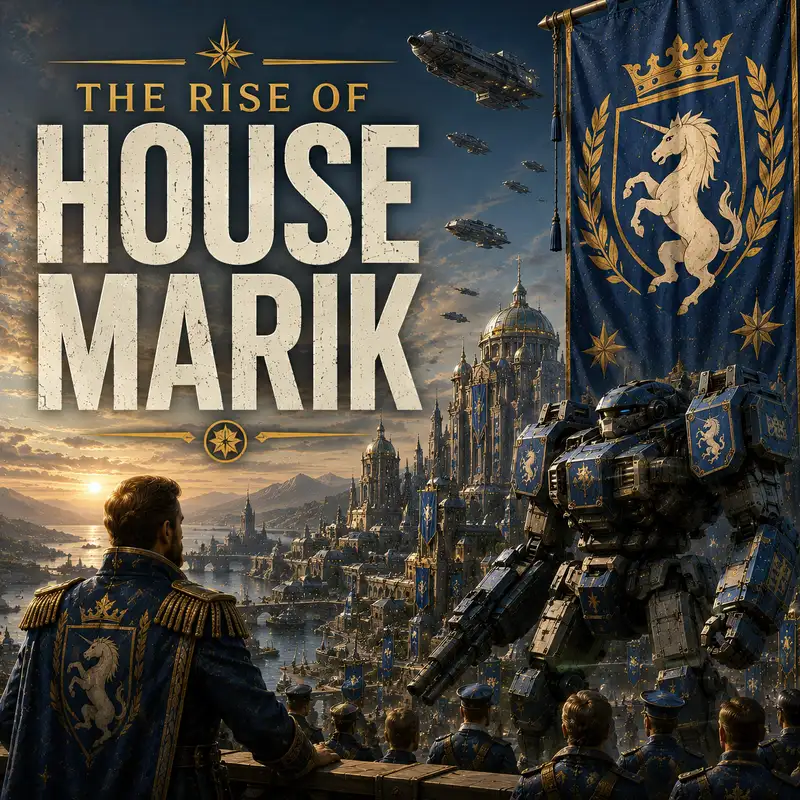
The Rise of House Marik
In the year twenty-four twenty-seven, the Free Worlds League Parliament sent a delegation to a country estate on Marik. Lyran forces had taken Bolan, then Dixie and Kamenz. The League needed a commander who could stop the advance, and the members of Parliament believed they knew the only family capable of doing it. Terrence Marik listened to their appeal and refused. He would accept the office of Captain-General only after Parliament repealed the law limiting his authority. More worlds fell. Parliament repealed the law. Terrence accepted. House Marik had not seized the government with soldiers in the streets. The government had crossed interstellar space to ask the family to take command on its own terms.
That scene captures the central contradiction behind the rise of House Marik. The Free Worlds League was founded as a federation, not a hereditary monarchy. Its Parliament was supposed to remain sovereign. Its provinces kept their own governments, identities, and military traditions. The Captain-General was an emergency commander selected to fight a war, not a crowned ruler entitled to pass the state to an heir. Yet the League’s wars repeatedly placed members of one family at the center of federal power. House Marik rose because it combined political skill, military experience, economic resources, and a talent for making itself appear indispensable. It did not abolish the League’s institutions. It learned how to dominate them while leaving them visibly intact.
The family’s official histories reached back to medieval Central Europe, where generations of Mariks survived shifting borders and stronger neighbors. Later accounts treated that experience as preparation for governing a buffer state, although family histories are rarely written without a little polishing. One well-documented ancestor, Antonín Marik, fled Czechoslovakia after its annexation in nineteen thirty-eight and served in the Royal Air Force during the Second World War. Centuries later, his descendants became involved in interstellar commerce and colonial development. In the year twenty-one thirty-nine, the family helped establish the world that would bear its name. Marik possessed valuable mineral deposits, and those resources gave the clan an economic base before it possessed an independent government.
By the early twenty-third century, Charles Marik had become a successful businessman and the Terran Alliance senator representing Marik. He was not remembered as a charismatic tribune. Contemporary descriptions instead present a reserved public figure whose quiet manner concealed an aggressive political operator. That combination served him well during the Outer Reaches Rebellion. Charles warned Alliance leaders that military coercion and political inflexibility were turning colonial unrest into separation. When Terra withdrew its forces in twenty-two thirty-seven, he judged that the Alliance could no longer enforce its authority. Marik declared independence the following year. Charles had waited until the rebellion had changed the balance of power, then moved before a new regional order could form without him.
Independence did not produce immediate unity. Rival factions on Marik proposed competing constitutions, including plans that would have restrained Charles and strengthened commercial interests outside his control. He answered with bargaining, intimidation, and bribery. By twenty-two forty-one, his preferred constitution bound four prosperous worlds into the Republic of Marik. Several of his most bitter opponents soon became business partners. The arrangement said much about Charles’s method. He did not destroy every rival. He made resistance less profitable than cooperation. The republic gave House Marik an executive structure, a legal foundation, and access to the revenue of several worlds. It also created the first durable connection between the family’s private economic network and the machinery of an interstellar state.
Charles initially tried to expand by negotiation. Nearby settlements declined his offers. In twenty-two forty-five, persuasion gave way to military action. Republic forces captured Atreus the next year, and Charles reorganized his state as the Marik Commonwealth. He moved the capital to the conquered world and continued expanding with the help of his sons, Alonzo and Detlev. By twenty-two seventy-one, the Commonwealth controlled twenty inhabited systems. That growth was not merely a sequence of flags planted on maps. Each annexed world required garrisons, shipping, tax collection, local accommodations, and a reason for elites to accept the new arrangement. House Marik learned state-building through conquest, then administered the result with enough competence to keep the Commonwealth functioning.
Detlev inherited leadership after Charles died in twenty-two fifty-one. He received a larger realm than the republic his father had founded, but he also inherited neighbors that could not be absorbed cheaply. The Federation of Oriente and the Principality of Regulus were established states with their own leaders, armed forces, commercial interests, and pride. None wished to become another Marik province. Yet all faced the same strategic problem. The Terran Alliance was retreating, local powers were expanding, and no single state in the region could guarantee the security of the rest. A permanent union offered protection, but it also raised the question every federal agreement eventually encounters: who would command when the members disagreed?
The initiative came largely from Tomás Allison of Oriente, working through the diplomat George Humphreys. In twenty-two sixty-six, Humphreys approached Detlev about an alliance linking Oriente, Regulus, and the Marik Commonwealth. Detlev liked the strategic logic but doubted that the competing rulers could accept one another’s terms. Humphreys persisted for years. He even used the leaders’ shared enthusiasm for collecting rare objects to open a personal channel between Detlev and Raju Selaj of Regulus. It was an oddly domestic bridge to an interstellar federation, but diplomacy often succeeds through details that military histories omit. The correspondence reduced mistrust enough for formal negotiation to continue.
In twenty-two seventy-one, Detlev Marik, Tomás Allison, and Raju Selaj met on Marik and signed the Treaty of Marik, also known as the Articles of Unification. The Free Worlds League was born from three states that wanted collective strength without surrendering their identities. Parliament stood above the federal executive. The member states retained extensive autonomy. Atreus, already the capital of the Marik Commonwealth, became the capital of the new League. Detlev took the federal post of Minister of Defense rather than a royal title. House Marik therefore gained influence at the center of the new state, but it did not legally own that state. Oriente had supplied much of the vision, Humphreys had done the patient negotiating, and Regulus remained a powerful partner.
The arrangement nevertheless favored House Marik in several practical ways. The Marik Commonwealth was already a coherent multiworld government with an experienced ruling family and a functioning military establishment. The federal capital sat within its territory. Detlev controlled the defense ministry, the institution most likely to grow whenever diplomacy failed. House Marik also understood that federal power could be accumulated through service rather than proclamation. A family that openly demanded supremacy would unite Parliament against it. A family that repeatedly solved problems Parliament could not solve might be granted the same supremacy one emergency at a time. The distinction mattered politically, even when the result began to look familiar.
For the first two decades, the League expanded through inducement, pressure, and negotiation. Some worlds joined because membership offered trade and protection. Others discovered that the federation could be persuasive in the way a large fleet parked nearby is persuasive. The Stewart Commonality refused. Its ruler, David Genovese, believed the young League lacked the will and unity for a serious campaign. Parliament responded in twenty-two ninety-three by creating the office that would define House Marik’s future. It appointed Juliano Marik as the first Captain-General and placed the combined military forces of the League under his command.
Juliano’s campaign against Stewart was brief because Genovese helped defeat himself. The dictator insisted on directing operations personally despite poor communications and severe weather. Orders arrived late or no longer matched conditions on the ground. Stewart troops were positioned to defend terrain that monsoon rains had turned into swamp, while Juliano kept the League’s separate contingents moving toward a common objective. Within four months, organized resistance collapsed. The six systems of the Commonality were absorbed into the League. The victory demonstrated that a federal army could fight effectively when one commander possessed clear authority. More important for House Marik, it associated that authority with a Marik before any rival family had built a comparable record.
Juliano then did something as politically important as winning the war. He returned control of the military to Parliament. The constitution required it, but compliance was not automatic in an age when ambitious commanders regularly converted emergency powers into personal governments. By stepping down, Juliano strengthened the office and his family at the same time. Parliament could appoint a Marik without believing it was signing away the republic forever. Provincial leaders could accept centralized command because the authority had an expiration point. House Marik’s restraint became part of its claim to future power. The family appeared dangerous enough to defeat an enemy and disciplined enough to go home afterward, which is an unusually effective combination in politics.
The League soon tested whether that success belonged to Juliano alone or to the wider system. In twenty-three oh-six, Parliament appointed Danak Selaj as the first non-Marik Captain-General during a conflict involving the Capellan states. His command failed. The details mattered less to League politics than the comparison. Juliano had coordinated provincial forces and won quickly. Selaj did not. By the end of the century, House Marik had secured the right of first refusal when Parliament selected a Captain-General. The office remained elective in law, but the family now stood at the head of the line. A constitutional preference had begun to resemble a dynastic expectation.
Juliano also expanded the family’s reputation beyond battlefield command. When James McKenna established the Terran Hegemony in the twenty-three teens, League leaders feared that Terra’s new state might threaten their independence. Juliano returned to federal service and sent James Humphreys to negotiate. The resulting Treaty of Terra normalized relations instead of producing a costly war. Juliano also sponsored the creation of a federal intelligence organization in twenty-three seventeen, an ancestor of the institution later known as SAFE. These measures strengthened the League’s central government while reinforcing the idea that Marik leadership could provide both military defense and diplomatic control. House Marik was becoming not merely a family of generals, but the family associated with federal security.
Later Mariks built on that position. Allan Marik led campaigns during the twenty-three sixties that added Capellan worlds to the League. Expansion brought revenue and strategic depth, but it also brought the federation into sharper conflict with the states to its east. When those Capellan states united under House Liao, border disputes became wars between larger and more organized powers. Andurien, claimed by both sides and valuable to each, became the recurring center of the struggle. Parliament turned again to House Marik, not because the family had a constitutional right to rule, but because generations of appointments had made alternative leadership seem increasingly experimental.
Peter Marik became Captain-General in twenty-three ninety-six as war with the Capellan Confederation approached. When Chancellor Kurnath Liao attacked in twenty-three ninety-eight, Peter took command on the Andurien front. His early record was not flawless. A serious defeat at Kwamashu in twenty-four oh-one gave House Selaj an opportunity to challenge his leadership. Peter answered not with a cautious defense, but by driving the war toward Sian. The offensive produced a victory close enough to the Capellan capital that Chancellor Aleisha Liao sought peace in twenty-four oh-four. Peter returned to Atreus as the commander who had recovered from defeat by attacking the political center of the enemy’s war effort.
That victory accelerated House Marik’s rise and exposed the danger within it. Peter was popular with soldiers and civilians who saw him as the defender of the League. Parliament saw a commander who had acquired prestige, controlled federal forces, and did not always treat legislative direction as binding. The problem was not imaginary. Peter continued military operations after some members believed the immediate threat had passed. During a later war with the Lyran Commonwealth, he captured Rochelle even as Parliament pressed for an armistice. The world’s mineral wealth made the prize attractive. Its political cost made the operation look less like defense and more like a Captain-General setting foreign policy through conquest.
In twenty-four eighteen, Parliament passed the War Powers Act. The law restricted the Captain-General and strengthened legislative oversight of military operations. Its supporters believed they were protecting the federation from an ambitious dynasty. Peter regarded the act as an insult and a guarantee that future commanders would be blamed for wars they lacked the authority to conduct. Both sides had a defensible argument. Parliament could not remain sovereign if a general ignored its orders. A general could not defend a frontier spread across scores of systems while every operational decision became a parliamentary negotiation. The League had created a federal command for emergencies without resolving where military necessity ended and political control began.
The contradiction became a crisis in twenty-four twenty. The Lyrans renewed their offensive and Parliament asked Peter to serve again. He refused while the War Powers Act and its oversight machinery remained in force. Parliament appointed Joseph Stewart, one of Peter’s former subordinates. Stewart was a respected field officer, but he lacked Peter’s grasp of interstellar strategy. League forces lost Rochelle, Amity, and Dansis before suffering a wider defeat at Concord. The offensive eased only when the Lyrans redirected attention toward another threat. Peter had allowed the League to suffer rather than accept restricted command. Parliament had preferred a weaker commander rather than concede. The enemy demonstrated the cost of that constitutional argument.
Peter’s political standing rose even though he had not led the defense. Many citizens and legislators concluded that the disaster proved only a Marik could coordinate the League’s wars. That belief was convenient for House Marik and unfair to every competent officer outside it, but institutions are often shaped by memorable failures. Peter entered Parliament in May of twenty-four twenty-two confident that opposition was collapsing. An assassin killed him as he left the building. Members of House Selaj were suspected, but proof never settled the matter. The murder removed Peter without resolving the dispute. It also made him a symbol of a family that claimed to be punished for protecting the state.
Five years later, the Lyrans attacked Bolan. Parliament offered the Captain-Generalcy to Peter’s son Terrence. He repeated his father’s refusal. The War Powers Act would have to go. Bolan fell, followed by Dixie and Kamenz. Only then did Parliament repeal the act and ask again. Terrence accepted immediately. He reorganized the defense, stopped the worst of the Lyran advance, and fought the Commonwealth to a stalemate over fourteen years of active campaigning. He did not recover every lost world. Militarily, the outcome was incomplete. Politically, House Marik had won something larger. Parliament had accepted that the family could dictate the conditions under which it would defend the League.
By twenty-four forty-one, the line between federal appointment and family succession had become thin. When Terrence retired, House Marik gathered at Dormuth to decide who should follow him. His daughter Micaela pressed her claim. Terrence’s younger brother Peter had supporters of his own. The dispute ended in a sword duel between the sixty-two-year-old Peter and the thirty-nine-year-old Micaela. Peter won, and the family presented its choice for federal command. The scene was almost feudal, yet it occurred inside a state that still possessed an elected Parliament and a written constitution. House Marik had not formally made the Captain-Generalcy hereditary. It had reached the point where the dynasty could settle its candidate internally and expect the League to accept the result.
This did not make the Mariks absolute rulers. Oriente, Regulus, Andurien, and numerous smaller provinces retained their own governments, interests, armed forces, and political blocs. Parliament could still deny funds, impose conditions, elevate rivals, and sometimes bring down a Captain-General. House Marik itself divided into branches that competed as bitterly as outside families. The League’s diversity limited the dynasty in ways House Davion or House Kurita rarely experienced. Yet those limits also kept producing the conditions that favored Marik leadership. Provincial forces required coordination. Border wars required a single commander. Parliamentary delay created military risk. Every crisis renewed the argument that temporary central authority was necessary, and House Marik was already waiting beside the office.
The dynasty’s rise therefore depended on more than victory. Charles Marik used commerce, constitutional maneuver, and conquest to build a viable state. Detlev accepted federation rather than demand annexation and secured control of its defense institutions. Juliano proved that a Marik could command provincial forces, win, and then return authority without destroying the constitution. Peter and Terrence used military reputation to force Parliament into concessions that earlier generations could not have demanded openly. Rivals helped complete the process whenever they failed in command, overreached in Parliament, or allowed personal hostility to weaken the common defense.
House Marik became powerful because it represented both sides of the League’s identity. It was a provincial dynasty with its own territory, army, wealth, and family ambitions. It was also the family most closely associated with federal command, collective defense, and the survival of the union. That dual position produced centuries of tension. A strong Captain-General could protect the League while threatening its freedoms. A strong Parliament could preserve those freedoms while making coordinated war almost impossible. Neither side permanently solved the problem because each needed the other. The League did not surrender to House Marik in a single coup. It called the family back, crisis after crisis, until temporary command began to look like inheritance.