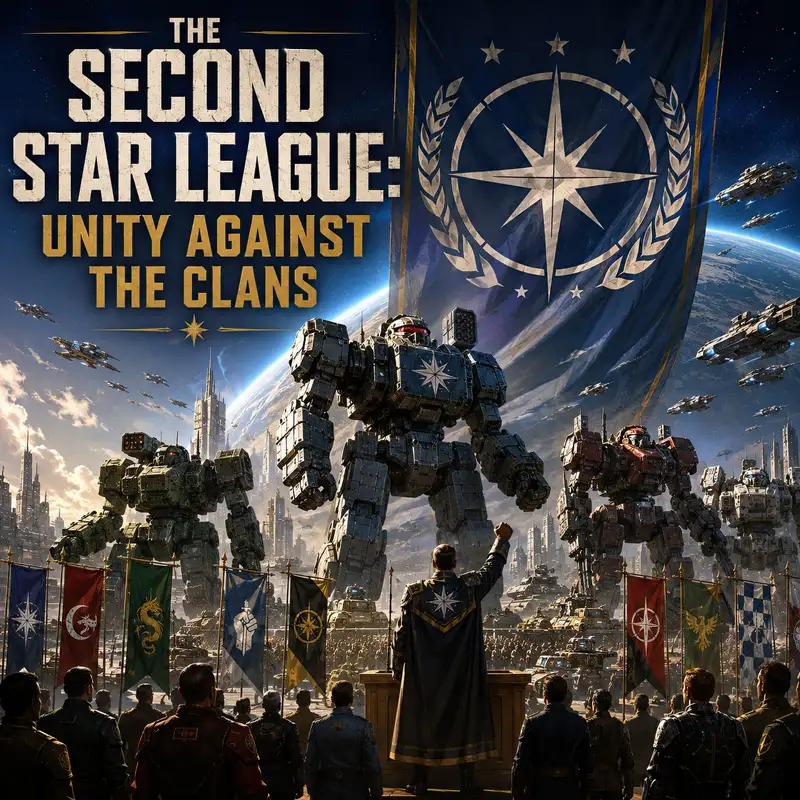
The Second Star League: Unity Against the Clans
On November twenty-first, in the year thirty fifty-eight, leaders whose governments had invaded, betrayed, and undermined one another signed the same constitution on Tharkad. The document proclaimed a new Star League, a name associated with humanity’s lost golden age and with three centuries of war over who had the right to inherit it. The ceremony looked like reconciliation. The military planning behind it was considerably less sentimental. The signatories had agreed that one of the Clans had to be destroyed.
The Second Star League was not created because the Great Houses had suddenly discovered common values. It was created because the Truce of Tukayyid had solved only the immediate military problem. The Clan drive toward Terra had stopped, but the occupation zones remained, the Crusader cause survived, and the treaty would expire in the year thirty sixty-seven. The Inner Sphere possessed time, not security. Its rulers needed a way to convert temporary cooperation into an offensive powerful enough to change Clan politics.
That distinction explains both the League’s success and its weakness. It was extraordinarily effective when aimed at a defined enemy under a finite military plan. It was far less effective as a permanent government. The leaders at Tharkad did not surrender sovereignty, merge their economies, or forget their rival claims. They created a coalition whose members could fight beneath one banner while retaining the ability to leave, refuse troops, and pursue national interests. Unity existed, but it had carefully negotiated limits.
The immediate catalyst came from Coventry. Early in the year thirty fifty-eight, Clan Jade Falcon launched a major incursion into the Lyran Alliance. Forces from several states and commands converged to relieve the world, including Com Guards, mercenaries, Lyran units, troops associated with the Draconis Combine, and warriors from Clan Wolf-in-Exile. The coalition did not operate flawlessly, but it functioned. Former enemies shared intelligence, transport, aerospace support, and battlefield responsibilities because no participant could handle the Falcon force alone.
Victor Steiner-Davion ended the crisis by offering the Jade Falcons hegira, a Clan rite allowing a defeated enemy to withdraw with honor and much of its surviving force. The decision angered officers who wanted the Falcons destroyed, but it prevented another costly battle and showed that Inner Sphere commanders could use Clan institutions as strategic tools. Coventry demonstrated something more important than victory. Diverse militaries could assemble, accept a common operational purpose, and avoid turning political suspicion into friendly fire.
The conference that followed was hosted by Katherine Steiner-Davion on Tharkad. The leaders and advisers of the five Great Houses attended, along with representatives of the Free Rasalhague Republic, the St. Ives Compact, ComStar, Clan Wolf-in-Exile, and the Arc-Royal Defense Cordon. Every delegation arrived with grievances, private agendas, and a preferred version of unity in which someone else provided most of the troops. The palace offered excellent accommodations. It could not offer a shared political memory.
Consensus formed around a narrower question. What action would prevent the Clans from simply waiting until the Tukayyid truce expired? Defending the line forever would surrender the initiative. Attacking every Clan at once was beyond the available transport and political trust. The conference therefore considered destroying one invading Clan completely. Such a victory would prove that the Inner Sphere could carry war into Clan territory and would weaken the Crusader faction that demanded renewed invasion.
Clan Smoke Jaguar became the target. Clan Wolf and Clan Jade Falcon had devastated one another during the Refusal War. The Jaguars remained one of the strongest Crusader powers in the Inner Sphere and had earned lasting hatred through occupation policies symbolized by the destruction of Edo on Turtle Bay. Their occupation zone lay within the Draconis Combine, where Theodore Kurita could concentrate forces, restrict information, and conceal preparations more effectively than most rulers. The Jaguars were dangerous, isolated, and politically useful to defeat.
Phelan Kell supplied the conference with an insider’s understanding of Clan politics. Destroying the Smoke Jaguars would remove a leading Crusader voice and demonstrate that conquest carried an existential price. The objective was not simply to liberate several Combine worlds. It was to alter the debate inside the Clan Grand Council. Military planners were selecting a target whose destruction might produce effects far beyond its occupied territory. This was strategy directed at an enemy’s political system rather than only its regiments.
The League’s constitution reflected the distrust that made the alliance necessary. The First Lord would not be a hereditary Cameron monarch. The office would rotate among member-state leaders in three-year terms, and no ruler would serve again until the others had received their turn. The position carried prestige and the authority to appoint the military commander, but much of its power remained ceremonial. The Council of Lords retained the decisive political voice. No dynasty was going to acquire the original Star League by winning one election.
Selecting the first First Lord exposed every rivalry in the room. Katherine expected to control the process and believed she had positioned herself for the office. Victor instead supported Sun-Tzu Liao, Chancellor of the Capellan Confederation. Choosing the ruler of one of the smaller Great Powers could be presented as proof that the new League would not become a Davion, Steiner, Kurita, or Marik instrument. It also denied Katherine the victory she expected. Interstellar unity had begun with a compromise and a successful piece of sibling maneuver.
Sun-Tzu’s election was not evidence that the leaders trusted him. It showed that they trusted one another even less. His office gave the Confederation status without giving it command over every member’s military. Other rulers could watch him through the Council, while the constitution limited the duration of his term. The arrangement allowed every delegation to claim equality and prevented the largest state from openly dominating the alliance. It was politically clever, which is not the same as being politically stable.
The Second Star League Defense Force was designed around the same caution. Its long-term goal was an independent military loyal to the League, but such a force did not yet exist. Member states loaned regiments, aerospace units, ships, and support formations for fixed periods, generally six to nine months unless the donor agreed to longer service. During that assignment, the units operated under the League chain of command and its articles of war. Their home governments still owned the formations and could refuse requests for troops.
This structure made rapid coalition warfare possible without requiring national armies to dissolve. It also created predictable problems. Equipment standards differed. Command languages and staff procedures differed. One state’s elite regiment might regard another state’s senior officer as a hereditary enemy with an inconvenient new title. Ammunition, replacement parts, medical systems, and transport schedules had to be reconciled. A coalition army can share a flag quickly. Sharing maintenance catalogs usually takes longer.
A headquarters staff based on Tukayyid included advisers from member states, but the staff had limited time to mature before the first campaign. Anastasius Focht served as the League’s senior military commander while remaining Precentor Martial of ComStar. He brought experience from Tukayyid, access to ComStar communications, and a professional understanding of the Clans. He also represented an institution that had lost Terra to the Word of Blake and had its own reasons to prove that ComStar still mattered.
The League adopted symbols meant to connect the new force with the old Star League Defense Force. The Eridani Light Horse, a mercenary command descended from the original army, accepted a permanent place within the organization. The Royal Black Watch tradition was revived as protection for the First Lord. These choices offered continuity and morale, but they also served a practical purpose. The coalition needed core formations whose loyalty did not vanish when a six-month national deployment ended.
Intelligence required similar integration. Every major state possessed agencies that guarded information from one another as carefully as they guarded it from the Clans. The new Star League created mechanisms to coordinate those services, compare reports, and distribute operational intelligence. That was essential because Clan occupation zones, ComStar records, Wolf-in-Exile knowledge, and Great House reconnaissance each contained only part of the picture. The alliance’s first real weapon was not a BattleMech. It was a common estimate of the enemy.
During the conference, Focht presented the information that transformed a punitive offensive into a campaign of destruction. A Smoke Jaguar defector had provided the Exodus Road and the location of Huntress, the Clan’s homeworld. The League could now strike the Jaguars in two places at once. One force would liberate their Inner Sphere occupation zone. Another would cross the Deep Periphery and destroy the institutions that produced replacement warriors, trained new sibkos, stored matériel, and sustained Jaguar power.
The two operations solved different military problems. Operation Bulldog would attack occupied worlds along a front close enough to support from the Draconis Combine. Task Force Serpent would travel for months through poorly charted space to reach Huntress, with no expectation of quick reinforcement. Bulldog required concentration, deception, and a sequence of rapid planetary assaults. Serpent required endurance, navigation, medical support, spare parts, and enough transport to survive a journey where a single disabled JumpShip could remove an entire regiment from the war.
Morgan Hasek-Davion volunteered to command Task Force Serpent. Its units came from several states, ComStar, and major mercenary commands, selected not only for combat ability but for transport, discipline, and the capacity to operate far from established supply. The force had to carry what it could not expect to find. Every BattleMech placed aboard a DropShip competed with ammunition, recovery equipment, food, hospital capacity, and technical stores. Heroism was useful. Cargo allocation remained mandatory.
Bulldog drew heavily upon the Draconis Combine, whose worlds had suffered under Smoke Jaguar rule and whose forces could assemble near the target zone without crossing another state’s territory. ComStar contributed communications, intelligence, advanced units, and Focht’s command experience. Federated, Lyran, Capellan, Marik, Rasalhagian, St. Ives, mercenary, and Wolf-in-Exile formations added capabilities and political legitimacy. No participant could describe the campaign as someone else’s private war once its own troops entered the deployment schedule.
Victor and Focht became the public military partnership behind the offensive. Focht supplied institutional command and a lifetime of strategic experience. Victor brought political standing, field experience against the Clans, and relationships across states that did not always trust ComStar. Neither man could make the coalition free of rivalry. They could ensure that operational objectives remained clearer than the political arguments surrounding them. The distinction mattered whenever a national commander questioned why a regiment was being risked on another ruler’s world.
Operational security depended upon limiting what the Jaguars could see. Theodore’s censorship and control inside the Combine helped conceal troop movements. Training exercises, staging areas, and transport schedules were arranged so that the buildup did not reveal the full plan. Operation Bird Dog sent smaller forces ahead to weaken garrisons and collect information. When Bulldog began in May of the year thirty fifty-nine, the Jaguars faced an offensive larger and better coordinated than the isolated resistance they had learned to expect.
The opening waves advanced faster than the planners’ most optimistic estimates. Star League task forces struck several worlds, forced Jaguar garrisons to withdraw or surrender, repaired enough equipment to continue, and moved onward before the enemy could establish a stable defense. The Jaguars had prepared for renewed attacks toward the Inner Sphere, not a multinational offensive moving in the opposite direction. Their fellow Clans offered no meaningful rescue. Rivalry and political calculation isolated the very Clan that had treated strength as the only dependable alliance.
Clan Nova Cat’s defection made the imbalance worse. Nova Cat warriors and leaders concluded that their future lay with the new Star League and the Draconis Combine rather than the Crusader cause. Their knowledge of Clan procedures, equipment, and battlefield habits strengthened Bulldog. Their participation also carried political weight. The campaign could no longer be dismissed as an Inner Sphere attack upon all Clan society. A Clan was helping the League destroy another Clan because it believed the invasion had followed the wrong path.
The coalition still faced the normal friction of interstellar operations. WarShips and DropShips from different services had to operate in improvised squadrons. Ground commanders sometimes resisted outside control. Salvage, prisoners, and liberated infrastructure created disputes that had to be settled before the next wave. Yet the central plan held. The League did not need every officer to enjoy cooperation. It needed transports to arrive, units to attack assigned objectives, and replacement supplies to follow before the next jump.
By the end of Bulldog, Clan Smoke Jaguar had been driven from its Inner Sphere occupation zone. The campaign succeeded so quickly that Victor could detach forces and move toward Huntress, where Task Force Serpent had encountered a far more dangerous situation. Serpent had crossed the Exodus Road, lost Morgan Hasek-Davion to assassination, assaulted the Jaguar homeworld, and suffered severe casualties. Surviving Jaguar forces returning from the Inner Sphere threatened to overwhelm the exhausted task force.
The relief column demonstrated what the League’s shared command could accomplish. Forces originally assembled for the Combine front were redirected across enormous distance to support units drawn from nearly every political region of the Inner Sphere. Victor did not arrive with one national army rescuing another. He arrived with the usable remainder of a coalition campaign. Huntress fell, and Clan Smoke Jaguar ceased to function as a major military and political power. Unity had produced an effect no Great House could have achieved alone.
Destroying the Jaguars still did not formally end the Clan invasion. Victor carried the League’s challenge to Strana Mechty and demanded a Trial of Refusal against the invasion itself. On April twenty-third, in the year thirty sixty, selected Star League units faced Crusader Clan forces in a series of separate engagements. The League won the majority. Under Clan law, the Crusader claim to conquer the Inner Sphere was defeated. The Second Star League had used Clan institutions to close the war the Clans had begun through those same institutions.
The Great Refusal was the political return on the campaign’s military investment. Bulldog liberated territory. Serpent destroyed the Jaguar base. The Trial on Strana Mechty converted those victories into a decision the Clans were bound to recognize. This sequence explains why the Second Star League mattered. It did not simply mass more BattleMechs. It aligned battlefield action, enemy political culture, intelligence, transport, and diplomatic purpose toward one conclusion.
For the occupied populations, unity had a more immediate meaning. Jaguar garrisons withdrew, prisoners were released, and local governments attempted to rebuild authority. Liberation also brought damaged cities, disrupted production, abandoned equipment, and communities divided by resistance, collaboration, and survival. Star League flags could mark the return of Inner Sphere rule. They could not repair water systems or settle every claim created by years of occupation. The political celebration moved faster than reconstruction crews.
The new League’s limits became clearer once the Clan mission succeeded. Member states had never surrendered their separate ambitions. Sun-Tzu used his prestige and position while pursuing Capellan claims against the St. Ives Compact. Katherine expanded her control over the divided Federated Commonwealth. Victor returned from Clan space to discover that victory abroad had not preserved his authority at home. The same rulers who had cooperated against Smoke Jaguar continued undermining one another where no common enemy forced restraint.
The Second Whitting Conference in the year thirty sixty-one demonstrated that the institutions could survive a change in leadership, though not without theater. Sun-Tzu’s term ended. Katherine attempted to secure election as First Lord. The vote divided the Council, and ComStar held the deciding position. Focht resigned rather than cast the political vote himself, named Victor as his successor, and allowed Victor to vote against his sister. Theodore Kurita became First Lord and appointed Victor to command the Star League Defense Force.
This was constitutional government by the standards of the era, which still left room for surprise entrances, dynastic maneuver, and a resignation timed like an artillery strike. The process did matter. Leadership changed without a coup, and the League continued. Yet the episode also showed how much the institution depended upon personalities. Its rules provided a framework. They did not eliminate the family rivalries and state interests operating inside it.
The military never fully became the independent force its founders imagined. Most of its strength remained on temporary loan from national armies. Permanent core units grew, and a professional staff developed, but member governments retained the ability to deny forces or recall them when domestic crises became more important. During later conflicts, Star League units could appear on opposing sides as political loyalties shifted. The banner was common. Ownership of the regiments was not.
The Second Star League succeeded against the Clans because its purpose was narrow, urgent, and measurable. The members agreed on the enemy, accepted a finite campaign, and understood that failure endangered them all. They created enough common command to direct armies without demanding permanent political integration. They coordinated intelligence, pooled transport, and selected an objective whose destruction would change both the military balance and the enemy’s internal debate. Limited unity was not a weakness in that campaign. It was the condition that made unity possible.
It failed to become a lasting union for the same reason. Once the Clan invasion had been defeated politically, every member again measured the League against national interests. The constitution could rotate the First Lord, but it could not compel trust. The military could defeat Clan Smoke Jaguar, but it could not force Katherine, Victor, Sun-Tzu, Thomas Marik, Theodore Kurita, and the lesser states to value the coalition above their own governments. The League had solved a common problem without creating a common state.
The alliance endured until the year thirty sixty-seven, when a vote of no confidence dissolved it. That later failure does not make its earlier unity false. For two years, enemies who had spent centuries preparing to fight one another shared plans, ships, intelligence, casualties, and command. They expelled a Clan from the Inner Sphere, destroyed its homeworld power, and defeated the legal basis of renewed invasion. The Second Star League was not the rebirth of the Cameron order. It was something more modest and, for one campaign, more useful: a coalition strong enough to win because its members agreed exactly what they would do together, and no more.