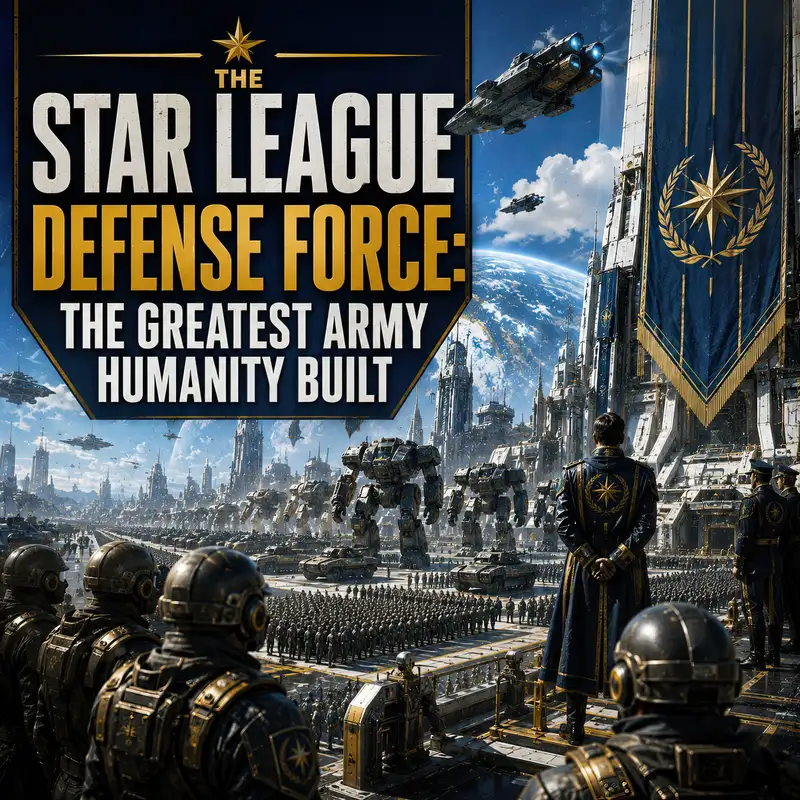
The Star League Defense Force: The Greatest Army Humanity Built
The greatest army humanity had ever assembled did not fall in battle. It was maneuvered out of position by its own government. By late twenty-seven sixty-six, more than sixty percent of the Star League units normally stationed inside the Terran Hegemony had been sent toward the Periphery. Rim Worlds troops moved into the vacated bases with legal access, official credentials, and the First Lord’s approval. When Stefan Amaris struck, he did not have to breach every fortress from the outside. He had already been shown where the doors were.
That failure can make the Star League Defense Force seem less impressive than its reputation. It should do the opposite. The force survived the destruction of its political leadership, rebuilt while cut off from its industrial heartland, defeated the Rim Worlds Republic, reconquered the Terran Hegemony, and finally took Terra itself. The central question is not whether the Star League Defense Force was invincible. It was not. The question is what allowed one institution to coordinate soldiers, machines, fleets, factories, and supply routes across almost three thousand worlds more effectively than any military before or after it.
The force began in twenty-five seventy-one as an experiment in controlled mistrust. The newly formed Star League did not dissolve the armies of the five Great Houses. No ruler would have accepted that. Instead, the Terran Hegemony transferred its entire military into the new federal force, while each Great House contributed roughly one quarter of its own establishment. Units that had spent generations preparing to fight one another were now expected to share headquarters, supply systems, doctrine, and objectives. A common insignia could be painted quickly. A common military identity required far more work.
Ian Cameron appointed Shandra Noruff-Cameron as the first commanding general. Her task was not simply to command an army. She had to invent one. The force needed ranks, regulations, military regions, staff procedures, equipment standards, transport priorities, schools, courts, and a chain of command acceptable to officers whose original loyalties still pointed toward New Avalon, Tharkad, Luthien, Sian, Atreus, or Terra. Shandra divided the League into military regions and built corps from a deliberate mixture of Hegemony and member-state formations. Integration was treated as an operational requirement rather than a ceremonial aspiration.
The first structure was modest only by later Star League standards. By twenty-five seventy-five, the defense force fielded ten full corps, each built around divisions, brigades, regiments, aerospace support, and attached logistics. The Reunification War immediately tested the system. Some corps lacked enough JumpShips to begin operations on schedule. Commanders had to borrow, lease, or redirect transport while politicians demanded progress. Units arrived with different maintenance practices and incompatible habits. The new army learned its first lesson before many soldiers reached the battlefield. Interstellar strategy begins with transportation, and enthusiasm has never added a docking collar to a DropShip.
The Reunification War also exposed the moral limits of the institution. Some commanders, such as Marion Marik in the Magistracy of Canopus, imposed restraint and continued observing the Ares Conventions. Others used bombardment, collective punishment, and scorched earth. The Star League Defense Force could coordinate overwhelming force, but it did not automatically produce humane decisions. That distinction mattered because the army’s mission combined defense with political compulsion. It was created to protect the League, then immediately used to force independent Periphery states into it. From the beginning, service under the Cameron Star meant defending an order that not everyone had chosen.
After the war, the force expanded from an improvised coalition into a permanent interstellar institution. By twenty-seven sixty-four, official organization placed it at more than fifteen thousand regiments. Four hundred and fifty divisions formed the main body: one hundred and twenty-five BattleMech divisions, two hundred mechanized infantry divisions, seventy-five jump infantry divisions, and fifty infantry divisions. Independent regiments provided reconnaissance, rapid reaction, specialized assault, artillery, armor, engineering, and other capabilities. Twenty numbered armies were distributed through the League’s military regions. The scale was enormous, but scale alone does not explain effectiveness. Large organizations can become very efficient methods of losing track of equipment.
The division was the center of Star League ground power. A BattleMech division normally contained two BattleMech brigades and one mechanized infantry brigade. A mechanized infantry division reversed that balance. Infantry divisions paired foot formations with a lighter BattleMech brigade for cities, mountains, and terrain hostile to heavy vehicles. Jump infantry divisions emphasized speed, surprise, and vertical movement, with additional aerospace support. These were not collections of BattleMechs surrounded by decorative personnel. They were combined-arms formations designed to hold ground, breach defenses, exploit movement, and continue fighting after the most visible machines had passed through.
That standardization was one of the force’s greatest achievements. A regiment transferred from the Federated Suns region to the Free Worlds League region entered a familiar administrative system. Ammunition requests, medical evacuation, replacement personnel, and transport schedules followed common procedures. BattleMech companies were often organized around similar machines, reducing the number of unique parts technicians needed to carry. Specialized armored battalions handled reconnaissance, heavy assault, vertical lift, or pathfinding. The defense force understood that tactical variety becomes expensive when every unit requires a different supply chain. Standardization did not remove complexity. It kept complexity from becoming paralysis.
The Royal formations stood apart. Their personnel came entirely from worlds of the Terran Hegemony, and they received new military technology before Regular Army units. Royal divisions formed the hard core of regional forces and often carried the best BattleMechs, armor, sensors, and support equipment available. They also answered through a Royal Command descended from the old Hegemony high command. Officially, this protected specialized interests and preserved elite standards. Politically, it ensured that House Cameron retained a force within the force. The Star League preached a common identity while reserving its sharpest tools for soldiers born closest to Terra.
Regular units were not second-rate. They included personnel from every member state and eventually from the Territorial States of the Periphery. Member-State Liaison Command deliberately worked to turn recruits into Star League soldiers rather than temporary representatives of their home governments. Training, assignments, uniforms, awards, and shared service were meant to create loyalty to the institution. This succeeded often enough that many units later followed Aleksandr Kerensky rather than return to the governments of their birth. It never erased older identities completely. A soldier can learn a new allegiance without forgetting where the family lives.
The army’s visible power rested on a much larger administrative system. Fifteen major commands managed operations, personnel, law, medicine, transport, intelligence, procurement, and replacement. Regular Army Command supervised BattleMechs, armor, infantry, aerospace forces, artillery, engineers, resupply, and planning. Naval Command handled WarShips, DropShips, fighters, transports, and Marines. Medical Command maintained advanced treatment facilities, vehicles, spacecraft, and orbital stations. Replacement-Deployment Command moved recruits toward units and carried the wounded, retired, and dead in the other direction. The machinery of war included forms for every stage of a military career, including the final one.
Quartermaster Command connected the battlefield to the Star League economy. It monitored more than three hundred major weapons manufacturers and hundreds of smaller firms, inspected contractors, enforced technology restrictions, and arranged the movement of supplies. Transport Command coordinated men and matériel through constantly updated interstellar schedules. The work depended on computers, reliable records, and an immense fleet of JumpShips and DropShips. A BattleMech regiment could look self-contained while standing on a parade field. In combat, it was the final delivery point for an industrial process spread across dozens of systems.
The Star League Navy made that process possible. WarShips protected jump points, escorted transports, hunted pirates, supported planetary operations, and fought for control of orbital space. DropShips carried troops from orbit to the surface. JumpShips moved them between stars. Aerospace fighters defended both. Marines seized ships, stations, and critical facilities. Naval bases provided repair yards, housing, stores, and command centers. More than five hundred major naval bases supported the fleet by the late Star League era. Ground power without this network could win a planet and still fail to reach the next one.
Permanent bases gave the force endurance. Castles Brian protected critical worlds through buried facilities, hardened command centers, stores, repair bays, and defenses capable of sheltering large formations. Outpost Castles extended the concept into the Periphery, where their purpose was as political as it was military. Supply depots were concealed or integrated into larger fortifications. Space Defense Systems protected strategic approaches with automated stations and drone WarShips. These installations allowed the Star League to stockpile equipment near likely fronts. They also created fixed assets that became catastrophic liabilities when Amaris obtained their access codes and operational details.
Training turned equipment and organization into combat power. The defense force inherited old Hegemony institutions and expanded a network of academies across the League. Sandhurst, the War Academy of Mars, the Military Academy of Aphros, the Combat College of New Earth, and major naval and flight schools produced officers and specialists for different branches. Standard curricula gave recruits a shared professional language. Simulators allowed crews to practice complex operations without consuming ammunition or damaging irreplaceable machines. Staff colleges taught officers to think above the level of a single regiment, where the enemy was often distance, timing, and the limits of available lift.
Training remained connected to competition. Beginning in twenty-six forty, the Martial Olympiad brought units together every four years for more than a hundred events involving ground forces, aerospace units, and spacecraft. The exercises tested doctrine, rewarded excellence, and created a public spectacle around military professionalism. They also allowed commanders to compare units that rarely served together in war. No exercise reproduces combat perfectly. The Olympiad still gave the defense force something the House armies often lacked: a recurring institution for measuring performance across regional and cultural boundaries.
The First Hidden War demonstrated why that mattered. Beginning in twenty-six eighty-one, former Draconis Combine warriors and Combine champions challenged Star League MechWarriors to personal duels. The defense force had better equipment and broader operational doctrine, yet many of its pilots lost. The defeats exposed a gap between institutional confidence and individual combat skill. The response was the Advanced Combat and Maneuvering Skills Project, later known as the Gunslinger Program. It combined technical training, psychology, martial traditions, and advanced simulation to produce pilots capable of meeting the Combine’s duelists on their own terms.
Technology gave the force another advantage, particularly in Royal units. Star League engineers refined armor, engines, heat management, targeting systems, communications, medical support, and aerospace design. BattleMechs such as the Black Knight, Highlander, King Crab, and Atlas reflected different requirements for command, mobility, assault, and survival. Advanced equipment let formations carry more capability into the same battlefield space. It also increased maintenance demands. A superior component that could be manufactured on only a few Hegemony worlds remained superior until those factories were captured, destroyed, or cut off.
That dependency is often hidden by the phrase Star League technology. The technology was not a substance poured into every regiment equally. It was a network of universities, laboratories, contractors, skilled workers, quality controls, test ranges, and protected shipping. Royal units received innovations first. Regular units adopted them later as production expanded. House militaries obtained some systems through authorized transfers and others through espionage or imitation. The defense force’s advantage came from managing the whole cycle more effectively than its rivals, from research through field repair. The weapon was only the visible end of the process.
The Council Edict of twenty-six fifty increased the defense force’s political importance by limiting the size of the Great House militaries. The stated purpose was to reduce the danger of renewed war between member states. The practical result was to make the federal army the dominant military institution while the Houses looked for ways around the restrictions. Some reduced regiments to cadres that could expand later. Others protected favored formations, shifted personnel, or preserved equipment outside official counts. The Star League had created one army large enough to restrain the Houses, but it never eliminated the Houses’ expectation that they might need to fight again.
Most service was not dramatic. Units garrisoned worlds, patrolled borders, guarded depots, trained, inspected routes, and waited for crises that might never arrive. Engineers improved bases. Naval crews escorted shipping. Intelligence personnel watched member-state forces and Periphery resistance movements. Judge Advocate General officers administered military law and sometimes governed worlds under martial control. The uniform acquired enormous prestige, and civilian fashion even copied parts of its appearance. That respect reflected discipline and public service. It also reflected the presence of an armed institution that could place a military governor over a rebellious population.
The force was therefore both shield and enforcement arm. It protected trade, suppressed piracy, deterred House conflict, and provided a common defense. It also occupied Periphery worlds, enforced League decrees, and stood ready to intervene when local politics threatened the federal order. Its professionalism did not make its missions neutral. Soldiers could perform a lawful order with discipline while the policy behind that order remained coercive. The Star League Defense Force was greatest at turning political decisions into organized action. That is a military virtue and, under the wrong government, a political danger.
By the twenty-seventh century, long peace created its own problems. Some formations became more concerned with readiness reports than readiness. Quiet fleets lost experience. Senior posts could attract patronage. Regional commands adapted to local politics and developed relationships with the House militaries they were supposed to monitor. The force remained formidable, but its size made uneven quality inevitable. The Sixth Fleet, for example, entered the Periphery crisis with declining standards before hard operations restored its effectiveness. The Star League could maintain an excellent average while still possessing units that had not been seriously tested in decades.
Aleksandr Kerensky inherited this institution at the moment its political foundation began to crack. The repeal of the Council Edict allowed House armies to expand again. First Lord Richard Cameron alienated the High Council, increased taxes, and drove Periphery worlds toward rebellion. The Star League Defense Force deployed outward to suppress the uprising while Rim Worlds troops moved inward to replace it. The decision separated the army from its home bases, families, depots, and government. No tactical doctrine could compensate for a First Lord who gave a future enemy access to the defense network.
The Amaris coup destroyed or isolated many Royal formations in the opening hours. Bases were seized before units could deploy. Chemical and nuclear weapons struck barracks, ships, and fortifications. Space Defense Systems and Castles Brian designed to protect the Hegemony were turned against its liberators. The Royal Black Watch fought with extraordinary skill near Unity City and was destroyed by a nuclear strike. Across the Hegemony, some units surrendered after being falsely told the First Lord remained alive. Many were executed. The defense force’s finest security architecture had been defeated through political access and surprise.
Kerensky’s response demonstrated the institution’s deepest strength. He refused Amaris’s orders, reorganized forces outside the Hegemony, secured supply lines, and first destroyed the Rim Worlds Republic as a base of support. The defense force then spent years rebuilding for Operation Chieftain. Army groups were created or reassigned. Damaged units were combined. Recruits trained while fleets repaired. Intelligence mapped defenses that had once belonged to the Star League itself. The campaign was not a sudden heroic charge toward Terra. It was a deliberate reconstruction of military power after the government, industrial base, and strategic rear had been stolen.
The reconquest of the Hegemony required the full system. WarShips fought through defended approaches. Engineers cleared ports and restored facilities. Ground units reduced fortresses designed by their own predecessors. Aerospace forces contested skies above worlds where automated defenses still functioned. Medical and replacement commands absorbed losses. Transport officers kept armies moving through corridors vulnerable to raids. Kerensky’s forces captured one system, repaired the route, shifted supplies forward, and began again. The army’s greatness appeared less in any single BattleMech duel than in its ability to repeat complex operations across an entire realm.
Terra fell in twenty-seven seventy-nine after a campaign of enormous cost. The defense force had defeated Amaris, but it could not restore House Cameron or compel the Great Houses to accept a new First Lord. The political institution it served had died while the military institution was still winning. Kerensky was stripped of his position as Protector, and the House rulers began maneuvering for succession. The army now faced an impossible mission. Any choice of claimant would turn the federal force into one dynasty’s weapon against the others.
In twenty-seven eighty-four, Kerensky chose Exodus. One hundred and thirteen surviving divisions left the Inner Sphere with their fleets, dependents, technicians, records, and equipment. Some units refused and remained behind. Others fractured during the journey or later in the Pentagon worlds. The departure removed the one force that might have limited the coming Succession War, but using it to impose a new ruler would have betrayed the institution’s claim to serve the whole League. Kerensky preserved the army by abandoning the society that had built it.
The defense force’s legacy survived in contradictory forms. The Great Houses absorbed units, officers, depots, and doctrine left behind. Later militaries copied Star League formations and searched for its caches. ComStar inherited portions of its communications and military infrastructure. The Helm Memory Core helped recover knowledge preserved from the era. Far beyond the Periphery, descendants of the Exodus transformed themselves into the Clans, retaining the belief that they alone carried the Star League’s military purpose. The greatest army became both a lost standard and the ancestor of a new threat.
The Star League Defense Force was humanity’s greatest army because it united more than firepower. It connected research, industry, transport, medicine, training, law, intelligence, naval power, and combined-arms formations under one professional system. It could move a regiment, replace it, feed it, repair it, support it from orbit, and integrate it into a campaign spanning dozens of worlds. No Successor State could reproduce that entire network after the League collapsed.
Its final history also defines the limit of military power. The defense force defeated the enemies placed before it, including the ruler who destroyed its government. It could not manufacture legitimate political authority after victory. The Star League had built an army capable of defending almost three thousand worlds, then allowed the agreement holding those worlds together to fail. The greatest army humanity built was not beaten in the field. It outlived the state that gave its victories meaning.