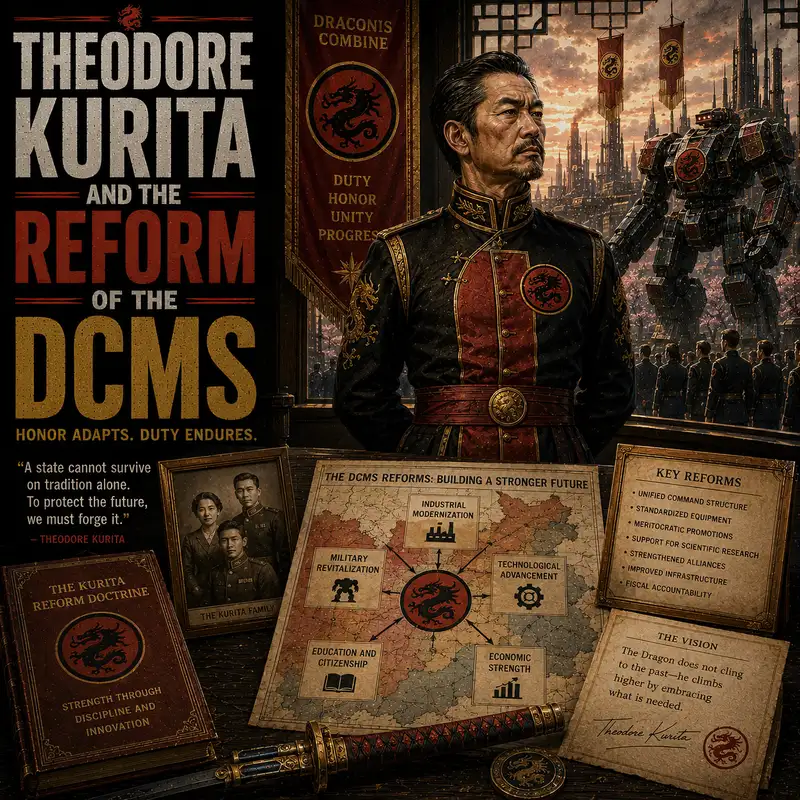
Theodore Kurita and the Reform of the DCMS
In July of the year thirty thirty-nine, Theodore Kurita sent the equivalent of only ten BattleMech battalions into Federated Commonwealth territory and encouraged the enemy to believe they were full regiments advancing toward Robinson. The Draconis Combine was already stretched close to its limit. If Hanse Davion recognized the deception, the invading armies could resume their advance and overwhelm the remaining reserves. Theodore led one of the raiding battalions himself. He was gambling the survival of the state on his enemy mistaking movement for strength.
The plan was called Operation Orochi, and almost nothing about it resembled the traditional image of the Draconis Combine Mustered Soldiery. It did not seek a decisive frontal engagement. It relied on concealment, merchant JumpShips, dispersed raids, and a careful exaggeration of force. Retreating units were not ordered to die merely because they had lost ground. Irregular formations and people once considered unsuitable for honorable service carried much of the burden. Theodore had not abandoned bushido. He had redefined what honorable service was supposed to accomplish.
The military he inherited possessed real strengths. Combine troops were disciplined, aggressive, and capable of enduring punishment that would break many opponents. Elite formations such as the Sword of Light regiments carried formidable traditions, while academies produced officers trained to obey, attack, and accept personal responsibility. Those virtues could become liabilities. Commanders often favored assaults against the enemy's center, treated withdrawal as disgrace, and sometimes chose ritual death after failure when the state still needed their experience.
Institutional suspicion made the problem worse. Officers competed for the Coordinator's favor and worried that independent judgment could be interpreted as disloyalty. A commander who followed a bad order exactly might be safer politically than one who altered it and won. BattleMechs received prestige and resources while infantry, armor, aerospace forces, engineers, and logistics were treated as supporting scenery. The Combine could produce fierce tactical attacks while wasting the combined-arms structure needed to turn those attacks into campaigns.
Theodore understood that culture from the inside. Born in the year twenty-nine ninety-seven, he was the only son of Coordinator Takashi Kurita and the heir to House Kurita. He studied at the Sun Zhang MechWarrior Academy, where Minobu Tetsuhara was among his instructors, and completed advanced military education at the Wisdom of the Dragon. He finished at the top of his class. Takashi responded by questioning whether favoritism had helped him and punished one of the teachers associated with his success. The relationship between father and son rarely suffered from excessive reassurance.
Early service placed Theodore in line units and staff positions, including duty with the Dieron Military District. He learned how orders moved through the Combine, how district warlords guarded authority, and how intelligence could become a weapon in internal politics. In the year thirty twenty-four, after another dispute with Takashi, he was sent to command the Legions of Vega. The assignment was intended to isolate him in a formation with almost no prestige and even less political influence.
The Legions were a dumping ground for misfits, disgraced warriors, troublesome mercenaries, and soldiers who had failed to die in the approved manner. They received poor equipment, delayed parts, and intense surveillance from the Internal Security Force. Their MechWarriors were often paid by mission rather than through normal salaries, and the procurement bureaucracy placed them below units it already regarded with contempt. The government expected them to absorb losses. Continued survival was almost an administrative error.
Theodore turned that neglect into freedom. Since respectable officers were not expected to imitate the Legions, he could test methods that traditional formations dismissed as dishonorable. He encouraged maneuver around strong positions, local initiative, planned withdrawal, and the close integration of BattleMechs with armor, infantry, aerospace fighters, artillery, and engineers. A commander was expected to preserve combat power when an objective no longer justified the losses. The Dragon benefited more from a veteran returning with a damaged regiment than from a beautifully documented collective suicide.
Combined arms was not a fashionable phrase in Theodore's system. It answered practical weaknesses. Light BattleMechs could reconnoiter and exploit openings, but they could not hold every city or protect every supply route. Tanks carried heavy firepower more cheaply. Infantry secured terrain, guarded repair areas, and found enemies hiding where a BattleMech pilot could not see them. Aerospace forces controlled landings and punished exposed columns. Technicians and recovery crews determined whether yesterday's casualties became tomorrow's reinforcements.
The Legions improved because Theodore also changed the meaning of failure. A warrior sent to Vega could earn redemption through competent service rather than seeking a dramatic death at the first opportunity. That created an incentive to learn, cooperate, and survive. It did not make the units orderly overnight, and their supply problems remained severe. It gave men and women written off by the institution a reason to believe performance might matter more than reputation.
The Fourth Succession War tested that idea. Lyran forces struck across the Combine frontier in Operation Götterdämmerung and initially gained ground with unexpected speed. Theodore's Legions helped defend Vega and showed that flexible movement could frustrate a stronger attacker. When local conditions made a position untenable, units broke contact rather than remaining in place for ceremonial destruction. They counterattacked where the Lyran line was thin and preserved enough strength to fight again.
Theodore later exploited political disorder inside the Lyran Commonwealth. Duke Aldo Lestrade of Skye weakened sections of the front while pursuing his own separatist goals. Theodore used the opening to strike worlds near Skye and threaten the regional capital. Katrina Steiner had to commit important reserves to stop him. The counteroffensive did not reverse every Combine loss, but it demonstrated that an army suffering strategic defeat could still create operational problems if its commander recognized where the enemy's politics had opened a flank.
By the end of the war, Takashi could no longer dismiss his son's military reputation. Theodore had preserved Vega, coordinated counterattacks, and succeeded where several district commanders had failed. By the year thirty thirty-one, he had become Gunji-no-Kanrei, the deputy for military affairs and effective professional head of the Combine military. Takashi remained Coordinator and retained supreme authority. The son now possessed enough institutional power to reform the army while remaining answerable to a father who regarded many of those reforms as dangerously soft.
Theodore proceeded carefully. He did not issue one proclamation announcing that centuries of military culture had been mistaken. He created units whose performance could make the argument for him. The Genyosha combined elite status with tactical initiative. The Ryuken, trained in the methods of Wolf's Dragoons, emphasized mobility, permanent support elements, and commanders expected to think beyond the next formal order. The Legions of Vega became a path of rehabilitation rather than a disposal site.
The Ryuken were especially important because their history exposed both the promise and cost of reform. Takashi had ordered their creation after observing Wolf's Dragoons, and Minobu Tetsuhara supervised their training. Four Ryuken regiments were nearly destroyed at Misery while serving political vendettas and divided leadership. Theodore rebuilt the survivors instead of treating their defeat as permanent disgrace. Their doctrine respected reconnaissance, terrain, logistics, and attached conventional forces. They became evidence that a unit could fail catastrophically, learn, and return stronger.
This approach challenged the traditional promotion system. Theodore needed officers who could adapt, not merely recite the proper answer before a superior. He encouraged merit and useful initiative, though he never removed political loyalty from the calculation. He also accepted capable people from backgrounds the old military distrusted. Reform in the Combine did not mean that prejudice vanished. It meant the state had become frightened enough to notice how much talent prejudice was wasting.
The manpower crisis after the Fourth Succession War forced the issue. Many regular regiments had been destroyed or badly damaged. The Federated Commonwealth alliance was growing stronger, and another invasion appeared inevitable. Military academies could not produce enough experienced MechWarriors quickly without lowering standards. Theodore therefore accepted an idea associated with Michi Noketsuna and negotiated with the yakuza, the criminal organizations whose networks reached deeply into Combine society.
The resulting Ghost Regiments recruited from the yakuza, lower social classes, women, and others normally kept outside the preferred military path. The formations were concealed from the official rolls to surprise future enemies. Their backers supplied money, personnel, equipment, and access to merchant transport. Theodore gained new regiments without asking the existing academy system or procurement bureaucracy to admit that its assumptions had failed.
The bargain carried serious risks. Ghost units often remained loyal to the oyabun who had raised them as well as to the Coordinator. Procurement officers denied them equipment, forcing some to use black markets and criminal connections for supply. Discipline varied widely. Some regiments fought with skill and devotion. Others looted, pursued private interests, or behaved like armed extensions of their sponsors. Theodore had expanded the state's military power by formalizing a relationship with organizations the state officially condemned.
That contradiction was typical of his reform program. He was pragmatic, not liberal. He did not recruit marginalized citizens because he had rejected the Combine's hierarchy in principle. He recruited them because the Dragon needed soldiers. The opportunity was real for the people who entered the new units, and so was the exploitation. The state offered recognition in exchange for service under conditions that could leave a Ghost regiment unsupported when respectable formations received the last replacement parts.
Rebuilding also required machines. Combine industry developed or restored designs suited to the coming war, including the Hatamoto-Chi and improved versions of older BattleMechs. The Helm Memory Core helped researchers recover technical knowledge, while surviving factories expanded where possible. Theodore understood that doctrine without production becomes a collection of excellent suggestions. New regiments needed weapons, vehicles, ammunition, DropShips, technicians, and the industrial capacity to replace losses.
His most audacious logistical bargain came through ComStar and the creation of the Free Rasalhague Republic. Myndo Waterly wanted a neutral buffer that would weaken the Federated Commonwealth and preserve ComStar's influence. Theodore wanted to shorten the Lyran frontier, remove a persistent insurgency, and acquire equipment. He agreed to release much of the Rasalhague Military District. In return, the Combine received political support, intelligence advantages, lower communications costs, and Star League-era BattleMechs from ComStar's hidden stores.
The arrangement was strategically brilliant and morally complicated. Rasalhagians gained a genuine independent state after centuries of occupation, but their borders were negotiated by larger powers pursuing their own interests. Theodore retained selected worlds and converted the remaining territory into a buffer. The Lyrans were pressured to surrender many of the worlds they had taken during the Fourth Succession War. House Kurita lost territory while improving its defensive geometry and military inventory.
Not every Combine soldier accepted the decision. Several formations refused to leave Rasalhague and became the ronin of the Ronin War. Theodore denounced them and personally led loyal forces back into the new republic after its government requested assistance. The campaign removed disobedient units and demonstrated that reform would be enforced by force when necessary. Theodore's version of flexibility did not extend to officers deciding that the Coordinator's heir lacked authority.
By the late thirty thirties, Hanse Davion believed the Combine remained weakened by defeat, secession, and internal conflict. Theodore encouraged that judgment. Many Ghost Regiments stayed hidden. ComStar-supplied BattleMechs and recovered technology were not displayed more widely than necessary. The Free Rasalhague Republic covered much of the former Lyran frontier, while the remaining border forces prepared for attacks through the Dieron, Benjamin, and Galedon districts.
The Federated Commonwealth invaded in April of the year thirty thirty-nine. Its forces struck numerous worlds, captured important positions, and initially drove back garrisons that appeared unable to resist. On several planets, Combine units withdrew after limited fighting. Under older expectations, those retreats might have been treated as proof of collapse. Theodore saw them as the first stage of a defense designed to preserve formations until the attackers dispersed, consumed supplies, and committed reserves to occupation.
Vega provided the clearest demonstration. Federated Commonwealth troops overwhelmed organized resistance and took the world, while the Legions of Vega withdrew rather than die in place. Several months later, the Legions returned with Dieron Regulars and retook the planet. The Fourteenth Legion was effectively destroyed in the process, and other units suffered heavily. The result was not bloodless maneuver. It was a counterattack made possible because enough experienced troops had survived the first battle to conduct a second.
Across the front, the attackers encountered BattleMechs they had not expected to see, some carrying technology associated with the Star League. Ghost Regiments appeared where intelligence estimates showed no corresponding units. Ryuken formations raided through the Terran Corridor. Combine commanders used local counterattacks, infiltration, and disrupted communications to isolate occupied worlds. The surprises did not produce effortless victories. Several Ghost units were mauled because enthusiasm and secrecy could not replace discipline. They created uncertainty at exactly the moment the invaders needed confidence.
Theodore knew that defensive success alone would not be enough. The Federated Commonwealth possessed greater reserves and could renew its advance if the war became a contest of replacement. Operation Orochi was his answer. Ten BattleMech battalions, supported by mercenaries, would raid ten enemy worlds and masquerade as a much larger invasion force moving toward Robinson. Theodore used a command circuit of merchant JumpShips, many tied to the yakuza, to carry the raiders through uncolonized systems and maintain the illusion of rapid concentration.
He joined the operation with a battalion of the Ryuken. The decision exposed the state's military leader to capture or death, but it also ensured that local commanders understood the purpose of the gamble. They were not expected to conquer every target. They were expected to move, strike, disappear, and make every report sound like the leading edge of something larger. A battalion that remained to defend captured ground would reveal its size. A battalion that kept moving could become several regiments in the enemy's imagination.
Some raiding groups were destroyed or driven off. Others caused enough damage and confusion to reinforce the deception. At the same time, Combine forces counterattacked across occupied worlds, while separate Dieron operations captured Fomalhaut and Quentin. Quentin was especially valuable because Independence Weaponry produced assault BattleMechs favored by House Davion. The Combine had not merely stopped retreating. It had taken an important factory world inside enemy territory.
Hanse halted the offensive rather than risk a deeper war against a Combine that appeared capable of defending its borders and launching a counterinvasion. The Exeter Accords suspended hostilities in January of the year thirty forty. Only a limited number of worlds changed hands. The Federated Commonwealth had committed a powerful coalition to destroy an apparently weakened enemy and gained little. The Combine emerged with restored prestige and the image of military strength.
The image was larger than the reality. Operation Orochi had dangerously overextended the Combine. Merchant shipping had been seized for military use, damaging the economy and disrupting ordinary commerce. Reserves were thin, several reform units had taken severe losses, and some successful counterattacks could not have been repeated. If Hanse had recognized that the raiding battalions were not full regiments and resumed the invasion, Theodore might not have possessed another answer.
That was why the War of thirty thirty-nine validated the reforms without proving the Combine invulnerable. Theodore had created an army capable of surviving mistakes, preserving units, using irregular manpower, integrating support forces, and turning deception into operational effect. He had not created unlimited resources. His military won because it made the enemy believe the next line of resistance was stronger than it was and because enough commanders understood that their duty was to keep the campaign alive rather than die on the first line.
The reforms did not transform the Draconis Combine into an open society. The Coordinator still ruled through hereditary authority. The Internal Security Force watched officers and civilians. Occupied populations and political dissidents still faced repression. Traditionalists remained powerful, and many regarded the Ghost Regiments, the Ryuken, and Theodore's interpretation of bushido as corruption. The later Black Dragon movement would build much of its appeal around restoring the older vision he had challenged.
Nor did Theodore reject honor. He made honor answer to strategic purpose. A retreat could be honorable if it preserved the regiment. Combined arms could be honorable if it won the campaign. A disgraced officer could recover honor through competent service. A person from the wrong class or background could serve if the state needed the skill. This was a conservative reform in the most literal sense. Theodore changed the institution so the institution could survive.
The War of thirty thirty-nine also changed his relationship with Takashi. The old Coordinator had resisted his son's methods, but he could not ignore a victory that saved the Combine from a larger enemy. Father and son presented a more unified public front afterward, though Takashi remained on the Chrysanthemum Throne until the year thirty fifty-four. Theodore possessed military authority long before he possessed supreme political authority. His reforms succeeded because he built results that even his father had to accept.
Their value became clearer when the Clans invaded in the year thirty fifty. Theodore used deception and terrain at Wolcott, accepted cooperation with former enemies, and organized the defense of Luthien with regular troops, mercenaries, aerospace forces, armor, infantry, and allies House Kurita had once sworn to destroy. Those later victories did not emerge from a sudden abandonment of tradition. They were the mature form of lessons first tested among the unwanted soldiers on Vega.
Theodore Kurita reformed the Draconis Combine Mustered Soldiery by changing the military meaning of loyalty. Under the old system, loyalty was often proven through obedience and death. Under his system, it was proven by preserving the Dragon's ability to fight. That allowed commanders to retreat, technicians to matter, outcasts to become regiments, criminals to become logisticians, and ten battalions to appear large enough to stop an invasion. The reformed DCMS survived because Theodore taught it that dying correctly was less useful than returning with a plan for the next battle.