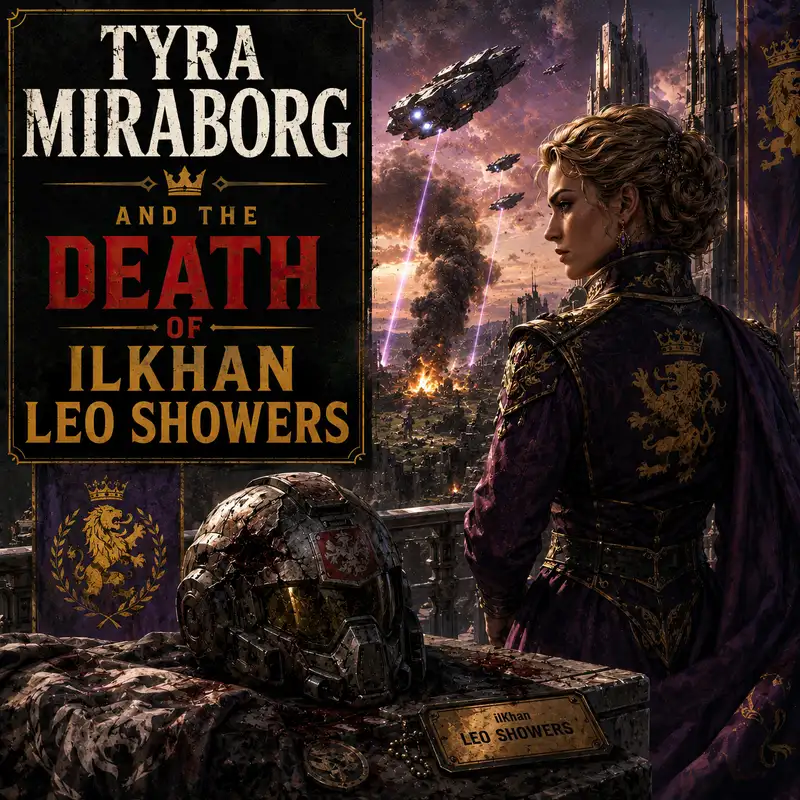
Tyra Miraborg and the Death of ilKhan Leo Showers
By the time Tyra Miraborg turned her Shilone toward the bridge of the Dire Wolf, her mission had already succeeded. The JumpShip Norseman, carrying Elected Prince Haakon Magnusson, had vanished from Radstadt using a stored jump charge. The Flying Drakøns had bought the minutes required for that escape. Tyra’s fighter was crippled, Clan interceptors were closing, and recovery was no longer realistic. She could spend her final seconds trying to survive, or spend the aircraft against the nearest threat to her Prince. She chose the second option. The collision killed ilKhan Leo Showers and stopped Operation Revival for nearly a year. Tyra had launched to save one ship. She struck the command structure of the entire invasion.
Popular memory often compresses Radstadt into a simple statement: one pilot saved the Inner Sphere. That is close enough for a memorial and not quite sufficient for military history. Tyra’s attack mattered because the Clans had concentrated senior political authority aboard one WarShip, because their rival invasion corridors required an ilKhan to settle disputes, and because replacing him required the Bloodnamed leadership to return to the Clan Homeworlds. Remove any of those conditions and the ramming remains an extraordinary sacrifice with local consequences. With all of them present, a damaged sixty-five-ton fighter became more disruptive than a victorious regiment.
Tyra came from Gunzburg, a world whose independence had been purchased through upheaval rather than ceremony. Her father, Tor Miraborg, helped restore order after the Free Rasalhague Republic separated from the Draconis Combine. The effort left him scarred, physically damaged, and deeply embittered after a mercenary command broke its contract on technical grounds. Gunzburg remembered Tor as the Iron Jarl, a symbol of national endurance. Tyra grew up inside that public legend and inside the more difficult private reality of a father whose pain hardened into distrust. She joined the Gunzburg Eagles and rose to the Rasalhagian rank of Kapten in its aerospace arm.
Her encounter with Phelan Kell exposed a life beyond Gunzburg. Phelan belonged to the Kell Hounds, exactly the kind of mercenary organization Tor had taught his world to mistrust. Tyra and Phelan formed a brief relationship before their identities and obligations caught up with them. She declined the path he offered, but she did not remain where she had been. Tyra transferred to the First Rasalhague Drakøns and joined the honor guard of Elected Prince Haakon Magnusson. The decision placed her at the center of the Republic’s collapse. It also created one of Radstadt’s sharpest ironies. Phelan would later stand inside the WarShip she struck.
The Flying Drakøns were the aerospace wing of the First Drakøns, not an ornamental escort attached to a ceremonial ruler. Their pilots had to screen DropShips, contest landing zones, strike ground targets, and protect the government’s movement across space. Tyra flew a Shilone, a sixty-five-ton medium aerospace fighter developed in the Draconis Combine. It carried heavier weapons and protection than many fighters in its class, with missiles and lasers suited to several engagement ranges. It was a capable military aircraft. It was not designed to duel Clan OmniFighters on equal terms, and it was certainly not intended to attack an eight-hundred-thirty-thousand-ton heavy cruiser.
Tyra had already demonstrated that she was more than a well-connected officer. When Clan Ghost Bear struck Thule during the opening phase of the invasion, she destroyed a Jengiz Prime, generally recorded as the first known Clan fighter kill by an Inner Sphere pilot. The action did not reverse the battle, but it proved that Clan aerospace machines could be caught and killed. The Flying Drakøns escaped and were recalled to Rasalhague, where Clan Wolf was moving against the Republic’s capital. Tyra arrived in time to see the defense become an evacuation.
Clan Wolf’s attack had been shaped partly by Phelan Kell, by then a bondsman advising Khan Ulric Kerensky. Phelan understood that an indirect approach toward the unfinished city of Asgard would encourage Magnusson to flee Reykjavik and take his elite aerospace guard with him. The plan worked. The Flying Drakøns covered the Prince’s departure, then followed because they were low on fuel and under pressure from Clan fighters. Their withdrawal weakened the capital’s defense, but it preserved the constitutional head of a government whose territory was being torn apart. Strategic choices are often less satisfying when both available outcomes are losses.
Magnusson’s destination was Radstadt, an important provincial capital still believed to be in friendly hands. The Elected Prince traveled aboard the Norseman, a modified Star Lord-class JumpShip escorted by three smaller JumpShips, combat DropShips, and the Flying Drakøns. The flotilla avoided inhabited systems to reduce the chance of interception. Then machinery imposed its own campaign plan. The Norseman suffered serious drive and power failures twice, forcing weeks of repair. The ships spent roughly two months moving through empty systems and became so overdue that the KungsArmé listed the Flying Drakøns as missing in action.
Those delays changed the destination without changing the coordinates. While the flotilla repaired itself, Clan Wolf captured Radstadt. The Rasalhagians did not know. Reliable interstellar warning required functioning hyperpulse communications, friendly stations, and routes that had not been cut by an invasion. The convoy had deliberately chosen isolation for security and paid for it with ignorance. When the Norseman finally prepared to jump into Radstadt on October thirty-first, in the year thirty fifty, its passengers expected refuge. They entered a system containing the deepest Clan advance toward Terra and a gathering of senior enemy leaders.
Leo Showers had created that gathering. The Smoke Jaguar Khan had used the discovery of the Outbound Light to force the long Clan debate over returning to the Inner Sphere toward invasion. As ilKhan, he divided the offensive into corridors and tried to keep the participating Clans moving toward a common objective. He also traveled aboard Clan Wolf’s flagship rather than his own. The choice let him monitor Ulric Kerensky, the Warden Khan who had opposed Operation Revival and whose forces were now outperforming the Crusader Clans that had demanded it.
By the fourth wave, Showers had reasons to be angry. Clan Wolf had advanced farther and faster than its rivals. Smoke Jaguar had suffered a humiliating defeat at Wolcott. Jade Falcon had lost the Falcon Guards at Twycross. The campaign still favored the Clans, but its internal competition was producing the wrong political winner. Showers called a Grand Kurultai to consider the invasion and, according to most accounts, to censure or restrain Ulric. The meeting would take place aboard the Dire Wolf near newly conquered Radstadt. A war council intended to repair Clan unity concentrated that unity’s fragile leadership in one place.
Ulric obtained an important condition. Other Khans were not to arrive in vessels as large as the Dire Wolf. The official reasoning was security. A collection of major WarShips would advertise the presence of the Clan leadership and tempt an attack. The less official advantage was that Clan Wolf would control the strongest vessel if political argument turned into something less parliamentary. Showers accepted. Hours before the council, the Sovetskii Soyuz-class heavy cruiser arrived at Radstadt’s nadir jump point with its escorts. Moments later, the Norseman and the Rasalhagian flotilla appeared only minutes away.
Both groups were surprised, but surprise does not remove the need for someone to act first. Major Cnut Bernadotte, commander of the Flying Drakøns, ordered the aerospace wing and combat DropShips against the Dire Wolf. The target was not selected because anyone knew Leo Showers stood on its bridge. It was the closest and most dangerous WarShip threatening the Elected Prince. Twenty-four fighters and five combat DropShips accelerated toward the Clan flagship. Some DropShips opened their cargo bays so BattleMechs could fire from the doors. It was not elegant naval doctrine. Elegance had become a secondary requirement.
The Norseman possessed the feature that made escape possible: a lithium-fusion battery containing an additional charge for its Kearny-Fuchida drive. An ordinary JumpShip arriving in a system normally needs days to collect enough energy for another interstellar jump. The stored charge allowed the Norseman to jump again without that long recharge, but its crew still needed time to plot a safe destination and prepare the drive. The Flying Drakøns were buying that time. They could not expect to return after the JumpShip left. Their recovery platform would be gone, and Clan fighters would control the jump point.
The opening attack caught the Dire Wolf unprepared. Rasalhagian fighters crossed close to the hull, using the ship’s surface and their own speed to complicate defensive fire. Their first passes damaged the WarShip and struck the defenders trying to organize along it. Clan OmniMechs were moved onto the outer hull to engage the attackers, an unusual answer to an equally unusual assault. Inside the bridge, Showers, Ulric, and the command crew watched through the ship’s tactical displays while the Golden Keshik struggled to launch its fighter screen.
The imbalance soon reasserted itself. The Dire Wolf was a Star League heavy cruiser maintained and upgraded by Clan Wolf. Its weapons could tear apart capital vessels, while its armor and structure were built to survive attacks far beyond what a Shilone could deliver. Golden Keshik OmniFighters entered the battle, and reinforcements from other Clan ships began closing. Each Drakøn pass became more expensive. The Rasalhagians were not defeating the fleet. They were converting aircraft, DropShips, and trained crews into minutes on a navigator’s clock.
Then the Norseman jumped. One moment the vessel carrying Magnusson and the surviving government was present. The next, the Kearny-Fuchida drive removed it from the system. The escort mission had succeeded, but success left the Flying Drakøns without a place to land and without enough force to break away. The surviving pilots made another attack. Seven fighters under Tyra’s leadership completed additional strafing runs before most were disabled or destroyed. Her Shilone took severe damage, and Tyra herself was wounded.
The surviving accounts support a deliberate final decision, though they do not establish that Tyra knew who occupied the bridge. She turned the damaged Shilone toward the Dire Wolf, removed the engine restraints, and drove the fighter at full power into the command section. The armored hull absorbed much of the impact, but not all of it. The Shilone punched through near the bridge, filled the compartment with blast damage and shrapnel, and opened the area to decompression. Showers and many others were killed. Ulric was badly injured. The fighter and its pilot were destroyed.
Phelan Kell and ComStar’s Precentor Martial Anastasius Focht were near the bridge when the impact threw them down. A temporary HarJel seal held atmosphere inside the damaged compartment, but it was failing. Phelan helped force access and pulled Ulric and another officer clear before the barrier gave way. Tyra and Phelan had once met on Gunzburg as young people imagining futures beyond the expectations surrounding them. At Radstadt, without meeting or necessarily knowing the other was present, she killed the ilKhan outside the hull while he saved the future ilKhan inside it.
That coincidence should not turn the battle into a romance written by destiny. Tyra’s military objective was concrete. She protected Magnusson and attacked the enemy flagship after escape became impossible. Phelan’s objective was equally immediate. He rescued wounded people from a decompression hazard. Their earlier relationship gives the event human symmetry, but neither action requires an invented private speech or a final realization. The record is powerful enough without adding one.
Showers’s death mattered because Operation Revival was not directed by a conventional unified headquarters. Each invading Clan remained politically sovereign, commanded its own corridor, guarded its prestige, and competed to reach Terra first. The ilKhan could coordinate the invasion and arbitrate disputes among Khans who did not accept permanent subordination to one another. Showers was not a magical key whose death disabled every Clan unit. He was the recognized authority holding a coalition of rivals together. Removing him created a constitutional and command problem at the same time.
The surviving Khans first demanded vengeance. Ulric reportedly answered by asking whom they intended to punish. The pilot responsible was dead, the Prince had escaped, and the Rasalhagian ships left behind had already paid heavily. Anger could produce another bombardment or raid, but it could not choose a lawful ilKhan. SaKhan Perigard Zalman of Clan Steel Viper emphasized the practical point. The invasion needed a supreme commander, and the election required participation by the Bloodnamed warriors through Clan institutions centered on Strana Mechty.
The Khans therefore agreed to withdraw the senior Bloodnamed leadership to the Homeworlds. Non-Bloodnamed forces and second-line units remained to hold the occupation zones, supported in places by ComStar’s administrative arrangements. The main advance stopped. The Clans departed in December and did not resume the offensive until the following autumn. The pause became known as the Year of Peace, although the name is more useful from a strategic map than from an occupied town. Resistance, reprisals, garrison duty, and fear continued behind the halted front.
The Inner Sphere did not immediately understand what had happened. Great House leaders expected the assault to resume from another direction and were cautious about committing battered armies to a premature counteroffensive. When the new blows failed to arrive, they began rebuilding units, moving supplies, studying captured equipment, and reorganizing defenses. In January of the year thirty fifty-one, Wolf’s Dragoons gathered senior leaders on Outreach and explained the Clans’ origins, organization, technology, and customs. Tyra had not provided that knowledge. She had provided the time in which it could be used.
Time changed the military problem. Factories replaced losses. Commanders distributed reports from Twycross, Wolcott, and other battles. Defenders learned to exploit terrain, concentrate fire, protect logistics, and avoid treating the batchall as a binding invitation to be destroyed politely. Political enemies began coordinating because the invasion threatened all of them. None of this eliminated the Clan advantage. It meant the next wave would meet forces that understood what an OmniMech was, what Elementals could do, and why isolated planetary defenses had failed.
The delay also changed Clan politics in a way Showers would have disliked. Crusader Khans tried to blame Ulric for the ilKhan’s death. Phelan’s testimony helped defeat the charge. The Crusaders then supported Ulric for ilKhan, expecting the office to bind a Warden to carry out the invasion ordered by the Grand Council. Ulric was elected after months of political struggle. Showers had called the meeting at Radstadt partly to restrain Clan Wolf. His death eventually elevated Wolf’s Khan to supreme command.
It is tempting to claim that Tyra single-handedly saved the Inner Sphere. Counterfactual history should be handled more carefully. The Clans still occupied a vast corridor, still possessed superior technology, and returned with additional forces. Their campaign later threatened Luthien and reached Tukayyid. Tyra did not defeat Operation Revival at Radstadt. She broke its tempo. In a campaign built around speed, surprise, and the belief that defenders could not adapt quickly enough, nearly a year was a strategic resource of enormous value.
Her sacrifice also preserved the Free Rasalhague Republic’s government in exile. Magnusson survived aboard the Norseman, allowing the shattered state to retain constitutional continuity after losing most of its territory and its capital. That survival did not restore the Republic’s worlds or rebuild the KungsArmé. It gave refugees, surviving officials, and remaining planets a recognized government around which to organize. Tyra’s mission was therefore successful before the Dire Wolf’s bridge was struck. The death of Showers multiplied an achievement that already mattered to her own people.
The Flying Drakøns deserve a place beside her in that memory. Major Bernadotte and the other pilots attacked knowing their carrier and JumpShip would leave if they succeeded. DropShip crews brought large vessels into capital-scale fire. BattleMech crews fired from open bays into space because every weapon that distracted the Dire Wolf bought another moment. Tyra delivered the blow history remembers, but the approach to the bridge was created by a unit spending itself together. Heroic biography can illuminate war. It can also narrow the frame until everyone outside the famous cockpit disappears.
Later Rasalhagian institutions carried Tyra’s name, including a military academy known especially for aerospace training. Clan Smoke Jaguar remembered Showers through its own martial tradition as the Crusader leader who had shown the path toward Terra and died pursuing it. The same collision therefore became two political memories. For Rasalhague, it represented sacrifice against conquest. For the Jaguars, it represented a martyred ilKhan and a grievance against the Inner Sphere. Memory preserved the dead and continued the argument they had died inside.
The most revealing fact at Radstadt is not that a fighter could damage a WarShip. Space combat always allows a small craft, enough velocity, and an exposed system to create disproportionate harm. The revealing fact is that Leo Showers had placed himself aboard the flagship of the rival he intended to discipline, at a meeting designed to manage a coalition whose unity depended heavily on his office. Tyra found the physical vulnerability. Clan politics supplied the strategic one.
Tyra Miraborg did not leave Gunzburg intending to become the pilot who interrupted the Clan invasion. At Radstadt, she faced a narrower duty: protect the Norseman, keep the Elected Prince alive, and make the enemy pay for the time required. She completed that mission, then turned a crippled Shilone toward the largest target in front of her. The fighter could not destroy an eight-hundred-thirty-thousand-ton cruiser. It did not need to. It struck one bridge, killed one ilKhan, and gave a divided Inner Sphere the one resource Operation Revival had been designed to deny it: time.