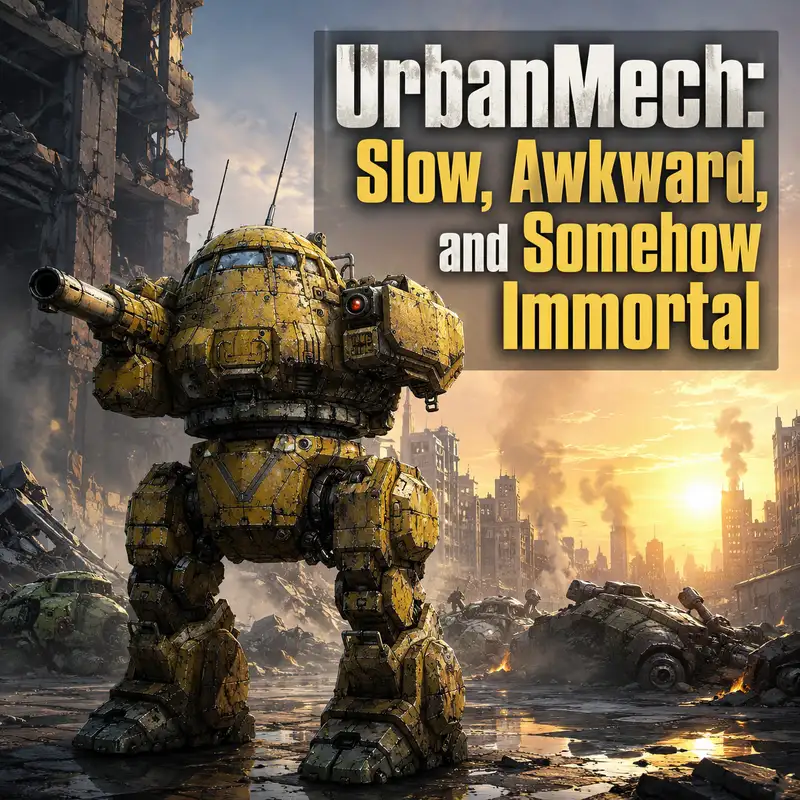
UrbanMech: Slow, Awkward, and Somehow Immortal
A raiding force entering a city can make one dangerous mistake before the first shot is fired. It can assume that anything slow enough to hide behind a warehouse is also too slow to matter. Then a squat thirty-ton BattleMech steps from an alley, fires an autocannon into the lead vehicle, and disappears behind concrete before the escorts can bring their weapons around. The machine does not pursue. It does not need to. Its job is to make every intersection, parking structure, rail yard, and factory courtyard feel like the mouth of a gun barrel. That machine is the UrbanMech, and its history rests on a contradiction. It is one of the least mobile BattleMechs ever placed in regular service, yet it has survived for centuries in a military culture that usually treats speed as life.
The UrbanMech endured because it was never intended to behave like a normal light BattleMech. A Locust scouts. A Wasp jumps ahead of the formation. A Jenner uses speed to create a brief attack advantage. The UrbanMech was designed as a defensive weapon for built-up terrain, closer in purpose to a mobile bunker than a cavalry scout. Its designers accepted humiliating speed because city streets, walls, towers, and industrial obstacles already limited movement. They spent the saved mass on armor and a weapon heavy enough to punish enemies who entered the wrong firing lane. Outside that environment, the compromise looked absurd. Inside it, the machine could be economical, dangerous, and extremely difficult to remove without damaging the city it defended.
Orguss Industries introduced the standard UrbanMech in the year twenty-six seventy-five. The company operated from Marcus and built the machine for the defense of Star League cities, where garrisons faced guerrillas, raiders, light BattleMechs, and civil disturbances rather than open-field maneuver armies. The requirement did not call for a glamorous machine. It called for something cheap enough to issue in numbers, durable enough to remain at a local post, and powerful enough to stop a fast intruder before that intruder reached a command center or power plant. The resulting design was brutally focused. It offered almost nothing a commander wanted in a pursuit force. It offered several things a city defender needed, provided the defender understood the map and had no intention of chasing anyone beyond it.
At thirty tons, the UrbanMech sat near the upper end of the light class. Its Leenex sixty fusion engine was exceptionally small for the chassis. The machine cruised at little more than twenty-one kilometers per hour and could reach only about thirty-two kilometers per hour at maximum ground speed. That was slow enough for many combat vehicles to outpace it and slow enough for almost every enemy BattleMech to choose whether to engage or withdraw. Two jump jets allowed the UrbanMech to cross roughly sixty meters in a bound. This did not make it agile in the usual sense. It gave the pilot a way to clear a wall, cross a blocked street, rise onto a low structure, or retreat through terrain that might delay a heavier pursuer.
Those jump jets were more important than their limited range suggests. Urban combat is not simply open battle with buildings added. Streets channel movement. Rubble blocks routes. Collapsed overpasses turn a direct approach into a long detour. A machine that cannot run quickly may still gain a local mobility advantage by crossing one obstacle the enemy must go around. The UrbanMech could jump from cover to cover, change levels, or escape a threatened position without exposing itself for the entire distance. It could not redeploy across a city quickly once the enemy shifted the main effort. That remained a serious weakness. A defense commander had to place UrbanMechs where the attack was likely to come, because the machines would not correct a poor estimate by racing to the opposite district.
Six tons of armor gave the standard model protection that compared favorably with many lighter and even some medium BattleMechs. That armor did not make the machine invulnerable. Repeated heavy fire could destroy it, and close urban ranges often meant shots landed before a pilot had much time to react. The armor did provide enough staying power to survive return fire after an ambush and reach the next position. The chassis was narrow and low by BattleMech standards, making it easier to conceal among buildings. Its arms were minimal, with no hands for lifting cargo, clearing debris, or handling field equipment. The UrbanMech could fight in a city, but it was not particularly helpful when the city needed engineering work after the fighting stopped. Its torso could traverse through an unusually wide arc, helping the pilot follow targets in confined streets without turning the entire chassis. Some adaptations exaggerate that advantage into continuous full rotation.
The standard weapon was an Imperator B autocannon mounted in the right arm. It delivered the destructive effect associated with a class ten autocannon, enough to rip through light armor, cripple combat vehicles, and force medium BattleMechs to respect the threat. A small laser in the left arm provided a limited backup weapon and a way to suppress exposed infantry at close range. The weapons were not balanced for a long independent mission. They were balanced for an ambush. The pilot waited until a target entered a prepared lane, fired the autocannon, and displaced before the enemy organized a response. Against a careless light BattleMech, one solid hit could decide the engagement. Against a heavier machine, several UrbanMechs could attack from separated positions and make every turn expose a different side.
A single ton of autocannon ammunition gave the UrbanMech only ten main-gun shots. That shortage defined the machine’s endurance more clearly than heat. Eleven conventional heat sinks were more than sufficient for the original weapons under normal conditions. The pilot could fire without the difficult thermal choices imposed by many laser-heavy BattleMechs. The more pressing question was whether a target deserved one of the ten rounds. A nervous pilot who fired at poor angles could turn the UrbanMech into a slow platform armed mainly with a small laser. A disciplined pilot treated ammunition as part of the defensive plan. Specific intersections, bridges, and approach routes received priority. Everything else was someone else’s problem, preferably an infantry platoon’s.
UrbanMech lances were commonly employed as dispersed ambushers rather than as four machines standing together in a street. Individual BattleMechs occupied separate buildings or concealed positions and covered overlapping routes. After firing, they withdrew to another line, forcing the attacker to repeat the process. The tactic traded mobility across the city for familiarity within a prepared sector. Pilots needed surveyed firing points, known jump routes, demolition plans, and clear instructions about when to abandon a position. A machine that waited too long could be surrounded. One that withdrew too early surrendered the value of the terrain. The UrbanMech’s slow pace made discipline essential, because once the enemy passed behind it, the machine was unlikely to catch up and repair the tactical mistake. Infantry observers, engineers, mines, tanks, and artillery made the ambush network more effective. Once attackers located a position, they could suppress it, flank it, bypass it, or bring down the building around it. The UrbanMech needed a defensive system as much as that system needed its gun.
Cities also contain civilians, hospitals, transit systems, water plants, and industrial facilities whose destruction may defeat the purpose of defending them. The UrbanMech’s heavy direct-fire weapon could stop an attacker, but every missed shot still traveled into something. A defender using buildings as cover risked drawing return fire onto occupied structures. Retreat routes could become evacuation routes, and demolition plans could cut services to neighborhoods that had nowhere else to go. The machine’s design made sense for urban warfare, but it did not make urban warfare clean. A local commander still had to decide which districts could be sacrificed, which infrastructure had to survive, and whether preserving the city required fighting outside it before the UrbanMechs could contribute.
Its low cost was as important as its battlefield profile. Orguss began with a straightforward chassis, a small engine, conventional armor, and familiar weapons. A planetary government that could not afford a regiment of modern line BattleMechs might still afford a few UrbanMechs for the capital, major spaceport, or industrial zone. The design’s limited role also reduced some training demands. A pilot did not need to master high-speed reconnaissance or long-range maneuver. The pilot needed to know a sector in intimate detail and place accurate autocannon fire under pressure. Maintenance remained real. Jump jets, actuators, sensors, and the ammunition feed all required trained technicians. Cheap by BattleMech standards has never meant maintenance-free. It usually means the procurement meeting ends with fewer people leaving the room in despair.
Transport complicated the economic argument. A thirty-ton UrbanMech still occupied a BattleMech bay aboard a DropShip, the same specialized berth that might carry a much more capable medium or heavy machine. That made it unattractive for expeditionary forces. A commander paying to move combat power between worlds preferred a machine useful in more than one terrain type. The UrbanMech made better sense when it was already stationed where it would fight. Planetary militias, fixed garrisons, training commands, security forces, and reserve units could keep it near the city or installation it protected. Its weakness as an expeditionary asset became part of its strength as a local one. It stayed home, which is an excellent way for military equipment to avoid being destroyed in someone else’s offensive.
Orguss produced large numbers from its facilities on Marcus until the assembly lines were destroyed in the year twenty-eight thirty-seven. By then, the design had already spread widely enough that the loss of new production did not remove it from service. The Succession Wars devastated advanced industry and consumed countless BattleMechs in repeated campaigns. The UrbanMech survived partly because many senior officers did not want it near those campaigns. Armies placed the machines in garrisons, assigned them to secondary duties, cannibalized some for parts, and overlooked others in storage. Prestige machines were sent to the front and lost. The UrbanMech remained behind, performing uncelebrated work and waiting for the next inspection team to decide it was still not worth transporting.
Examples could be found in every Successor State, but the Capellan Confederation became the design’s most committed user. The Confederation suffered severe territorial and military losses during the Fourth Succession War. It needed BattleMechs to rebuild units and defend a reduced realm, and it could not afford to dismiss useful chassis merely because other states considered them embarrassing. UrbanMechs appeared in front-line and reserve formations, particularly within the Confederation Reserve Cavalry and the Capellan Defense Force. The Tikonov Republican Guard and the St. Ives Armored Cavalry also fielded significant numbers during their respective periods. Necessity turned a garrison machine into a line asset, although the laws of speed did not change merely because the personnel office had run out of alternatives. Outside the Confederation, the Federated Suns’ Capellan March Militia held many captured examples, a reminder that salvage can change the flag on a machine more easily than it changes the maintenance manual.
Capellan use also pushed the UrbanMech beyond its ideal conditions. On defensive worlds, in industrial centers, and around fixed objectives, the machine could still perform its intended role. In a mobile campaign, it became a burden. Faster formations had to slow down, leave the UrbanMechs behind, or assign them to protect supply areas. The Confederation’s decision was not irrational. A slow BattleMech guarding a depot could release a faster one for offensive operations. A reserve unit could hold a town long enough for reinforcements to arrive. The problem came when shortages encouraged commanders to treat availability as suitability. An UrbanMech ordered across open ground did not become a different machine. It simply became a target carrying a useful autocannon.
The most notorious modification was the R sixty L, associated with the Capellan Confederation. It replaced the standard autocannon with a class twenty weapon capable of inflicting catastrophic damage at close range. To make the heavier gun fit, the variant sacrificed two tons of armor. It carried only five main-gun rounds. The result was the UrbanMech’s philosophy pushed almost to parody without ceasing to be militarily serious. From a concealed position, the machine could destroy many light BattleMechs with one hit and maul a medium target. If it missed repeatedly, survived long enough to expend its ammunition, or was caught crossing open ground, the thinner armor made the pilot pay for the upgrade. The variant was an ambush weapon with almost no interest in a second phase.
Other early modifications tried to solve different problems. The R fifty removed the arms to reduce the machine’s silhouette, but the loss of already limited arm functions outweighed the benefit, and few survived. Field refits replaced lost autocannons with particle projection cannons and machine guns, or installed larger engines taken from Wasps and Stingers to improve speed. Those changes revealed how hard it was to repair the original compromise. A larger engine required a new gyroscope and consumed mass that had made the armor and weapon possible. Improving mobility meant redesigning the machine’s reason for existing. Many operators therefore accepted the slow engine and changed only the equipment around it.
The recovery of advanced technology produced the R sixty-three, an official Capellan upgrade distributed before the year thirty fifty. It replaced the standard autocannon with an L B ten X model and added a small pulse laser while retaining the original small laser. The new cannon improved flexibility, including the use of cluster ammunition against damaged armor, vehicles, or aerospace targets operating at low altitude. Yet the upgrade left the speed unchanged. That was not laziness. Replacing the engine would have been disproportionately expensive and would have consumed the mass needed for the machine’s defining protection and weapon. The Confederation chose to make the UrbanMech better at being an UrbanMech rather than spend heavily to create an inferior imitation of a faster scout.
Other states reached similar conclusions. A Draconis Combine variant replaced the autocannon with a thirty-tube medium-range missile system, giving the R sixty-eight a dangerous volley that surprised Clan Ghost Bear during the Combine and Ghost Bear War. The Free Worlds League developed the R sixty-nine with an ultra-class autocannon, gaining a higher potential rate of fire while making the ammunition problem even more severe. The Federated Suns created the R seventy with a rotary autocannon and improved energy weapons. Each state applied its own industrial preferences, yet none escaped the basic geometry. The machine remained slow, short-legged, and dependent on favorable terrain. Modern weapons made the ambush more violent. They did not make the UrbanMech a pursuit machine.
Later Capellan models leaned even more heavily into specialized defense. The R eighty added a snub-nose particle projection cannon, electronic warfare equipment, a targeting laser, an active probe, and improved jump jets. It could detect threats, disrupt enemy sensors, mark targets, and move through a city with slightly greater freedom. The R ninety-three carried a plasma rifle and an extraordinary mass of hardened armor, becoming tougher while reducing an already unimpressive ground pace. The R ninety-six combined hardened protection with a snub-nose cannon and improved jumping capability. These machines were not attempts to win beauty contests or reconnaissance races. They were designed to occupy a defensive sector, survive contact, and make an attacker spend far more time and ammunition than the defender had invested in the chassis.
Production itself returned during the Jihad. Hellespont Industrials reactivated its Betelgeuse facility while the Capellan Confederation and the wider Inner Sphere struggled with damaged industry and material shortages. The plant produced UrbanMechs alongside simpler RetroTech designs for garrison forces. Plans to close the facility after the crisis did not end the story. Production continued and expanded, supplying Capellan forces and later supporting the secret buildup associated with the Hidden Lion regiments. New UrbanMechs were still being manufactured deep into the thirty-second century. A design created for Star League cities had outlived the Star League, survived the destruction of its original factory, and returned because later governments once again needed an inexpensive machine for fixed defense. The design had even traveled with the Star League Defense Force during Kerensky’s Exodus, eventually inspiring the Clan-built UrbanMech two C, another narrow endorsement of the original concept.
Technicians contributed as much to that longevity as designers. The UrbanMech used a conventional fusion engine, standard internal structure, familiar armor, and weapons that could be maintained without the most demanding industrial base. Its small engine left space and mass for repairs that did not require exotic components. The chassis was widely understood, and centuries of field service created a deep pool of practical knowledge. Damaged examples could be rebuilt from cannibalized machines, locally fabricated parts, and components taken from other common light BattleMechs. Recovery was still necessary, because thirty tons does not walk home after losing a leg. The difference was that a recovered UrbanMech was often worth restoring, especially for a militia that had no replacement waiting in the next shipment.
Its public reputation eventually escaped the boundaries of military history. The UrbanMech became a beloved mascot in BattleTech fan culture precisely because it looked unimpressive and refused to disappear. Jokes, novelty variants, plush machines, special miniature releases, and even deliberately absurd interpretations built on the contrast between its appearance and its gun. That cultural afterlife should not be confused with core battlefield performance. The humor works because the underlying design is real. The UrbanMech is genuinely slow. It is genuinely limited. It is also genuinely capable of ruining a careless opponent’s day from the shelter of a loading dock. The mascot did not replace the military machine. It exaggerated the same contradiction that had kept the machine memorable for centuries.
The UrbanMech was never immortal because it was secretly perfect. It survived because it was specialized, inexpensive, widely distributed, easy to understand, and frequently left out of the offensives that destroyed more prestigious machines. Its flaws discouraged commanders from spending it recklessly, while its strengths remained relevant wherever cities, factories, spaceports, and fixed installations needed defense. New weapons could be fitted without rebuilding the entire chassis. Old machines could be repaired because technicians knew them. New production could restart because the design did not demand the most advanced industry. The UrbanMech moved slowly through history for the same reason it moved slowly through a city. It was not trying to be everywhere. It only had to be waiting at the one intersection the enemy could not avoid.