Warhammer: The Heavy ’Mech Everyone Recognizes
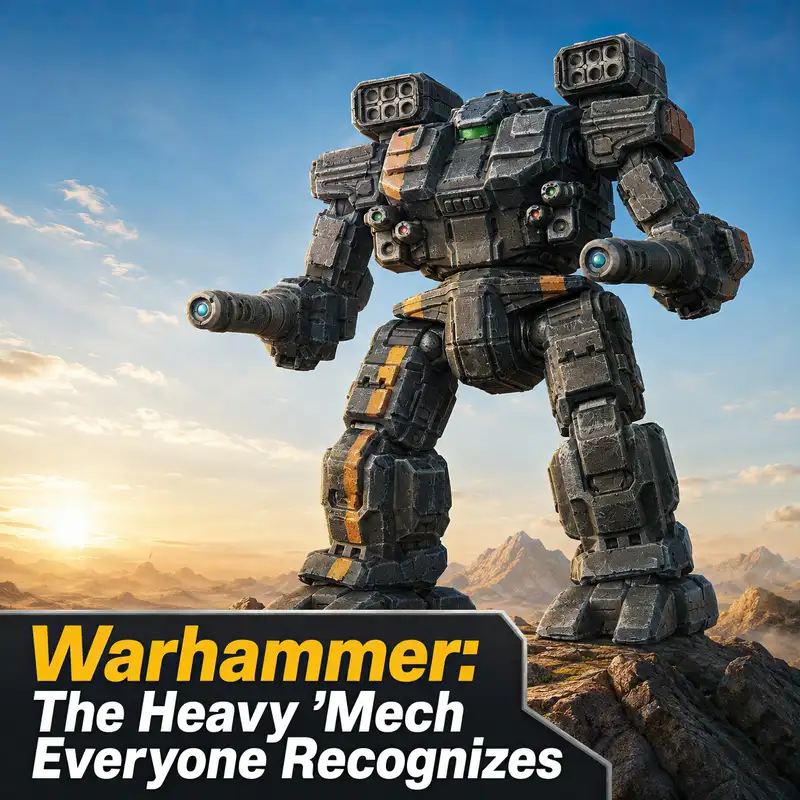
A reconnaissance officer does not need a transponder code to identify the machine on the ridge. A broad torso stands between two long weapon arms. A missile rack rises over the right shoulder. A searchlight sits over the left. When both arm cannons begin to glow, the remaining uncertainty becomes academic. The contact is a Warhammer, and the unit below has seconds to find cover, return fire, or discover how much armor two particle projection cannons can remove before breakfast.
Few BattleMechs communicate their purpose so clearly. The Warhammer looks like a weapons platform because that is what StarCorps Industries intended. It is not the fastest heavy machine, the best armored, or the easiest to cool. It cannot jump, and its ammunition gives technicians reason for concern. Yet the design entered production in the year twenty-five fifteen and remained recognizable across centuries of war. Its promise was simple: deliver heavy fire at long range, remain dangerous when the enemy closes, and use components that armies could continue to build and repair.
The Warhammer appeared during the Age of War, when the Great Houses were still learning what a mature BattleMech force should look like. Early machines often pursued one idea with considerable enthusiasm and uneven restraint. Some were mobile but lightly armed. Others carried impressive weapons at speeds that allowed opposing commanders to complete their paperwork before contact. StarCorps drew on earlier heavy designs, including the BattleAxe and Hammerhands, and sought a more balanced line fighter. The company wanted a mobile BattleMech able to destroy or severely damage an opponent of equal or lighter mass. That requirement became the standard Warhammer six R.
At seventy tons, the Warhammer occupied the upper heavy class without becoming an assault machine. Its two hundred eighty-rated fusion engine gave it a top speed near sixty-five kilometers per hour. That was enough to advance with heavy formations, reposition along a defensive line, and keep pace with many older medium machines. It could not chase modern scouts or escape every unfavorable engagement. The standard chassis carried no jump jets, so rivers, collapsed bridges, ravines, and urban obstacles could dictate its route.
The main weapons were two Donal particle projection cannons, one in each arm. That arrangement defined the machine’s appearance and tactics. Each cannon struck hard at long range without consuming ammunition. Together they let a Warhammer damage armor before many opponents could reply. Separate mounts also allowed broad tracking and preserved one main gun if the other arm was lost. A Warhammer arriving on a ridge did not need to explain its place in the battle line. The explanation was already warming at the end of each arm.
The particle projection cannons also created the machine’s first important choice. The standard Warhammer carried eighteen single heat sinks. Firing both main guns produced more heat than the cooling system could remove during the same exchange, especially while moving. The pilot could fire both and accept a gradual heat rise, alternate cannons to remain cool, or pause after a heavy volley. The correct answer depended on whether the target was exposed, return fire was likely, and immediate movement was necessary. The machine rewarded fire discipline and punished the understandable desire to press every available trigger.
Heat management became more complicated as the distance closed. Two medium lasers and two small lasers were mounted in the side torsos. A six-tube short-range missile launcher sat above the right shoulder. Two machine guns provided defense against infantry at very close range. This gave the Warhammer a layered arsenal rather than one narrow engagement envelope. The pilot could begin with the particle projection cannons, introduce missiles and medium lasers as the enemy approached, then use the smallest weapons against infantry, damaged vehicles, or targets already inside the main guns’ most comfortable range.
The weapon mixture made the Warhammer flexible, but flexibility is not the same as permission to fire everything at once. A full close-range attack could drive the heat level upward just as quickly as sustained long-range fire. Experienced pilots changed weapons as the range changed. They did not simply add new systems to the previous volley. One particle projection cannon, the short-range missiles, and the medium lasers could form a practical close attack. Both main guns might be used when a single decisive strike mattered more than the next turn’s mobility. The Warhammer fought best when the pilot treated heat as a budget rather than an unpleasant surprise.
Ammunition introduced risks that the primary weapons avoided. The missile launcher carried fifteen full salvos, while the machine guns shared two hundred rounds stored in the center torso. Neither supply was protected by later systems that redirected an internal explosion away from the engine and cockpit. A penetrating hit could therefore destroy a machine that still had armor elsewhere. The machine-gun ammunition was particularly notorious because most battles required only a few bursts. The remaining rounds then served mainly as an internal demolition charge.
The six R carried ten tons of armor. That was meaningful protection by the standards of its introduction, but it was not generous for a seventy-ton BattleMech. The Warhammer could stand in the line, but it was not designed to absorb punishment like an Atlas or a heavily protected assault machine. Its legs and side sections demanded attention, and repeated concentrated fire could remove combat capability faster than the machine’s reputation suggested. The Warhammer’s best defense was to damage the enemy first, use cover, and avoid presenting the same armor section to every hostile gunner in the province.
This balance explains the Warhammer’s proper battlefield role. It is a heavy brawler with a strong long-range opening, not a stationary sniper and not a pure close-assault machine. From a protected position, it can use both particle projection cannons to force movement and break armor. As the formation advances, the Warhammer follows the line rather than racing ahead of it. When the enemy closes, the secondary battery keeps the machine dangerous. A commander who uses it as an unsupported spearhead will eventually test the armor more thoroughly than StarCorps intended. A commander who leaves it far behind wastes half the arsenal.
In a combined-arms formation, the Warhammer benefits from scouts that identify targets, infantry that secure broken ground, engineers that clear routes, and vehicles that screen the flanks. Its machine guns make it less helpless against infantry than many heavy BattleMechs, but they do not make urban clearing a one-machine assignment. Its lack of jump jets means that reconnaissance reports about terrain are especially important. A Warhammer can dominate an avenue of approach only if it can reach that avenue. The most powerful gun on the wrong side of a canyon remains a strongly worded opinion.
The searchlight over the left shoulder became one of the design’s most recognizable features. It could operate as an ordinary battlefield light or work with the targeting system to improve night operations. In an age when electronic warfare, smoke, weather, and damaged infrastructure could reduce visibility, that was more than decoration. The Warhammer could illuminate a target for its own weapons and for friendly units, although doing so also announced its position. Night fighting often involves deciding whether seeing the enemy is worth helping the enemy see you. The Warhammer provided a very large switch for making that decision.
Its communications and targeting systems were considered simple and effective, which allowed the Warhammer to serve as a command machine when necessary. A company commander could remain close enough to the main fight to observe events while carrying enough firepower to influence them directly. That arrangement carried a familiar command risk. A conspicuous seventy-ton BattleMech firing paired particle projection cannons is not difficult for enemy observers to notice. The machine could lead from the front, but doing so encouraged every hostile gunner to participate in the chain of command.
The Warhammer’s internal simplicity and broad parts base contributed as much to its longevity as its firepower. Its engine, structure, weapons, and electronics were familiar to generations of technicians. The design earned a reputation for ruggedness and stability, and examples appeared in nearly every major military. Ubiquity creates its own support network. Salvage crews know what can be recovered. Depots stock compatible components. Veteran technicians teach younger crews which access panel conceals the troublesome connection. A rare advanced machine may outperform a Warhammer on the first day of a campaign. The Warhammer’s advantage often appears on the fifth day, when both machines need parts.
Recovery remained a serious matter. Seventy tons of damaged BattleMech requires specialized vehicles, trained crews, and a route strong enough to carry the load. Damage to a leg could leave the machine on the ground. A commander using one in a delaying action still had to decide whether the recovery team could reach it afterward. Military history contains many machines called expendable by officers who were not responsible for replacing them.
The Star League Defense Force used the Warhammer in front-line formations, and it became a favored machine in the Gunslinger Program. Elite pilots trained there to fight other MechWarriors and prepare for renewed conflict among the Great Houses. The Warhammer suited that purpose. Its main guns rewarded accurate shooting at range, while its secondary weapons demanded judgment once a duel became close and confused. A skilled pilot could demonstrate technique with the standard machine rather than rely on exotic equipment to compensate for poor decisions.
Royal Star League units received more advanced versions. The six R B added improved armor, better cooling, and enhanced missile guidance. The later seven A carried extended-range cannons, double-strength heat sinks, lighter internal construction, and upgraded secondary weapons. These models showed the potential inside the basic layout, but depended on an industrial system that did not survive the Star League intact. When advanced components became scarce, the simpler six R remained the version most armies could repair and reproduce.
The Succession Wars destroyed factories, erased technical knowledge, and turned surviving BattleMechs into inherited military capital. The Warhammer endured because production had spread across the Inner Sphere and into the Periphery. Other manufacturers maintained lines, rebuilt damaged examples, and produced regional versions. Some factories managed only a handful each year. That was still enough to prevent the machine from becoming a relic found only in museums, noble vaults, and mercenary stories about equipment that had definitely existed before the creditors arrived.
The Great Houses adapted the Warhammer according to their own experience. The Federated Suns favored the six D, which removed the missile launcher and machine guns, added four tons of armor, and installed two more heat sinks. The result sacrificed close-range variety for greater protection, cleaner logistics, and freedom from ammunition explosions. The six D answered a practical question: if the paired particle projection cannons define the machine, how much of the secondary battery is worth risking the rest of it?
The Draconis Combine’s six K made a smaller change. It removed the machine guns and their ammunition, then used the available mass for two additional heat sinks. The short-range missile launcher remained, preserving a close-range punch while reducing one source of internal catastrophe. The Capellan six L replaced the machine guns with flamers, producing a variant known as the Hot Hammer. That version improved anti-infantry and anti-position utility, while creating additional heat in a machine already required to manage it carefully. Procurement offices across the Human Sphere rarely encounter a compromise they cannot relocate.
These variants reveal why the Warhammer became more than one fixed configuration. Every operator recognized the value of the paired arm cannons and the familiar seventy-ton chassis. They disagreed about everything around them. Some wanted armor. Some wanted cooling. Some wanted better anti-infantry weapons. Later models added jump jets, advanced targeting systems, improved engines, modern missile launchers, and stronger protection. The core image remained stable because the design’s central argument remained persuasive: two powerful long-range weapons on a mobile heavy platform, backed by enough secondary firepower to survive a changing fight.
Natasha Kerensky did more than almost any pilot to turn that image into a threat. As commander of the Black Widow Company, she piloted a black Warhammer six R maintained in exceptional condition. The machine was not famous because it carried a secret arsenal. Published accounts identify it as a standard model. Its effectiveness came from the pilot, the technicians who kept it operating, and a unit culture willing to use speed, deception, and concentrated violence with little concern for an opponent’s comfort. A stock Warhammer in expert hands proved more memorable than many advanced machines used without comparable skill.
Natasha’s Warhammer also demonstrated the importance of maintenance. A machine built in the twenty-sixth century and fighting in the early thirty-first had not survived with every original component untouched. Parts were replaced, systems rebuilt, armor renewed, and tolerances restored repeatedly. The BattleMech’s identity persisted even as its components changed. Continuity resided partly in the chassis number, partly in the maintenance record, and partly in the people who insisted that the machine leaving the bay was still the same one that entered it.
Yorinaga Kurita gave the Warhammer another place in Inner Sphere legend. On Mallory’s World in the year thirty sixteen, he faced Morgan Kell’s Archer in a duel remembered for the mysterious Phantom BattleMech incident. The exact nature of what occurred became the subject of myth, competing explanations, and institutional memory. What is certain is that Yorinaga’s Warhammer stood opposite an Archer in one of the setting’s most famous encounters. The paired cannons, broad shoulders, and deliberate stance became part of the visual language of that duel, linking the machine to honor, shame, and a rivalry that shaped later events.
Neither Natasha nor Yorinaga made the Warhammer invincible. Their reputations can distort tactical judgment. Enemy commanders learned to exploit the machine’s limitations. Fast units could force it to turn, separate it from support, or lure it across ground it could not traverse quickly. Missile boats could pressure it from beyond favorable sight lines. Concentrated fire could overwhelm its moderate armor. Infantry could use dense terrain to approach from angles the main guns could not cover efficiently. The Warhammer was dangerous enough to deserve a plan, and conventional enough that experienced opponents could develop one.
Recovered Star League knowledge produced a new generation of Warhammers. The Free Worlds League received the seven M in the late thirty-forties, with extended-range cannons, double-strength heat sinks, updated electronics, and an anti-missile system. The Federated Commonwealth’s seven S followed with its own combination of extended-range cannons, pulse lasers, and guided short-range missiles. These machines restored capabilities that earlier centuries could not support and addressed the original design’s heat and defensive weaknesses.
The Clan Invasion complicated the equation. Advanced Clan weapons could strike farther, weigh less, and punish an old six R before it reached its preferred position. The Warhammer was no longer the unquestioned standard against which every heavy machine could be measured. Yet it did not disappear. Updated models gained stronger armor, better cooling, improved electronics, and more efficient structures. Even the Clans preserved the concept in the Warhammer I I C, an eighty-ton descendant that retained the recognizable twin-cannon arrangement while applying Clan technology and greater protection. The design had become an idea durable enough to survive the society that created it.
Later Warhammers became more specialized. Some carried stealth armor. Others mounted heavy particle projection cannons, targeting computers, network equipment, advanced missiles, or jump systems. A few stripped away the familiar secondary battery and concentrated on long-range fire. Others returned to the six R pattern with modern ammunition protection and stronger armor. Designers knew what a Warhammer was supposed to look like. They still had to decide what it was supposed to do in the current war.
The machine’s recognition extends beyond the fictional battlefield. The Warhammer appeared in BattleTech’s earliest boxed games, technical art, fiction, miniatures, and later computer games. Its original image became one of the designs collectively called the Unseen when legal disputes removed certain artwork from official use. The BattleMech remained part of the setting. Project Phoenix supplied a new interpretation, and later redesigns returned to the classic visual cues. The art changed. The name, configuration, and battlefield role survived.
That history explains why several generations of players can picture different Warhammers and still recognize the same machine. One version may be narrower, another broader, another more industrial, and another shaped for a modern game engine. The paired arm cannons remain. The shoulder missile launcher remains. The searchlight or its visual echo remains. The cockpit sits beneath a wide armored torso that looks built around weapons rather than human proportions. Recognition does not depend on every plate matching. It depends on preserving the design’s visual sentence.
The Warhammer’s reputation therefore matches its battlefield utility only when the machine is understood correctly. It is not an assault BattleMech wearing a lighter classification. Ten tons of armor do not support that interpretation. It is not a pure sniper, because much of its mass is invested in weapons intended for the close fight. It is not an effortless gun platform, because heat and ammunition require discipline. It is a heavy line fighter able to open a battle at range and remain relevant as the engagement contracts. That versatility is genuine, but it rests on judgment rather than excess.
Commanders kept buying, salvaging, and rebuilding Warhammers because the design solved a common problem without demanding a rare doctrine. Almost every army needs a heavy machine that can threaten targets across open ground, accompany an advance, and continue fighting after the enemy reaches close range. Almost every technician prefers a familiar chassis with an established parts network. Almost every pilot understands the reassurance of two powerful weapons pointing in the same direction. The Warhammer survived because its compromises were visible, manageable, and worth accepting.
That is why everyone recognizes the Warhammer. Its silhouette is not merely famous artwork. It is a diagram of military purpose. The arm cannons announce the opening blow. The shoulder weapons acknowledge that the enemy may survive and close. The searchlight accepts that battles occur in darkness and confusion. The moderate armor reminds the pilot that firepower does not excuse poor positioning. Across centuries, manufacturers changed the components and artists changed the lines, but the central image remained intact: a heavy BattleMech standing where the fight is about to become serious, dangerous enough to command attention, and human enough in its compromises to need skill, support, and a competent recovery crew.