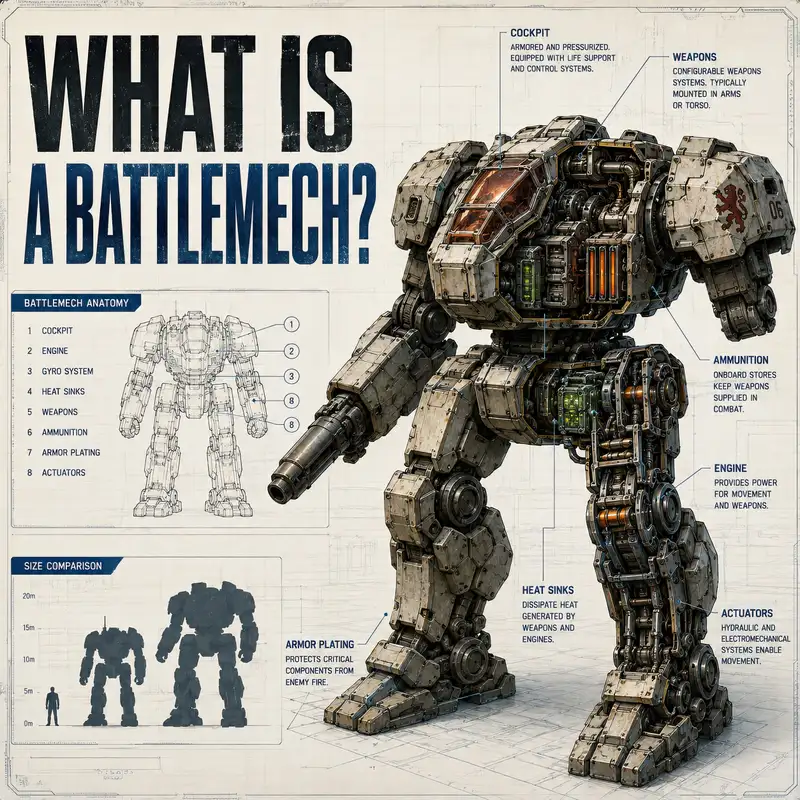
What Is a BattleMech?
A BattleMech limps back to its repair bay with half the armor stripped from one side, a ruined weapon hanging from its shoulder, and enough heat in the cockpit to make the pilot’s gloves uncomfortable. The machine still walks. It still carries weapons. Given a few hours, a recovery crew, several tons of replacement armor, and a technician with a flexible understanding of sleep, it may fight again. That ability to absorb damage, remain mobile, and return to service is more important than its silhouette. A BattleMech is not simply a large robot. It is an armored combat system built around mobility, concentrated firepower, survivability, and one human being’s ability to control all of them at once.
Most BattleMechs stand roughly eight to fourteen meters tall and weigh between twenty and one hundred tons. The majority are bipedal, although quadrupedal and other unusual forms exist. Their shapes often suggest the human body because the basic design uses a torso, articulated limbs, joints, and a balance system that allows movement across ground where many conventional vehicles would struggle. Some are broad and heavily armored. Others are narrow, fast, and lightly protected. A few look like a weapons engineer was given an excellent budget and no supervision. Appearance matters less than purpose. Every BattleMech is a set of compromises intended to solve a battlefield problem.
The simplest definition is that a BattleMech is a purpose-built military machine designed for combat. That distinguishes it from IndustrialMechs, which perform civilian work such as mining, logging, loading cargo, farming, and construction. Industrial machines may resemble BattleMechs and can be armed in emergencies, but they usually lack the armor, weapons, control systems, and battlefield durability of purpose-built military designs. A modified mining machine can threaten infantry or a lightly defended position. It is still not the machine a professional commander wants standing in the front line when particle cannon fire begins arriving.
A BattleMech begins with an internal structure that functions much like a skeleton. This frame carries the machine’s weight and provides mounting points for the engine, cockpit, armor, weapons, ammunition, electronics, and other equipment. Actuators at the shoulders, elbows, hips, knees, ankles, and other joints allow the limbs to move. Damage to the armor may be repaired by replacing plates. Damage to the internal structure is more serious because the skeleton holds everything else in alignment. A machine can continue fighting after losing armor. It becomes much less persuasive after the supporting structure begins coming apart.
Wrapped around that skeleton are bundles of myomer, an artificial muscle technology that contracts when activated by electrical current. Myomer gives BattleMechs the strength to move their own mass, carry weapons and armor, climb difficult slopes, rise after a fall, and perform motions that tracked vehicles cannot duplicate. The system does not make a BattleMech graceful in the ordinary sense. It makes a machine weighing dozens of tons responsive enough to follow the intentions of a trained pilot. Myomer also generates heat and requires power, which means locomotion is connected to the same thermal and electrical limits that govern the rest of the machine.
The power normally comes from a fusion engine buried in the torso. That engine supplies electricity for the myomer, sensors, computers, life-support systems, and energy weapons. It can operate for very long periods without the constant fuel demands associated with internal-combustion engines. This does not make the BattleMech independent of logistics. The engine may not need frequent refueling, but armor, ammunition, lubricants, replacement actuators, electronics, coolant systems, and trained maintenance personnel remain essential. A commander who hears that the reactor can run for decades and concludes that the unit no longer needs supply officers has misunderstood both engineering and supply officers.
The fusion engine is often misunderstood as a nuclear bomb waiting for a dramatic moment. A destroyed machine may produce fire, plasma, electrical discharge, and secondary explosions, but the reactor is designed to shut down when containment is lost. Ammunition and overheated internal systems are often more immediate dangers. A burning BattleMech is dangerous enough without improving the story afterward.
Keeping the machine upright requires a gyro, control computers, and the MechWarrior’s neurohelmet. The gyro provides mechanical stabilization. The onboard systems monitor motion, terrain, acceleration, and the condition of the machine. The neurohelmet reads signals associated with the pilot’s sense of balance and helps the control system distinguish between an accidental loss of stability and a deliberate maneuver. The pilot still uses physical controls, pedals, displays, and targeting systems. The neurohelmet does not allow a MechWarrior to think a BattleMech into action. It lets human balance and machine balance cooperate under conditions that are rarely polite.
That cooperation explains why piloting skill matters. Combat requires sudden changes in speed, direction, facing, and posture while weapons strike the armor and terrain shifts beneath the feet. A good MechWarrior learns how the machine carries its weight, how quickly it turns, and how much damage it can absorb before a movement becomes unsafe. An exceptional pilot may make a heavy machine seem agile. The laws of mass remain in effect. They are merely being managed with unusual competence.
The cockpit is usually located in the head, though some designs place it elsewhere. It contains controls, displays, communications equipment, life support, and the pilot’s ejection system. The cockpit is protected, but it is not comfortable. Heat, vibration, noise, restricted visibility, and the knowledge that several enemies are actively trying to remove the compartment from the machine all affect the pilot. Sensors provide a broader picture than the canopy alone, combining visual feeds, thermal data, radar, targeting information, and identification systems. Battle damage can reduce that picture until the pilot is making decisions with fragments of information and a great deal of professional optimism.
Armor provides the first layer of protection. BattleMech armor is designed to absorb and ablate under weapons fire, protecting the internal structure and components beneath it. Damage is localized. A machine may lose armor from one arm while the opposite side remains intact. This allows a pilot to turn damaged sections away from the enemy, protect an exposed ammunition bin, or continue fighting with part of the machine compromised. Armor is not a single measure of health. Where the armor remains can matter as much as how much remains.
Beneath the armor, the arrangement of internal components creates both resilience and vulnerability. Weapons may be disabled independently. An actuator can be damaged without destroying the entire limb. A leg hit can reduce speed or bring the machine down. Damage to the gyro can make every movement dangerous. Damage to the engine can reduce power, increase heat, or force shutdown. A direct strike into ammunition storage may produce a catastrophic internal explosion. BattleMechs survive because their systems are distributed and protected. They die when damage reaches the wrong place in the wrong order.
Heat is the invisible limit governing nearly every design. Movement produces heat. Jump jets produce more. Lasers and particle projection cannons convert electrical energy into weapons fire and generate substantial waste heat. Ballistic and missile weapons usually produce less heat but require ammunition. Heat sinks transfer that energy away from the machine, but they have finite capacity. A pilot who fires too many weapons may reduce mobility, degrade targeting, risk ammunition ignition, or trigger an automatic shutdown. The machine may possess enough weapons to destroy an opponent and not enough cooling to use all of them safely at once.
This creates a central decision in BattleMech combat. Fire heavily now and accept reduced performance later, or preserve cooling capacity and risk giving the enemy another opportunity. The answer depends on range, terrain, armor condition, ammunition, and whether the target must be stopped immediately. A BattleMech’s true firepower is not everything mounted on the chassis. It is what the pilot can use without making the next thirty seconds disastrous.
Weapons generally fall into three families. Energy weapons, including lasers and particle projection cannons, draw power from the fusion engine and need no conventional ammunition, but they create heat. Ballistic weapons can deliver powerful effects with less thermal burden, but ammunition adds weight and eventually runs out. Missiles offer flexible ranges and specialized munitions while sharing the ammunition problem. Designers combine these systems to shape how a BattleMech fights and how long it can continue.
A long-range support machine may carry missiles and particle weapons while relying on other units to keep opponents at distance. A close-range brawler may mount heavy armor and destructive short-range weapons but require time to reach the fight. A scout may sacrifice protection for speed, sensors, and the ability to report what heavier formations cannot see. A command BattleMech may reserve space for communications equipment. Role is not determined by tonnage alone, especially when bridges, DropShip bays, and maintenance crews have opinions about weight.
BattleMechs are commonly divided into four regular weight classes. Light machines weigh from twenty to thirty-five tons. Mediums range from forty to fifty-five. Heavies weigh from sixty to seventy-five, and assault designs from eighty to one hundred tons. These categories describe tendencies, not guaranteed behavior. Lights are often scouts and raiders. Mediums serve as versatile workhorses. Heavies bring greater armor and firepower. Assault machines can dominate a direct engagement but may struggle to reach one on favorable terms.
Speed is purchased with engine mass. Armor is purchased with weight that cannot be used for weapons. Weapons create heat, require ammunition, or consume internal space. Jump capability adds mobility but takes weight and generates more heat. Advanced materials can save weight while increasing cost, manufacturing difficulty, or bulk. Every design therefore answers a question. How fast must it be? What must it survive? At what range should it fight? How long should it remain effective without resupply? Which factories can build it? Which technicians can maintain it? Procurement officials may prefer one answer. Pilots tend to develop opinions after the first ambush.
The first true BattleMech was the Mackie, developed by the Terran Hegemony during the Age of War. Its famous live-fire trial took place in the year twenty-four thirty-nine, when Colonel Charles Kincaid piloted the prototype against four remotely controlled heavy tanks. The Mackie destroyed them and demonstrated that a single pilot could control an armored machine with exceptional mobility, protection, and concentrated firepower. The test did not prove that tanks had become useless. It proved that military power had acquired a new instrument, and every major state soon wanted one.
The Terran Hegemony guarded the technology as a strategic advantage. Other powers used espionage, negotiation, defection, and raids to obtain the knowledge needed to produce their own machines. BattleMech technology spread because no state could accept a rival’s monopoly. The pattern would repeat throughout history. A new weapon appears, its owner calls it decisive, and intelligence services begin earning their budgets.
BattleMechs improved during the Star League era as industry refined engines, armor, structures, electronics, and weapons. The Succession Wars then destroyed factories, technical schools, archives, and specialized production facilities. Many advanced components became rare or impossible to manufacture. Surviving machines remained valuable because they could be repaired, modified, and kept in service for generations. A chassis might outlive several pilots, governments, and explanations for why the current war was different.
That longevity explains why a BattleMech can be an inheritance as well as a weapon. A state may own the machine and assign it to a pilot, while a family or mercenary command may possess it directly. A damaged BattleMech can represent lost military capacity, family status, collateral on a loan, and the unit’s only reliable way to earn repair money. Its tactical value and social value are not always aligned.
Variants appear because wars, technology, and available parts change. Two BattleMechs sharing the same basic chassis may carry different weapons, armor, engines, heat sinks, sensors, or electronics. Some variants are factory designs built for a particular customer or battlefield role. Others are field modifications created because the preferred component was unavailable and the unit needed the machine operational by morning. Later eras introduced advanced materials, improved cooling, more efficient engines, and new weapons. The name on the chassis may remain the same while its battlefield behavior changes substantially.
OmniMechs take modularity further. Developed by the Clans and later copied in the Inner Sphere, they use standardized mounting arrangements that allow major equipment packages to be changed more quickly. One chassis can shift from long-range support to close assault when the correct components and facilities are available. Modularity improves flexibility. It does not make replacement parts appear or teach an exhausted technician to work faster.
Some BattleMechs mount jump jets for short powered leaps over obstacles, buildings, or broken ground. Jumping can reposition a machine rapidly and complicate an enemy’s firing solution. It also produces heat, stresses the pilot, and may leave the BattleMech exposed when it lands. Machines without jump jets depend on ground speed, making deployment and terrain even more important.
BattleMechs can fight in cities, forests, mountains, deserts, arctic regions, vacuum, and underwater when properly equipped. Their articulated movement gives them access to terrain that may restrict conventional vehicles. That versatility is not immunity. Mud can trap them. Rubble can cause falls. Narrow streets create ambushes. Bridges have weight limits. Water may cool a machine while concealing hazards. The ground remains an active participant in every battle.
Physical combat is another distinctive feature. A BattleMech can punch, kick, charge, push, or use a melee weapon. Such attacks are destructive at close range, especially against damaged opponents, but they carry risk. Missing a kick may cause a fall, and closing exposes weakened armor to return attacks. Physical attacks are what happens when two armored systems survive long enough to become personally acquainted.
For all their strengths, BattleMechs are expensive. They require specialized factories, advanced materials, skilled workers, trained pilots, technical crews, recovery vehicles, spare parts, and transport. A DropShip can carry only a limited number. A damaged machine may need equipment powerful enough to lift or tow dozens of tons. A lost leg in enemy territory can turn an otherwise repairable BattleMech into salvage for the opposing side. Conventional tanks, infantry, artillery, aerospace forces, and battle armor remain essential because states must defend more ground than their BattleMech inventories can cover.
Combined arms also exposes the limits of a BattleMech’s perspective. A pilot may dominate the immediate area and still fail to locate hidden infantry, stop an aerospace strike, clear a minefield, repair a bridge, or hold every street after the machine moves on. Tanks can bring heavy weapons at lower cost. Infantry can occupy buildings and control populations. Artillery can strike beyond direct line of sight. Aerospace fighters can attack transport and supply. Engineers make movement possible. The BattleMech is powerful because it fits into a larger force, not because the rest of the force has become decorative.
Maintenance determines how much of that power is real. Armor must be replaced after every serious fight. Weapons require alignment and inspection. Actuators wear. Myomer bundles can be damaged. Heat sinks, sensors, life support, and control systems all demand attention. Ammunition must be loaded safely and correctly. Field repairs can return a machine to action, but repeated improvisation creates future problems. A unit may list twelve BattleMechs on paper while only seven can deploy, two can walk but should not, and three are being used to teach technicians new forms of profanity.
Recovery and salvage are therefore part of BattleMech warfare. A disabled machine may be worth more than the ground on which it fell. Commanders send recovery teams forward under fire because repairing a captured or damaged chassis can replace losses that industry cannot quickly restore. Mercenary contracts often define who owns battlefield salvage because ownership determines whether the unit can rebuild. Destroying an enemy BattleMech removes a threat. Recovering it may create a future asset. The difference is measured in transport capacity, technical skill, and how long the enemy permits everyone to remain on the field.
The tabletop record sheet reflects this philosophy by tracking armor and internal structure by location, along with heat, ammunition, movement, weapons, and critical damage. Those rules are abstractions, but they capture the machine’s character. A BattleMech does not possess one simple pool of strength. It deteriorates, loses capabilities, and develops vulnerable sides. The pilot must adapt as the machine changes during the fight.
No single BattleMech is best in every situation. The Atlas can absorb punishment and deliver immense firepower, but it cannot be everywhere. The Locust can scout quickly, but it cannot trade fire with an assault machine for long. The Archer favors missile engagements at range. The UrbanMech can excel in the terrain and role for which it was designed while becoming far less convincing during a fast pursuit across open country. Design is context made from metal.
A BattleMech is therefore a fusion-powered armored vehicle built around an artificial skeleton, myomer muscles, a gyro, a human pilot, and a collection of weapons and systems chosen for a particular role. That definition explains how it moves. It does not fully explain why it matters. The machine concentrates the combat power of a larger force into one mobile platform, gives a skilled pilot unusual freedom of action, and can remain dangerous after suffering severe localized damage. It can cross difficult terrain, shift weapons among targets, and survive long enough for experience to matter.
It also carries the limitations of every military system ever built. It can be deployed badly, maintained poorly, supplied inadequately, transported too late, or assigned a mission its designers never intended. Its armor can fail. Its ammunition can explode. Its pilot can make a mistake. Its government can win the battle and lose the reason for fighting it. The BattleMech is BattleTech’s defining machine not because it escapes human limitations, but because it concentrates them inside a towering weapon. Beneath the armor, every advantage is a compromise, every system depends on people, and every step toward the battlefield begins with someone deciding that this machine is worth what it will cost.