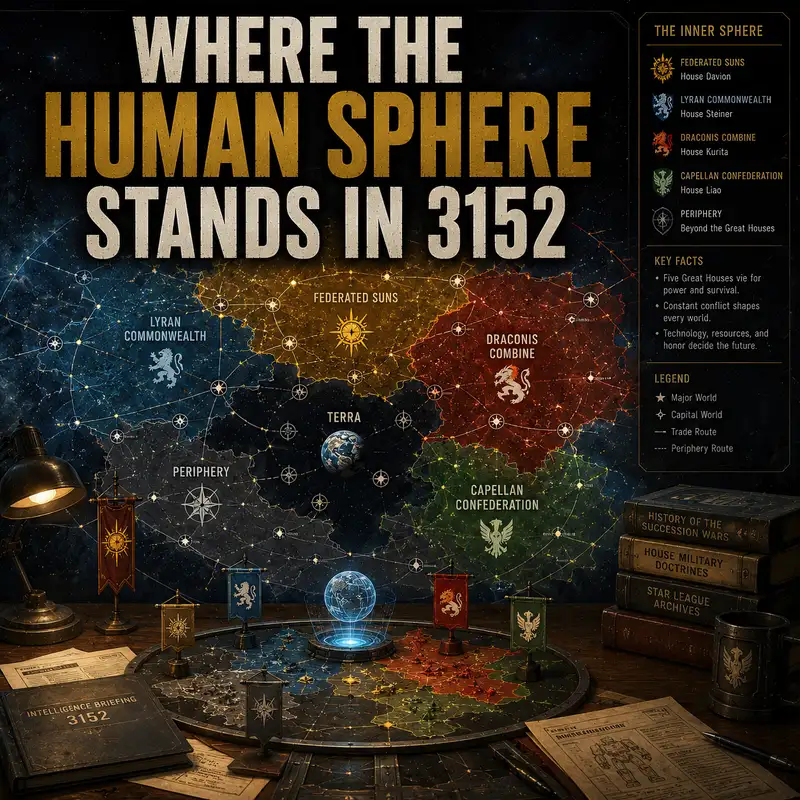
Where the Human Sphere Stands in 3152
In the summer of thirty-one fifty-two, a proclamation leaves Terra under the seal of Alaric Ward. Clan Wolf has conquered humanity’s birthplace. Alaric has been recognized as ilKhan by the Clans accepting his authority, and he now calls himself First Lord of a reborn Star League. On paper, the oldest political dream in the Human Sphere has returned. Beyond Terra, the response is less orderly. Some rulers see a conqueror wearing history as a uniform. Others are already fighting wars they cannot pause because a new flag has been raised over humanity’s homeworld. Terra has a victor. The Human Sphere does not yet have a master.
That is the essential condition of thirty-one fifty-two. It is not a stable endpoint after the Dark Age. It is the opening of the ilClan era, when old political structures have collapsed before new ones can prove they deserve to survive. The Republic of the Sphere is gone. Clan Jade Falcon has been shattered as a major territorial power. Clan Wolf has won the greatest symbolic prize in human space while leaving its former empire exposed. The Great Houses remain powerful, but none is secure. Smaller realms, mercenary commands, Clan enclaves, and regional coalitions are filling the gaps. The map is not simply changing color. Authority itself is being renegotiated.
The crisis began long before the battle for Terra. In thirty-one thirty-two, the hyperpulse generator network suffered the catastrophic failure remembered as Gray Monday. Interstellar communication did not vanish, but the dependable system tying governments, markets, and militaries together broke apart. Messages again traveled with courier ships across many routes. Information became slower, less reliable, and easier to manipulate. Governors acted without instructions. Commanders guessed what neighboring forces were doing. Regions dependent on central authority discovered how much power existed locally. The Blackout did not create every conflict that followed, but it removed the warning system, nervous system, and rumor control office at the same time.
The Republic of the Sphere suffered most visibly. Created after the Word of Blake Jihad, the Republic had tried to turn the devastated region around Terra into a new political order. It disarmed populations, relocated communities, blended former enemies, and served as a buffer against renewed Great House war. When communications failed, the system fractured. Republic worlds declared independence, joined neighboring states, or fell under military control. Devlin Stone withdrew behind the Fortress walls around a reduced core, abandoning much of the wider Republic to preserve Terra. The strategy bought time. It also convinced former citizens that the Republic’s promise of protection ended when protection became expensive.
When the Fortress opened, Clan Wolf and Clan Jade Falcon raced toward Terra. Both claimed that the Clan conquering humanity’s birthplace would become the ilClan, above all others. The Republic Armed Forces defended their last territory while the Wolves and Falcons also fought one another. In thirty-one fifty-one, Clan Wolf emerged victorious. The Republic was destroyed as a sovereign power. Devlin Stone was defeated. Clan Jade Falcon lost most of the warriors Malvina Hazen had brought to Terra. Alaric Ward gained the prize that generations of Clan leaders had treated as the purpose of their civilization.
Victory gave Alaric titles, territory, and a powerful story. It did not give him automatic obedience. His new Star League is strongest on Terra and nearby worlds where Clan Wolf and allied forces can impose policy directly. Farther away, his claim becomes a political question rather than an established fact. The Successor Lords possess dynasties, bureaucracies, militaries, and populations that will not disappear because a Clan leader invokes Aleksandr Kerensky. Even among the Clans, recognition of an ilKhan does not mean enthusiasm for every order. Alaric has achieved legitimacy within a tradition. He must still turn it into transport, taxation, recruitment, administration, and consent. Conquest is faster than government.
The forces on Terra face their own problems. Clan Wolf suffered severe losses taking the planet, as did allies and mercenaries fighting beside it. Occupying humanity’s most politically important world requires more than winning a Trial. Terran civilians have lived under several governments and possess no obligation to admire the newest one. Former Republic personnel remain scattered through the region. Resistance, sabotage, and noncooperation consume troops that might support expansion. Alaric’s Star League therefore builds a defensive belt in the former Republic while rebuilding its military. The result is a state formidable at the center but disconnected from many resources once controlled by Clan Wolf elsewhere.
The Capellan Confederation presents the most immediate external challenge. Under Chancellor Daoshen Liao, Capellan forces had expanded aggressively into the collapsing Republic and approached closer to Terra than any previous Capellan government. The Confederation entered the ilClan era with experienced troops, functioning industry, a strong national identity, and the confidence produced by years of territorial gains. Daoshen did not accept that Alaric’s victory settled the future of the former Republic. To the Capellans, worlds taken through blood and planning were not gifts to be returned because the Wolves had won on Terra. Alaric therefore faced an opponent that was neither a scattered remnant nor an exhausted minor power, but one of the strongest conventional states in the Inner Sphere.
Capellan strength carries its own dangers. Daoshen’s obsession with Terra pushes the Confederation toward a confrontation that could consume the advantages it has accumulated. Campaigns around the former Fortress region cost troops, ships, and political capital. His increasingly destructive decisions create unease inside a state that depends heavily on confidence in the Chancellor. During thirty-one fifty-two, the struggle around his rule places Danai Liao-Centrella at the center of the Confederation’s future. Whether leadership changes through planned succession or crisis, the strategic problem remains. The Capellans are close to Terra, powerful enough to threaten Alaric, and burdened by the temptation to treat proximity as proof that final victory is affordable.
Far to the east, the Federated Suns is recovering from one of the worst periods in its history. The Draconis Combine had captured New Avalon, while the Capellan Confederation seized major worlds along the opposite frontier. First Prince Julian Davion returned to a state whose military had been mauled and whose political confidence had been shaken. By thirty-one fifty-one, Davion forces had retaken New Avalon. In thirty-one fifty-two, they continued attacking the chain of Combine-held worlds known as the Dragon’s Tongue. The recovery is real. It is not complete. The Armed Forces of the Federated Suns must rebuild units, restore administration, and reconcile commanders whose cooperation was forged by emergency rather than trust.
Julian Davion’s greatest advantage is that the Federated Suns once again has a visible center. New Avalon provides a capital, an industrial base, and a symbol around which the state can rally. His greatest danger is assuming that liberation has solved the political damage of occupation. The Draconis March retains deep hostility toward House Kurita and powerful regional leaders expect a voice in the next campaign. The Capellan frontier remains dangerous even when temporary agreements reduce immediate pressure. The Suns can win worlds faster than they can repair every regiment or restore every local government. In thirty-one fifty-two, House Davion has moved from possible collapse to determined recovery. It has not returned to the effortless strength its own propaganda remembers.
The Draconis Combine remains dangerous despite losing New Avalon. Coordinator Yori Kurita rules a state with substantial industry, disciplined institutions, and centuries of experience surviving reversals. Yet the failed occupation exposes weakness. Forces committed deep inside Davion territory are difficult to reinforce and harder to withdraw in good order. Traditional expectations of duty encourage resistance, but can make retreat politically hazardous. The Combine must decide how much more blood to spend on the Dragon’s Tongue while other borders become active. An empire can lose an invasion without ceasing to be powerful. It can also discover that prestige is the most expensive supply item in the depot.
The Rasalhague Dominion should have been one of the more stable powers in the region. It had spent generations blending the culture of Clan Ghost Bear with the people and institutions of the former Free Rasalhague Republic. Alaric’s victory placed that fusion under strain. Clan traditionalists saw the ilClan as the fulfillment of a sacred historical purpose. Many Dominion citizens and warriors refused to surrender the political identity they had built merely to enter Alaric’s League on his terms. A referendum produced division rather than unity, and the conflict between Joiners and Deniers escalated into internal violence. By thirty-one fifty-two, the immediate fighting had diminished, but the Dominion’s image of effortless harmony had been broken.
The Dominion responds to that internal crisis partly by looking outward. Operations against the Draconis Combine redirect military energy toward an old rival and provide a purpose on which competing factions can agree. This does not erase the argument over Alaric. It demonstrates why external campaigns can be politically useful even when they create new strategic obligations. Clan Ghost Bear remains one of the strongest military forces in the Inner Sphere, backed by a large and developed population. If the Dominion regains cohesion, it can shape the entire northern balance. If its institutions continue to divide between Clan destiny and Rasalhagian sovereignty, every foreign policy decision will reopen the same wound.
The Lyran Commonwealth faces a different form of fragmentation. Archon Trillian Steiner rules a wealthy state whose territory, military, and prestige have all contracted. The Commonwealth survived the Dark Age, but it could not protect every border region from Clan Wolf, Clan Jade Falcon, separatists, and opportunistic neighbors. Worlds that endured occupation without meaningful help from Tharkad are not eager to accept lectures about loyalty after liberating themselves. Trillian can still command major industrial resources and capable formations. What she cannot do is act everywhere at once. Every attempt to restore central authority risks driving another regional leader to declare that local defense has earned local independence.
Nowhere is that clearer than the former Jade Falcon Occupation Zone. Most of the Falcon strength departed for Terra and did not return. The vacuum became known as the Hinterlands, a region where old borders matter less than the force available to defend them. The Tamar Pact, Vesper Marches, Arc-Royal Liberty Coalition, Alyina Mercantile League, and other local powers emerge from different combinations of military necessity, commerce, resentment, and ambition. Some leaders claim to restore historic communities. Others are building personal states under more flattering language. All must secure food, transport, technicians, and troops while larger neighbors decide whether to recognize, absorb, or exploit them.
Clan Jade Falcon is not entirely gone. Remnant warriors under new leadership attempt to preserve a Clan identity after the disaster on Terra. They must rule or recruit from populations that remember Falcon occupation, rebuild without the resources once controlled by their touman, and decide which parts of Malvina Hazen’s legacy to reject. Clan Hell’s Horses also sees opportunity in the northern disorder. The Horses possess a strong combined-arms tradition and little reason to let abandoned Falcon territory settle peacefully under Lyran influence. The Hinterlands are therefore more than a collection of new flags. They are a test of whether small states can become durable governments before a major military power decides the experiment has lasted long enough.
The Free Worlds League has returned from political disintegration, but reunion has not eliminated its old federal habits. Captain-General Nikol Marik leads a restored League composed of provinces, noble houses, military commands, and regional interests that do not always agree on the meaning of restoration. The weakened Wolf Empire offers lost worlds and prestige. Several League factions attack across the border before the central government is fully prepared to own the consequences. Nikol must balance the desire to recover territory against the danger that private offensives will drag the whole League into a larger war. The League is stronger than it was when divided. It is not yet a single instrument that moves as quickly as its title suggests.
The Wolf Empire is one of the year’s sharpest strategic ironies. Alaric Ward created it as a territorial base before marching on Terra, then took many of its best warriors with him. The remaining authorities must defend a long border with reduced forces and uncertain communication from the ilKhan. Lyran and Free Worlds League units test its defenses. Local populations judge whether the distant victory on Terra makes their government stronger or merely more absent. Alaric can claim both Terra and the Empire in political language, but geography still requires ships, troops, administrators, and time. A realm whose ruler has achieved his greatest goal may be more vulnerable than it was while he was still pursuing it.
Clan Sea Fox may possess the most unusual form of power in thirty-one fifty-two. Its merchant fleets move equipment, information, and credit across political boundaries. Sea Fox enclaves and commercial relationships give the Clan access that conventional conquerors cannot easily reproduce. Most important, the Sea Foxes are positioned to help restore portions of interstellar communication. The reactivation of hyperpulse generator service on Alyina during the year is a small event compared with the capture of Terra, but it may have deeper long-term consequences. A state can fight without rapid communication. It cannot coordinate an interstellar economy efficiently forever. Whoever reconnects the Human Sphere will influence more than message traffic.
Mercenaries thrive in this uncertainty, although thriving and surviving remain different occupations. New states require professional troops before they can build national armies. Great Houses need deniable raiders, emergency reinforcements, and formations able to move quickly. The Wolf’s Dragoons emerge from Terra with catastrophic losses and a profound grievance against Alaric Ward. Other commands return to old employers, rebuild shattered units, or sell their services in the Hinterlands and along the Wolf Empire’s borders. Contracts are plentiful because governments have more commitments than soldiers. Payment is less certain because several of those governments also have more flags than functioning treasuries.
The Periphery is equally active, though maps centered on Terra often reduce it to a border. The Magistracy of Canopus remains closely tied to Capellan politics and commerce while protecting its own interests. The Taurian Concordat continues to view Davion power through centuries of hostility and suspicion. The Marian Hegemony looks for opportunities along weakened frontiers. The Raven Alliance watches the coreward routes with military and commercial leverage. Independent worlds, pirate kingdoms, and Deep Periphery states respond to the Blackout and the new wars according to local conditions. The ilClan may claim a destiny for humanity. Many communities beyond the Great Houses are more concerned with whether the next ship carries medicine, taxes, raiders, or all three.
That logistical reality limits every major power. Clan Wolf on Terra needs troops and supplies from a realm separated by hostile space. The Federated Suns must rebuild while continuing offensives. The Combine must support distant garrisons under pressure. The Capellans must decide how much strength to spend near Terra. The Lyrans cannot reclaim every breakaway world simultaneously. The Free Worlds League must coordinate provinces that begin campaigns on their own schedules. Small states in the Hinterlands may possess excellent warriors but lack replacement engines, transport, or trained administrators. In thirty-one fifty-two, many factions can win a battle. Fewer can exploit the victory, occupy the world, repair the force, and still answer the next crisis.
The Blackout magnifies that problem by encouraging regionalization. A governor who cannot receive timely instructions becomes a decision-maker by necessity. A general with the only mobile regiment in several systems becomes a political figure whether the constitution intended it or not. Merchants with working ships carry intelligence as well as cargo. Mercenary commanders negotiate directly with planetary leaders. This creates opportunities for competent local government, but also for warlords and separatists. The Human Sphere is not simply breaking into smaller pieces. It is discovering which institutions remain useful when communication with the capital becomes occasional rather than dependable.
For civilians, the year is experienced through consequences rather than era names. A world liberated from occupation may face destroyed infrastructure and another round of conscription. A former Falcon planet may gain independence but lose the trade network that supplied its factories. A Terran citizen may hear that the Star League has returned while watching Clan troops patrol the neighborhood. Refugees cross borders that did not exist when they left home. Workers discover that a new government honors old currency at a less generous rate. Farmers are asked to feed armies that promise protection from the armies arriving next month. Political transformation is impressive on a map. On the ground, it often resembles new forms, new uniforms, and the same damaged bridge.
There is no uncontested strongest power. Clan Wolf holds Terra and the greatest symbolic claim, but its forces are depleted and its territory divided. The Capellan Confederation possesses momentum, industry, and proximity to the center, but leadership ambition may outrun strategic endurance. The Federated Suns is rising from disaster, not returning to its old peak. The Draconis Combine has suffered a major reversal without losing its capacity for war. The Free Worlds League is reunited but still politically plural. The Lyran Commonwealth remains rich and militarily relevant while losing authority at its edges. The Rasalhague Dominion has great strength and a dangerous argument about its identity. Every apparent winner carries a structural weakness.
The decisive contests after thirty-one fifty-two will therefore be about legitimacy as much as firepower. Can Alaric make the Star League mean more than Clan Wolf’s victory? Can the Great Houses restore territory without repeating the wars that weakened them? Can new states in the Hinterlands create institutions before larger neighbors absorb them? Can the Sea Foxes and others reconnect interstellar communication without replacing one monopoly with another? Can the Rasalhague Dominion reconcile Clan tradition with popular sovereignty? These are not separate questions. Each asks whether military success can produce an order that people will support after the BattleMechs leave.
The Human Sphere in thirty-one fifty-two stands between a dead Republic and an unproven Star League. Terra has changed hands, but the Great Houses remain. The Clans have achieved their ancestral objective, but disagree over what fulfillment requires. Regional powers grow where larger states failed to provide security. Technology makes war devastating, while transport and broken communications keep victory local. No faction controls the whole board, and several leaders mistake possession of one vital square for the end of the game. The future will belong not simply to whoever wins the next battle, but to whoever can connect worlds, sustain armies, govern populations, and make cooperation less costly than resistance. No one has done all four.